RiDERgy at the AGYLE Live Week in Berlin
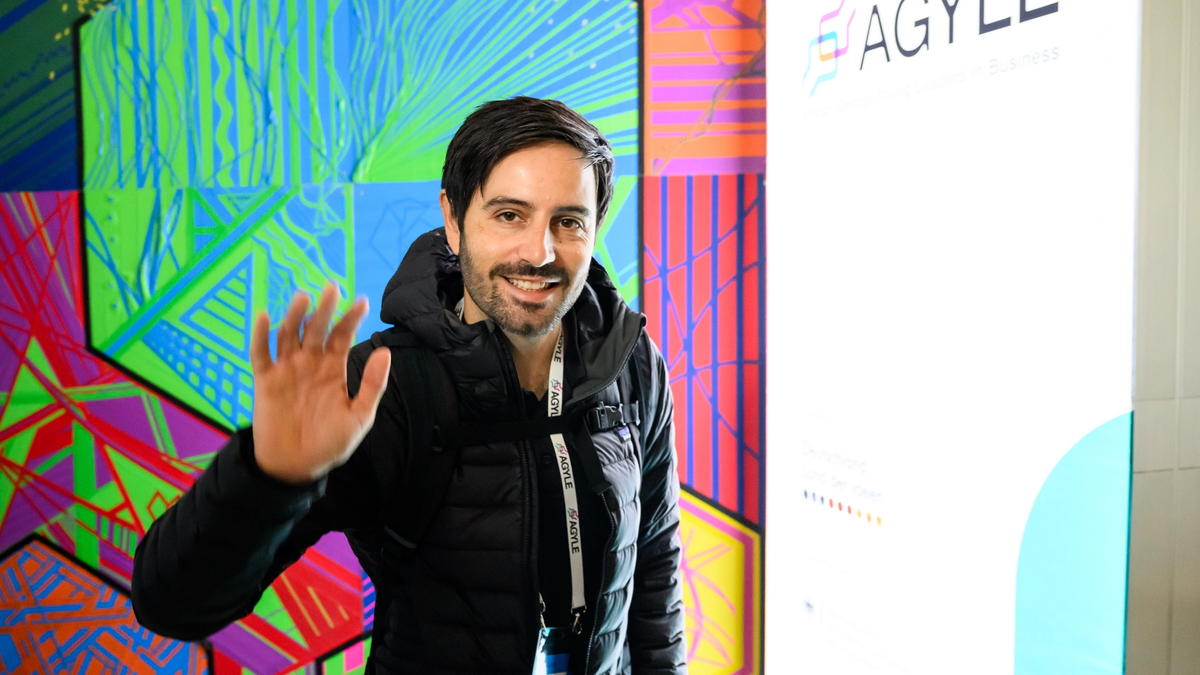
Last week, 40 young leaders from Ethiopia, Ghana, Kenya, Morocco, Rwanda, Tunisia, Austria, and Germany came together in Berlin for the AGYLE Live Week, the highlight of the African-German Young Leaders program, this year themed "GreenTech for Impact." I was one of the Germans in the room. Five days of panels, business cases, company visits, and long dinners. I arrived expecting a networking event. I left with a notebook full of lessons, a corrected worldview, and a clear conviction: we are underestimating this continent, and I'm going to do something about it.
Here is what stayed with me.
A continent in one room
You learn more about a continent in a week of shared dinners than in a year of market reports. The room held Rwanda, Kenya, Ethiopia, Ghana, Morocco, Tunisia, Senegal, Germany, and Austria, and the cultural contrasts were visible from day one.
The Rwandans were the calmest people there. Thoughtful, measured, patient. It fits the country: one of Africa's least corrupt nations, ranked 43rd globally, ahead of most of southern Europe, and the second-best place to do business on the continent. Then, roughly in ascending order of volume and energy: the Kenyans and the Ghanaians. And hovering over all of it, the cultural reference point of the continent: Nigeria. Not in the room, but impossible to ignore. With around 230 million people, Africa's largest population, Nigeria shapes the continent's culture and economy the way a big neighbor shapes a street. When West Africans talk about where markets, music, and momentum come from, the conversation is shaped by this country.
One evening we cooked together. And I learned that for my African friends, dancing is simply part of life. Music on, moving between the pots, stirring and chopping in rhythm. In Germany, cooking is a task. There, it's a celebration that happens to produce food.
I got pulled onto the floor and protested that I don't have a dancing body. I was told otherwise, in front of everyone. I still highly disagree ;) But that moment captures the week better than any panel could: this energy doesn't allow spectators.
And a special mention for Alexandra Antwi-Boasiako, whose powerful energy in the moderation reminded of Michael Buffer :)
The misunderstood continent
That energy from the kitchen was everywhere. And it has a source. Africa is the youngest continent on earth: median age around 19, and about 70% of the population under 30 (contrast that with Europe at 44 years of average age). By 2050, one in four humans will be African.
Now layer on the context these young founders operate in. Venture funding for African startups collapsed from around $6.5 billion in 2022 to barely $3.2 billion in 2024. The recovery since has been real but modest: African startups raised $2.10 billion across 275 deals in the first eight months of 2026, roughly flat year on year, with Nigeria pulling the largest share at $528.6 million, according to TechCabal Insights. Scarce capital, volatile economies, thin infrastructure.
And yet they build. With passion and a kind of grit I rarely see in Berlin. In Europe, the continent is too often reduced to crisis headlines. The reality I met was ambition, humor, and entrepreneurial hunger. Europe misunderstands Africa at its own expense.
Germans and Africans who took the leap
What impressed me most: the people who stopped talking and just went to the other side.
Henri Depe Tchatchu came to Germany from Cameroon, studied electrical engineering in Karlsruhe, the same alma mater as me and joined CarMedialab GmbH in 2008, when e-mobility wasn't even a buzzword. By 2010 his team had built the charging controller for Daimler's first electric smart prototype. Today he's Managing Director, and CarMedialab's software manages electric bus fleets in about 30 cities worldwide, from Barcelona to Dublin. And since 2024, Dakar's new all-electric bus rapid transit system in Senegal runs on their charging software. The man who left Africa for Germany now electrifies public transport back on the continent. Full circle.
Marie-Claire Bartmann from Impacc showed me a model I'd never seen before: a non-profit venture fund. Donations become equity investments in African startups, local founders with local ideas for local markets. When the ventures succeed, returns flow back into the fund and finance the next generation. So far: 14 companies, over 2,200 jobs created. Venture capital as a tool of development, not extraction.
And Stefan Schmid, who left financial services to co-found VIRIDE, now growing microalgae in open saltwater ponds in the Moroccan desert. Ten thousand square meters pilot farm, scaling to 75 hectares, producing biomass for food, feed, bioplastics, and fertilizers while capturing CO2. Building industrial climate infrastructure in the Sahara.
I was impressed by Joseph Nguthiru who made a number of fascinating partnerships a.o DHL and is present in both continents frequently a global leader as recognized as Barack Obama leader. He had an aura reminding me of my idol Barack!
During the week I also heard the story of Simon Sondern and later listened to his OMR Podcast episode, which I can only recommend. After graduating from WHU, he took a one-way ticket to Rwanda instead of a corporate career, hustled through a stint at Jumia and some gloriously odd business ideas involving magical quail eggs, and today runs the Fortico Group, developing real estate in Kigali. Sometimes the pattern is that simple: take the chance.
Rwanda: small country, big playground
A true Rwandan (global) leader, Hervé Girihirwe!
Which brings me to the market that got me thinking hardest. Rwanda has about 15 million people and a tenth of Germany's surface. Small. But exactly that makes it the perfect playground to start in Africa, especially for a company like RiDERgy.
The numbers surprised me. Rwanda grew EV registrations from 19 in 2020 to over 7,000 by 2025. Kigali has nearly 200 charging stations, and the national plan is that no EV should ever be more than 50 km from a charger. Charging electricity is capped at roughly $0.10 per kWh, half the standard rate. Zero import duties on EVs, batteries, and charging equipment, plus a 15% preferential corporate tax rate for e-mobility investors. And the fleets are already real: Spiro runs around 25,000 electric motorcycles in the country, Ampersand just celebrated 10,000 e-bikes on Rwandan roads.
A government that actively pulls e-mobility forward, thousands of electric vehicles in commercial fleets, and a market compact enough to learn fast. That's not a nice-to-have test market. That's the smartest entry point on the continent.
A note that changed my thinking
One detail from the conversations keeps stuck in my head: in most African cities, public transport and waste collection are run almost entirely by private operators. No tenders, no municipal utilities. For a company like ours that means the customer is the fleet owner directly, and the value case has to stand on its own. Honestly, I find that refreshing.
The peers in my own space
Some of the best conversations of the week were with people building in my own space, mobility and energy.
Elizabeth Wokabi is Principal Project Lead and Owner's Engineer at Linden Hof in Kenya, and we ended up exchanging notes on the regulatory environment for hours. It sounds dry. It isn't. Regulation decides which business models are even possible: who can sell electricity, how charging is billed, what grid connections cost. In markets that are being built right now, understanding the rules early is a genuine competitive advantage, and comparing German and African regulatory realities with someone who navigates them daily was worth the flight alone.
Alfred Afutu is building DriveJini in Ghana, helping ride-hailing and taxi drivers switch to electric vehicles through lease-to-own financing and charging access. Exactly the kind of fleet segment where smart energy management decides whether the math works. We had a lot to talk about.
And Devis Musiu is co-founding Rudi, a logistics platform in the spirit of Zenda, the Kenyan startup matching cargo with verified drivers so trucks don't drive empty while freight sits waiting. Fittingly, rudi means return in Swahili. Logistics is where electrification will hit first at scale: high utilization, predictable routes, brutal cost pressure. Watching peers build the demand side of that transition was energizing.
Two sentences every founder should hear
The week also delivered two pieces of advice I wrote down verbatim.
Aneri Pradhan, who built ENVenture into Africa's largest energy access accelerator, brought clean energy to over 150,000 people in rural Uganda, and exited through acquisition, said it plainly: don't scale too early. Scale when you have product-market fit. Coming from someone who actually did it, in one of the hardest markets on earth, it lands differently than the usual growth-at-all-costs mantra.
And Sebastian Ulm, board member at Climate Tech Hub e.V. and founder of Berlin's Urban Innovation Forum, named the mistake underneath that one: founders don't validate their core assumptions enough. Scaling early is just the symptom. The root cause is falling in love with your solution and never stress-testing who pays, how much, and why now. And assumptions that hold in Berlin rarely survive contact with Kigali or Accra. Validation is not a checkbox. It's continuous, and it's local.
Why this matters to me personally
Let me be honest about my motivation here.
I find it deeply unfair that the poorest people in the world pay the highest prices for energy and mobility. In sub-Saharan Africa, running a diesel generator costs at least 2 to 4 times the average grid tariff. Small diesel units produce electricity at around $0.35 per kWh, among the most expensive power on earth. The people who can least afford it pay the most, in money, in noise, in fumes, in health.
The trap has always been the same: the sustainable alternative costs too much upfront. Not in operation, where solar and electric win clearly, but in the first check you have to write.
That is now changing, and this is the turning point. Pay-as-you-go models already proved it in solar: companies like Sun King and d.light turned small daily mobile payments into a financing structure, and that structure is now credible enough that Sun King securitized $286 million of customer receivables and d.light issued a $50 million green bond. Innovation created the financial plumbing that made CapEx disappear for the customer.
The same logic now comes to mobility. Bundle the right hardware with intelligent software, structure the financing so operators pay as they earn, and the world's smartest innovations become accessible in the world's highest-growth markets. The next decades of growth will come from this continent. The question is only whether that growth runs on diesel or on something better.
We want to be part of making it something better. And we want to be there while it happens, not read about it afterwards.
What I'm taking home as a leader
The days were full of leadership sessions, and two skills stuck with me.
Listening. Not just hearing, but choosing your lens first: compassion, curiosity, or a mix. The same words land completely differently depending on which one you bring. In an age where AI drafts, summarizes, and answers, deeply listening to another human might be the most underappreciated skill left. It's also one you can hone forever.
And deciding under uncertainty. Speed is rising, certainty is falling, and waiting for complete information is no longer an option. My takeaways: know yourself, especially what you actually want. Trust your intuition a bit more; it's built from everything that worked before. And ask one question first: how reversible is this decision? Reversible decisions deserve speed. Irreversible ones deserve depth.
And if a decision leads to challenges? Challenges are part of life. It's not about avoiding them. As Rocky Balboa put it, in one of my favorite quotes: it's not how hard you hit, it's how hard you can get hit and keep moving forward.
My new friend Hervé Girihirwe, who runs Murika Farms in Rwanda, suggested this resilience has a name: the honey badger attitude, and qualified me as one. I found that hilarious. Then I watched the videos. Check them out, and you'll understand why I've decided to take it as a compliment.
What's next
Thanks a lot to Deutsche Gesellschaft für Internationale Zusammenarbeit (GIZ) GmbH, the Agentur für Wirtschaft und Entwicklung, BDI - Bundesverband der Deutschen Industrie e.V., and the whole AGYLE - African-German Young Leaders in Business team for an extraordinary week.
For many of us, this continues soon: the German-African Business Summit takes place 23-25 November in Accra, Ghana, Germany's signature business event on the continent, with up to 1,000 leaders from both continents. See some of you there, I can't wait to be there.
And the bigger picture: Africa leapfrogged landlines straight to mobile phones. E-mobility is next, and this time it can be built with better energy management from the get-go. That's exactly where RiDERgy is heading: starting operations in Africa as this transition happens, not after it.
If you're building in African e-mobility, heading to GABS, or just disagree about my dancing body: reach out. Let's make it happen together.
Möchten Sie das für Ihre Flotte in Aktion sehen?
Buchen Sie eine 30-minütige Demo unserer Energiemanagement-Software.