.png)

Dynamic Changes in Charging Technology
The world of charging station technology is developing dynamically! In short it’s becoming more varied and functional. Below we explore the key trends (in Germany) within the technology’s main characteristics: power features, load management, metering, payment & authentication and connectivity.
Charge points are generally known as being AC or DC chargers depending on the existence of a converter, as we explained here. AC stations are used for slow charging while DC for fast charging. Nevertheless, low power DC wallboxes are being developed. The most frequent AC charging point power levels are:
- For private charge points: 7.4 kW and increasingly 11 kW, given that the Federal grant requires an installation of 11 kW charge points.
- For public charge points: 22 kW (3 phases, 32A). Previously, there were 43/44 kW charging points. The original Renault Zoewas one of the few models on the market with a 44 kW onboard charger.
The most frequent DC charging point power levels are:
- In the range from 7.4 kW to 350 kW. And 22 kW, 50 kW and 150 kW are most common.
- We see increasingly low power DC 22 kW chargers as they are faster than AC chargers with 11 kW onboard chargers and are easily installed as they do not require a foundation.
- Very fast high power charging (HPC) 350 kW ones are experiencing strong growth on highways.
Overview of the most frequent power levels at charge points (according to the German grid regulator BNetzA and other sources.)
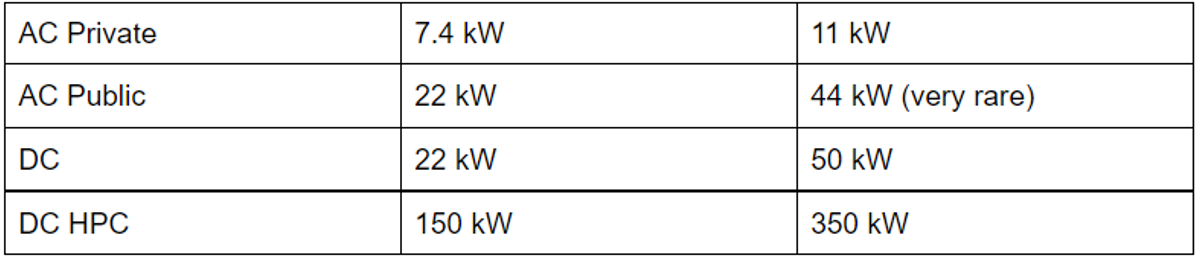
****Overview charging speeds
Different plugs and standards are used depending on AC vs DC charging or the geography.
- For AC’s type 2 is the standard in Germany. Shuko can be used at homes but it is not common at charging stations.
- For DC charging Chademo is being discontinued as the European Commission decided that CCS should be the standard for Europe.
- Each charging station can have 1 up to 4 plugs (common are 2). Plugs can be of different types.
Moreover, vehicle voltage levels are being raised from 400 V to 800 V, enabling more efficient and faster charging.
Load management is nearly always necessary. This has different causes. For instance, a site may have only limited available power, requiring the ability to reduce the charging power. Additionally, as some vehicles need to be recharged faster, the power flow may need to be adjusted per charger.
To save on costs, charging should occur when electricity is cheaper. Thus, the power needs to be distributed across multiple charging points according to some principle. The trend is to move from static load management to a dynamic, smarter, and more efficient approach.
It would take into account a building’s consumption or signals coming from the energy grid. To distribute the power among the charge points, a basic local master-slave, local charge controller, or a cloud solution is used. The more sophisticated solutions allow charging in a more efficient way.
The communication to the single charging station is done via a charge controller, which could be added or integrated into a charging station. Different communication pathways, as shown in the connectivity section below, are used. Some stations can transfer the load bi-directionally. Those using the Chademo standard are already able to do it, for instance, with the Wallbox Quasar 7.4 kW model. Some new models are being offered with 11 kW using CCS, like the model offered by Ambibox.
Circuit breakers and residual current devices to protect components and humans should be installed in all stations.
Metering
For public stations where electricity is not given out for free, a certified electricity meter is required. Also, smart meters capable of communicating with the grid operator need to be installed at the grid connection point. New stations must install these from the start, whereas retrofitting will not be necessary for most charging stations depending on the installation date.
Payment & Authentication
In the first installed charging points, payment was only possible via RFID cards or an online/app subscription entering credit card details. Roaming between charging point operators (CPOs) and mobility service providers (MSPs) was not commonplace. As an authentication method, RFID is being replaced due to security and practical reasons. The new German LSV regulation mandates the possibility to pay via credit cards with NFC on-site.
Furthermore, the Plug and Charge standard is to be implemented soon, enabling automatic charging as the vehicle would bear all the required information. For full transparency and best measurement of the power charged at a given charging point, Germany insisted on having two measures in place: First, prices needed to be communicated clearly in advance or on-site. Second, charge points need to implement the so-called Eichrecht or the calibration law. This allows drivers to verify the energy they have drawn via the charging points’ public key. Some charging points have implemented it already, while others are still in the process. Being certified can take almost two years, leading to some companies having this USP, like Compleo.
Connectivity
Charge point connectivity is important for remote control, e.g., for fault fixing and maintenance purposes. The trend is towards more connectivity. Protocols are increasingly becoming interoperable for better charging experiences. The standard protocols used to communicate with the charging point are OCPP, GSM or 3G or 4G, WLAN, Ethernet RJ45, and Bluetooth.
In Germany, to receive subsidies, wallboxes must be controllable by distribution grid operators, favoring the installation of connected charge points.
- Display: Not all charging stations have a display. Public ones often have one whereas private ones like home wallboxes often come without one. These show the price, charging power and charged energy.
- Led lights: Some charging stations provide led lights to find the station and signal the charging status.
- Cables: Some stations, especially the very fast ones have an attached cable, which the new LSV regulation allows. Cables are also differentiated by their length, and weight.
- Cooling: During the charging process, heat is generated. The higher the power, the more the heat. Cooling technology is essential to guarantee good heat management and battery health. It can generate a lot of noise if not designed properly. For fast-charging passive / air cooling is not enough. There active or liquid cooling is used. They provide liquid-cooled equipment such as liquid-cooled cables.
- Weatherproofing: There are different levels. e.g. from IP 54, not dustproof and withstanding little water, up to the very high IP 65 with much better protection.
If you need to decide on charging technology for your use case do not hesitate to reach out to us at RiDERgy for either an expert consultation or even general support.
Wilt u dit in de praktijk zien voor uw wagenpark?
Boek een demo van 30 minuten van onze software voor energiebeheer.