

Static load management
A fixed maximum holds power back
One value is set at installation and never sees the building. It has to leave room for the worst building load of the year, so most of the time it holds back power that is available.
Product
Load management keeps a depot under its limits. RiDERgy's AI-powered software goes further: it learns how your chargers and vehicles are actually used and plans every charge across the day, the days ahead and every site, so vehicles are ready on time and each kilowatt-hour is used when it is cheapest.
RiDERgy is AI-powered energy management software for EV fleet depots. Load management stops a charging site from exceeding its fuses; RiDERgy does that at every level, from the grid connection down to each strand, and then goes further. It connects to the chargers, meters, vehicles and business systems around a site, learns how the chargers and vehicles are actually used, and plans every charging session ahead against prices, solar, battery, building load and departure times. The plan covers the day, the days ahead and every site of a fleet, and is recalculated every 15 minutes. Because the plan is granular, power goes where and when it saves the most, and fleets usually save around 20% on their charging costs.
A fuse limit keeps the site safe, but on its own it does not decide when a vehicle should charge. Two common approaches stop there.
Static load management
One value is set at installation and never sees the building. It has to leave room for the worst building load of the year, so most of the time it holds back power that is available.
Dynamic load management
It measures the building and shares the headroom, which is right for safety. But it charges as vehicles arrive and knows neither prices nor departure times, so the whole fleet charges into the evening peak.
| Measure | Dynamic load management | Dynamic with a 150 kW peak cap | RiDERgy plan |
|---|---|---|---|
| Highest draw at the connection | 277 kW | 150 kW | 150 kW |
| Average charging cost | 30.1 ct/kWh | 27.9 ct/kWh | 24.0 ct/kWh |
| Vehicles short of their target | 4 | 6 | 1 |
Example depot with invented fleet, buildings and fuses and real EPEX day-ahead prices, 20 January 2026. The cap holds the connection at the depot's own peak of 150 kW. One example day, not a forecast for your site.
Each level reacts to more than the one before. The comparisons on this site are against dynamic load management, the strongest of the other three.
Unmanaged
Every vehicle charges at full power the moment it plugs in. With enough vehicles, a fuse trips or the grid connection is overloaded.
Static
Charging stays under one fixed value, set once at installation. It does not see the building load, so the value has to leave room for the worst building load of the year. A peak shaving setting works the same way: one fixed cap on the site's total draw.
Dynamic
Measures the building load and gives the chargers whatever headroom is left on each fuse, and can hold a peak shaving cap too. It still charges on arrival: it knows neither prices nor departure times.
Predictive load management
AI-powered, learns from your site
Everything dynamic load management does, plus forecasts of prices, solar, building load and departures. Charging, solar, battery and the peak are planned together and re-planned every 15 minutes.
Like software tiers: each level builds on the one before. Use it to check what a load management product you are offered actually includes.
| Feature | Unmanaged Full power on plug-in Typically runs: Nowhere: no control | Static One fixed maximum Typically runs: In the charger or a local controller | Dynamic Reacts to the building Typically runs: A local controller with a meter | RiDERgy Predictive load management Plans ahead Typically runs: In the cloud through your CPMS |
|---|---|---|---|---|
| Protection | ||||
| Protects the grid connection | Not included | Included | Included | Included |
| Protects every fuse level Sub-distributions and strands, not only the main fuse | Not included | Partly One fixed value per circuit, if configured | Included | Included |
| Takes the building load into account | Not included | Not included | Included Measured live | Included Measured and forecast |
| Peak shaving Keeps grid import under a cap that drives grid fees | Not included | Partly One fixed cap | Partly One fixed cap | Included Planned against the billing peak |
| Energy on site | ||||
| Uses own solar first | Not included | Not included | Partly Surplus as it happens | Included With a solar forecast |
| Stationary battery | Not included | Not included | Not included Runs its own rule | Included Planned with the chargers |
| Bidirectional charging (V2G, V2B) | Not included | Not included | Not included | On the roadmap With compatible vehicles and chargers |
| Cost | ||||
| Dynamic and time-of-use tariffs Charging moves into the cheapest quarter hours | Not included | Not included | Not included | Included |
| Forecasts of prices, solar and building load | Not included | Not included | Not included | Included |
| Energy markets and grid services | Not included | Not included | Not included | On the roadmap |
| Fleet | ||||
| Departure times and target state of charge | Not included | Not included | Not included | Included |
| Vehicle data (state of charge) From manufacturer APIs, telematics or DC chargers | Not included | Not included | Not included | Included |
| Priorities and driver requests | Not included | Not included | Not included | Included |
| Re-plans when something changes A new plan every 15 minutes | Not included | Not included | Partly Reacts, does not plan | Included |
| Platform | ||||
| Works with your existing chargers and CPMS | Not included | Partly Usually tied to one charger brand | Partly Usually a local controller per site | Included Cloud, API first, local gateway optional |
| Several sites in one view | Not included | Not included | Not included | Included |
| Savings, energy and charging reports | Not included | Not included | Not included | Included |
| API and white label | Not included | Not included | Not included | Included |
Typical capabilities of each category. Individual products differ, so check the features you need. The RiDERgy column describes RiDERgy.
Zoom out
The same planning works at four scales. Step through them.
Day-ahead prices swing through the day. The plan moves charging into the cheap quarter hours and still has every vehicle ready at departure.
The dearest quarter hour costs about 3.7 times the cheapest.
Prices and weather change from day to day. The plan holds the connection at its limit every day and charges at a lower cost per kWh than dynamic load management.
Tue 27 Oct 2026, autumn
Wed 17 Jun 2026, summer
Tue 20 Jan 2026, winter
Planning several sites together, with vehicles that move between them, is on the roadmap.
Using vehicle batteries as storage is on the roadmap, with compatible vehicles and chargers.
Example depot with invented fleet, buildings and fuses and real EPEX day-ahead prices on three days in 2026. Not a forecast for your site.
Because RiDERgy connects to all relevant systems and has the data, it can show the savings before you commit, build the plan, and then control and automate it.
Chargers, meters, batteries, solar and vehicle data, through the systems you already run.
Your site and fleet modelled, then replayed on real prices to show what would change.
An AI-powered plan for every charge, against every fuse, price and departure.
Each charge point gets its own limit, sent automatically.
Re-planned every 15 minutes, with a safe fallback if a signal drops.
One example depot, the same vehicles and real day-ahead prices. Dynamic load management charges on arrival. The RiDERgy plan moves the energy to the cheap hours and keeps the peak down.
Same depot, same vehicles, same real day-ahead prices. Dynamic load management starts charging on arrival and shares the headroom the building leaves on each fuse. The RiDERgy plan looks ahead.
Peak at the grid connection
150 kW
RiDERgy plan
277 kW
Dynamic load management
277 kW limit
Average cost of charging
24.0 ct/kWh
RiDERgy plan
30.1 ct/kWh
Dynamic load management
20% lower
Vehicles short of their target
1
RiDERgy plan
4
Dynamic load management
of 21 sessions
Example data, 20 January 2026, operating day from 12:00 to 12:00. Fleet, buildings, fuses and tariff adders are invented. Prices are real EPEX day-ahead prices for Germany and Luxembourg (energy-charts.info). One example day, not a forecast for your site.
Scrub through the day, switch between the RiDERgy plan and dynamic load management, trigger an overload on a strand, or open the site plan with cable sizes. Click a vehicle to see its plan.
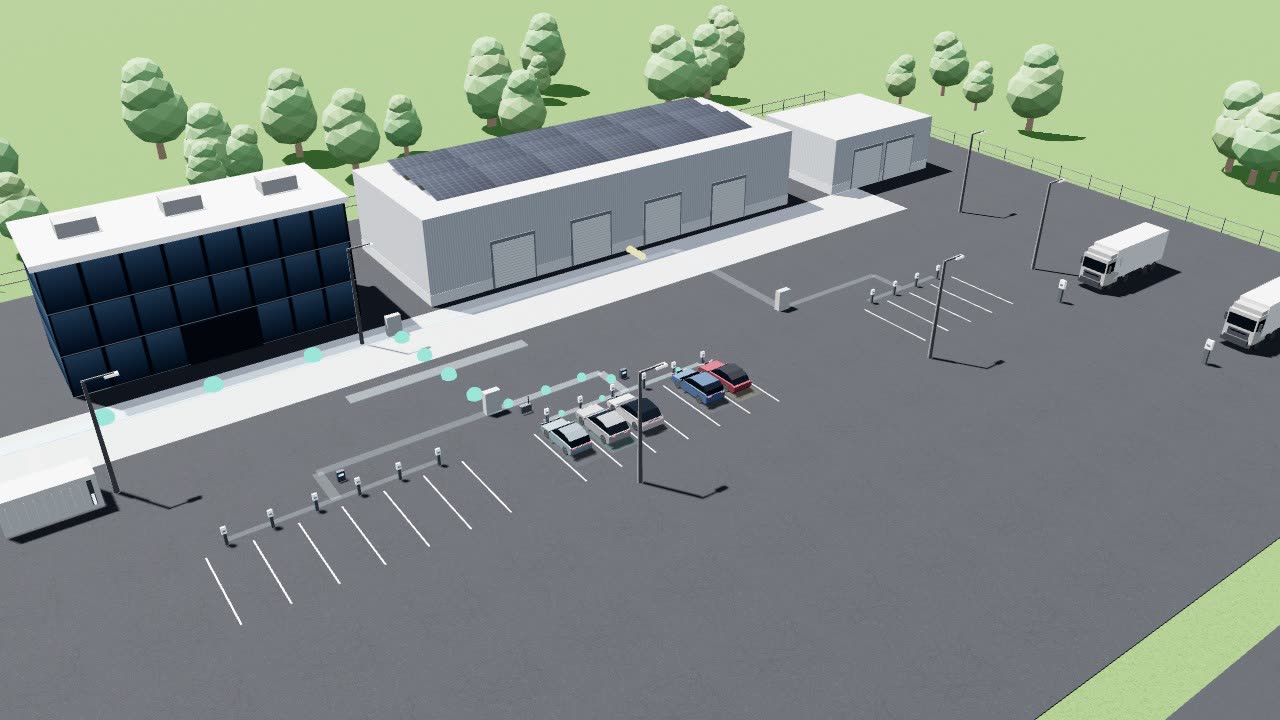
Three things change what a kilowatt-hour costs. The plan weighs them together instead of one at a time.
Day-ahead market prices move through the day, and dynamic tariffs follow them. Time-of-use tariffs are the most common today. Moving charging into the cheap quarter hours lowers the cost per kWh.
Many grid tariffs bill the single busiest quarter hour of the billing period. Charging as vehicles arrive creates exactly that peak. Spreading the same energy across the night flattens it.
Spare solar and stored energy are used first. With a solar forecast, and the panels' size, inclination and orientation taken in during onboarding, the plan can leave room for midday output instead of reacting to it.
Onboarding has two phases: learning and modelling your site, then connecting it step by step. After go live the plan is recalculated every 15 minutes.
Planning · 01
30 minutes
We go through your fleet, shifts and departure times, the chargers and the charge point management system (CPMS), the grid connection, the electricity tariff, and any solar (size, inclination and orientation of the panels), battery or building loads on the same connection.
You bring
Planning · 02
Every fuse, every meter
We map the electrical tree of the site: grid connection, main switch, sub-distributions, strands and each charge point, with the rating of every fuse and the meters that measure them. Building loads, solar and storage are placed where they actually connect.
You bring
Planning · 03
Real day-ahead prices
We replay your site on real day-ahead prices and compare the RiDERgy plan with plain load management. Together we agree priorities, milestones and the offer.
Operation · 04
Read first, then steer
Access to your CPMS takes a few clicks, and we read what is happening in real time before we steer anything. Meters, vehicles, solar and storage follow step by step: you do not have to onboard everything at once.
You bring
Operation · 05
About a week, then 2 to 3 weeks
We start on one or two charge points and check every session against the plan for about a week. When the pilot holds, the rest of the site follows, typically within two to three weeks.
Operation · 06
A new plan every 15 minutes
Each quarter hour the plan is recalculated with fresh prices, meter values and vehicle data. You see energy flows, sessions, savings and reports in our web app or inside your own software, and add vehicles or assets whenever you are ready.
The same planning, applied to how each kind of fleet actually uses its chargers.
Depot logistics
Vehicles return in the evening and leave at a fixed time. The plan fills every one by departure at the lowest cost.
Bus depots
Few, large loads on one connection and tight departure windows. Power goes first to the vehicles that need it first.
Multi-site parking
Parking lots with mixed vehicles and buildings that share the connection. Planning several sites together is on the roadmap.
Each lever is planned together with the others, so they add up instead of competing.
Power management
Every fuse, from the grid connection down to each strand, stays within its rating.
Peak shaving
Charging is spread out so the site does not set a new peak that the grid tariff bills.
Solar and battery
Spare solar and stored energy go to the vehicles first, planned together with charging.
Energy procurement optimization
Charging follows the price signals that apply to the site, from day-ahead spot prices to dynamic tariffs.
Bidirectional charging
RoadmapUsing vehicle batteries as storage is on the roadmap, with compatible vehicles and chargers.
Power goes first to the vehicles that need it first, with priorities and driver requests built into the plan.
Each vehicle's departure time and how much charge it still needs decide when it charges.
If a reading or a link is lost, charging carries on at a reduced limit until it comes back.
In practice
Fleets usually save around 20% on charging costs. The saving is larger where prices swing widely and vehicles stay plugged in for long.
Customer story
HelloFresh's depot charges its electric vans overnight on a limited grid connection. RiDERgy's software-only smart charging does peak shaving to stay within the breaker limit, and shifts charging to the cheapest spot prices, so every van is ready by morning.

“What convinces us most is the combination of technical know-how, innovative strength and a clear understanding of operational requirements.”
Pierre Rudolph
Senior Fleet Manager Logistic DACH, HelloFresh

For partners
Charge point operators, charge point management systems, fleet management software and vehicle and charger makers work with RiDERgy. See how on the Partners page.
Questions
Load management keeps a site under its fuse ratings, which is necessary. It does not see prices or departure times, so it cannot choose when to charge. RiDERgy does the protection at every level and plans the charging on top, so vehicles are ready on time and energy is bought when it is cheapest.
Static load management keeps charging under one fixed maximum and ignores the building. Dynamic load management measures the building load and gives the chargers the headroom that is left. Predictive load management, which is what RiDERgy does, is AI-powered, learning software: it also forecasts prices, solar, building load and departures, and plans the charging ahead.
Chargers through your charge point management system or by API. Meters at the connection and below, plus solar and storage. Vehicle data where your fleet allows it. No specific charger brand is needed.
RiDERgy first learns your site and models it, then gets read access to your charge point management system and adds meters, vehicles, solar and storage step by step. A pilot on one or two charge points runs for about a week, and the rest of the site is typically connected within two to three weeks.
Dynamic tariffs change regularly throughout the day based on the price of the day-ahead electricity markets. By using mobility data with our energy management software, we schedule vehicle charging when dynamic tariff prices are lowest, resulting in even greater savings potential.
The most common tariff we currently optimize is time-of-use; however, our algorithms also work with dynamic tariffs, which change regularly throughout the day based on the price of the day-ahead electricity markets. Ask us about existing tariffs in your country.
Our software optimizes solar energy generation to ensure maximum self-consumption. We predict when the sun will shine, using the size, inclination and orientation of your panels, ensuring minimum curtailment and maximum savings. We also optimize stand-alone batteries.
A one-time set-up fee plus a monthly fee per charge point or vehicle.
Bidirectional charging (V2G and V2B) is on the roadmap, with compatible vehicles and chargers.
Start with the five steps, then follow the savings or your fleet.
We walk you through the dashboard on a fleet like yours and show what planning every charge would change.