

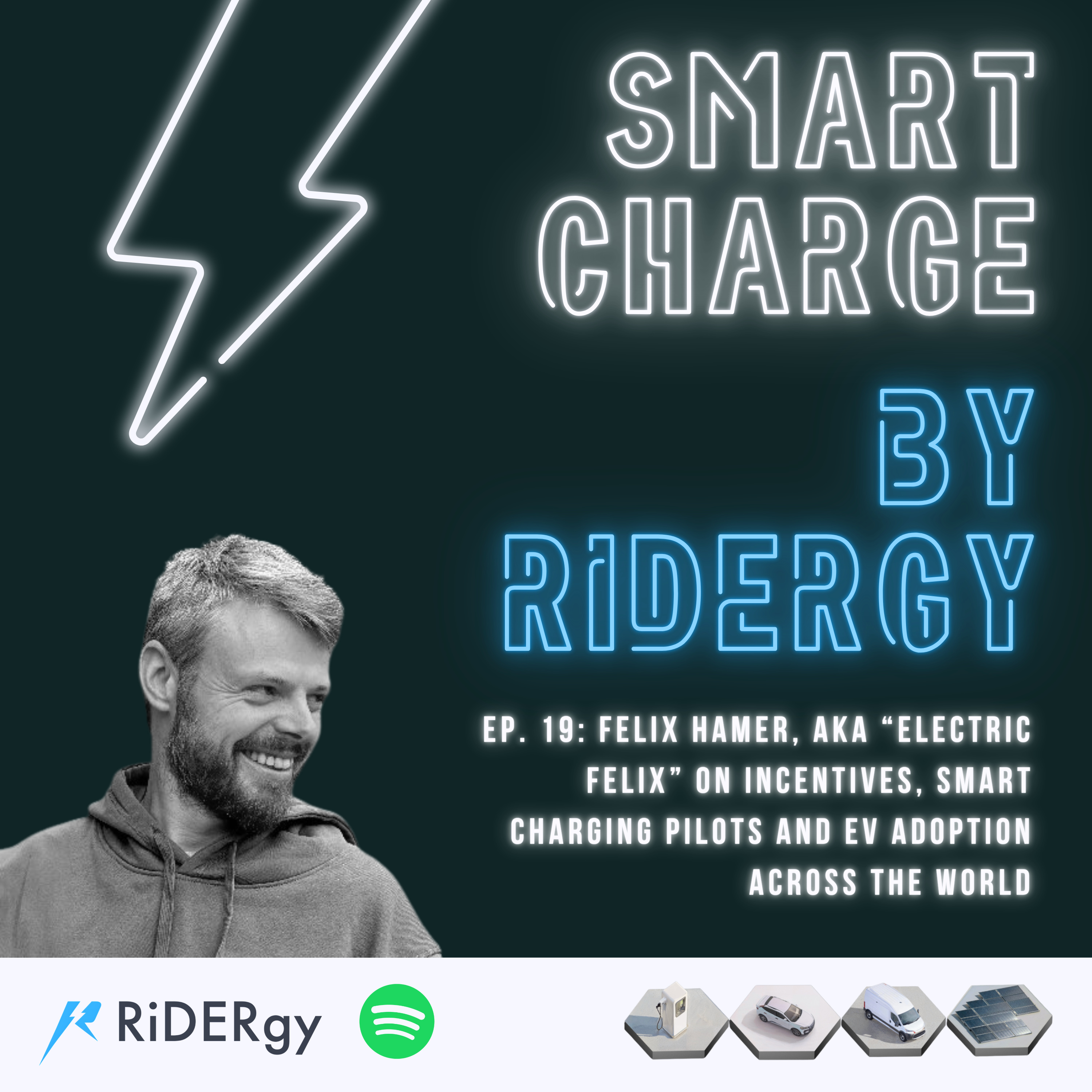
Ep. 19: Felix Hamer, AKA “Electric Felix” on Incentives, Smart Charging Pilots and EV Adoption Across The World
Transcripción
Depurada a partir de una transcripción automática. Las traducciones son automáticas y pueden contener errores.
Bienvenidos al podcast Smart Charge by RiDERgy. Soy Claudio Geyken, fundador y CEO de RiDERgy. Este es tu programa para aprender sobre gestión de energía y la innovación en smart charging para vehículos eléctricos y flotas.
Hola y bienvenidos al podcast Smart Charge. Soy tu anfitrión Claudio, y nos conectamos con Felix Hamer, mejor conocido como Electric Felix. Felix es uno de los narradores de VE más reconocidos de Europa, un creador holandés que ha recorrido incontables kilómetros reales por todo el continente e incluso en China, poniendo a prueba redes de carga desde Ionity hasta puestos de CA de pequeños negocios, y convirtiendo esos viajes por carretera en análisis brutalmente honestos, boletines profundos e hilos de redes sociales basados en datos. Lo que distingue a Felix no son solo las pruebas de autonomía o
las reseñas de cargadores, sino la forma en que traduce kilovatios, tarifas y planificadores de rutas en decisiones humanas. ¿Funcionará este cargador a las 2 de la mañana? ¿Confío en esa tarjeta RFID? ¿Cómo se siente un viaje familiar por carretera cuando el SOC llega al 7% y el siguiente cargador DC está a 40 kilómetros de distancia? En este episodio exploraremos algunos de estos aspectos y mucho más: las diferencias geográficas y qué hace que la adopción de VE en algunos países sea mejor que en otros, y especialmente su experiencia en China, Alemania, los Países Bajos y Dinamarca. Y también smart charging, sus experiencias
con eso, pilotos, su visión perfecta de cómo debería ser, y muchas cosas más. Vamos a sumergirnos. Hola Felix, gracias por acompañarme hoy. ¿Cómo fue tu viaje a Berlín? Muy tranquilo, de hecho, gracias por invitarme. Sí, viajamos ayer desde Ámsterdam hasta aquí en un Tesla muy casual de batería pequeña, y sí, es simplemente cuestión de - me enfoco en cargadores asequibles, lo cual desafortunadamente no deja tantas opciones, pero sí, conducir eléctrico hasta
Berlín durante años ha sido bastante fácil, pero el precio es otro tema. Bien, sí, pero al menos llegaste. Eso es una cosa, y definitivamente hablaremos de todos los desafíos y dificultades relacionados con la carga de VE y con tu configuración personal. Antes de profundizar en eso, para ayudar a los oyentes a entender un poco quién está hablando, ¿puedes presentarte? ¿Cuál es tu formación? ¿Cómo llegaste a lo que haces hoy? Sí, gracias. Soy Felix Hamer, y
algunas personas me conocen como Electric Felix, porque hace unos 8 años probé una motocicleta eléctrica por primera vez. Aunque soy un tipo de TI en Ámsterdam, me gusta probar cosas nuevas, y esta moto realmente me sorprendió. Me mostró la carga rápida como una especie de oportunidad definitiva para electrificar cualquier cosa. De repente me di cuenta: si esta moto puede ser eléctrica - yo tenía una moto de gasolina en ese momento - entonces supongo que cualquier cosa
podría serlo. Estos cargadores rápidos crean toda posibilidad. Puedes tener un cargador lento y está bien, pero el cargador rápido crea esta oportunidad de que simplemente puedes seguir adelante. Y eso es - creo, porque soy viajero de carretera de corazón - he estado viajando por Europa durante muchos años y solía hacerlo con autos diésel. Nunca tuve un auto propio porque vivo en Ámsterdam, y el alquiler de diésel era simplemente
siempre la mejor oferta para ir lejos de casa. Y esto es lo que noté con la carga rápida que probé con la moto: si buscabas la oferta correcta, especialmente hace 7 años, era súper fácil cargar barato en muchos lugares, aunque era menos rápido que hoy. Eso me creó la oportunidad de viajar mucho a un nivel muy asequible, en una moto eléctrica. Esa es la clave. La moto también me abrió la puerta para buscar
alquileres de autos también. Llevé un BMW i3 a París, por ejemplo, y fue en realidad un desastre total, pero mi mejor amigo estaba en el auto y aun así se pasó a VE después de esa experiencia, porque en el camino de regreso, tan pronto como entramos a los Países Bajos nuevamente, estábamos en este paraíso de carga rápida donde tenían una red nacional que hacía todo fácil. Inmediatamente se dio cuenta de que necesitaba deshacerse de su auto de gasolina, porque estaba haciendo muchos kilómetros en
los Países Bajos y al pasarse a VE podía hacerlo a la mitad del precio. Así que sí, muchas cosas sucedieron en la última década. Creé un blog simplemente para compartir mis experiencias de viaje y todo se intensificó un poco, así que ahora, especialmente en LinkedIn, tengo miles de seguidores, y solo trato de mantener a la gente actualizada sobre lo que está pasando en la escena de la carga. También me sorprendieron principalmente las diferencias - este primer viaje a Francia realmente mostró que incluso
yendo 500 kilómetros desde casa, París no está lejos de Ámsterdam, pero el panorama eléctrico cambió varias veces en ese pequeño viaje. Incluso hoy todavía puedes ver que viajar a Italia es completamente diferente de viajar a España. Mientras que yo veo eso como divertido porque puedo escribir sobre ello, también creo que para la adopción masiva, las cosas necesitan ser fáciles y asequibles, y no como este rompecabezas donde necesitas encontrar la oferta correcta para ir a la izquierda o a la derecha así
Bien. Gracias por eso - eso ya nos da bastantes puntos para tocar. Primero, ¿qué te entusiasmó tanto de las motos eléctricas, viniendo de tu experiencia con el diésel? ¿Cuáles fueron los elementos centrales, si recuerdas? Sí, la moto me sorprendió tanto porque acababa de tener mi licencia por, creo, alrededor de un año, y acababa de tener mi moto de gasolina por ese tiempo. Y la experiencia de esta moto eléctrica - inmediatamente obtienes
Esta sensación de la potencia que simplemente sigue empujando, y que estás en esta máquina que no tiene cambio de marchas, que simplemente puede avanzar - hay cierta fluidez en ello que es simplemente, no la conoces de la era fósil porque no existe. Es algo completamente nuevo. Y sí, creo que simplemente la combinación de eso realmente pone tecnología en el espacio de la movilidad. Siempre, incluso me gusta andar en bicicleta. Todavía me encanta andar en bicicleta porque
me da tanta libertad, y una e-bike simplemente añade a esta libertad porque puedes ir más lejos en el mismo tiempo. Y la e-bike realmente te muestra, en un país como los Países Bajos, que cantidades masivas de gente usa e-bikes para ir al trabajo. Y sí, creo que la mitad de ellos nunca tomarían la bici para ir al trabajo porque llegarías todo sudado y nunca irías muy lejos todos los días. O sea, si puedes permitírtelo, simplemente harías el upgrade.
Y sí, creo que aquí está realmente esta especie de salsa secreta donde hay esta oportunidad de hacer cosas que no hacíamos antes, porque los vehículos eléctricos crean una oportunidad que no estaba ahí antes. También la combinación de, como, una motocicleta eléctrica no es tan silenciosa, así que la gente piensa que los vehículos eléctricos son como aburridos porque no hay rugido de motor. Pero la moto que probé es esta moto de Italia, y en realidad la compañía está en muchos problemas, pero en aquel entonces realmente estaban
empujando los límites. Y la cosa es que, sí, cuando vas a toda velocidad, en realidad hace mucho sonido. Claramente es como este sonido eléctrico agudo - es muy diferente, pero sí, realmente te empuja a volverte loco. Y la cosa es también que tenía amigos atrás en Ámsterdam, y todavía hablan de esos viajes, porque es simplemente tan increíble que ese torque viene de la nada. Y
sí, si entonces piensas en lo que puedes hacer con esa moto, y lo fácil que es encontrar carga asequible para que puedas en realidad repetir esto todos los días a fácilmente la mitad del precio que jamás podrías pensar en hacer tales cosas con gasolina - y al mismo tiempo también te muestra que si tienes un gran espacio interior también puedes manejarla ahí porque los gases no están. Hay simplemente todas estas cosas que pasan,
pero sí, fue la carga rápida que esa motocicleta podía hacer lo que la hizo tan especial para mí. Podía cargar en DC - necesitaba un cargador de 50 kW, pero la cosa es que podía cargar en DC a 20 kW o algo así, así que no era el máximo absoluto. Pero la cosa es que la batería era de 11 kWh, así que simplemente muy pequeña. Para ahora la duplicaron a 20 kWh, y eso es todo. O sea, cuánta autonomía - tenía una
autonomía realista de un poco más de 100 kilómetros si la usabas normalmente. Y entonces sí, podías maximizar la eficiencia para sacar un poco más, y la manejé en verano así que podías sacar un poco más. Pero sí, fue también esta combinación con la infraestructura que era simplemente tan emocionante. Llevé la motocicleta a Suiza, y descubrí que los cargadores que necesitaría en el norte de Francia solo estaban en los supermercados que tenían los
cargadores abiertos solo mientras la tienda estaba abierta, porque era un servicio para clientes y no podías pagar por ello - era gratis, lo cual era increíble. Pero al mismo tiempo significaba que no podía hacer el viaje en domingo porque las tiendas cerrarían y los cargadores se apagarían, y en esa área de Francia simplemente no había alternativa. Así que sí, eso realmente te muestra que, para mí, este elemento de los enchufes desbloqueando todo es
como el mayor secreto para mí. Y sí, ahí es también donde pienso que en Europa lo estamos haciendo bastante bien expandiendo la infraestructura, pero la cosa es que si los enchufes no están donde necesitan estar - que es frente a las caras y casas de la gente - sí, las cosas simplemente irán demasiado lentas. ¿Y puedes usar los mismos enchufes con motocicletas que con coches? Sí, curiosamente. Todo gira alrededor del enchufe CCS en Europa. Por suerte, la UE decidió sobre
eso muy temprano, así que puedes en realidad usar la misma infraestructura. Y esto es, creo, también uno de estos elementos clave por qué, por ejemplo, la UE lo está haciendo mejor que Estados Unidos, porque en Estados Unidos incluso hoy simplemente hay este desastre de enchufes. Y tan pronto como vas a carga rápida comparado con carga lenta, necesitas diferentes cables, diferentes convertidores. Realmente depende de tu vehículo y tu casa, y muchas cosas, lo que necesitas. Y en Europa es bastante simple,
donde tenemos un estándar AC que es simplemente el mismo para todos, y el estándar DC que, aparte de la vieja historia de Nissan, es simplemente CCS - así que está completamente unificado. Y entonces ahora tengo un entendimiento de cómo entraste en e-mobility como tema y qué te llevó entonces a empezar a compartirlo en un blog. Sí, así que lo que encontré tan extraño sobre esta motocicleta es que no podía creer lo que podía hacer,
pero tampoco entendía por qué no sabía de ella. Porque la cosa es, gané un paseo en la motocicleta y luego la renté para probarla varias veces, y lo que más me sorprendió fue simplemente que no sabía que existía. Y creo que esto es, hasta cierto punto, incluso como cierto hoy - que mucha gente, si fueras por Europa y preguntaras a la gente en las
calles de una ciudad europea aleatoria y simplemente los entrevistaras y les preguntaras si alguna vez probaron un vehículo eléctrico, espero que la mayoría de la gente diga que no. Y espero que la mayoría de la gente no sepa muchas cosas sobre vehículos eléctricos. Incluso hoy casi me desmayo cuando veo una motocicleta eléctrica en Ámsterdam, por lo poco que las veo. Y esto es 8 años después de yo probar la motocicleta, y después de probarla por una tarde me di cuenta de que cualquier holandés que trabaje
en los Países Bajos y vaya en moto al trabajo, tal vez con una motocicleta, tal vez con un coche, o lo que sea. Pueden tomar esa motocicleta al trabajo, sin problema, por la infraestructura que ya teníamos. Y hoy, incluso más loco, pero la mayoría de la gente ni siquiera sabrá que está ahí afuera. Así que eso me motivó a empezar mi blog primero, incluso solo una página de Instagram, y simplemente compartir mi experiencia de carga, mis viajes por carretera, para simplemente mostrar a la gente: si fueras a buscar en Google algo eléctrico, entonces tal vez me encuentres
la historia. Y también por eso escribí en inglés, porque me encontré con mucha gente. Imagina llevar esa moto a Francia - a los franceses les encantan las motos. Muchísimas personas se me acercaban cuando estaba cargando, daban vueltas alrededor de la moto, y todos me preguntaban por ella. Cada francés que hablaba conmigo sobre la moto siempre pensaba que era híbrida, porque no podían creer que no lo fuera. Y creo que eso sigue siendo cierto hoy en día, que la mayoría de la gente
no te va a creer cuando les muestras que estas cosas existen. Lo cual es solo una de las razones por las que sigo adelante y simplemente escribo sobre ello como si fuera normal, porque creo que debería serlo, pero aún no hemos llegado ahí, supongo. Claro, y mencionaste las diferencias entre distintos países, y especialmente una cosa que más capturó mi curiosidad fue la diferencia entre España e Italia, con la que no estoy tan familiarizado. ¿Puedes elaborar un poco sobre
esos aspectos geográficos y las diferencias en los desafíos? Sí, entonces lo que me resulta tan extraño en Europa es esta diferencia - creo que tiene que ver con, ya sabes, incluso tiene que ver con la red de carreteras. Italia tiene más autopistas de peaje que España, creo. Y hacen las cosas muy diferente en cuanto a quién es dueño de las carreteras y los lugares donde puedes ir a buscar combustible y demás. Pero sí, creo que los mercados energéticos de Europa son
simplemente un completo - todos hacen lo suyo, y aunque Europa está más o menos bien conectada, eso no significa que tengamos un solo precio por kilovatio-hora para Europa en absoluto. Y realmente ves esto cuando, digamos, vives en Roma y sales mucho de la ciudad y quieres hacerlo con un EV. Cargar en Roma es como el doble del precio de cargar en Madrid. Y cuando digo
esto en voz alta, simplemente siento como - ¿cómo puede ser esto? Por un lado, entiendo totalmente que no están cerca una de la otra, pero ambas son grandes ciudades soleadas en lugares donde sería tan fácil poner paneles solares por todos lados. Ambas tienen suficiente espacio para construir grandes estaciones. Claramente, sí, España tiene más área tal vez con menos gente, así que quizás aún más fácil instalar solar. Pero la
cuestión es que cargar ahora mismo en España puede hacerse bastante fácilmente a la mitad del precio comparado con Italia. ¿De qué estamos hablando? Sí, realmente estamos hablando de cargar en Italia donde es completamente normal encontrar cualquier tipo de cargador a 80 céntimos por kilovatio-hora, y en España es bastante fácil encontrar cargadores a 40 céntimos. En mi opinión, claramente, tan pronto como puedes cargar en casa las cosas cambian, pero ahí ya puedes
ver una gran diferencia de nuevo en que mucha gente en Italia no puede cargar en casa porque la conexión del hogar en realidad no lo permite. Y esto es de nuevo esas cosas - incluso si miramos los Países Bajos, los Países Bajos tienen ciertas leyes para el mercado eléctrico que ralentizan nuestros cargadores AC. Limitamos nuestros cargadores AC a menos de 19 kilovatios porque eso crea una conexión mucho más barata a la red. Pero eso significa que tan pronto como
estás en Ámsterdam y te conectas a un cargador que parece un cargador de 11 kilovatios - que ya es lento, pero para la mayoría de los vehículos esto es simplemente el cargador a bordo que tienen, así que no importa - tan pronto como dos coches se conectan ahí, ni siquiera consigues 11 kilovatios, y eso ya es poco. Esto tiene que ver con, en mi opinión, una ley holandesa que nunca fue - sabes, fue escrita cuando la carga no existía, y simplemente no entiendo por qué no
actualizamos estas cosas, por qué no nos tomamos esto en serio, porque necesitábamos un millón de cargadores públicos en los Países Bajos ayer que funcionen a 11 kilovatios cuando la gente los necesite, y simplemente no lo estamos haciendo. Aunque tenemos la red AC más increíble de Europa - tal vez del mundo, pero quedémonos con Europa - aún estamos haciendo muchas cosas mal, en mi opinión, que podríamos hacer mejor. Y solo para entender: ¿cuál es la situación típica si dos puntos de carga
están ocupados? ¿Qué conseguirías? Sí, entonces ambos conseguirían 8.5 kilovatios, y por supuesto podrías decir que está lo suficientemente cerca de 11 - pero no lo está. La gente conduce EVs alemanes con baterías de 100 kilovatios-hora hoy en día. Puedes conseguir EVs chinos con baterías incluso más grandes que esas. Y también depende de tu cargador a bordo. Los Países Bajos tuvieron muchas bromas en el pasado porque fuimos tan tempranos con la adopción de EVs, porque teníamos muy buena regulación fiscal cuando se trata
de EVs. Así que teníamos algunos EVs como el Jaguar, que probé mucho porque era un coche de alquiler asequible en ese momento. Este Jaguar tenía un cargador a bordo monofásico, lo que significa que si lo enchufas en Ámsterdam a un cargador público trifásico, en realidad consigues menos de 4 kilovatios. Así que significa que puedes estar allí todo el día y simplemente no llenar la cosa, y por eso hizo mucha gracia en mis viajes por carretera cuando llevaba el
Jaguar a Alemania. Entonces finalmente podía cargar a 11 kW, y yo decía, sí, la carga AC es increíble. Pero sí, es solo una de esas viejas historias que, si los compras de segunda mano hoy - son coches de segunda mano bastante populares - entonces en los Países Bajos en la red pública, es absolutamente una porquería cargar un coche así. Y eso tiene que ver con el cargador a bordo también, pero también es esto: sí, incluso lo ralentizamos al no ofrecer, en Alemania,
porque puedes cargar 22 kW en un cargador AC, eso crea esta oportunidad para el Jaguar de llegar a 11, que en los Países Bajos simplemente nunca conseguirá. Así que hay tantos puntos aquí para discutir, en los Países Bajos todavía tal vez. Podemos partir desde ahí. ¿Cuáles son las cosas que crees que en los Países Bajos son particularmente buenas - y puedes presumir aunque todos sabemos que eres holandés - y entonces digamos todas las cosas que
podría mejorarse en los Países Bajos. Porque creo que de todos los países - y has estado en bastantes países, quizás puedas elaborar y siéntete libre de entrar en cierto nivel de detalle sobre todos los países donde has experimentado la carga de VE - y luego, aunque sabemos que estás sesgado, puedes decir cuál es el número uno en tu ranking en términos de paraíso de VE. Sí, entonces una de estas
cosas en los Países Bajos es que tuvimos carga AC durante mucho tiempo. Así que incluso si retrocedes 5 años, Ámsterdam ya tenía miles de enchufes públicos, y ahora creo que hemos superado la marca de los 8,000, pero hace 5 años ya teníamos 4,000 si no me equivoco. Ya estábamos a mitad de camino. Y eso, por ejemplo - la red de carga AC de Ámsterdam probablemente era más grande hace 5 años que la red de carga AC de Berlín hoy en día. Y luego
sí, eso sin siquiera considerar los precios. Y eso es bastante impresionante, porque Ámsterdam es mucho más pequeña que Berlín, y tenemos muchos menos coches, así que no es para nada una ciudad enfocada en los coches. Y aquí, cuando camino por las calles, la cantidad de coches que veo me deja alucinado - lo cual también entiendo, porque es mucho más grande y por supuesto la gente trabaja fuera de la ciudad, etc. Pero sí, la cosa es que en
los Países Bajos, si miramos la carga AC, puedes ver que venimos de la situación donde empezamos muy temprano a desplegar estos enchufes e hicimos muy fácil para la gente conseguir un cargador público cerca de su casa, o al menos cerca de donde necesitaban el cargador. Así que eso es algo que la gente pedía - o el gobierno proactivamente... No, podías - tan pronto como tenías un VE, así que esa era la única
condición - y lo que en mi opinión era como la parte equivocada de esto era que mientras esperabas tu VE no podías conseguir el enchufe. Así que habría una etapa donde no lo tendrías. Pero de todos modos, tan pronto como tenías un VE, simplemente podías usar el sitio web del gobierno para decir que estabas interesado, y ellos realmente - en una ciudad como Ámsterdam, realmente
medirían desde cierta distancia de tu casa si los enchufes que estaban allí, cuando querías usarlos, estarían disponibles en el día promedio que los quisieras. Y luego instalarían uno nuevo cerca si se demostraba que ese enchufe no estaría disponible cuando más lo necesitaras. Hoy en día esto ha cambiado, y lugares como Ámsterdam pero también muchos otros lugares simplemente han comenzado a desplegar enchufes basándose en predecir dónde estará el
crecimiento, porque simplemente pueden ver que la flota sigue creciendo y los cargadores siguen usándose más. ¿La distancia - un mínimo o máximo - también es un criterio, que no puedas tener que caminar demasiado lejos? Exacto. Así que sí, creo que en Ámsterdam, si no me equivoco, era como 300 m, algo así. La semana pasada tuve una entrevista justo aquí en tu lugar con el jefe de la - la Nationale Leitstelle für Elektromobilität alemana, sí - Johannes Palka. Y entonces
estábamos discutiendo la distancia que debería ser realista en términos de cualquier ciudadano en Alemania, y creo que era bastante más. Así que 300 m suena bastante generoso y bastante genial. Sí, y aquí es donde puedes ver que los Países Bajos - si fuéramos a llevar un VE desde Berlín a algún lugar en los Países Bajos, entonces probablemente si terminas en algo que parece un pueblo o más grande, las posibilidades son muy altas de que
haya infraestructura pública cerca de donde te quedas o donde necesitas ir a trabajar o lo que sea. Como, incluso si vas a una playa holandesa, probablemente haya un cargador AC cerca de donde estás estacionando. Y luego, claramente, en un día de verano podrían estar en uso porque la demanda pico sigue siendo un problema. Pero la cosa es que en los Países Bajos, me atrevería a decir que es bastante fácil enchufarse cuando estacionas, porque también si
usas mucho estacionamientos - y en los Países Bajos se está volviendo, creo, casi imposible encontrar un estacionamiento donde no pudieras cargar al mismo tiempo. Yo mismo, si estoy conduciendo por los Países Bajos, lo cual no hago muy seguido pero sí lo hago, no me enchufo en muchos estacionamientos porque no me gusta el precio de los cargadores que instalan, porque muchos cargadores en estacionamientos tienen algunos acuerdos que en mi opinión simplemente no tienen
ningún sentido para un cargador AC. Pero aquí es donde se vuelve interesante para mí. Primero, como crecí en Ámsterdam y vi muchos coches compartidos hace más de 10 años que también usé mucho, y pudieron electrificarse porque la red de carga estaba ahí. Así que Ámsterdam estaba tratando de lograr que estas empresas invirtieran en ir VE temprano, desde el primer día. Los coches Smart de una red llamada Car2Go en ese
momento eran todos VE, y si iba a Hamburgo en ese momento, el mismo coche tendría un motor de gasolina porque no tenían suficientes cargadores para cargarlos. Y en Ámsterdam, toda la flota era VE desde 2013 porque podían cargar en la red pública. Esta fue una de las primeras veces que experimenté VE en mi vida personal, porque en realidad si los enchufabas cuando tenían un estado de carga bajo, obtenías minutos de bonificación, y creó esta
oportunidad para mí de probar VE en Ámsterdam durante muchos años, pagando muy poco dinero, e incluso ayudando a la red de cierta manera. Hoy en día esto ya no es necesario, porque la gente los enchufará de todos modos y hay tantos enchufes alrededor. En los viejos tiempos todavía necesitabas buscar un enchufe, y ahora en Ámsterdam si caminas por la calle promedio simplemente verás un enchufe. Pero aquí hay una de estas cosas donde todavía
siento que tenemos una red que es algo vieja. En los Países Bajos, porque empezamos tan temprano, está basada en la tarjeta RFID - la tarjeta de carga que la gente probablemente conoce si conduce VE o si lo ha probado. Era cierto que cada tarjeta de carga holandesa funcionaba en cada cargador holandés. Durante mucho tiempo ese era simplemente el mundo tal como era. Y hoy en día puedes ver que hemos llegado a un lugar donde
simplemente no es tan sencillo. En primer lugar, probablemente funcione, pero el precio puede estar mal. Y hoy en día, como estas redes han envejecido, en lugares como Rotterdam o Amsterdam puede que ya haya habido tres licitaciones que instalaron cargadores públicos, y todos pueden tener sus propias tarifas. Así que es completamente normal si hoy visitáramos lugares como Rotterdam y Amsterdam que pudiéramos caminar por una calle donde literalmente viéramos a izquierda y derecha en la
calle cargadores públicos que se ven iguales, pero tendrían un precio diferente. Y a veces sería fácil de ver porque el precio estaría en la máquina, o tal vez uses una app que lo muestre bien, pero sí, la app promedio no lo mostrará bien. Puede que no te avisen si no es lo que esperas. Si vives ahí y usas el cargador cada semana, puede que no notes que el precio realmente cambia. Así que todavía hay
tantas cosas que en mi opinión simplemente tenemos que mejorar, y esto es lo que es tan genial de venir a Berlín hoy. Por ejemplo, antes yo conducía aquí hace siete años y las posibilidades de que encontrara un cargador tarde por la noche eran prácticamente cero. Y ahora si conduzco a un barrio cualquiera de Berlín, habrá un cargador ahí, pero el precio variará enormemente. Hay, creo
yo, al menos cinco operadores ahora en la ciudad que tienen una cantidad decente de cargadores AC, y es gracioso porque los cargadores también se ven muy diferentes y se comportan diferente. Algunos vienen con su propio cable, lo cual me parece súper genial - estos cargadores AC con cable integrado me parecen increíbles. Pero sí, no son para nada la norma, así que mi papá definitivamente se bajaría del auto, tomaría su cable, y luego se encontraría con este cable en la calle que no esperaría. Así que
también es gracioso. Pero en fin, este problema de información - donde simplemente no es tan fácil entender a dónde ir, dónde encontrar el mejor precio, o dónde es fácil quedarse más tiempo - sí, podríamos seguir y seguir. Me parece increíble que realmente empecé mi blog por la jungla de carga que encontré en Europa, y siempre esperé que se volviera menos, pero
como que siento que se ha vuelto más - como que hoy tenemos más jungla que hace cinco años, lo cual no es exactamente lo que esperaba. Más jungla - esa es una buena afirmación. Una cosa que me daría curiosidad: tal vez podamos hacerlo estilo pregunta-respuesta rápida, porque estoy bastante seguro de que eres único en ese sentido en el mundo. Para entender qué países has experimentado hasta ahora en términos de carga de vehículos eléctricos -
repasemos los países de la UE. ¿Has estado en todos ellos, o por grupos - Europa Occidental, Europa del Este? Sí, más Europa Occidental, porque he viajado a lugares como Italia y España y Suecia y Noruega y el Reino Unido. Pero al extremo este todavía tengo que ir, así que al este de Polonia, al este de Rumania - sí, todavía es uno de mis objetivos conducir a Estambul, porque ahí realmente - sí, en cuanto como que
sales de Hungría, la mayoría de las apps de carga de Europa Occidental simplemente se pierden completamente, y todavía es un poco emocionante encontrar estos cargadores que no conoces. Podrías encontrar muchos más cargadores chinos y cosas así. Y luego el Reino Unido - no he ido en años, pero sí fui al principio varias veces. Ya ahora les va mucho mejor en el sentido de que realmente hay unas diez redes allí que están empujando fuerte, pero
Al mismo tiempo notas que el precio es algo enorme en el Reino Unido, donde las personas con carga en casa pueden cargar fácilmente durante la noche por casi nada, y la carga pública puede ser como €1 por kilovatio hora, fácil de encontrar. Y estas cosas me parecen increíbles - ¿cómo pueden estas cosas escalar tan locamente? €1 por kilovatio hora, no creo, es muy sensato. Luego sé que has estado en China, y
tendremos una inmersión profunda sobre China, pero ¿otros países en Asia en los que has estado? He estado en otros países de Asia pero no en mi época de VE, así que - definitivamente, porque lugares como Indonesia y Tailandia se están desarrollando muy rápido - he estado en Tailandia pero mucho antes de los VE. Y las Américas nunca las visité en tiempos de VE, así que la última vez fue 2018 e hice un viaje por carretera a gasolina con un amigo. Y asumo que nada en
África tampoco. No, exacto. Tuvimos un episodio reciente, por cierto, sobre Etiopía, que tal vez sepas es el primer país que ha prohibido que se vendan autos de gasolina en el país. Por eso tuvimos una inmersión profunda con alguien que realmente lo entendía, y fue interesante. Así que te animo - si quieres compartir tu experiencia allí, me daría mucha curiosidad ver tu experiencia, y
entonces vamos a tener un poco de - creo que ya tuvimos un poco de inmersión profunda sobre los Países Bajos, pero una cosa que me interesa particularmente - dos aspectos en realidad de los holandeses - es que me encantaría tener tu opinión sobre esto. Las redes son conocidas por estar muy congestionadas, y esa es una de las razones por las que creo que hay limitaciones tan estrictas en los niveles de potencia que pueden ser - ¿cómo
ves todo esto? La congestión de red es un fenómeno fascinante. Creo que tiene que ver con el orgullo holandés en la eficiencia, y eso tiene este efecto extremo hoy: teníamos una red eléctrica eficiente para lo que hacíamos, y por nuestra burbuja de gas en Groningen todos piensan que calentar con gas es increíble y barato - y hoy en día no lo es - así que finalmente la gente está instalando bombas de calor. Afortunadamente
tenemos mucha medición inteligente en casa, pero el punto es que simplemente muchas cosas en los Países Bajos no eran eléctricas. Ahora por supuesto muchas empresas y personas querrán volverse eléctricas por todo tipo de razones, y luego de repente fingimos descubrir ayer que la red no es capaz de crecer de la noche a la mañana por el margen que necesitemos. Y esto realmente nos mete en problemas serios, porque digamos que diriges una empresa de logística y
tienes 50 camiones y simplemente quieres electrificar lo antes posible - necesitarías una plaza de carga seria para hacer 50 camiones durante la noche, o de la forma que quieras hacerlo, dependiendo de cómo manejas tu negocio. Pero si te enteraras de esto hoy y fueras a la empresa de energía y solicitaras un par de megavatios para hacer esto, bueno, simplemente se reirían en tu cara y
literalmente te dirían que pueden entregar en 2032 - y eso si tienes suerte. Así que estamos en un lugar donde me pregunto qué tan rápido saldremos de esto, porque claramente se planea mucha expansión y vendrá, etc. Pero ahora mismo realmente nos pone en cierto punto muerto, y en una ciudad como Utrecht ya tiene el efecto de que
limitan la carga en Utrecht. Creo que si conectas a las 7 de la noche obtienes muy poco o nada, porque el vecindario simplemente tiene tanta demanda de energía de gente que llega a casa del trabajo. Y aquí es también donde la red de carga pública es un poco tonta como está hoy, porque todas estas personas conducen sus autos al trabajo, todos llegan a casa aproximadamente a la misma hora, todos se conectan al cargador público al mismo tiempo, y luego
en casa también conectan todo, comienzan a cocinar, etc. Y no hay absolutamente ninguna necesidad - el 90% de los autos que se conectan a las 6 p.m. no tienen absolutamente ninguna necesidad de energía en ese momento cuando se conectan. Aquí es, por supuesto, donde creo que los Países Bajos pueden, durante muchos años, resolver su problema simplemente haciendo las cosas de manera más inteligente, porque en muchos casos también es que, tan pronto como una empresa - digamos
esta empresa construye una plaza de carga con un par de megavatios - el DSO, si solicitas 5 megavatios, te reservará eso en todo momento. Y esto es completamente absurdo, porque la mitad de estos camiones estarán fuera la mayor parte del día, así que tu conexión en realidad estará cerca de cero cuando los camiones no estén ahí. Por supuesto, todos los vecinos deberían poder usar esa capacidad justo en ese momento. Así que creo que en
muchos casos simplemente tendremos que organizar las cosas de manera mucho más inteligente, y entonces probablemente podamos continuar durante años e incluso expandirnos. Y creo que en cierto sentido también muestra la importancia de la carga pública, porque imagina 5 empresas de logística cerca una de otra - si hay un gran hub de carga en el medio, entonces no todos necesitan construir el suyo propio detrás de la puerta y solicitar su propia conexión que la mayor parte del día
nadie usará. Así que creo que también es solo cuestión de hacer las cosas bien y hablar de manera más inteligente. Este podcast se llama Smart Charge by RiDERgy - ¿qué experiencias tienes? También lo he visto en LinkedIn: ya tienes bastantes iniciativas relacionadas con smart charging en los Países Bajos. ¿Puedes quizás compartir tu experiencia y cómo encaja con lo que acabas de decir? Sí, tengo suerte porque en
Ámsterdam está realmente la primera prueba pública real donde ahora puedes usar los cargadores AC que ya estaban allí en la ciudad. Algunos de ellos han sido habilitados para hacer lo que llaman smart charging. Y desafortunadamente, necesitas una aplicación de carga para hacerlo, y luego sí, creo que es realmente este caso donde están probando algo genial, pero para mí fue - pensé que, digamos la primera vez que lo intenté, pensé que sería
inteligente conectar durante el día cuando estoy cerca de la casa mucho, y es fácil conectar el auto de mi papá si me apetece. Y luego tenemos muchos días soleados, especialmente en el fin de semana, donde el precio de la energía está cerca de cero o incluso negativo. Así que pensé que tendría sentido para mi primer intento conectarlo, digamos a las 11, cuando hay tantos cargadores públicos en Ámsterdam que no están en uso de todos modos, así que es
como esta combinación óptima. Pero el asunto es que hicieron esta prueba - la están ejecutando - solo te recompensa cuando realmente pueden retrasar la sesión. Así que no tiene nada que ver con los precios de la energía o la carga real. Es solo que si te conectas en un momento que no quieren que lo hagas, y pueden retrasarlo para ti porque dices en la aplicación cuándo necesitas tu auto de nuevo, entonces calcularán, porque
conocen tu vehículo - tienes que iniciar sesión a través de la API - así que saben cuántas horas se necesitan para llenarlo, y luego crea esta situación donde ahora he intentado varias veces y he hablado un poco con la gente detrás de esto. Sí, al menos he descubierto cómo quieren que lo hagas. Así que tienes que conectarte en el momento subóptimo, y entonces retrasará la sesión para
ti, y así es como obtienes la recompensa. La recompensa se basa en eso - la aplicación te mostrará el rango de precios al que se retrasa tu sesión, pero no es muy claro. Y luego también esta aplicación es más cara de usar que la aplicación que normalmente uso. Así que al final, la mitad del tiempo no me ayudó mucho. La mejor recompensa que obtuve fue, creo, poco más de €1, pero en Ámsterdam eso significa que te
regalan kilovatios hora, que es más que nada. Pero si miras el lío por el que tuve que pasar solo para obtener eso - literalmente, porque quería tener otra prueba de concepto, me conecté la otra noche antes de venir aquí. Y esta recompensa fue menos de 20 céntimos, ni siquiera vale 1 kWh. Y más tarde me di cuenta de que si simplemente hubiera salido de casa una hora antes en la
mañana y me hubiera conectado en el primer Supercharger fuera de Ámsterdam a las 8 a.m., habría ahorrado mucho más haciendo eso, porque Tesla tiene precios variables en los Países Bajos y en muchos otros países también. Creo que se basa principalmente en el mercado spot, pero creo que también es su contrato local, porque difiere por ubicación completamente. Solo para los oyentes que no están tan familiarizados - y quizás tú también lo sabes, lo cual sería interesante - hay diferentes flujos de valor
si quieres. Una es la congestión de las redes, lo que significa que las redes de distribución locales de las que estamos hablando están muy congestionadas, así que ayudas a la red no cargando en momentos particulares cuando las redes están congestionadas. Y asumo que esa es la recompensa que obtienes a través de la app de la que acabamos de hablar, y no a través del mercado spot, que es lo que insinuaste y lo que esperabas que fuera la recompensa - tipo, es un precio negativo, es un mercado spot que cambia cada
hora - que es un mercado diferente, ¿verdad? Cierto, sí. Así que eso es definitivamente algo a mejorar y a considerar, tanto en una buena solución de smart charging. Pero hay una cosa - no sé si tuviste experiencia con esto o si sabes algo al respecto - pero una cosa que también encontré interesante en los Países Bajos es el caso de V2G de Utrecht, que aparentemente es uno de los más avanzados del mundo. ¿Has visto algo de eso, o podría
la experiencia influir en tu carga allí? Bueno, me invitaron a la inauguración, así que he visto cómo funciona el concepto, y dicen que está funcionando. Pero sí, este es uno de esos casos de nuevo donde me pregunto: OK, es genial, esto seguro ayudará a la ciudad de Utrecht, definitivamente ayudará a la empresa que opera los vehículos compartidos, incluso podría ayudar a las empresas que venden estos coches. Pero me pregunto - sí, para mí la pregunta es
¿qué hay en esto para mí? Porque si vives en Utrecht y te gusta usar estos coches compartidos, creo que la mejor manera de hacer estas cosas es asegurarse de que la gente los use en el momento correcto, que la gente los conecte en el momento correcto. Y me pregunto dónde están los incentivos para el usuario final real. Porque estos son coches Renault - creo que es súper genial que Utrecht los tenga. Estoy
algo celoso de que Ámsterdam no los tenga. Tal vez los consigamos en algún momento. Pero sí, yo solo - si esta cosa de V2G significa que alguien recibe una recompensa, siento que no son las personas que en cierto modo lo merecen, que son las personas en las calles que renuncian a su coche para usar el coche compartido que tiene capacidad de V2G. Si viven con - oh, las luces pueden quedarse encendidas, estoy tan feliz. No, tipo,
dales un descuento en ese coche si está haciendo V2G, que te está haciendo ganar dinero como empresa. Así que me pone un poco triste que he visto muchos coches compartidos que me encanta usar y que uso mucho - principalmente se han vuelto más caros. Si miro Berlín, donde probé muchos de los coches eléctricos que probé por primera vez en mi vida, muchos de esos coches ya no están, y las empresas que solía usar ya
Hasta ahora apenas he visto solo coches compartidos de gasolina, y es 2025, y veo estas cosas y me pregunto qué está pasando aquí. Me temo que tiene que ver con - digamos esto: creo que algunos de estos coches compartidos, me encantaba usar esos coches eléctricos en Berlín hace años, pero supongo que no a todos los locales les gustaban tanto, porque no había muchos cargadores, así que probablemente
encontrarías muchos de estos coches a media carga y luego no encontrarías un cargador cerca. Así que me temo que definitivamente tiene que ver con este mundo real donde Berlín durante muchos años no ha ayudado a estas empresas a operar la flota compartida, porque una flota compartida necesita infraestructura pública para tener éxito. Y es un poco triste ver que ahora camino por estas calles de Berlín donde de repente hay muchos cargadores disponibles - tanto que esa flota que tengo en mi
cabeza de hace tres años podría cargar en todas partes ahora. Y la flota real ya no está, y probablemente vendida con pérdidas o enviada a Dinamarca, porque allí los EVs son increíblemente exitosos. En uno de los países donde hace varios años ya usaba cargadores públicos DC a mitad de precio, porque el mercado spot bajaba y podía conectarme en un cargador DC durante el almuerzo a mitad de precio - en un país que ya tiene precios atractivos, pero el precio baja aún más en la
tarde cuando necesitas tu cargador rápido. Así que sí, es raro para mí que en algunos lugares las cosas se mueven tan rápido, y luego vengo aquí y realmente veo este movimiento en infraestructura, pero la flota parece tener problemas. Volviendo a los Países Bajos - un último punto, y a tu último punto también. ¿Qué hace que los Países Bajos estén así - en la vanguardia - o Dinamarca, u otros países que podrías tener
en mente aquí en Europa, como Noruega - cuál fue la motivación o la razón detrás de que estén tanto en el liderazgo comparado con otros países? Sí, creo que si miras a Europa, es más o menos fácil ver que la mayoría de estos países donde los EVs son exitosos o tienen mucha infraestructura o tienen infraestructura asequible. Pero no solo eso - en muchos casos, si miras a Noruega, simplemente no hay impuestos sobre los EVs. Así que de repente,
justo el otro día descubrí que conseguir un Model Y en Noruega es miles de euros más barato que aquí donde se construye, porque no lo gravan. Así que lo envían lejos de donde se fabrica y luego se vuelve más barato porque simplemente no hay impuestos sobre él. Así que imagina si Alemania simplemente dijera que los EVs no tienen impuestos - puedes simplemente venderlos y no cobramos impuestos. Los EVs estarían en auge desde ayer en Alemania si hicieras eso, porque todos quieren el mejor
negocio. Confío en eso ciegamente. Así que el punto es que los EVs tienen que ser el mejor negocio. En China lo son - esa es la única razón por la que son exitosos. Si quieres el coche más barato de tu vida en China, siempre irás por un EV, porque es más barato de comprar, es más barato de usar, y probablemente en la ciudad donde vives, la mitad del tiempo ni siquiera se te permite conducir gasolina, o restringirán los días o las horas. Y
Creo que estas cosas - tomemos el ejemplo de París, porque me encanta París por ser tan amigable con las dos ruedas. En Europa, incluso diría que en París ves más motos eléctricas que en China. ¿Y por qué es eso? Por las reglas locales. París introdujo estacionamiento de pago para motos, y el día que introdujeron esto, dijeron que las motos eléctricas no pagan nada. Así que todo el mundo en París - bueno, estoy exagerando, pero mucha gente en París - ese día cambió a una
moto eléctrica. También obtenías un descuento por entregar tu moto de gasolina, etc. Pero en París puedo caminar por una sola calle y ver varias motos eléctricas estacionadas juntas cargándose en el semáforo, y esta es la única ciudad en Europa donde esto sucede - y eso es por una regla de estacionamiento. Simplemente te muestra que si estableces estas reglas correctamente, como en los Países Bajos fue algo así como este tema de impuestos donde todo el mundo en los Países Bajos
conduce un auto de empresa - los autos nuevos son viejos autos de empresa - y simplemente no había impuestos si te ibas por un vehículo eléctrico, así que todo el mundo se compró un Tesla. La mitad de todos los Teslas en 2019 que llegaron a Europa vinieron a los Países Bajos. Ahora es cierto en Bélgica. En Bélgica ahora verás más vehículos eléctricos hechos en Alemania que en Alemania, porque a todo el mundo todavía le encantan sus autos alemanes en Bélgica y simplemente no pagan impuestos por ellos. En Dinamarca también es así, porque si entras a una
sala de exhibición danesa - digamos que te gusta BMW - la sala de exhibición danesa simplemente te mostrará el Serie 4 a, digamos, 80,000 coronas danesas, y luego serán 60,000 para ir por el i4. Y ni siquiera he mencionado que Dinamarca, por ejemplo, tampoco cobra impuestos sobre tu electricidad en casa si usas solar y si cargas tu vehículo eléctrico, etc. Así que se convierte en algo completamente obvio: tienes esta compra fósil super cara, o te vas por menos de la mitad del precio
yéndote por un vehículo eléctrico. Y luego también hay que mencionar la infraestructura pública, porque en Dinamarca es absolutamente increíble - es un país pequeño y las autopistas tienen la infraestructura de carga rápida más increíble de toda Europa, quizás excepto Noruega. Pero Noruega no es UE, así que está como aparte - están tan lejos. Dinamarca es tan fácil de visitar si vienes de Alemania, y no vas a creer lo que ves, porque será fácil de
pagar con tarjeta de crédito, pagar la mitad del precio de lo que estás acostumbrado, encontrar más enchufes disponibles. En realidad, en Alemania he estado en muchas ubicaciones donde hay, digamos, 40 Superchargers, o hay un gran parque de carga BMW con, digamos, 30 enchufes. ¿Pero los veo alguna vez ocupados? OK, tal vez en un día de deportes de invierno. Pero en Dinamarca - puedes simplemente conducir a Dinamarca ahora mismo, estar allí en un par de horas - y estará muy
ocupado en todos estos grandes parques de carga, porque todo el mundo está conduciendo vehículos eléctricos hoy en día. El crecimiento de la flota allí es tan absurdo que en algunos meses de este año han importado más vehículos eléctricos que nuevas ventas, porque son así de atractivos de usar. Es bastante genial. Hablemos de China. Has estado allí - ¿cuándo fue? - dos veces, en enero y en abril.
Visité lugares como Guangzhou, Shenzhen, Hong Kong, Shanghái y Hangzhou. Y es un poco salvaje, porque estar en Berlín ahora e intentar compararlo con un día en Shanghái o algo así - es totalmente loco. Porque todo sobre eso, si tomas un taxi, estarás en este taxi viejo que, sí, parece un auto viejo, pero es un vehículo eléctrico. Y he estado en algunos
taxis que ya han recorrido 300,000 kilómetros, de marcas que nadie aquí conoce. Y ese taxista - he estado con algunos taxistas que eran demasiado jóvenes para saber lo que significa un auto fósil, y nunca conducirán uno otra vez, por supuesto. Así que todo sobre eso es simplemente salvaje. Y creo que la parte loca también es que en un país como los Países Bajos hemos tenido un par de empresas chinas activas por un tiempo - todas
dijeron que vendrían a Alemania, pero está yendo más lento aquí. Pero en los Países Bajos tuvimos un par de empresas activas por un tiempo, y simplemente puedes ver que las cosas están moviéndose tan rápido, en el sentido de que estos vehículos eléctricos ya estaban cargando a 800 voltios el año pasado, pero ahora ponen una nueva batería y puede ir otra vez como al doble de la tasa de kilovatios. Recientemente probé el auto Zeekr, y es
realmente algo difícil en los Países Bajos encontrar un cargador que pueda suministrarle lo que puede manejar. Puede hacer más de 400 kW - en realidad necesitas un cargador capaz de ir mucho más allá de 500 amperios, lo cual no es tan común. Y creo que es simplemente esta combinación de - sí, simplemente tenían los cargadores más rápidos que he visto. La carga más barata que he visto también estaba allí. ¿De qué números puedes hablar? Sí, así que cuando
estaba probando un auto Zeekr en Hangzhou, estaba fuera de la ciudad, simplemente haciendo clic en la pantalla. No estaba en la ciudad - estaba cerca de un lago, se sentía bastante tranquilo - pero en la pantalla podía ver que en cualquier dirección que mirara, a un par de kilómetros, habría cargadores rápidos de varias velocidades y varios operadores. Y encontré carga de 120 kW a 10 centavos, por ejemplo, pero
encontré carga de 500 o 600 kW a 15 centavos, y eso fue sin buscar, así que estoy seguro de que no encontré los más baratos. Y es simplemente tan loco darse cuenta de que estás en un país donde, en China, un litro de gasolina - si no consigues el trato correcto - te costará 1 €, y la carga de 120 kW es fácil de encontrar a 10 centavos. Así que eso ni siquiera es tener una
opción - eso es simplemente: te vas por un vehículo eléctrico, es 6 veces más barato. Eso es simplemente tan salvaje. Y creo que la velocidad de estos cambios - he estado en estos modelos que ya me impresionaron el año pasado, aunque el ADAS nunca es tan bueno como uno alemán que he probado hasta ahora. Incluso en el auto Zeekr puede cargar mucho más rápido que un BMW, pero el BMW todavía puede manejar mejor la Autobahn. Y
nunca puedes usar el control de crucero a la velocidad más alta, y lo que sea - así que todavía hay formas en las que los alemanes pueden decir, sabes, ofrecemos algo que ellos no tienen, y por ahora eso es totalmente cierto. Pero podría ser que justo el año que viene eso ya no sea cierto, por la velocidad a la que las cosas están avanzando. Y aquí es donde me pregunto si somos lo suficientemente conscientes de que estas cosas se mueven a la velocidad que lo hacen. Porque Volkswagen - sí, OK -
alguien me dijo esta mañana en Bluesky que llegarán a un millón de EVs este año, lo cual suena increíble, y si es cierto, eso es aún más increíble. Pero entonces te das cuenta de que Volkswagen vende 10 millones de vehículos, así que en realidad solo 1 de cada 10 es un EV. Y entonces si la competencia que hace 5 millones de autos ya son todos EVs - sí, ¿qué será eso el año que viene? Y el punto es que realmente creo que la gente no se da cuenta de que
cuando estos precios de las baterías bajen de la forma en que lo están haciendo, será tan fácil incluso instalar hubs en América. Tesla ahora ha construido su sitio más grande de la historia - dicen que sin conexión a la red, aunque en realidad no es cierto, tiene una conexión diminuta a la red - pero eso realmente te muestra que de repente hay un sitio de carga que tiene una conexión de 1.5 MW si no me equivoco, y tienen 10 de estos Megapacks, así que en realidad pueden manejar 1,000 Teslas llegando en un
par de horas, cargarlos a todos. Y eso se puede hacer, gracias a estas baterías, en un lugar en medio de la nada. Y creo que en Europa ese tipo de medio de la nada ni siquiera existe, pero ese es el punto - ni siquiera tenemos ese tipo de medio de la nada, y aún así vamos demasiado lento con esto. Eso realmente me frustra, porque siento que en las megaciudades que visité en
China, sí. Es como que tienes desafíos que creo que de cierta forma son más difíciles que lo que tenemos aquí, pero los están abordando a una velocidad que como europeo es casi imposible de creer, ¿no? Así que viste una cantidad inmensa de puntos de carga en las apps que - y eso también es esta cosa rara donde sí vi, por ejemplo, muchos cargadores AC caminando por ahí. Pero lo raro es que realmente notas que
lo que ya sentía un poco en los Países Bajos: es muy fácil vivir en un lugar donde la carga AC podría no ser ideal. En mi opinión, si un cargador AC está funcionando a 50 centavos por kilovatio hora, creo que por lo que es eso es inexcusablemente caro. El punto es que en mi opinión ese tipo de cargadores se convierten en un lujo para gente que no le importa, gente que no lo paga ella misma, o gente que simplemente
necesita esa carga - claramente se van a conectar. Pero si operas la infraestructura de carga DC correcta, definitivamente puedes ir por debajo de esos precios, pero tiene que ser infraestructura inteligente, de la cual no tenemos mucho en Europa. Y en China, ves que noté que muchos de los cargadores AC eran a veces más caros que los cargadores DC que vi por todos lados. Y también podías ver que los cargadores DC estaban en todas partes. Había todos estos
autos usando infraestructura que no fue construida para su auto. También vi muchos EVs viejos que nunca había visto antes - ni siquiera pueden cargar rápido, pero pueden cargar y es barato, así que la gente los usará y serán súper interesantes de segunda mano y lo que sea. Y creo que ese es también este punto de que en Europa hay como este riesgo donde estamos haciendo muchos EVs. Una compañía como Volkswagen está produciendo una cantidad muy decente
de EVs. Y en Italia, donde quiero que la gente se pase a EV a una velocidad más rápida que los Países Bajos porque se lo merecen, no tiene ningún sentido para la mayoría de la gente hacerlo. Y si no arreglamos eso, entonces no sé qué estamos haciendo en realidad. Porque sí, esta idea - en Europa todavía estamos en este punto donde ni siquiera es raro ver que un EV es algo para gente que puede pagarlo, y eso
no tiene ningún sentido dada la logística de los EVs reales. Pero es cierto en muchos lugares. ¿Hubo algo más que te sorprendiera mucho en China comparado con tu experiencia en Europa? Sé que tocamos el tema del pago vía WeChat - o como, puedes elaborar quizás sobre eso. Es absolutamente increíble que - digamos, en mi caso, déjame solo
contar mi historia. Descargué tanto WeChat como Alipay, y con esas dos apps viví 3 semanas en China. Compré comida en la calle de noche de una señora que tenía este carrito de bicicleta friendo cosas súper sabrosas a los precios más absurdos de la historia, y simplemente hay este código QR colgando en el puesto. Cuando lo escaneé - más rápido de lo que he hecho un pago en Europa - ella recibe este mensaje fuerte de su teléfono o cualquier
dispositivo de que yo había pagado. Y entonces también está esta realización de que simplemente no hay fricción. Y es una sociedad de consumo loca. Cuando camino por China, siento que estoy en una versión hiperveloz de la América que creía conocer, donde hay autos en todas partes, grandes ciudades con rascacielos por todos lados. Realmente en
muchas formas se parece a América para mí, pero las cosas son asequibles, todo es digital, el transporte público es alucinante. Y es un poco extraño estar en este lugar que se ve como América pero donde todo se siente como que está funcionando.
Y eso es simplemente - sí - y luego el caso de los EVs lo hace aún más loco por supuesto. Pero creo que también es un caso de - supongo que tienen una pirámide poblacional más joven donde simplemente hay tantos nativos digitales. Si estoy en un metro de Berlín - estuve en el metro de Berlín esta mañana - claramente veré un par de personas en sus teléfonos, y tenemos muchos teléfonos aquí, ese no es el punto. Pero si estás
en un metro chino, en primer lugar, es tres veces el tamaño de cualquier metro que hayas visto en Europa. Tal vez he estado en un metro tranquilo, pero los otros 50 metros estaban ocupados. Así que es simplemente el tamaño de la multitud y cómo lo manejan, y también te das cuenta de que si no te vuelves digital cuando tienes ese tipo de multitudes, nada funciona. Así que tiene sentido que lo hayan hecho desde
el principio. Y esta mañana leí un artículo sobre un pueblo costero holandés en el sur, Domburg, donde no querían actualizar los parquímetros a unos que ya no aceptan efectivo porque reciben muchos visitantes alemanes que esperan pagar el estacionamiento en efectivo. Y me hizo sonreír, porque si leyeras eso sobre un pueblo pesquero chino que recibe muchos turistas de otra provincia, nadie te lo creería -
porque no vi efectivo en las 3 semanas que estuve allí. Entonces pagaste, por ejemplo, la carga con WeChat o Alipay. ¿Cómo me puedo imaginar eso - era la UX igual para cada punto de carga? Bueno, el tema es este: tienen este modelo increíble donde en WeChat hay estas mini apps para todo. Entonces la app de WeChat es como un portal al mundo digital chino, y en cuanto vas a una ciudad nueva, toma
Sabes, cuando tomas tu primer metro allí, tienes que iniciar sesión en el metro. Pero sí, es sin fricción, solo tienes que decir que sí a sus términos o lo que sea. Y sí, lo mismo con la carga - normalmente solo lo escaneas con WeChat y entras a esta mini app de ese proveedor, y esa es la forma en que pagas. Y entonces no
tienes el riesgo - sabes, el fraude con código QR fue un gran debate aquí en Europa. Entonces creo, pero claro yo no soy chino, así que eso es algo que tendríamos que investigar. El WeChat como portal probablemente crea esta situación donde no estás escaneando un código QR con tu cámara, que es a lo que estoy acostumbrado en Europa. Si escaneo un código QR uso mi cámara. Y
podría llevarte a cualquier sitio web, podría ser cualquier cosa. Y el truco, creo, es que la app de WeChat escanea el código QR y probablemente solo te enviará a las partes que conoce. No me sorprendería escuchar sobre alguien que descubrió una forma de evitar eso, pero el tema es que
no he visto muchos sitios web chinos - ese es el tema. Todo está escondido detrás de estos mega portales. Siento que casi no hay, ni siquiera puedo probarte que los sitios web chinos hacen mucho. Claramente habrá muchos sitios que no conozco, pero no vi, sabes - aquí en Europa tal vez también publicitamos menos los sitios web, pero para mí sigue siendo completamente normal ir
a un sitio web cuando quiero información. Cuando conocí gente allí, nunca fueron a un sitio web para mostrarme nada. Fueron a WeChat, fueron a la mini app del alquiler de coches o lo que fuera, y ahí es donde me mostraban cosas. Sí, o sea, no sé si lo sabes, pero yo también tengo algo de historia con China, así que el concepto de super app allí es bastante diferente a lo que conocemos en Europa. Hay esta mini
app para todo, lo que lo hace bastante conveniente cuando estás ahí. Así que no tienes muchos MSPs como los conocemos, donde descargarías una app separada - solo usarías la mini app. Sí, es como un mundo donde realmente conocemos la tienda de apps como el centro donde hacemos esas cosas, y realmente siento que ellos no. Y hablando de VE ahora, en términos realmente de los vehículos, si
tuvieras que clasificarlos desde las mejores experiencias que has tenido hasta ahora hasta las peores,
tal vez puedas compartir algunos ejemplos e historias.
Cuando hablas de esto, inmediatamente pienso en, por ejemplo, cuando viajé a Francia hace cinco años con un Aiways, y esa fue una de las primeras veces que pude probar un VE chino. Fueron muy tempranos en llegar a los Países Bajos. La marca se llama Aiways. Ya ni siquiera están activos en China, así que solo venden en Europa - no estoy seguro cuánto ahora mismo, es muy difícil averiguar qué está pasando realmente. Pero de todos modos, llevé
ese coche a Francia y, la forma en que cargaba - incluso la forma en que pusieron el enchufe CCS en el frente del coche, de lado, así que tuve muchas dificultades con los cables CCS para realmente meterlos y tuve que sentarme en el asfalto para enchufarlo. Solo te demuestra que, sí, ¿alguien probó esto antes de lanzarlo? Y tenía este
gran ojo mirándome, así que inmediatamente le puse algo encima y por suerte no se quejó. Pretendía poder hacer CarPlay, pero no podía. Y creo que eso es también - incluso probé otros vehículos chinos el año pasado que prometían CarPlay pero no lo tenían. Pero aquí es donde ves, sí, se están moviendo muy rápido, así que hoy en día CarPlay ya es normal. De hecho pueden actualizar muchas
cosas por aire, así que puedes ver que están mejorando las cosas de las que me quejé tal vez hace solo un año. Y sí, realmente hay esta diferencia en que algunas de estas compañías tal vez son simplemente demasiado pequeñas - como esta compañía Aiways, no tengo conocimiento de que tengan una compañía matriz muy grande detrás. Pero en China, en Europa podrías ver una marca como Zeekr o incluso Polestar, y mucha gente
simplemente verá eso y no tendrá idea - estuve en Gotemburgo el mes pasado y había Polestars por todas partes. Creo que muchos suecos, y por supuesto Polestar tiene una gran oficina allí, pero cuando veo un Polestar pienso en Geely porque me interesa la industria. Y creo que una compañía como esa - cuando caminas por la ciudad promedio en China, lo que ves conduciendo por ahí - como cuando visité
Guangzhou en enero, la normalidad del Zeekr 001 - conozco dos de esos coches en Ámsterdam. En Guangzhou, puedes estar en un semáforo y ya ver tres, y el resto del día esto continuará. Puedes ver miles en un solo día solo caminando por la ciudad. Y simplemente te das cuenta de que este coche que aquí todavía se ve nuevo y ya es bastante impresionante por lo que hace al precio - allá, completamente casual. Ya lo han actualizado tres veces. Carga
el doble de la velocidad que aquí. Ni siquiera venden la versión de carga más rápida aquí porque a nadie le importa. La infraestructura tampoco está de todos modos. Ya es competitivo con muchos coches alemanes, así que. Sí, es un poco loco, y el lujo también es alucinante, porque realmente puedes ver esta diferencia completa en el enfoque hacia las pantallas. En China, incluso algunas ciudades en China se sienten como una pantalla porque están proyectando cosas en estos edificios, y también me pregunto: ¿qué estáis haciendo y
por qué? Pero eso no importa - no importa si me impresiona. El caso es que si te sientas en un EV chino moderno que cuesta un poco de dinero, entonces sí, me he sentado en uno que tenía dos pantallas 6K: una en el frente para el conductor y el pasajero, y otra pantalla 6K en la parte trasera. Y me di cuenta, sentado allí viendo alguna película china, de que no tengo ningún amigo que tenga una pantalla 6K en casa. Y en
China, no quiero decir que sea normal todavía en los coches tener varias, pero pronto lo será. Y obviamente eso no nos importa - no va a crear de repente una obsesión por las pantallas para los europeos que necesiten pantallas 6K en su coche. Pero para cualquier persona china eso será normal, y no aceptarán nada menos. Si no construimos eso, nunca volverán a comprar nada alemán - ni de broma. Y estas cosas importan porque la mitad de las
exportaciones alemanas eran a China, y en 3 años, si me preguntaras, yo diría que se espera cero. Mi pregunta también estaba más relacionada con tu experiencia con cualquier tipo de EV, no necesariamente solo chinos. Así que si tuvieras que compartir cuáles son tus modelos de EV favoritos - o sea, no sé cuántos modelos de EV has conducido, y nunca son suficientes - pero el que siempre mencionaré es el Taycan, porque sigue siendo el más bonito que he
conducido yo mismo, simplemente por la forma en que daba esa sensación de estar conectado a la carretera en un EV, lo cual es completamente inusual, porque incluso hoy muchos EVs no están construidos de esa manera. Y simplemente te muestra que, sí, creo que hicieron bien en apostar por los EV muy temprano. Mucha gente piensa hoy en día - hay un artículo escrito - que en cierto modo fueron demasiado pronto, y creo que eso es completamente falso. Hicieron absolutamente bien en ir temprano, y desafortunadamente
no estoy seguro de si pusieron las baterías correctas y todo, pero aún así - aunque ahora cargo un vehículo chino tan rápido como un Taycan - eso es 5 años después, así que puedes ver que realmente establecieron un punto de referencia en 2020. Podía cargar a una velocidad pico de 270 kW y podía mantenerla durante un rato, así que creó esta oportunidad de cargar cerca de 60 kWh en 15 minutos. Así que incluso
hoy eso sigue siendo muy impresionante. Y el nuevo Taycan, que nunca he conducido, carga aún más rápido. Así que simplemente es un muy buen producto. Pero de nuevo, realmente puedes notar - me senté en uno la otra semana porque un amigo mío tiene uno ahora. Están - no voy a decir asequibles, pero puedes comprarlos de segunda mano a un precio muy diferente del que eran nuevos. Y notas que, sí, si vienes
de un EV reciente, se siente diferente - se siente más como un coche. Hay muchos botones. Te sientas muy bien, te sientas muy bajo, lo cual sigue siendo muy inusual en la mayoría de los EVs. Pero de nuevo, siempre será un producto de nicho por lo que es, y creo que ahí es donde me pregunto si tienen el enfoque correcto con ir después con el Macan -
retrasado - y siento que el Cayenne también está retrasado otra vez. Yo diría que esos productos ya tenían que estar ahí. Esta conducción del Taycan que disfruté tanto fue hace tanto tiempo que, por un lado, sigo tan impresionado por ella y guardaré para siempre esa experiencia. ¿Pero qué pasó mientras tanto? Estaba esperando con algunos amigos alemanes probar el Boxster, e hicimos un viaje juntos a Glasgow de hecho, a la
Copa. Era 2021, y en ese entonces todos sentíamos que el Boxster EV venía, y hablamos de nuestro potencial viaje juntos - como amigos recién hechos - como nuestro objetivo. Y aquí estoy sentado contigo, 4 años después de discutir eso con algunos chicos alemanes, y todos estábamos listos para ese producto hace años. Ahora se ha retrasado hasta, creo, 2027. Y hablaste de Porsche, y una compañía que intenta
medirse al mismo nivel - lo cual encuentro también particularmente interesante - es Xiaomi, que en cierto modo está haciendo lo que Apple no hizo, y creó el - para los que no lo sepan, Xiaomi es este gran fabricante de smartphones y otros electrónicos, muy exitoso, bastante tarde en realidad en crear - creo que en 2012 más o menos, no hace tanto - pero ahora siendo salvajemente popular, quizás con razón. Tendría curiosidad por escuchar tu opinión. Así que
solo para poner algunas de las marcas que están mucho en mi mente en términos de dar forma a la e-movilidad: BYD por supuesto, Xiaomi de China, ya tocaste Geely - quizás las tres líderes en China. Y luego en Europa tenemos los fabricantes alemanes que están un poco cautelosos en este momento; están intentando, pero no lo suficiente. Tendría curiosidad por ver esta comparación y cómo se desarrollará en los próximos
años en tu opinión. Sí, así que eso fue una de las cosas muy geniales de estar en China este año, porque simplemente me sorprendió tanto - incluso porque visité tanto en enero como en abril - que pude ver esta diferencia. Ya vi muchos Xiaomis en enero. Pero luego volviendo en abril, acababan de lanzar el Ultra, creo que un par de semanas antes de que fuera realmente, y caminando por una ciudad como Shenzhen, simplemente podía dar vueltas por la ciudad
y ver varios Ultras circulando. Sí, realmente puedes notar que hay una multitud seria que está interesada en conseguir lo nuevo. Y sí, no lo conduje, así que solo visité el showroom, pero solo ver la cantidad loca de centros comerciales allí llenos de tiendas vendiendo teléfonos y cosas. Pero el caso es que hoy en día si entras en estas tiendas de Huawei - que no mencionaste - o tiendas de Xiaomi,
sí, fácilmente la mitad de la tienda está repleta de - podrían ser laptops, podrían ser tablets, podrían ser aspiradoras en el caso de Xiaomi. Y la otra mitad de la tienda de repente está llena de autos. Así que cuando visité, el Ultra ocupaba el lugar central en abril, y luego alrededor estarían las versiones más lentas. Pero digamos que tú y yo voláramos a Shenzhen mañana - todavía es julio cuando
grabamos esto, así que son meses después de que yo apenas visité - y la tienda de Xiaomi ya me parecería una tienda nueva otra vez, porque su nuevo modelo ahora estaría en el centro. Y eso va a ser una competencia brutal para el Model Y, sin duda. Olvidé, por supuesto - Tesla, escuchar tu opinión sobre Tesla también. Sí, muy interesante tenerlo en el radar. Y lo que ves es simplemente que este enfoque - que una empresa como Xiaomi debería
compararse con cosas como Apple porque ofrecen un ecosistema - y que, sí, si eres como un treintañero en China con un trabajo decente, entonces probablemente podrías tener una casa llena de productos Xiaomi manejando tus luces, haciendo tu aspirado, haciendo todo tipo de cosas en la casa, y automatizarlas. Y ahora tu auto se integra a esto. Y sí, no me sorprendería si también hicieran baterías para el hogar y
ese tipo de cosas en algún momento. Pero sí, una empresa como BYD es probablemente un mejor ejemplo de eso, porque ya tienen esa cadena de valor integrada. Pero sí, realmente puedes ver que hay simplemente este conjunto completo de oferta, y el auto es solo una nueva parte de su rompecabezas más grande. Y simplemente te muestra que la gente puede andar por ahí y nunca va a abandonar un lugar así, entonces siempre van a mirar el sistema Xiaomi
después. Y quería comprar un walkie-talkie ahí, pero no pude, porque los necesitaban - tenían muchos walkie-talkies por ahí, pero los necesitaban como demos para esta tienda de autos. Y también me mostró que yo pensé que estaba en un centro comercial porque la gente iba de compras ahí, pero en realidad la gente compra en sus teléfonos. Así que aunque el auto Xiaomi esté frente a ti, la mayoría de la gente los va a comprar en su teléfono. Y eso es realmente, creo yo, donde Tesla entra
en juego - en que todavía son uno de los muy pocos donde puedes simplemente ir al sitio web ahora mismo y conseguirte un Tesla en tu teléfono mientras estamos sentados aquí. Podrías hacer la compra antes de que terminemos este podcast. Y esa empresa ha estado haciendo eso por más de una década, y realmente me hace preguntarme que hay muy pocas empresas que en realidad simplemente copian ese modelo para hacer lo mismo - nada más, no mejor, simplemente lo mismo -
para ser un competidor de Tesla. Y creo que ahí es realmente donde los alemanes brillan en perder completamente el punto, porque no ofrecen esto - como incluso solo un configurador alemán de un auto. Claramente entiendo que algunas personas quieren una experiencia muy personalizada, así que siempre habrá un espacio para eso. Pero la simplicidad de comprar un Tesla es un punto de venta, y creo que Xiaomi copia eso en gran medida, porque simplemente entré a su sitio web en la tienda ahí. Y era simplemente
muy fácil hacer clic y conseguir un SU 7. Y ahora podríamos hacer lo mismo con el YU 7. Antes de comprar, ves el tiempo de espera para tu producto, entonces puedes decidir si mejorar para conseguir uno más rápido, porque estará ahí en 30 semanas en lugar de 50 semanas. Y este es el mismo truco que Tesla ha estado jugando - pueden simplemente lanzar un producto nuevo, te darán el rápido, y después
habrá un modelo aún más rápido y boom, habrá un nuevo ciclo de hype alrededor de eso. Y sí, creo que eso es realmente - sí, simplemente te muestra que también los americanos - porque no nos enfoquemos solo en los alemanes - los americanos, excluyendo a Tesla, también han perdido completamente ese punto. Viven en su burbuja del modelo de concesionarios tan profundamente que piensan que esa es la única manera, y con los EVs eso nunca será cierto. Así que
necesitas salir de ahí, y si no encuentras una manera entonces te vas a quedar atascado. Y ese es un riesgo tan grande que siento - que Europa en su conjunto está simplemente en este lugar donde sí, creo que estamos haciendo algunas cosas mejor que los americanos por ejemplo, pero también realmente estamos perdiendo, sí, ver lo que podríamos hacer al mismo tiempo. Y sí, con Tesla es simplemente fascinante que - aquí hay un producto que
supongo, sí, siempre se destacaron por la simplicidad. Su software está súper bien pulido. En ese nivel, creo que hay muy poca competencia incluso hoy. Pero sí, puedes ver que donde una vez ofrecían carga más rápida que la mayoría, si vas a China hoy, casi cualquier marca - incluso algunas marcas que serían casi consideradas como económicas - serían muy competitivas con la experiencia Tesla. Así que afortunadamente para Tesla, todavía son muy eficientes y casi nadie les gana en esto, tal vez los
alemanes. Pero luego en China, cuando miras lo que cuesta la carga, por ejemplo, cuánta gente va a estar muy interesada en eficiencia. Así que creo que ese es también el elemento donde Europa realmente puede enfocarse en eso, porque somos buenos en ello y podemos elegir seguir siendo buenos en ello. Así que estoy muy contento de ver una marca como Mercedes realmente enfocándose en algo así. Pero al mismo tiempo, ¿cómo llegamos
al verano de 2025 y no estoy viendo el CLA en ninguna parte? Sé que puedes comprarlo. No sé cuándo lo conseguirías si lo hicieras, pero no lo estoy viendo. Solo quiero verlos en las calles - cuando viajáramos a algún lugar, veríamos este auto. Y vamos también a este punto donde me alucina que en América - si miras a América desde la perspectiva global, yo
creo que nadie está fallando tan rotundamente en EVs como América. Sin embargo tienen Lucid, tienen Rivian. Hay otra empresa viniendo con otra camioneta BEV, y querían usar los subsidios que ya fueron cancelados y lo que sea. Pero ¿dónde está el Rivian europeo? ¿Dónde está el Lucid europeo? Bueno, Lucid europeo, algunos podrían decir Rimac, pero yo digo que no hay escala. Simplemente no lo estás comparando. Quiero que estas cosas sean verdad, sí,
Sí, el auto solar, sí. Y eso, creo, es incluso más doloroso. Algunas personas intentaron estas cosas y realmente merecían mucho apoyo. No lo obtuvieron. Y sí, solo te muestra que Xiaomi realmente está teniendo éxito y está en el comienzo de algo que puede ser tan grande que ningún europeo lo va a creer. Eso te muestra cosas que están por venir hacia nosotros, y no hay forma de que las detengamos. Tenemos que ser mejores. ¿Quién
lo va a hacer? Sí, simplemente BYD - porque es el número uno. ¿Lo ves manteniéndose como número uno, o has manejado uno? BYD es curioso porque hacen muchísimo. Puedes ir a California y manejar un autobús escolar allí con algunos niños y podría ser un autobús escolar de BYD en Los Ángeles. Eso realmente me sorprende. Puedes encontrártelos en cualquier lugar. He estado en las ciudades más extrañas donde de repente vi un
autobús de BYD y no podía creer lo que veían mis ojos. Y luego, al mismo tiempo, cuando me siento en algunos de sus autos - si a veces usas un Tesla y luego llegas a la interfaz del Atto 3, bueno, no compiten. Sin embargo, el Atto 3 en los Países Bajos cuesta €38,000 y el Model 3 en los Países Bajos cuesta €40,000, así que hay €2,000 entre esos. Pero sí, cuando hablamos de BYD, son tan colosales que realmente siento que
la única comparación que me atrevo a hacer es con el Grupo VW, y ahí ya puedes ver que algunas cosas realmente no coinciden, porque claramente el Grupo VW no tiene el potencial de baterías que ellos tienen. Y no estoy al tanto de cómo está VW en autobuses. Pero de todos modos, tienen este enfoque clásico donde operarían una concesionaria normal, y eso también les da esta ventaja donde operarán, creo, una cantidad competitiva
de concesionarias en comparación con la mayoría de las marcas europeas, probablemente para finales del próximo año en Europa. Y esas concesionarias venderán autos, y eso significa que esa gente no comprará un auto europeo. Creo que a muchas personas les gustará lo que compren porque, en los Países Bajos ahora y de manera similar en Dinamarca, por ejemplo, pero incluso en Francia, en la autopista veo estos autos Seal U por todas partes. Y en los Países Bajos, más de la mitad de ellos este año han sido
autos a gasolina con enchufe de batería plug-in. Y realmente te muestra que la Comisión Europea - al menos eso es lo que dicen - pensó que estos autos eléctricos de China son una especie de riesgo para los fabricantes de automóviles europeos o lo que sea, y necesitábamos más tiempo. Así que introdujeron aranceles en los autos eléctricos. Lo que hizo la Comisión Europea, en mi opinión, es que hicieron los plug-ins aún más atractivos para que los chinos los vendan, y pueden ganar mucho más dinero
haciéndolo. Y hay una multitud muy grande en Europa totalmente no lista para pasarse a los EV, porque en tu vecindario local la carga probablemente será desconocida para ti, cara, o simplemente no te interesa - podría seguir, la lista es interminable. Así que esto es un poco hilarante, porque incluso algunas de las empresas de las que era gran fanático en el pasado en China se están yendo todas a los EREVs, porque la cosa es que incluso en China, en primer lugar, muchas personas pueden permitirse
seguir comprando gasolina. Y también pueden permitirse simplemente no preocuparse, no querer preocuparse por la carga, porque vas a necesitar resolver cosas con una app. Vas a necesitar averiguar dónde está el cargador, incluso si está a la vuelta de la esquina de tu casa. Si estás acostumbrado a ir a la gasolinera, tal vez simplemente no te importa. Así que la cosa es que ves que muchas empresas que solían vender solo BEV en China se van a
también vender EVs. Xiaomi es una de ellas, porque habrá una multitud enorme para eso, y simplemente te muestra que, sí, eso es incluso más peligro para nosotros, siento, porque simplemente te muestra que estos autos son tan competitivos que para que nosotros sigamos siendo competitivos como Europa, va a ser tan desafiante. Creo que la mitad de la gente aquí simplemente no quiere saber, pero eso realmente no es tan interesante. Y cambiando de tema - pero también una buena transición.
BYD anunció con Octopus Energy en el Reino Unido un gran programa V2G que acaban de lanzar, y me emocionó bastante esto. Para los oyentes, es como un paquete de £300, creo, con el leasing de un auto, y luego obtienes conducir gratis si te adhieres a las condiciones V2G de Octopus Energy. ¿Qué opinas de ese anuncio en particular, y en general, como conductor de EV, cuál es tu opinión sobre V2G y cuál sería tu
paquete ideal de smart charging V2G, por así decirlo, en tu día a día? Sí, ese paquete del Reino Unido es súper interesante, y realmente te muestra que aquí tenemos un jugador de energía ágil en el Reino Unido que está tomando la mitad del mercado y convirtiéndose en un verdadero coloso del Reino Unido. Y puedes ver que una empresa como BYD entra - y ese podría haber sido un acuerdo con Tesla, sabes, tienen un Powerwall. Comenzaron a venderlo en muchos más países en las últimas semanas en
Europa que nunca antes. Creo que sienten la amenaza, y te muestra que BYD simplemente entra allí. Tienen más modelos para ofrecer, tienen baterías de sobra, y simplemente te venderán estas cosas - y pueden subsidiar si quieren, lo que sea. Y es simplemente, en el Reino Unido creo que estas cosas tienen mucho sentido, porque - ya hablamos de esto - la carga pública es un poco irregular, definitivamente en cuanto a precios. Y hasta donde sé,
los números en el Reino Unido son como 50% de las personas pueden estacionar en su propia entrada. Y sí, esa es una cantidad que en la mayoría de los países europeos no nos acercamos, así que el potencial de mercado allí para carga en casa y baterías en casa es increíblemente grande. Simplemente hay un grupo de clientes potenciales tan grande, y sí, estos incentivos para obtener un buen precio mensual y luego incluso buenas tarifas de energía - simplemente lo conectarás cuando llegues a casa de todos modos, y el
la app se encarga de ello. Conocen tu vehículo, conocen tu ritmo energético, así que sí, estas cosas son como algo obvio. Las matemáticas cuadran tres veces. Es simplemente absurdo. Y creo que esa es también la parte de - sí, muchas compañías automotrices no llegarán a esa etapa donde realmente - como que se convertirían en una compañía energética a tiempo parcial, o al menos podrían haberlo sido. Y creo que este potencial, sí,
para una empresa como BYD es natural porque vienen del lado de las baterías, pero eso es simplemente, sí, completamente inusual por supuesto en la industria. Y sí, esperaría que tales ofertas llegaran a cualquier país europeo que tenga un jugador tipo Octopus - podría pasar desde ayer. Creo que el potencial es enorme. La empresa - estoy tan acostumbrado a un país como los Países Bajos que siempre me concentro en el lado de la carga pública. Entonces en los Países Bajos es
tan inusual - para un grupo enorme de personas es muy inusual que estaciones frente a tu propia casa, como en tu propia propiedad. Esa no es la norma. Claramente hay muchas propiedades donde la gente tiene autos y es muy diferente, pero sí, tan pronto como te acercas a Ámsterdam esto se vuelve completamente inusual. Y hay un millón de personas allí, que ya es casi el 10% del país de todos modos, así que tenemos que hacer las cosas públicamente.
Y es por eso que estoy súper ansioso por ver que las pruebas de carga pública lleguen a una etapa donde cada cargador coopere, muchas más apps soporten esto, y principalmente, realmente, este incentivo para que yo conecte en el momento correcto - o sepa cuándo debería hacerlo - porque ahí es realmente donde creo que ahora mismo estamos perdiendo mucho. La gente no está consciente. Como, ¿cuánta gente en Europa siquiera conoce el precio por kWh en su casa? Siento que eso simplemente no es
- claramente, gracias a cosas que están pasando en el este, esto ha cambiado un poco, así que algunas personas claramente lo descubrieron. Pero sí, todavía es simplemente - creo, y ahí es también donde me pregunto si la UE está lo suficientemente alerta para entender que, sí, educación en kWh - deberíamos tenerla en la escuela. Es simplemente básico. Y si tuvieras que - quizás has pensado en ello - pero si tuvieras que
imaginar cuál sería el caso V2G ideal del futuro. He pensado en ello, obviamente, y lo que creemos es que el usuario debería tener una experiencia fluida en el sentido de no tener demasiada entrada manual. De alguna manera la app debería aprender del comportamiento pasado, o de integraciones con tu calendario u otros tipos de puntos de datos que sean útiles para entender las preferencias del usuario, de modo que solo tengas que conectar y
- probablemente la app aprendería cuándo te gustaría conectar y cuándo te gustaría irte de nuevo y usar el vehículo, de modo que las necesidades de movilidad sean, cada vez más con el tiempo, aprendidas. Y entonces simplemente programa automáticamente la carga para que puedas recorrer el siguiente rango de kilómetros que necesitas. Si hay una excepción podrías especificarla, pero eso debería ser la excepción más que la
regla, y luego minimizas tu costo tanto como puedas, incluso quizás hasta llegar a cero, como en el caso de Octopus en el Reino Unido, para un cargador público. Pero para privado, o para un cargador público - ¿es así... cómo lo harías tú, has pensado en ello, o qué crees tú, cuál sería el caso ideal en el futuro esperemos que muy próximo? Sí, bueno, creo que definitivamente la parte de automatización de
las cosas es simplemente muy importante, porque claramente simplemente no habrá esta aceptación de que la gente no quiere estar presionando botones todo el día, conectando en el momento correcto - estas cosas no tienen sentido. Pero si puedes iniciar cosas remotamente, y si simplemente suceden porque el sistema sabe que es lo correcto - o la recompensa que simplemente estableces, que quieres ser recompensado y el sistema será más agresivo al respecto - puedes vivir
con ello porque eres lo suficientemente flexible. Claramente la gente vive vidas diferentes, así que debería haber diferentes configuraciones. Pero me pregunto mucho sobre cómo podemos hacer que tales cosas funcionen en público, porque realmente, cuando miro una ciudad como donde vivo en Ámsterdam, activamente - sí, tengo esta mente curiosa donde simplemente me pregunto: OK, hemos estado haciendo crecer mucho la red de carga, pero aún así, la flota, aunque la flota de Ámsterdam está muy electrificada,
todavía hay muchos autos viejos por ahí. Y sí, ¿cómo se vería realmente ir completamente - como si todos tuvieran un EV? Simplemente necesitaríamos muchos más enchufes en lugares públicos para hacer que un caso V2G funcione, y sería tan fácil ver cómo podría funcionar, porque creo que tendría todo el sentido. Creas más flexibilidad si más gente puede conectarse, tienes más flexibilidad. Así que idealmente quieres eso, pero ¿realmente
quieres ver esta ciudad llena de cargadores? Esa es una muy dudosa. Así que siempre me pregunto cómo podría verse realmente eso, y creo que ves en los barrios que se construyeron más recientemente lo que pasa en un lugar como Ámsterdam - y supongo que lo mismo aquí - es que muchos más autos se ponen realmente debajo de edificios, etc. Y creo que tan pronto como tienes un gran garaje y eso, tener
una batería ahí, enchufes por todas partes - literalmente un garaje. Si construyes un garaje hoy y no pones el cableado para este tipo de modelos, entonces creo que simplemente estás - sí, o no quieres unirte a donde vamos, o los incentivos quizás simplemente están mal en tu mercado. Pero creo que aquí es realmente donde la UE tiene que estar señalando y realmente empujar a estos estados miembros, porque si estas cosas están pasando en
Dinamarca, nunca construirán un nuevo garaje sin enchufes. Y en Suecia, he estado en estacionamientos donde toda la planta tiene cargadores. Apenas veo eso en los Países Bajos, pero en Suecia es bastante común. Y ves que también son inteligentes al respecto, porque estos cargadores no son rápidos, pero no importa - estos autos simplemente se quedan ahí, simplemente se conectan, cargan lentamente, es asequible. En estos escenarios, eso es exactamente
lo que quieras. Pero la idea - quiero ver esas cosas en toda la UE, e idealmente a nivel mundial. Pero puedes ver que va a velocidades muy diferentes en Europa, y creo que ese es un riesgo que no deberíamos estar corriendo. Porque la cosa es que la gente dice que China se mueve tan rápido porque no tienen el petróleo. Bueno, nosotros tampoco tenemos el petróleo, así que ¿por qué no nos estamos moviendo tan
rápido, o más rápido? Podemos movernos más rápido - nada nos detiene. Muy bien, sí, con esa frase, quizás tienes un último mensaje que te gustaría dejar a los oyentes. Bueno, principalmente que simplemente intenten conducir eléctrico. Quizás no tienes un vehículo eléctrico, pero sigue mi consejo: alquila uno por el fin de semana, por el día, prueba un coche compartido, porque las posibilidades de que no lo disfrutes son muy bajas, así que sí, deberías. Felix, muchas
gracias, y sigue así. Creo que estás haciendo un gran trabajo.
Guau, qué episodio con Felix - Electric Felix - quien claramente es apasionado por la industria y nos ha mostrado de tantas maneras su experiencia y sus vivencias. Las más fascinantes para mí son los Países Bajos, las diferencias geográficas entre los diferentes países, los incentivos siendo claramente clave para una transición efectiva a los vehículos eléctricos, e incentivando a la gente con exenciones fiscales, por ejemplo, teniendo suficientes puntos de carga en todas partes, teniendo a los chinos con vehículos eléctricos muy baratos, pero también hasta precios de 10 céntimos por kWh. También está
el Xiaomi y otros tipos de dominio del software, y experiencias de Tesla también, y cómo comprar autos y cómo pagar por la carga eléctrica - eso necesita definitivamente ser el caso para motivar a la gente a hacer la transición. Su historia personal también fue bastante divertida, y entender su porqué con las motos eléctricas, y también sus experiencias en la mayoría de los países de la UE y compararlos con Alemania, que desafortunadamente aún no ha dado mejores resultados, pero estoy seguro de que lo haremos mejor. Y su visión sobre
smart charging, sus experiencias cuando probó el piloto de Ámsterdam - y ahí también, teniendo que combinar la carga basada en el mercado spot así como la congestión de la red del operador de distribución lo hará muy inteligente - o el caso de V2G, que no debería limitarse solo a los Renault 5 en Utrecht. Todavía hay camino por recorrer, pero ya es un comienzo. Sí, creo que fue un gran episodio. Espero que les haya gustado. Siéntanse libres de compartir y sintonicen la próxima vez.
Welcome to the Smart Charge by RiDERgy podcast. This is Claudio Geyken, founder and CEO of RiDERgy. This is your show to learn about all things energy management and smart charging innovation for electric vehicles and fleets.
Hello and welcome to the Smart Charge podcast. I'm your host Claudio, and we're plugging in with Felix Hamer, better known as Electric Felix. Felix is one of Europe's most recognizable EV storytellers, a Dutch-based creator who's logged countless real-world kilometers across the continent and even in China, stress-testing charging networks from Ionity to mom-and-pop AC posts, and turning those road trips into brutally honest breakdowns, deep-dive newsletters, and data-driven social media threads. What sets Felix apart isn't just the range tests or
charger reviews - it's the way he translates kilowatts, tariffs, and route planners into human decisions. Will this charger work at 2 a.m.? Do I trust that RFID card? How does a family road trip feel when the SOC hits 7% and the next DC charger is 40 kilometers away? In this episode we'll unpack some of these aspects and much more: geographical differences and what makes some countries' EV adoption better than others, and especially his experience in China, Germany, the Netherlands, and Denmark. And also smart charging, his experiences
with that, pilots, his perfect vision of how it should be, and many more things. Let's dive in. Hello Felix, thanks for joining me today. How was your trip to Berlin? Very smooth, actually, thank you for inviting me. Yeah, we traveled yesterday from Amsterdam to here in a very casual, tiny-battery Tesla, and yeah, it's just a matter of - I focus on affordable chargers, which unfortunately doesn't leave that many options, but yeah, driving electric to
Berlin for years has been fairly easy, but the pricing is a different point. Alright, yeah, but at least you made it. That's one thing, and we'll definitely talk about all the challenges and difficulties related to EV charging and to your personal setup. Before we dive into that, to help listeners understand a little bit who is talking, can you introduce yourself? What's your background? How did you get to what you're doing today? Yeah, thank you. I'm Felix Hamer, and
some people might know me as Electric Felix, because it was about 8 years ago that I tried an electric motorbike for the first time. Even though I'm an IT guy in Amsterdam, I like to try new things, and this motorbike really surprised me. It showed me fast charging as a sort of ultimate opportunity to electrify anything. I suddenly realized: if this motorbike can be electric - I had a petrol motorbike at the time - then I guess anything
could be. These fast chargers sort of create any possibility. You can have a slow charger and it's fine, but the fast charger creates this opportunity that you can just keep going. And that is - I think, because I'm a road tripper by heart - I've been traveling around Europe for many years and I just used to do that with diesel cars. I never owned a car because I live in Amsterdam, and the diesel rental was simply
always the best deal to go far from home. And this is what I noticed with the fast charging I tried with the motorbike: if you looked for the right deal, especially 7 years ago, it was super easy to charge cheaply in many places, even though it was less fast than today. That created the opportunity for me to travel a lot at a very affordable level, on an electric motorbike. That's the one. The motorbike also unlocked me to look for
car rentals as well. I took a BMW i3 to Paris, for example, and it was actually a full disaster, but my best friend was in the car and he still went EV after that experience, because on the way back, as soon as we entered the Netherlands again, we were in this fast-charging heaven where they had a nationwide network that made everything easy. He immediately realized that he needed to get rid of his petrol car, because he was making a lot of kilometers in
the Netherlands and by going EV he could do that at half the price. So yeah, many things happened in the past decade. I created a blog to simply share my travel experiences and it all escalated a bit, so by now, especially on LinkedIn, I have thousands of followers, and I just try to keep people updated on what is going on in the charging scene. I was mainly also surprised by the differences - this first trip to France really showed that even
going 500 kilometers from home, Paris isn't far from Amsterdam, but the electric landscape changed several times over in that tiny trip. Even today you can still see that traveling to Italy is completely different from traveling to Spain. While I see that as fun because I can write about it, I also think that for mass adoption, things need to be easy and affordable, and not like this puzzle where you need to find the right deal to go left or right like
this. Right. Thanks for that - that already gives us quite some points to touch upon. First, what got you so excited about electric motorbikes, coming from your experience with the diesel? What were the core elements, if you remember? Yeah, the motorbike surprised me so much because I had just had my license for, I think, about a year, and I had just had my petrol motorbike for that time. And the experience of this electric motorbike - you immediately get
This feeling of the power that just keeps pushing, and that you're on this machine that has no gear shift, that can just go - there's a certain fluidity to it that is just, you don't know it from the fossil age because it isn't. It is something completely new. And yeah, I think just the combination of that really puts tech into the mobility space. I always, I even like biking around. I still love to bike around because
it gives me so much freedom, and an e-bike just sort of adds to this freedom because you can simply go further in the same time. And the e-bike really shows you, in a country like the Netherlands, that massive amounts of people take e-bikes to work. And yeah, I think that half of them would never take the bike to work because then you get all sweaty and you would never go very far every day. Like, if you can afford it, you would just upgrade.
And yeah, I think that here is really this sort of secret sauce where there's this opportunity to do things that we didn't do before, because EVs create an opportunity that wasn't there before. Also the combination of, like, an electric motorbike isn't that silent, so people think that EVs are sort of dull because there's no engine roar. But the bike I tried is this bike from Italy, and actually the company is in a lot of trouble, but back then they were really
pushing the boundaries. And the thing is that, yeah, when you go full speed, it actually makes a lot of sound. Clearly it's like this high-pitched electric sound - it's very different, but yeah, it really pushes you to go crazy. And the thing is also that I had friends on the back in Amsterdam, and they still talk about those rides, because it is just so unbelievable that this torque comes from nowhere. And
yeah, if you then think about what you can do with that bike, and how easy it is to find affordable charging so that you can actually rinse and repeat this every day at easily half the price that you could ever think of doing such things with petrol - and at the same time it also shows you that if you have a big indoor space you can also ride it there because the fumes aren't there. There's just all these things that happen,
but yeah, it was the fast charging that that motorbike could do that made it so special for me. It could DC charge - it needed a 50 kW charger, but the thing is that it could DC charge at 20 kW or something, so that's not absolute maximum. But the thing is that the battery was 11 kWh, so just very small. By now they doubled it to 20 kWh, and that is it. Like, how much range - it had a
realistic range of a bit over 100 kilometers if you used it normally. And then yeah, you could hypermile it to get a bit more, and I drove it in summer so you could eke a bit more out. But yeah, it was also this combination with the infrastructure that was just so exciting. I took the motorbike to Switzerland, and I found out that the chargers I would need in the north of France were only at the supermarkets that had the
chargers only open while the shop was open, because it was a service for customers and you couldn't pay for it - it was free, which was amazing. But at the same time it meant that I couldn't ride the actual trip on a Sunday because the shops would close and the chargers would shut down, and in that area of France there was simply no alternative. So yeah, that really shows you that, to me, this element of the plugs unlocking everything is
sort of the biggest secret for me. And yeah, that is also where I think that in Europe we're doing pretty well in expanding the infrastructure, but the thing is that if the plugs aren't where they need to be - which is in front of people's faces and houses - yeah, things will just go too slow. And could you use the same plugs with motorbikes as you can with cars? Yes, interestingly enough. Everything revolves around the CCS plug in Europe. Luckily, the EU decided on
that very early on, so you can actually use the same infrastructure. And this is, I think, also one of these key elements why, for example, the EU is doing better than the US, because in the US even today there's just this mess of plugs. And as soon as you go fast charging compared to slow charging, you need different cables, different converters. It really depends on your vehicle and your house, and a lot of things, what you need. And in Europe it's fairly simple,
where we have an AC standard that is just the same for everyone, and the DC standard that, apart from the old Nissan story, is simply CCS - so that's completely unified. And so I now have an understanding of how you got into e-mobility as a topic and what led you then to start sharing it in a blog. Yeah, so what I found was so strange about this motorbike is that I couldn't believe what it could do,
but I also didn't understand why I didn't know about it. Because the thing is, I won a ride on the motorbike and then I rented it to try it out several times, and what surprised me the most was simply that I didn't know that it existed. And I think this is, to a point, even sort of true today - that many people, if you were to go around Europe and ask people in the
streets of a random European city and just interview them and ask them if they ever tried an EV, I expect most people to say no. And I expect most people to not know many things about EVs. Even today I almost faint when I see an electric motorbike in Amsterdam, because of how little I see them. And this is 8 years after me trying the motorbike, and after trying it for one afternoon I realized any Dutchman that works
in the Netherlands and rides to work, maybe with a motorbike, maybe with a car, or whatever. They can take that motorbike to work, no problem, because of the infrastructure that we already had. And today, even crazier, but most people will not even know it's out there. So that triggered me to start my blog first, even just an Instagram page, and just share my charging experience, my road trips, to simply show people: if you were to Google for something electric, then maybe you'll find
the story. And it's also why I wrote in English, because I ran into a lot of people. Imagine taking that motorbike to France - French people love motorbikes. So many people came up to me when I was charging, walking around the thing, and everybody would ask me about it. Every French person talking with me about the motorbike always thought it was a hybrid, because they could not believe it would not be. And I think that is even true today, that most people
will not believe you when you show them that this stuff is out there. Which is just one of the reasons for me to keep going and just writing about it as if it's normal, because I think it should be, but we're not there yet, I guess. Right, and you hinted upon the differences in different countries, and especially one thing that captured my curiosity most was the difference between Spain and Italy, which I'm not so familiar with. Can you elaborate a bit on
those geographical aspects and the differences in challenges? Yeah, so what is just so odd to me in Europe is this difference - I guess it has to do with, you know, it even has to do with the road network. Italy has more toll roads than Spain, I think. And they do things very differently with who owns the roads and the places where you could go for fuel and stuff. But yeah, I think the energy markets of Europe are
just a complete - everybody does their own thing, and even though Europe is sort of well connected, that doesn't mean we have one kilowatt-hour price for Europe at all. And you really see this when, let's say, you live in Rome and you do go out of the city a lot and you want to do that with an EV. Charging in Rome is sort of easily double the price of charging in Madrid. And when I say
this out loud, I just feel like - how can this be? On the one hand, I totally understand that they aren't close to each other, but they're both sunny big cities in places where it would be so easy to put solar everywhere. They both have enough space to build big stations. Clearly, yes, Spain has more area maybe with fewer people, so maybe even easier to install solar. But the
thing is that charging right now in Spain can fairly easily be done at half the price compared to Italy. What are we talking about? Yeah, we're really talking about charging in Italy where it's completely normal to find any type of charger at 80 cents per kilowatt-hour, and in Spain it's fairly easy to find chargers at 40 cents. In my opinion, clearly, as soon as you can charge at home things change, but there you can already
see a big difference again in that a lot of people in Italy cannot charge at home because the home connection actually doesn't allow it. And this is again the stuff - even if we look at the Netherlands, the Netherlands has certain laws for the electricity market that slow down our AC chargers. We limit our AC chargers to less than 19 kilowatts because that creates a much cheaper connection to the grid. But that means that as soon as
you're in Amsterdam and you plug into a charger that looks like an 11 kilowatt charger - which is already slow, but for most vehicles this is simply the onboard charger that they have, so it doesn't matter - as soon as two cars plug in there, you don't even get 11 kilowatts, and that's already little. This has to do with, in my opinion, a Dutch law that was never - you know, it was written when charging didn't exist, and I just don't understand why we
don't upgrade these things, why we don't take this seriously, because we needed a million public chargers in the Netherlands yesterday that run at 11 kilowatts whenever people need it, and we're just not doing this. Even though we have the most amazing AC network in Europe - maybe in the world, but let's just keep it to Europe - we're still doing a lot of things wrong, in my opinion, that we could do better. And just to understand: what's the typical situation if two charge
points are occupied? What would you get? Yeah, so then both would get 8.5 kilowatts, and of course you could say it's close enough to 11 - but it isn't. People drive German EVs with 100 kilowatt-hour batteries today. You can get Chinese EVs with even bigger batteries than that. And it's also depending on your onboard charger. The Netherlands had a lot of jokes in the past because we were so early with EV uptake, because we had very good tax regulation when it comes
to EVs. So we had some EVs like the Jaguar, which I tried a lot because it was an affordable rental car at the time. This Jaguar had a single-phase onboard charger, which means if you plug it in in Amsterdam to a three-phase public charger, you actually get less than 4 kilowatts. So it means that you can be there all day and simply not fill the thing, and that's why it made for a lot of fun on my road trips when I took the
Jaguar to Germany. Then I could finally charge at 11 kW, and I was like, yeah, AC charging is amazing. But yeah, it's just one of these old stories that, if you buy them secondhand today - they're pretty popular secondhand cars - then in the Netherlands on the public network, it absolutely sucks to charge a car like that. And that has to do with the onboard charger as well, but it's also this: yeah, we even slow it down by not offering, in Germany,
because you can charge 22 kW at an AC charger, that creates this opportunity for the Jaguar to go to 11, which in the Netherlands it will just never get. So there are so many points here to discuss, in the Netherlands still maybe. We can take it from there. What are things that you think in the Netherlands are particularly good - and you can boast even though we all know you're a Dutchman - and then let's say all the things that
could be improved in the Netherlands. Because I think out of all the countries - and you have been in quite some countries, maybe you can elaborate and feel free to go into some level of detail on all the countries where you have experienced EV charging - and then, even if we know you're biased, you can say which is the number one in your ranking in terms of EV heaven. Yeah, so one of these
things in the Netherlands is that we had AC charging for a long time. So even if you go back 5 years, Amsterdam already had thousands of public plugs, and by now I think we've crossed the 8,000 mark, but 5 years ago we already had 4,000 if I'm not mistaken. We're already halfway. And that, for example - the AC charging network of Amsterdam was probably bigger 5 years ago than Berlin's AC charging network today. And then
yeah, that's not even regarding pricing. And that's pretty wild, because Amsterdam is much smaller than Berlin, and we have way fewer cars, so it is absolutely not a car-focused city at all. And here, when I walk the streets, just the amount of cars that I see is mind-blowing to me - which I also understand, because it's so much bigger and of course people work outside of the city, etc. But yeah, the thing is, in
the Netherlands, if we look at AC charging, you can see that we come from the situation where we started very early in rolling out these plugs and we made it very easy for people to get a public charger nearby their house, or at least nearby where they needed the charger. So that is something people were asking for - or the government would proactively... No, you could - as soon as you had an EV, so that was the only
sort of condition - and what in my opinion was sort of the wrong part about it was that while you were waiting for your EV you could not get the plug. So there would be a stage where you wouldn't have it. But anyway, as soon as you had an EV, you could just use the government website to say that you were interested, and they would actually - in a city like Amsterdam, they would actually
measure from a certain distance of your house whether the plugs that were there, when you wanted to use them, would be available on the average day that you wanted to. And then they would install a new one nearby if it was proven that that plug would not be available when you needed it most. Nowadays this has changed, and places like Amsterdam but also many other locations have just started rolling out plugs based on predicting where the
growth will be, because they can just see that the fleet keeps getting bigger and chargers keep getting used more. Is distance - a minimum or maximum - a criterion as well, that you cannot have to walk too far? Exactly. So yeah, I think in Amsterdam, if I'm not mistaken, it was like 300 m, something like that. Last week I actually had an interview right here in your spot with the head of the German - the Nationale Leitstelle für Elektromobilität, yes - Johannes Palka. And then
we were discussing the distance that should be realistic in terms of any citizen in Germany, and I think it was quite a bit more. So 300 m sounds quite generous and quite cool. Yeah, and this is just where you can see that the Netherlands - if we were to take an EV from Berlin to somewhere in the Netherlands, then probably if you end up in anything that looks like a village or bigger, the chances are very high that
there is public infrastructure nearby where you stay or where you need to go for work or whatever. Like, even if you go to a Dutch beach, there's probably just an AC charger nearby where you're parking. And then, clearly, on a summer day they might be in use because peak demand is still a bit of an issue. But the thing is, in the Netherlands, I would dare to say that it's just fairly easy to plug in when you park, because also if you
use parking garages a lot - and in the Netherlands it's becoming, I think, close to impossible to find a parking garage where you could not charge at the same time. I find myself, if I'm driving around the Netherlands, which I don't do that often but I do do it, not plugging in at many parking garages because I don't like the price of the chargers they install, because many chargers in parking garages have some deals that in my opinion just don't
make any sense for an AC charger. But this is where it becomes interesting to me. First, since I grew up in Amsterdam and I saw a lot of shared cars already over 10 years ago that I also used a lot, and they could electrify because the charging network was there. So Amsterdam was trying to get these companies to invest in going EV early, like from day one. The Smart cars from a network called Car2Go at the
time were all EVs, and if I would go to Hamburg at that time, the same car would have a petrol engine because they didn't have enough chargers to charge them. And in Amsterdam, the whole fleet was EV from 2013 because they could charge at the public network. This was one of the first times that I went EV in my personal life, because actually if you plugged them in when they had a low state of charge, you got bonus minutes, and it created this
opportunity for me to try EVs in Amsterdam for many years, paying very little money, and even sort of helping the network. Nowadays this is not necessary anymore, because people will plug them in anyway and there are so many plugs around. In the old days you still needed to look for a plug, and now in Amsterdam if you're walking down the average street you will just see a plug. But here is one of these things where I still
feel that we have a network that is sort of old. In the Netherlands, because we started so early, it's based on the RFID badge - the charging card that people are probably aware of if they drive EV or if they've tried it. It was true that every Dutch charging card worked at every Dutch charger. For a long time that was simply the world as it was. And nowadays you can see that we've come to a place where
it's just not that straightforward. First of all, it will probably work, but the price might be off. And nowadays, because these networks have grown older, in places like Rotterdam or Amsterdam there might have been three tenders by now that put in public chargers, and they might all have their own tariff deals. So it's completely normal if we were to visit places like Rotterdam and Amsterdam today that we could walk around a street where we could literally see left and right in the
street public chargers that look the same, but they would have a different price. And sometimes it would be easy to see because the price would be on the machine, or maybe you use an app that shows it well, but yeah, the average app will not show it well. You might not be warned if it's not what you expect. If you live there and you use the charger every week, you might not notice that the price actually changes. So there are
still so many things that in my opinion we just have to improve, and this is what is so cool about coming to Berlin today. For example, in the old days I was driving here seven years ago and the chances of me finding a charger late at night were practically zero. And now if I drive to a random Berlin neighborhood, there will be a charger there, but the pricing will vary wildly. There are, I
feel, at least five operators now in the city that run a decent amount of AC chargers, and it's funny because the chargers also look very different and they behave differently. Some come with their own cable, which I think is super cool - these tethered AC chargers are amazing to me. But yeah, they're completely not the norm, so my dad would definitely get out of the car, take his cable, and then run into this cable on the street that he wouldn't expect. So
it's also funny. But anyway, this information problem - where it's just not that easy to understand where to go, where to find the best price, or where it's easy to stay longer - yeah, we could just go on and on. It is wild to me that I really started my blog because of the charging jungle that I found in Europe, and I always expected it to sort of become less, but I
sort of feel like it's become more - like today we have more jungle than five years ago, which is not exactly what I hoped for. More jungle - that's a good statement. One thing I would be curious about: maybe we can do it rapid-fire style, because I'm pretty sure you're unique in that sense in the world. To understand which countries you have so far experienced in terms of EV charging -
let's go through EU countries. Have you been to all of them, or batch-wise - Western Europe, Eastern Europe? Yeah, more Western Europe, because I've traveled to places like Italy and Spain and Sweden and Norway and the UK. But far east I still have to go, so east of Poland, east of Romania - yeah, it's still one of my goals to drive to Istanbul, because then you really - yeah, as soon as you sort of
leave Hungary, most Western European charging apps just get completely lost, and it's still a bit exciting to find these chargers that you don't know. You might find way more Chinese chargers and stuff like this. And then the UK - I haven't been in years, but I did go in the beginning several times. By now they're doing much better in the sense that there are really around ten networks out there that are really pushing, but
At the same time you notice that pricing is a huge thing in the UK, where people with home charging can easily charge overnight for next to nothing, and public charging can be sort of €1 per kilowatt hour, easy to find. And these things are just wild to me - how can these things just escalate so madly? €1 per kilowatt hour, I don't think, is very sensible. Then I know you have been in China, and
we'll have a deep dive on China, but other countries in Asia you've been to? I have been to other countries in Asia but not in my EV time, so - definitely, because places like Indonesia and Thailand are developing very fast - I have been to Thailand but way before EVs. And the Americas I never visited in EV time, so the last time was 2018 and I still did a petrol road trip with a friend. And I assume nothing in
Africa either. No, exactly. So we had a recent episode, by the way, about Ethiopia, which you might be aware is the first country that has banned petrol cars from being sold in the country. That's why we had a deep dive with somebody who really understood it, and it was interesting. So I encourage you - if you want to share your experience there, I would be very curious to see your experience, and
so let's have a little bit of a - I think we had a bit of a deep dive on the Netherlands already, but one thing that I'm particularly interested in - two aspects actually of the Dutch - is that I would love to have your opinion on this. The grids are known to be very congested, and that's one of the reasons I think there are such strict limitations on the power levels that can be - how do you
see all this? Grid congestion is a fascinating phenomenon. I think it kind of has to do with Dutch pride in efficiency, and that has this extreme effect today: we had an efficient power network for what we did, and because of our gas bubble in Groningen everybody thinks that heating with gas is amazing and cheap - and nowadays it isn't - so finally people are installing heat pumps. Luckily
we have a lot of smart metering at home, but the thing is that just a lot of things in the Netherlands weren't electric. Now of course many companies and people will want to go electric for all kinds of reasons, and then suddenly we pretend to find out yesterday that the network isn't capable of growing overnight by whatever margin we need. And this actually gets us into serious trouble, because let's say you run a logistics company and
you have 50 trucks and you just want to electrify as soon as possible - you would need a serious charging plaza to do 50 trucks overnight, or whatever way you want to do it, depending on how you run your business. But if you would find this out today and go to the energy company and request a couple of megawatts to do this, well, they would just laugh in your face and
literally tell you they can deliver in 2032 - and that's if you're lucky. So we're in a place where I wonder how fast we'll get out of it, because clearly a lot of expansion is planned and it will come, etc. But right now it really puts us in a certain gridlock, and in a city like Utrecht it already has the effect that they
throttle charging in Utrecht. I think if you plug in at 7 at night you get very little or nothing, because the neighbourhood just has so much power demand from people getting home from work. And this is also where the public charging network is a bit stupid as it is today, because all of these people drive their cars to work, they all come home at roughly the same time, they all plug into the public charger at the same time, and then
at home they also plug everything in, start cooking, etc. And there's absolutely no need - 90% of the cars that get plugged in at 6 p.m. have absolutely zero power need at that moment when they plug in. This is of course where I think the Netherlands can, for many years, sort of solve its issue simply by doing things smarter, because in many cases it's also that, as soon as a company - let's say
this company builds a charging plaza with a couple of megawatts - the DSO will, if you request 5 megawatts, reserve that for you at all times. And this is completely nonsense, because half of these trucks will be away most of the day, so your connection will actually be close to zero when the trucks are not there. Of course all the neighbours should be able to use that capacity right then and there. So I think in
many cases we'll just have to arrange things way smarter, and then we can probably go on for years and even expand. And I think in a certain sense it also shows the importance of public charging, because imagine 5 logistics companies nearby each other - if there's a big charging hub in the middle, then not everybody needs to build their own behind the gate and request their own connection that most of the day
nobody will use. So I think it's also just a matter of doing things well and talking smarter. This podcast is called Smart Charge by RiDERgy - what experiences do you have? I've seen it on LinkedIn as well: you have quite a few initiatives related to smart charging in the Netherlands already. Can you maybe share your experience and how it fits within what you just said? Yeah, I'm lucky because in
In Amsterdam is actually the first sort of real public trial where you can now use the AC chargers that were already there in the city. Some of them have been enabled to do what they call smart charging. And unfortunately, you need one charging app to do it, and then yeah, I think it's really this case where they're trying something cool, but for me it was - I thought that, let's say the first time I tried, I thought it would
be smart to plug in during the daytime when I am nearby the house a lot, and it's easy to plug in my dad's car if I feel like it. And then we have a lot of sunny days, especially in the weekend, where the energy price is close to zero or even negative. So I thought it would make sense for my first try to plug it in, let's say at 11, when there are so many public chargers in Amsterdam not in use anyway, so it's
sort of this optimal combination. But the thing is that they did this test - they are running it - it only rewards you when they can actually delay the session. So it has nothing to do with energy prices or the actual load. It is just that if you plug in at a moment that they don't want you to, and they can delay it for you because you say in the app when you need your car again, then they will calculate, because
they know your vehicle - you have to log in through the API - so they know how many hours are needed for it to fill up, and then it creates this situation where I've now tried several times and I've talked a bit with the people behind it. Yeah, at least I've found out how they want you to do it. So you sort of have to plug in at the suboptimal moment, and then it will delay the session for
you, and that's how you get the reward. The reward is based on that - the app will show you the price bracket that your session is delayed to, but it's not very clear. And then also this app is more expensive to use than the app I normally use. So in the end, half the time it didn't help me much. The best reward I ever got was, I think, just over €1, but in Amsterdam that means that you sort of
get gifted kilowatt hours, which is more than nothing. But if you look at the hassle I had to go through just to get that - I literally, because I wanted to have another proof of concept, plugged in the other night before I came here. And this reward was less than 20 cents, not even worth 1 kWh. And later I realized that if I would have just left home an hour earlier in the
morning and plugged in at the first Supercharger outside of Amsterdam at 8 a.m., I would save way more by doing that, because Tesla has variable pricing in the Netherlands and in many other countries as well. I think it's mainly based on the spot market, but I think it's also their local contract, because it differs per location completely. Just for the listeners who are not so familiar - and maybe you know it as well, which would be interesting - there are different value streams
if you want. One is the congestion of the grids, which means that the local distribution grids that we're talking about are heavily congested, so you help the grid by not charging at particular times when the grids are congested. And I assume that's the reward you get through the app we were just discussing, and not through the spot market, which is what you hinted at and what you expected the reward to be - like, it's a negative price, it's a spot market that changes every
hour - which is a different market, right? True, yeah. So that's definitely something to improve upon and to consider, both in a good smart charging solution. But there's one thing - I don't know if you had experience with it or if you know anything about it - but one thing that I also found interesting in the Netherlands is the V2G case of Utrecht, which apparently is one of the most advanced in the world. Have you seen anything of it, or could
the experience factor into your charging there? Well, I was invited to the opening, so I've seen how the concept works, and they say it is working. But yeah, this is one of those cases again where I wonder: OK, it is great, this will help the city of Utrecht for sure, it will definitely help the company running the shared vehicles, it might even help the companies selling these cars. But I do wonder - yeah, for me the question is
what's in it for me? Because if you live in Utrecht and you like to use these shared cars, I think the ultimate way to do these things is to make sure that people use them at the right time, people plug them in at the right time. And I wonder where are the incentives for the actual end user? Because these are Renault cars - I think it's super cool that Utrecht has them. I'm
sort of jealous that Amsterdam doesn't have them. Maybe we will get them at some point. But yeah, I just - if this V2G stuff means that somebody gets rewarded, I feel like it's not the people who sort of deserve it, which are the people in the streets who give up their car to use the shared car that is V2G capable. If they live with - oh, the lights can stay on, I'm so happy. No, like,
give them a discount on that car if it's doing V2G, which is making you money as the company. So it makes me a bit sad that I've seen many shared cars that I love to use and that I use a lot - they have mainly become more expensive. If I look at Berlin, where I tried many of the electric cars that I tried for the first time over my life, many of those cars are gone now, and the companies I used to use all
By now I have hardly seen only petrol shared cars, and it's 2025, and I see these things and I just wonder what's going on here. I'm afraid it has to do with - let's say this: I think some of these shared cars, I loved to use those electric cars in Berlin already years ago, but I guess not all the locals actually loved them so much, because there weren't many chargers, so probably you
would find a lot of these cars at half a charge and then not find a charger nearby. So I'm afraid that it definitely has to do with this real world where Berlin for many years hasn't helped these companies run the share, because a shared fleet needs public infrastructure to be successful. And it's a bit sad to see that now I walk through these Berlin streets where there's suddenly a lot of chargers available - so suddenly that fleet that I have in my
head from three years ago could charge everywhere now. And the actual fleet is gone, and probably sold at a loss or shipped to Denmark, because over there EVs are crazy successful. In one of the countries where several years ago I used DC public chargers already at half the price, because the spot market went lower and I could plug in at a DC charger during lunch for half price - in a country that already has attractive prices, but the price goes even lower in the
afternoon when you need your fast charger. So yeah, it's weird to me that in some places things are moving so fast, and then I come over here and I actually see this movement in infrastructure, but the fleet seems to struggle. Coming back to the Netherlands - a last point, and to your last point as well. What makes the Netherlands such - on the forefront - or Denmark, or other countries that you might have
in mind here in Europe, like Norway - what was the motivation or the reason behind them being so much in the leadership compared to other countries? Yeah, I think that if you look at Europe, it's sort of easy to see that most of these countries where EVs are successful either have a lot of infrastructure or have affordable infrastructure. But not only that - in many cases, if you look at Norway, there's simply no tax on EVs. So suddenly,
I just the other day found out that getting a Model Y in Norway is thousands of euros cheaper than here where it's built, because they don't tax it. So you ship it far from where it's made and then it becomes cheaper because there's simply no tax on it. So imagine if Germany simply said EVs have no tax - you can just sell them and we take no tax. EVs would be booming yesterday in Germany if you did that, because everybody wants the best
deal. I trust that blindly. So the thing is that EVs have to be the best deal. In China they are - that's the only reason why they're successful. If you want the very cheapest car of your life in China, you will always go EV, because it's cheaper to buy, it's cheaper to use, and probably in the city where you live, half the time you're not even allowed to drive petrol anymore, or they will restrict the days or the hours. And
I think these things - let's take the Paris example, because I love Paris for being so two-wheel friendly. In Europe, I would even say in Paris you see more electric motorbikes than in China. And why is that? Because of the local rules. Paris introduced paid parking for motorbikes, and on the day that they introduced this, they said electric motorbikes pay nothing. So everybody in Paris - well, I'm exaggerating, but a lot of people in Paris - that day switched to an
electric motorbike. You also got a discount for trading in your petrol bike, etc. But in Paris I can walk down a single street and see several electric motorbikes parked together charging up at the traffic light, and this is the only city in Europe where this happens - and that is because of a parking rule. It just shows you that if you set these rules correctly, which in the Netherlands was sort of this tax thing where everybody in the Netherlands
drives a company car - the new cars are old company cars - and there was simply no taxation if you went EV, so everybody took a Tesla. Half of all the Teslas in 2019 that came to Europe came to the Netherlands. It's now true in Belgium. In Belgium you will now see more German-made EVs than in Germany, because everybody still loves their German cars in Belgium and they simply pay no tax on them. In Denmark it's also this way, because if you walk into a Danish
showroom - let's say that you like BMW - the Danish showroom will simply show you the 4 Series at, let's say, 80,000 Danish kroner, and then it will be 60,000 to go for the i4. And I haven't even mentioned that Denmark, for example, also doesn't tax your electricity at home if you use solar and if you charge your EV, etc. So it becomes a complete no-brainer: you have this super expensive fossil purchase, or you go less than half price
by going EV. And then public infrastructure also has to be mentioned, because in Denmark it is absolutely wild - it's a small country and the highways have the most incredible fast-charging infrastructure of all of Europe, maybe except for Norway. But Norway is not EU, so it's sort of set apart - they're so far away. Denmark is so easy to visit if you come from Germany, and you will not believe your eyes, because it will be easy to
Pay by credit card, pay half the price of what you're used to, find more plugs available. Actually, in Germany I've been to many locations where there are, let's say, 40 Superchargers, or there's a big BMW charging park with, let's say, 30 plugs. But do I ever see them busy? OK, maybe on a winter sport day. But in Denmark - you can just drive to Denmark right now, be there in a couple of hours - and it will be crazy
busy at all these big charging parks, because everybody's driving EV today. The fleet growth there is so absurd that in some months this year they have imported more EVs than new sales, because they're that attractive to use. It's pretty cool. Let's talk about China. You have been there - when was it? - twice, in January and in April.
I visited places like Guangzhou, Shenzhen, Hong Kong, Shanghai, and Hangzhou. And it is a bit wild, because being in Berlin now and trying to compare it to one day in Shanghai or something - it is totally crazy. Because everything about it, if you take a cab ride, you will be in this old cab that, yeah, it looks like an old car, but it's an EV. And I've been in some
cabs that have 300,000 kilometres already driven, from brands that nobody here knows. And that cab driver - I've been with some cab drivers who were too young to know what a fossil car even means, and they will never drive one again, of course. So everything about it is just wild. And I think the crazy part is also that in a country like the Netherlands we've had a couple of Chinese companies active for a bit - they all
said they would come to Germany, but it's sort of going slower here. But in the Netherlands we had a couple of companies active for a while, and you can just see that things are moving so fast, in the sense that these EVs were already charging at 800 volts last year, but now they put in a new battery and it can go again like double the kilowatt rate. I recently tried the Zeeker car, and it is
actually sort of hard in the Netherlands to find a charger that can supply it with what it can handle. It can do over 400 kW - you actually need a charger capable of going way over 500 amps, which is not that common. And I think it's just this combination of - yeah, they simply had the fastest chargers I've ever seen. The cheapest charging I've ever seen was also there. What numbers can you talk about? Yeah, so when I
was trying a Zeeker car in Hangzhou, I was outside of the city, just clicking around on the screen. I wasn't in the city - I was nearby a lake, it felt kind of quiet - but on the screen I could see that in any direction I looked, within a couple of kilometres, there would be fast chargers of several speeds and several operators. And I found 120 kW charging at 10 cents, for example, but I
found 500 or 600 kW charging at 15 cents, and that was without looking, so I'm sure I didn't find the cheapest ones. And it's just so crazy to realise that you're in a country where, in China, a litre of petrol - if you don't get the right deal - will cost you €1, and 120 kW charging is easy to find at 10 cents. So that is not even having an
option - that is just: you go EV, it's 6 times cheaper. That is just so wild. And I think the speed of these changes - I've been in these models that already impressed me last year, even though the ADAS is never as good as a German one that I've tried so far. Even in the Zeeker car it can charge way faster than a BMW, but the BMW can still handle the Autobahn better. And
you can never use the cruise control at the highest speed, and whatever - so there are still ways in which the Germans can say, you know, we offer something that they don't, and for now that is totally true. But it might be just next year that that is no longer true, because of the speed at which things are moving. And this is where I just wonder if we are aware enough of these things moving at the speed that they are. Because Volkswagen - yeah, OK -
somebody told me this morning on Bluesky that they will get to a million EVs this year, which sounds amazing, and if it's true, that's even more amazing. But then you realise that Volkswagen sells 10 million vehicles, so actually only 1 out of 10 is an EV. And then if the competition that makes 5 million cars already is all-EV - yeah, what will that be next year? And the thing is, I really think that people don't realise that
when these battery prices come down the way that they are, it will be so easy to even install hubs in America. Tesla has now built their biggest site ever - they say without a grid connection, though not actually true, it has a tiny grid connection - but that really shows you there's suddenly a charging site that has a 1.5 MW connection if I'm not mistaken, and they have 10 of these Megapacks, so they can actually just handle 1,000 Teslas coming in in a
couple of hours, charge them all. And that can be done, thanks to these batteries, in a location in the middle of nowhere. And I think that in Europe that kind of middle of nowhere doesn't even exist, but that is sort of the point - we don't even have that kind of middle of nowhere, and still we're going too slow with this. That really frustrates me, because I feel like in the mega cities that I visited in
China, yeah. It's sort of, you have challenges that I think in a way are tougher than what we have here, but they're tackling them at a speed that as a European is almost impossible to believe, right? So you saw an immense amount of charge points in the apps that you - and that is also this weird thing where I did see, for example, a lot of AC chargers walking around. But the weird thing is that you really notice that
what I already felt a bit in the Netherlands: it's very easy to live in a place where AC charging might not be ideal. In my opinion, if an AC charger is running at 50 cents per kilowatt hour, I think for what it is that is sort of inexcusably expensive. The thing is that in my opinion those kind of chargers become a luxury for people who don't mind, people who don't pay for it themselves, or people who simply
need that charge - they will clearly plug in. But if you run the right DC charging infrastructure, you can definitely go below those prices, but it has to be smart infrastructure, of which we don't have that much in Europe. And in China, you see that I noticed a lot of the AC chargers were sometimes more expensive than the DC chargers I saw all over the place. And you could also see that DC chargers were everywhere. There were all of these
cars using infrastructure that wasn't built for their car. I also saw a lot of old EVs that I'd never seen before - they cannot even charge fast, but they can charge and it's cheap, so people will use them and they will be super interesting secondhand and whatever. And I think that is also this point that in Europe there is sort of this risk where we are making a lot of EVs. A company like Volkswagen is producing a very decent
amount of EVs. And in Italy, where I want people to go EV at a faster rate than the Netherlands because they deserve it, it doesn't make any sense for most people to do it. And if we don't fix that, then I don't know what we're actually doing. Because yeah, this idea - in Europe we're still at this point where it is not even weird to see that an EV is something for people who can afford it, and that
doesn't make any sense given the logistics of actual EVs. But it's true in many places. Was there anything else that was very surprising to you in China compared to your experience in Europe? I know we touched upon the payment via WeChat - or like, you can elaborate maybe on that. It is absolutely wild that - let's say, in my case, let's just
tell my story. I downloaded both WeChat and Alipay, and with those two apps I lived 3 weeks in China. I bought food in the street at night from a lady who had this bike cart frying super tasty stuff at the most absurd prices ever, and there's just this QR code hanging at the stand. When I scanned it - faster than I've ever done a payment in Europe - she gets this loud message from her phone or whatever
device that I had paid. And so there's also this realization that there's just no friction. And it is a crazy consumerist society. When I walk around China, I feel like I'm in a hyperdrive version of the America that I thought I knew, where there are cars everywhere, big cities with just skyscrapers all over the place. It really in
many ways looks like America to me, but things are affordable, everything is digital, public transport is mind-blowing. And it's a bit strange to be in this place that looks like America but where everything feels like it's working.
And that is just - yeah - and then the EV case makes it even crazier of course. But I think it's also a case of - I guess they have a younger population pyramid where there are just so many digital natives. If I'm in a Berlin metro - I was in the Berlin metro this morning - I will clearly see a couple of people on their phones, and we have a lot of phones here, that's not the point. But if you're
in a Chinese metro, first of all, it's three times the size of any metro you've ever seen in Europe. I've maybe been in one quiet metro, but the other 50 metros were busy. So it's just the crowd size and how they handle it, and you also realize that if you don't go digital when you have those kind of crowds, nothing works. So it sort of makes sense for them to have done that from
the beginning. And then I read an article this morning about a Dutch coastal town in the south, Domburg, where they didn't want to upgrade the parking meters to ones that don't accept cash anymore because they get so many German visitors who expect to pay for parking with cash. And it just made me smile, because if you were to read that about a Chinese fishing village that gets a lot of tourists from another province, nobody would believe you -
because I haven't seen cash in the 3 weeks that I was there. So you paid, for example, the charging with WeChat or Alipay. How can I imagine that - was the UX the same for each charge point? Well, this is the thing: they have this crazy model where in WeChat there are these mini apps for everything. So the WeChat app is sort of a portal to the Chinese digital world, and as soon as you go to a new city, it takes
You know, when you take your first metro there, you sort of have to log in to the metro. But yeah, it is frictionless, you just have to say yes to their terms or whatever circumstances. And yeah, the same thing with the charging - usually you just scan it with WeChat and you get into this mini app of that provider, and that is the way that you pay. And then you don't
have the risk - you know, the QR code fraud was a big debate here in Europe. So I think, but of course I'm not Chinese, so that is one that we would need to research. The WeChat as a portal probably creates this situation where you're not scanning a QR code with your camera, which I'm used to in Europe. If I scan a QR code I use my camera. And
it could lead to any website, it could be anything. And the trick, I think, is that the WeChat app scans the QR code and will probably only send you to the parties that it knows. I would not be surprised to hear about somebody figuring out a way around that, but the thing is that
I haven't seen many Chinese websites - that's the thing. Everything is hidden behind these mega portals. I feel like there's hardly, I cannot even prove to you that Chinese websites do a lot. Clearly there will be many sites I don't know about, but I didn't see, you know - here in Europe we also maybe advertise websites less, but for me it's still completely normal to go
to a website when I want information. When I met people there, they never went to a website to show me anything. They went to WeChat, they went to the mini app of the car rental or whatever, and that is where they would show me stuff. Yeah, I mean, I'm not sure if you know, but I also have some history with China, so the super app concept there is quite different to what we know in Europe. There's this mini
app for everything, which makes it quite convenient when you're there. So you don't have many MSPs like we know it, where you would download a separate app - you would only use the mini app. Yeah, it's sort of a world where we really know the app store as the center where we do those things, and I really feel like they don't. And talking EVs now, in terms of really the vehicles, if
you had to rank them from the best experiences you've had so far to the worst ones, maybe you can
share a few examples and stories.
When you talk about this, immediately I think of, for example, when I traveled to France five years ago with an Aiways, and that was one of the first times I could try a Chinese EV. They were very early to come to the Netherlands. The brand is called Aiways. They aren't even active anymore in China, so they just sell in Europe - I'm not sure how much right now, it's very difficult to find out what's actually going on. But anyway, I took
that car to France and, the way it charged - even the way that they put the CCS plug on the front of the car, sideways, so I had many struggles with CCS cables to actually get them in and I had to sit on the asphalt to even plug it in. It just shows you that, yeah, did anybody ever try this before they launched it? And it would have this
big eye looking at me, so I immediately put something on it and luckily it didn't complain. It pretended to be able to do CarPlay, but it couldn't. And I think that is also - I even tried other Chinese vehicles last year that were promising CarPlay but didn't have it. But this is where you see, yeah, they're moving very fast, so nowadays CarPlay is already normal. They actually can upgrade a lot of
things over the air, so you can see that they're improving the things that I complained about maybe just a year ago. And yeah, there's really this difference in that some of these companies are maybe just too small - like this Aiways company, I'm not aware that they have a very big parent company behind them. But in China, in Europe you might see a brand like Zeekr or even Polestar, and many people
will simply see that and have no idea - I was in Gothenburg the other month and there were Polestars everywhere. I think that many Swedes, and of course Polestar has a big office there, but when I see a Polestar I think of Geely because I'm interested in the industry. And I think that a company like that - when you walk around the average city in China, what you see driving around - like when I visited
Guangzhou in January, the normality of the Zeekr 001 - I know of two of those cars in Amsterdam. In Guangzhou, you can be at one traffic light and already see three, and the rest of the day this will continue. You can see thousands on a single day just walking the city. And you just realise that this car that here still looks new and is already pretty impressive for what it does at the price - over there, completely casual. They've already upgraded it three times. It charges
double the speed that it does here. They don't even sell the faster charging version here because nobody cares. The infrastructure isn't there anyway. It's already competitive with many German cars, so. Yeah, it's a bit crazy, and the luxury is also wild, because you can really see this complete difference in approach to screens. In China, even some cities in China feel like a screen because they're projecting stuff on these buildings, and I also wonder: what are you doing and
why. But that doesn't matter - it doesn't matter if it impresses me. The thing is that if you sit in a modern Chinese EV that costs a bit of money, then yeah, I've sat in one that had two 6K screens: one in the front for the driver and the passenger, and another 6K screen in the back. And I realized, sitting there watching some Chinese movie, that I don't have any friends who have a 6K screen at home. And in
China, I don't want to say that it's normal yet in cars to have several, but soon it will be. And obviously that doesn't matter to us - it won't suddenly create a screen obsession for Europeans who need 6K screens in their car. But for any Chinese person that will be normal, and they will not accept anything less. If we don't build that, they will never buy anything German anymore - not a chance. And these things matter because half of the German
exports were to China, and in 3 years, if you were to ask me, I would say zero is expected. My question was also related more to your experience with any type of EV, not necessarily only Chinese. So if you had to share what your top EV models are - I mean, I don't know how many EV models you have been driving, and never enough - but the one I will always mention is the Taycan, because it is still the nicest one I
have driven myself, just in the way that it gave this feeling of being connected to the road in an EV, which is completely unusual, because even today many EVs aren't built that way. And it just shows you that, yeah, I think they were right to go EV very early. Many people think nowadays - there's an article written - that they sort of went too early, and I think that's completely false. They were absolutely right to go early, and unfortunately
I'm not sure if they put in the right batteries and everything, but it was still - even though I now charge a Chinese vehicle as fast as a Taycan - that is 5 years later, so you can see that they really set a benchmark in 2020. It could charge at a peak rate of 270 kW and could hold it for a while, so it created this opportunity to charge close to 60 kWh in 15 minutes. So even
today that is still very impressive. And the new Taycan, which I have never driven, charges even faster. So that is just a very good product. But then again, you can really notice - I sat in one the other week because a friend of mine actually has one nowadays. They're - I'm not going to say affordable, but you can buy them secondhand at a very different price than they were new. And you notice that, yeah, if you
come from a recent EV, it does feel different - it feels more like a car. There are a lot of buttons. You sit really well, you sit really low, which is still very unusual in most EVs. But then again, it will always be a niche product for what it is, and I think that is where I wonder if they have the right approach with going Macan afterwards -
delayed - and I feel like the Cayenne is also delayed again. I would say those products already needed to be there. This Taycan drive that I enjoyed so much is so long ago that, on the one hand, I'm still so impressed by it and I forever will keep that experience. But what happened in the meantime? I was looking forward with some German friends to try the Boxster, and we did a road trip together to Glasgow actually, to
the Cup. It was 2021, and back then we all felt like the Boxster EV was coming, and we talked about our potential road trip together - as newly made friends - as our target. And here I'm sitting with you, 4 years after discussing that with some German guys, and we were all ready for that product years ago. Now it's been delayed to, I think, 2027. And you talked about Porsche, and one company that tries
to measure itself at the same level - which I find also particularly interesting - is Xiaomi, which is sort of doing what Apple didn't, and created the - for those that don't know, Xiaomi is this big smartphone and other electronics manufacturer, very successful, quite actually late in creating - I think in 2012 or so, not so long ago - but now being wildly hyped, maybe rightfully so. I would be curious to hear your opinion. So
just to put a few of the brands that are a lot on my mind in terms of shaping e-mobility: BYD of course, Xiaomi from China, you already touched upon Geely - maybe the three leading ones in China. And then in Europe we have the German automakers that are kind of very wary at the moment; they're trying, but not trying enough. I'd be curious to see this comparison and how it will develop in the upcoming
years in your view. Yeah, so that was one of the very cool things to be in China this year, because I was just so surprised - even because I visited both in January and in April - that I could see this difference. I already saw a lot of Xiaomis back in January. But then going again in April, they had just released the Ultra, I think a couple of weeks before I actually went, and walking around a city like Shenzhen, I could simply go around the city
and just see several Ultras driving around. Yeah, you can really notice that there's a serious crowd that is into getting the new thing. And yeah, I didn't drive it, so I just visited the showroom, but just seeing the crazy amount of shopping malls over there filled with stores selling phones and stuff. But the thing is that nowadays if you walk into these Huawei stores - that you didn't mention - or Xiaomi stores,
yeah, easily half of the store is lined up with - could be laptops, could be tablets, could be vacuum cleaners in the case of Xiaomi. And the other half of the store is suddenly packed with cars. So when I visited, the Ultra was taking center stage in April, and then around it would be the slower versions. But let's say that you and I would fly into Shenzhen tomorrow - it's still July when we
record this, so that's months after I just visited - and the Xiaomi store would already look like a new store to me again, because their new model would now be in the middle. And that's going to be crazy competitive to Model Y, no doubt. Forgot, of course - Tesla, to have your view on Tesla as well. Yeah, very interesting one to keep an eye on. And what you see is just that this approach - that a company like Xiaomi should
be compared to things like Apple because they offer an ecosystem - and that, yeah, if you're like a 30-year-old in China with some decent job, then probably you could have a house full of Xiaomi stuff doing your lights, doing your vacuuming, doing all kinds of things around the house, and automate them. And now your car gets integrated into this. And yeah, I wouldn't be surprised if they would also do home batteries and
stuff at some point. But yeah, a company like BYD is probably a better example of that, because they already have that value chain built in. But yeah, you can really see that there's just this full set of offering, and the car is just a new part of their bigger puzzle. And it just shows you that people can go around and they will sort of never leave such a place, so they will always look at the Xiaomi system
next. And I wanted to buy a walkie-talkie there, but I couldn't, because they needed them - they had a lot of walkie-talkies around, but they needed them as demos for this car shop. And it also showed me that I thought I was in a shopping mall because people went shopping there, but actually people shop on their phones. So even though the Xiaomi car is in front of you, most people will buy them on their phone. And that is really, I think, where Tesla comes
in - in that they're still one of the very few where you can simply go to the website right now and get yourself a Tesla on your phone as we sit here. You could do the purchase before we end this podcast. And that company has been doing that for over a decade, and it really makes me wonder that there are very few companies who actually simply copy that model to do the same - nothing else, not better, simply the same -
to be a competitor to Tesla. And I think that is really where the Germans shine in absolutely missing the point, because they don't offer this - like even just a German configurator of a car. Clearly I get that some people want a very personalized experience, so there will always be a space for that. But the simplicity of buying a Tesla is a selling point, and I think Xiaomi copies that in a big way, because I just went on their website in the store there. And it was just
very easy to click around and get an SU 7. And now we could do the same with the YU 7. Before you buy, you see the waiting time for your product, so you can decide on upgrading to get a faster one, because it will be there in 30 weeks instead of in 50 weeks. And this is the same trick that Tesla has been playing - they can just release a new product, they will give you the fast one, and later
there will be an even faster model and boom, there will be a new hype cycle around that. And yeah, I think that is really - yeah, it just shows you that also the Americans - because let's not focus on the Germans only - the Americans, excluding Tesla, have also missed that point completely. They live in their dealer model bubble so deeply that they think that is the only way, and with EVs that will never be true. So you
need to get out of it, and if you don't find a way then you will get stuck. And that is such a risk that I feel - that Europe as a whole is just in this place where yeah, I think we are doing some things better than the Americans for example, but we're also really missing, yeah, seeing what we could do at the same time. And yeah, with Tesla it is just fascinating that - here is a product that
I guess, yeah, they always stood for simplicity. Their software is super well polished. On that level, I think there's very little competition even today. But yeah, you can see that where once they offered faster charging than most, if you go to China today, almost any brand - even some brands that would be almost regarded as budget - they would be very competitive to the Tesla experience. So luckily for Tesla, they are still very efficient and hardly anybody beats them at this, maybe the
Germans. But then in China, when you look at what charging costs, for example, how many people will be very interested in efficiency. So I think that is also the element where Europe can really focus on that, because we are good at it and we can choose to stay good at it. So I'm very happy to see a brand like Mercedes really focusing on such a thing. But at the same time, how did we make it
to the summer of 2025 and I'm not seeing the CLA anywhere? I know you can buy it. I don't know when you will get it if you did, but I'm not seeing that. I just want to see them in the streets - when we would travel somewhere, we would see this car. And let's also go into this point where it freaks me out that in America - if you look at America from the global perspective, I
think nobody is utterly failing at EVs as bad as America. Yet they have Lucid, they have Rivian. There's another company coming with another BEV truck, and they wanted to use the subsidies that are already canceled and whatever. But where is the European Rivian? Where is the European Lucid? Well, European Lucid, some people might say Rimac, but I say there's no scale. You're just not comparing it. I want these things to be true, yeah,
yeah, the solar car, yeah. And that's, I think, even more painful. Some people tried these things and they really deserved a lot of support. They didn't get it. And yeah, it just shows you that Xiaomi is really succeeding and is at the very beginning of something that can be so big, no European will ever believe it. That shows you things that are about to come to us, and there's no way for us to stop them. We have to be better. Who's
going to do it? Yeah, just BYD - because it's the number one. Do you see it as staying number one, or have you driven one? BYD is a funny one because they do so much. You can go to California and drive a school bus there with some kids and it could be a BYD school bus in Los Angeles. That really surprises me. You can run into them anywhere. I've been in the weirdest cities where I suddenly saw a
BYD bus and I could not believe my eyes. And then at the same time, when I sit in some of their cars - if you sometimes use a Tesla and then you get to the Atto 3 interface, well, they don't compete. Yet the Atto 3 in the Netherlands costs €38,000 and the Model 3 in the Netherlands costs €40,000, so there's €2,000 between those. But yeah, when talking BYD, they're so colossal that I really feel that
the only sort of comparison that I dare to make is to the VW Group, and there you can already see that some things are really mismatched, because clearly VW Group doesn't have the battery potential that they do. And I'm not aware how VW is into buses. But anyway, they have this classical approach where they would operate a normal dealership, and that gives them also this edge where they will operate, I think, a competitive amount
of dealerships to most European brands, probably by the end of next year in Europe. And those dealerships will sell cars, and that means that those people will not buy a European car. I think many people will like what they buy because, in the Netherlands now and similarly in Denmark, for example, but even in France, on the highway I see these Seal U cars everywhere. And in the Netherlands, more than half of them this year have been
petrol cars with a battery plug-in. And it really shows you that the European Commission - at least that's what they say - thought that these electric cars from China are sort of a risk to European automakers or whatever, and we needed more time. So they introduced tariffs on the electric cars. What the European Commission did, in my opinion, is they made the plug-ins even more attractive for the Chinese to sell, and they can make way more money
doing it. And there's a very large crowd in Europe totally not ready to go EV, because in your local neighbourhood charging will probably be either unknown to you, expensive, or you're just not interested - I could go on, the list goes on forever. So this is a bit hilarious, because even some of the companies that I was a big fan of in the past in China are all going into EREVs, because the thing is that even in China, first of all, many people can afford to
still buy petrol. And also can afford to just not care, not want to care about charging, because you will need to figure things out with an app. You will need to figure out where the charger is, even if it's around the block from your house. If you're used to going to the gas station, maybe you just don't mind. So the thing is, you see that a lot of companies that used to sell BEV only in China are going to
Also sell EVs. Xiaomi is one of them, because there will be a huge crowd for it, and it just shows you that, yeah, that is even more danger to us, I feel, because it just shows you these cars are just so competitive that for us to stay competitive as Europe, it is going to be so challenging. I think half the people here just don't want to know, but that is really not that interesting. And switching gears - but also a good segue.
BYD announced with Octopus Energy in the UK a big V2G program that they just launched, and it got me quite excited about this. For the listeners, it's like a £300 package, I think, with leasing a car, and then you get driving for free if you adhere to the V2G conditions of Octopus Energy. What do you make of that particular announcement, and in general, as an EV driver, what's your take on V2G and what would be your ideal
smart charging V2G package, so to say, in your day to day? Yeah, that UK package is super interesting, and it really shows you that here we have an agile energy player in the UK that is taking over half the market and becoming a real UK colossus. And you can see that a company like BYD comes in - and that could have been a Tesla deal, you know, they have a Powerwall. They started selling it in way more countries over the last weeks in
Europe than ever before. I think they feel the threat, and it shows you that BYD just comes in there. They have more models to offer, they have batteries to go around, and they will just sell you this stuff - and they can subsidize if they want, whatever. And it's just, in the UK I think these things make so much sense, because - we talked about this already - the public charging is a bit hit and miss, definitely pricing wise. And as far as I'm aware,
the numbers in the UK are like 50% of people can park in their own driveway. And yeah, that is an amount that in most European countries we don't get close to, so the market potential there for home charging and home batteries is crazy big. There's just such a big potential customer group, and yeah, these incentives to get a good monthly price and then even good energy rates - you will just plug it in when you get home anyway, and the
app takes care of it. They know your vehicle, they know your energy rhythm, so yeah, these things are like a no-brainer. The mathematics add up three times over. It's just so absurd. And I think that is also the part of - yeah, many car companies will not go to that stage where they sort of really - like, they sort of will become a part-time energy company, or at least they could have been. And I think this potential, yeah,
for a company like BYD is natural because they come from the battery side of things, but that is just, yeah, completely unusual of course in the industry. And yeah, I would expect such offers coming to any European country that has an Octopus-like player - could happen yesterday. I think the potential is huge. The company - I'm so used to a country like the Netherlands that I'm always focused on the public charging side. So in the Netherlands it's
so unusual - for a huge group of people it's highly unusual that you park in front of your own house, like on your own property. That's not the norm. Clearly there are a lot of properties where people own cars and it's very different, but yeah, as soon as you get close to Amsterdam this will become completely unusual. And there's a million people there, which is already close to 10% of the country anyway, so we have to do things publicly.
And that is why I'm super eager to see public charging testing going to a stage where every charger cooperates, way more apps support this, and mainly, really, this incentive for me to plug in at the right time - or know when I should - because that is really where I think right now we're just missing out so much. People are unaware. Like, how many people in Europe even know the kWh price at their house? I feel like that is just not
- clearly, thanks to things happening in the east, this has changed a bit, so some people clearly found out. But yeah, it's still just - I think, and that is also where I just wonder if the EU is just alert enough to understand that, yeah, kWh education - we should get it in school. It's just basic. And if you had to - maybe you have thought about it - but if you had to
imagine what would be the ideal future V2G case. I've put some thought into it, obviously, and what we think is that the user should have a seamless experience in the sense of not having too much manual input. Somehow the app should learn from past behavior, or from integrations within your calendar or other types of data points that are useful to understand the user's preferences, so that you just have to plug in and it
- probably the app would learn when you would like to plug in and when you would like to leave again and use the vehicle, so that the mobility needs are, more and more with time, learned. And then it just automatically schedules the charging so that you are able to drive the next kilometer range that you need. If there's an exception you might be able to specify it, but that should be the exception rather than the
rule, and then you minimize your cost as much as you can, even maybe as far to zero, as in the Octopus case in the UK, for a public charger. But for private, or for a public charger - is that so... how would you, have you put some thought into, or what would you think, what would be the ideal case in the hopefully very upcoming future? Yeah, well, I think that definitely the automation part of
things is just so important, because clearly there will just not be this acceptance that people don't want to be pushing buttons all day, plugging in at the right time - these things don't make any sense. But if you can remotely start things, and if they just happen because the system knows that it's the right thing to do - or the reward you simply set, that you want to be rewarded and the system will be more aggressive about it - you can live
with it because you're flexible enough. Clearly people live different lives, so there should be different settings. But I wonder a lot about how we can make such things work in public, because really, when I look at a city like where I live in Amsterdam, I actively - yeah, I have this curious mind where I just wonder: OK, we have been growing the charging network a lot, but still, the fleet, even though the Amsterdam fleet is very electrified,
there's still a lot of old cars around. And yeah, how would it actually look to sort of go full - like if everybody had an EV? We would simply need many more plugs in public places to make a V2G case work, and it would be so easy to see how it could work, because I think it would make total sense. You create more flex if more people can plug in, you have more flexibility. So ideally you want that, but do
you actually want to see this city full of chargers? That is a very dubious one. So I always wonder how that could actually look, and I think that you see in the neighborhoods that are more recently built what happens in a place like Amsterdam - and I guess the same here - is that way more cars are actually put under buildings, etc. And I think as soon as you have a big garage and stuff, to have
a battery there, plugs everywhere - literally a garage. If you build a garage today and you don't put in the wiring for these kinds of models, then I think you're just - yeah, either you don't want to join where we're going, or the incentives are maybe just wrong in your market. But I think this is really where the EU has to be signaling and really push these member states, because if these things are happening in
Denmark, they will never build a new garage without plugs. And in Sweden, I've been to parking garages where the whole deck has chargers. I hardly see that in the Netherlands, but in Sweden it's quite common. And you see that they are also smart about it, because these chargers aren't fast, but it doesn't matter - these cars just stay there, they just plug in, they charge slowly, it's affordable. In these scenarios, that's exactly
what you want. But the idea - I want to see those things around the EU, and ideally just globally. But you can see that it's going at very different speeds around Europe, and I think that's a risk we shouldn't be taking. Because the thing is, people say that China moves so fast because they don't have the oil. Well, we don't have the oil either, so why aren't we moving as
fast, or faster? We can move faster - nothing is stopping us. All right, yeah, with that sentence, maybe you have a last message you would like to leave listeners with. Well, mainly to just try driving electric. Maybe you don't own an EV, but take my advice: rent one for the weekend, for the day, try a shared car, because the chances are just so very low that you won't enjoy it, that yeah, you should. Felix, thank
you, and keep it up. I think you're doing a great job.
Wow, what an episode with Felix - Electric Felix - who is clearly passionate about the industry and has shown us in so many ways his expertise and his experiences. The most fascinating ones for me are the Netherlands, the geographical differences between the different countries, the incentives clearly being key for an effective transition to EVs, and incentivizing people with tax breaks, for example, having enough charge points everywhere, having the Chinese with very cheap electric vehicles, but also down to 10 cents per kWh type of pricing. There's also
the Xiaomi and other types of software dominance, and experiences from Tesla as well, and how to purchase cars and how to pay for electric charging - that needs to definitely be the case to motivate people to make the transition. His personal story was also quite fun, and understanding his why with the electric motorbikes, and also his experiences in most EU countries and comparing them with Germany, unfortunately having yet to deliver better results, but I'm sure we will do better. And his view on
smart charging, his experiences as he tested the Amsterdam pilot - and there as well, having to combine spot market-based charging as well as DSO grid congestion will make it very smart - or the V2G case, which shouldn't be limited only to Renault 5s in Utrecht. There's still a way to go, but it's already a start. Yeah, I think it was a great episode. I hope you liked it. Feel free to share and tune in next time.
Notas del episodio
What makes EV uptake soar in one country and stall in another? Electric Felix (Felix Hamer) joins us to explain how policy, pricing and technology shape adoption from Amsterdam to Shenzhen. He walks us through his wide-ranging practical EV experience starting with electric motorbikes, compares tax breaks and charging-point density across EU markets, and reveals China’s advantage with ten-cent-per-kWh rates. Highlights include: - Lessons from Amsterdam’s smart-charging pilot: spot-market pricing, DSO grid management and smart-charging strategies - How Xiaomi and Tesla user interfaces influence payment models and customer experience - The road ahead for vehicle-to-grid beyond Utrecht’s Renault 5 trial Join us for a concise tour of the incentives, pilots and platforms driving Europe’s EV future.