

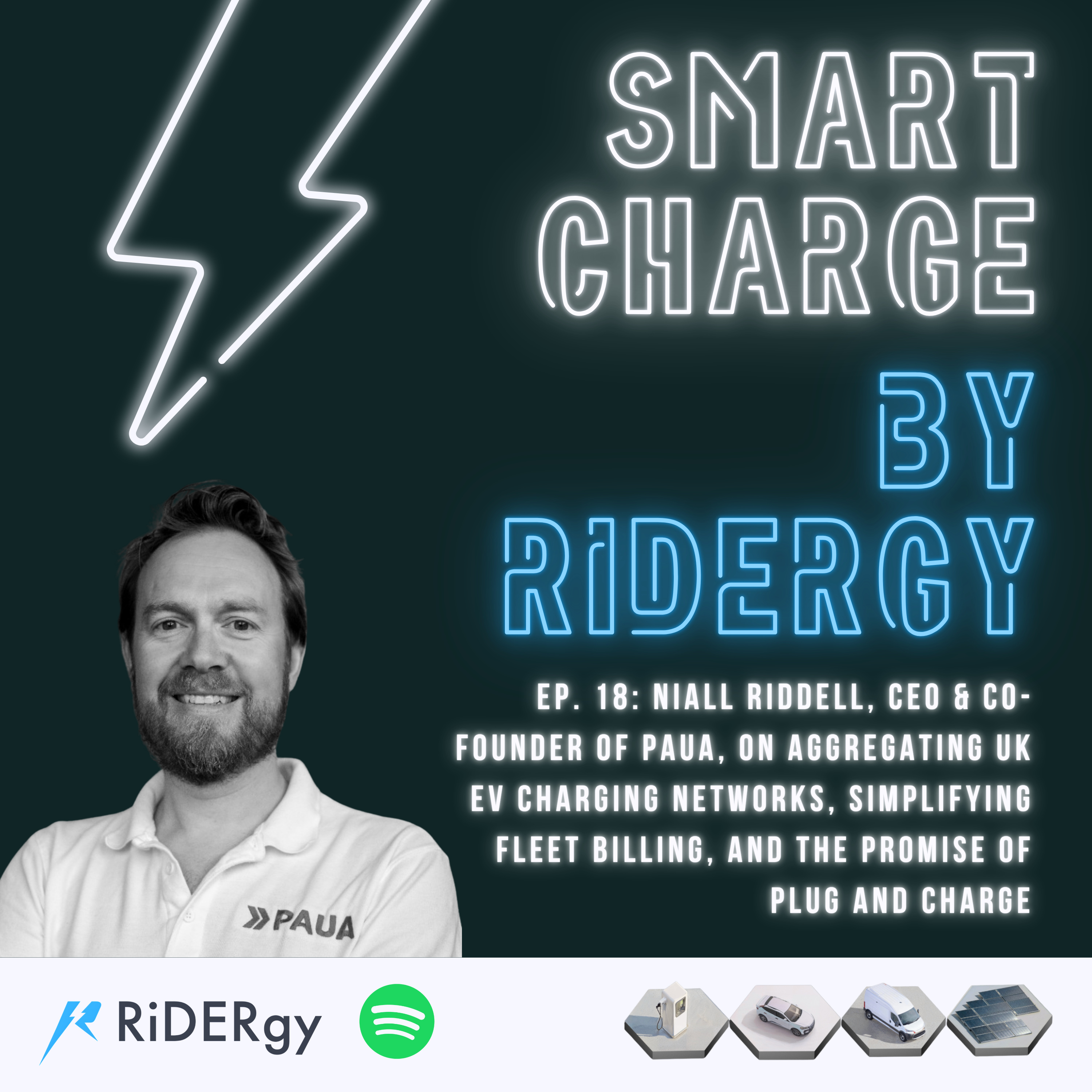
Ep. 18: Niall Riddell, CEO & Co‑Founder of Paua, on Aggregating UK EV Charging Networks, Simplifying Fleet Billing, and the Promise of Plug and Charge
Trascrizione
Ripulita a partire da una trascrizione automatica. Le traduzioni sono generate automaticamente e possono contenere errori.
Benvenuti al podcast Smart Charge by RiDERgy. Sono Claudio Geyken, fondatore e CEO di RiDERgy. Questo è il vostro programma per conoscere tutto ciò che riguarda la gestione energetica e l'innovazione della ricarica intelligente per veicoli elettrici e flotte.
Ciao e benvenuti all'episodio di oggi con Neil Riddell, co-fondatore e CEO di Paua, la startup con sede a Londra che sta ridefinendo il modo in cui le aziende possono ricaricare le flotte elettriche. Dopo 15 anni in grandi utility energetiche, compreso il colosso francese EDF, e un MBA che lo ha convinto che per imparare il business doveva creare un'impresa, Neil ha abbandonato i suoi stivali aziendali nel 2020 per lanciare Paua - che si scrive P-A-U-A, non Power. Dal suo debutto ufficiale, Paua è diventato il più grande aggregatore di reti di ricarica per veicoli elettrici del Regno Unito, collegando oltre 60.000 connettori
di più di 40 operatori di punti di ricarica in un'unica soluzione con carta e app, vincendo il premio Start-up of the Year agli EVIES 2023. Oggi approfondiremo perché la ricarica pubblica costa ancora più del diesel, come i programmi di salary sacrifice e i sosia Tesla di BYD stanno rimodellando le flotte britanniche, e la promessa allettante del plug and charge per rendere la ricarica fluida come una Tesla a un supercharger. Cominciamo.
Allora, Neil, come stai oggi? Grazie per essere venuto al podcast. Sto molto bene, grazie mille per avermi invitato. Sì, e per gli ascoltatori che non ti conoscono, magari puoi fare una breve presentazione di te stesso. Sì, assolutamente. Quindi ciao, mi chiamo Neil. Vengo da un'azienda chiamata Paua. Alcuni di voi che stanno guardando online staranno pensando, perché questo tizio non sa scrivere? Sono Neil che si scrive N-I-A-L-L e Paua che si scrive P-A-U-A.
Forniamo una soluzione di ricarica e pagamento per veicoli elettrici qui nel Regno Unito. Il mio background è che ho trascorso 15 anni in grandi utility energetiche, ho capito che se volevo davvero fare la differenza, avrei dovuto farlo da solo. Quindi abbiamo fondato Paua nel 2020, con l'obiettivo di semplificare il percorso per le aziende con veicoli elettrici. Grazie. E quindi eri in EDF, penso una delle più grandi aziende energetiche prima. Come sei passato
da EDF all'idea concreta di un'opportunità di business? Questa è una storia piuttosto lunga e complicata, ma facciamola. Ci sono due o tre elementi qui. Uno degli elementi è che sono un ingegnere di formazione. Sono stato molto fortunato - sono stato mandato a fare un MBA nel 2009, 2010 da un mio ex capo. Mi disse, imparerai un sacco di cose. E una delle cose che ho imparato era
il business, sorprendentemente. E sono uscito dal mio MBA rendendomi conto che se volevo davvero capire il business, probabilmente avrei dovuto costruirne uno io stesso. Quindi eccomi lì nel 2010 a pensare, probabilmente dovrei essere un imprenditore. Ci sono voluti 10 anni, ma in quei 10 anni mi sono seduto a guardare i mercati e tutte le cose che pensavo di dover sapere per costruire un'impresa. E guarda caso, non ero particolarmente bravo ad arrampicarmi sul palo ingrassato
di una grande azienda, e sono finito nel team di innovazione. Una delle cose che stavamo esaminando in EDF in quell'area di innovazione erano i veicoli elettrici. Questo era nel 2017, 2018. Chiaramente una grande tendenza, chiaramente molto interesse - alcuni modelli interessanti in arrivo sul mercato. Era il tempo della nuova Renault Zoe, la Jaguar I-Pace fu lanciata all'incirca in quel periodo, la Nissan Leaf di seconda generazione. Quindi c'erano alcuni
veicoli mainstream interessanti in arrivo. Pensai, questo è davvero fantastico - quali sono tutte le sfide? Ho iniziato ad aprire quelle sfide e mi sono reso conto che questo ecosistema di molti, molti diversi operatori di punti di ricarica sulla strada, con app diverse, carte diverse, e un'esperienza completamente frammentata, significava che c'era un'opportunità lì. E pensai, in realtà, sai una cosa, forse è il momento giusto per me di farmi da parte e andare a costruire la mia impresa, e fondamentalmente passare
dall'essere quello che descrivevamo come un imprenditore pollo a un imprenditore. Qual è il concetto di imprenditore pollo? Forse puoi elaborare su quello. Quindi ci sono due cose sull'imprenditore pollo. Innanzitutto, c'è il concetto di pollo - sei un po' un pollo, un po' codardo, hai troppa paura di farlo funzionare. L'altra è una storia che un mio amico raccontava, che è l'idea di un negozio di prosciutto e uova, e hai
un maiale e un pollo che camminano lungo la strada. Il maiale e il pollo stanno avendo una conversazione, e il pollo dice, penso che dovremmo aprire un'attività - faremo un negozio di prosciutto e uova. E il maiale si gira verso il pollo e dice, non penso che sarai completamente coinvolto. Starai solo partecipando. Perché in definitiva, il maiale deve sacrificarsi completamente per fornire il prosciutto per il negozio di prosciutto e uova, mentre il pollo deve solo partecipare fornendo
le uova. Quindi l'idea di un imprenditore pollo è qualcuno che non sta partecipando completamente, mentre il maiale è davvero coinvolto a pieno. Adoro la storia - le analogie sono le migliori. E quindi ora tu sei il maiale, per così dire. Cosa rende la tua vita da maiale? Molto bene. Cosa rende la mia vita da maiale? Voglio dire, se torniamo alle basi, qui nel Regno Unito siamo ancora solo al
3% di tutti i veicoli sulla strada che sono elettrici. Quindi siamo usciti da quella fase di early adopter - sai, persone che stanno esplorando, innovando, è figo, voglio provare qualcosa di diverso - verso l'inizio della early majority. E c'è una valle della morte lì, dove le persone dicono, non è abbastanza buono, mi aspettavo che fosse come X ed è invece come Y. Stiamo vivendo in quel mondo. Abbiamo molti conducenti che sono fiduciosi, e
Lo fanno da alcuni anni ormai, sono stati tra gli innovatori, e abbiamo un gruppo di autisti che semplicemente non sono rimasti colpiti dal modo in cui il mondo funziona realmente. Quindi quello che stiamo cercando di fare proprio in questo momento - ed è il divario che stiamo cercando di colmare - è fare la transizione tra l'aspettativa di come dovrebbe essere il mondo e come è realmente. Ci troviamo in un territorio pericoloso dove dobbiamo davvero dimostrare a quelli che sono i primi di
quella maggioranza precoce che siamo capaci di gestire l'affidabilità dei caricatori, l'esperienza al punto di ricarica, le frodi, permettere alle persone di ricaricare a casa ed essere comunque equamente rimborsate quando ricaricano a casa, permettere alle persone di condividere i depositi, semplificare e snellire l'intera questione del "dove si trova il caricatore" - l'esperienza di trovare, ricaricare e pagare. E questo è fondamentalmente, se lo si scompone, la sfida che affronto ogni giorno: come far sembrare e rendere
il più facile possibile per gli autisti trovare, ricaricare e pagare durante il loro viaggio. Quindi per mettere questo in contesto - era già ottimo - se dovessi dare delle priorità, quali sono le cose più grandi che non ti lasciano dormire la notte? Sfide che affronti ogni giorno, il nucleo della tua attività quotidiana. Ci sono due modi in cui guarderei a questo, due modi per rispondere a questa domanda. Uno è
come imprenditore che gestisce una piccola impresa, cosa mi tiene sveglio la notte operando in questo mercato, e quali sono le sfide che affrontiamo davvero? Come imprenditore, onestamente, il problema più grande che affronto quotidianamente è che ho la sindrome dell'oggetto luccicante. Tutto è eccitante, tutto è bello, dovrei dedicare un po' di tempo a questo, un po' di tempo a quello - quindi sono costantemente diviso tra: dovremmo parlare di plug-in charge, oppure dovrebbe essere tutto incentrato su
vehicle-to-grid, o dovremmo fare di più sulla flessibilità energetica? Abbiamo quella dinamica costante di conversazione. Ma da una prospettiva di settore, penso che una cosa su cui dobbiamo davvero tenere d'occhio sia il costo. In definitiva ci siamo allontanati dall'utilizzatore iniziale che ha detto, "Lo faccio perché voglio una Tesla, perché una Tesla è un simbolo di status, sono felice di pagare un po' di più per guidare una Tesla," verso un mondo in cui le aziende commerciali stanno prendendo decisioni finanziarie. E
la parte che proprio non abbiamo risolto qui nel Regno Unito è che costa semplicemente di più ricaricare in pubblico che comprare un litro di diesel. Ed è qui che abbiamo un vero problema da superare - sia attraverso economie di scala, cambiamenti alla tassazione, guardando alle cose su una base di costo totale di proprietà. Qualunque sia il metodo, dobbiamo aiutare quelle aziende che ora stanno iniziando ad avvicinarsi a questo mercato e dicono, "Sì, vedo che i veicoli elettrici
stanno arrivando, ma sembra piuttosto costoso." Come possiamo aiutarli a capire come possono ridurre i loro costi, gestire i loro costi, e in definitiva dare loro un business case di base? E questo include gli impatti operativi della guida di veicoli elettrici. Come possono ottenere un business case che dica, "Sai cosa, la cosa giusta da fare per me proprio ora è comprare 100, 1.000 furgoni elettrici così posso sostituire la mia flotta con veicoli elettrici oggi." Quindi questo è molto illuminante. Solo per metterlo
di nuovo in contesto, un passo indietro: Paua in sostanza, penso, è un MSP, in termini di posizionamento nel mercato. Forse puoi elaborare un po' per gli ascoltatori - abbiamo fatto alcuni episodi uno-a-uno, con Thomas Dava di Hubject per esempio; posso consigliare di tornare a riascoltare quell'episodio. Ma sì, forse puoi elaborare sul vostro posizionamento e anche dare una
introduzione all'azienda in modo più generico. Sì, questa è una sfida davvero buona perché, come con qualsiasi nuova industria, particolarmente dove è coinvolta la tecnologia, amiamo i nostri TLA - mettiamo un sacco di acronimi di tre lettere e linguaggio complesso per cercare di descrivere cosa facciamo. Ero su un altro podcast recentemente e sono stato rimproverato per aver usato troppi acronimi di tre lettere. In effetti, potremmo essere considerati un MSP, un Mobility Service Provider - forniamo
servizi alle persone in movimento. Il modo in cui abbiamo guardato al mercato è leggermente diverso. Hai effettivamente due grandi gruppi di clienti. Hai clienti B2C - business to consumer, direttamente a un individuo che guida - e hai clienti B2B, quindi un servizio business-to-business. In quel caso, la nostra azienda fornisce un servizio alle esigenze di ricarica dei veicoli elettrici di un'altra azienda. Siamo principalmente nel business di servire le esigenze di ricarica dei veicoli elettrici di altre aziende. Non facciamo infrastrutture -
siamo letteralmente solo un operatore software, e aggreghiamo molti tipi di software insieme, che sia nella tua casa, nel tuo posto di lavoro, o sulla strada. Ognuno di questi è una piattaforma software frammentata, uno strato software. Vai in un deposito, potresti trovare un po' di Monta, un po' di Ampeco, un po' di BP - beh, BP ha appena annunciato che sta lasciando il workplace, quindi niente più BP nei luoghi di lavoro - ma potresti aver avuto un po' di PodPoint o qualcos'altro nel tuo posto di lavoro. A casa, potresti
avere uno Zappi, potresti avere un caricatore Indra, potresti avere un caricatore Wallbox. E poi quando esci sulla strada, secondo il mio conteggio ci sono 120 operatori pubblici di punti di ricarica, ognuno con un marchio leggermente diverso, un modo di lavorare leggermente diverso - e questo è uno strato molto frammentato. Quello che stiamo facendo è portare insieme integrazioni con ognuno di questi strati, e chiaramente c'è molto lavoro da fare in quest'area. Ma stiamo integrando a più livelli per portare
tutti quei kilowattora di dati di ricarica e dati di prezzo in superficie. Quando possiamo portare in superficie tutti quei dati di prezzo, possiamo poi dire alle varie parti chi ha pagato per cosa e se qualcun altro deve soldi a qualcun altro. La vera grande sfida qui è che quando guidavi un veicolo a benzina o diesel, andavi alla stazione di servizio, pagavi per la tua benzina. Se era il veicolo della tua azienda, il tuo capo pagava per la tua benzina. Improvvisamente, quando ricarichi a casa, tutto quel flusso si inverte. Stai
ora si ricarica con la tua bolletta elettrica personale, quindi stai pagando personalmente la compagnia elettrica per l'elettricità che va nel tuo veicolo aziendale. È relativamente facile da capire: inverti il flusso di pagamento e paghi il conducente per quello che ha usato a casa. Diventa terribilmente complicato quando quel veicolo viene utilizzato sia per uso personale che aziendale. Quindi immagina un conducente di livello intermedio. Gli è stata data un'auto aziendale come benefit, gli viene detto di guidare fino a una conferenza nel nord dell'Inghilterra, quindi parte
e guida fino al nord dell'Inghilterra, torna, paga per ricaricare in pubblico, l'ha ricaricata un po' a casa, e poi va a portare i bambini al mare nel weekend. Chi paga per quale parte di elettricità che è andata in quale veicolo, e come fai - nel mio linguaggio - a suddividere quel denaro in modo che tutta la ricarica domestica, la ricarica sul posto di lavoro e la ricarica pubblica siano allocate correttamente, soprattutto quando la ricarica pubblica costa l'85% e la ricarica domestica il 10%? Questo è
un calcolo complesso. È un calcolo complesso su cui stiamo spendendo molto tempo per automatizzare, catturare tutti i dati, allocarli correttamente e assicurarci di poter poi elaborare la risposta giusta alla domanda su chi paga chi per quei chilometri aziendali percorsi. Ed è lì che c'è molto divertimento e complessità. Sì, descritto molto bene, penso. Sì, hai decisamente un modo carismatico e semplice di esporre le cose.
Non hai usato troppo gergo lì. Spero che gli ascoltatori - sono felice di usare gergo se qualcuno lo vuole. Esattamente, sì. Penso che nell'Insider's Guide to Energy, l'altro podcast che stai conducendo, lì usi un po' più - c'è un lato più geek. È abbastanza bello a volte andare un po' più geek perché dipende da chi sta ascoltando. Alcune persone dicono, "questo tizio l'ha semplificato così tanto che ho capito
tutto." È tipo, in realtà ci sono strati in quell'esercizio di sbucciare la cipolla che dobbiamo affrontare man mano che diventiamo più tecnicamente consapevoli. Una delle cose che devo fare costantemente è mantenere questa storia su come comunichiamo con i clienti, comunichiamo con persone nuove in questo settore. L'altro giorno ho avuto una situazione in cui per la prima volta stavo interagendo con un cliente che non aveva mai fatto nulla con i veicoli elettrici, e mi sono detto, beh, come lo fai,
come metti insieme quella storia? Quindi sì, mi sono divertito molto. Sì, ed è già interessante anche che tu faccia B2B, e che tutto lo strato infrastrutturale che hai descritto sia specialmente per lo spazio B2B. Quindi questo è anche, immagino, un modo per differenziarti dai player più grandi che potrebbero esserci là fuori, giusto? Le grandi utility, alcuni di quelli con cui hai lavorato prima. Se devi descrivere l'USP - che scegli
le tue battaglie, per così dire. Sì, voglio dire, ci sono molte caratteristiche nel business che sono davvero importanti per noi. Abbiamo sempre creduto fondamentalmente fin dall'inizio che mettendo insieme set di dati e informazioni, possiamo fornire uno strato di valore al cliente che non puoi fare nell'arena B2C. Quando parli con un singolo conducente per strada della sua esperienza di ricarica, cerca cose come convenienza, costo più basso possibile, rendilo facile. Il che puoi fare. Ma se il tuo
cliente è guidato solo dal prezzo, allora tutto quello che fai sono sconti sulle reti - questa è l'intera proposta con cui finisce il cliente. Nella nostra arena business, riceviamo domande davvero complicate come, "Sto adottando HGV elettrici. Dove posso ricaricarli?" E improvvisamente devi andare a classificare tutta l'infrastruttura di ricarica pubblica e chiedere: quali sono abbastanza grandi da gestire un HGV? Dove andrà? Quanto tempo ci starà? Ha bisogno di prenotare? Questi ragazzi possono gestire le prenotazioni?
Come gestiamo il pagamento? Abbiamo avuto alcuni scenari in cui i punti di ricarica si interrompono a un certo limite perché erogano solo circa 125 kWh. E se devi mettere 400 kWh nel tuo HGV, improvvisamente devi ricaricarlo tre volte. Quindi ci sono piccole stranezze divertenti che stiamo iniziando a scoprire mentre risolviamo sempre più problemi dei nostri clienti business. Sì, molto interessante. Penso che tu abbia anche descritto in un post recente dove
si parlava del futuro degli MSP e dei pagamenti diretti. Penso che mostri un po' la complessità, giusto - che se il pagamento diretto non risolve il problema di trovare i caricatori giusti per un HGV, sai. Sì, c'è una domanda affascinante qui perché, in teoria, una carta di credito può pagare per qualsiasi cosa. E una carta di credito può pagare per qualsiasi cosa, e questo introduce un elemento di rischio per un'azienda perché un'azienda potrebbe non voler dare a tutti
i suoi conducenti una carta di credito. Quindi inizi a parlare di bloccare la tua carta di credito a determinati codici che vengono utilizzati per determinate attività, come pagare solo per la ricarica. Sfortunatamente, la ricarica è stata classificata come parcheggio in alcuni posti e in altri posti è stata classificata come carburante. Quindi se la blocchi solo per la ricarica, non funziona ovunque. E la carta di credito non può dirti quanti kWh vengono erogati, dove si trova il caricatore, quale potrebbe essere il percorso - perdi tutta quella
funzionalità. La domanda che hai poi è, OK, quindi non facciamo le carte di credito, facciamo qualcos'altro. Come appaiono quegli strati? E poi devi iniziare a svelare, beh, potresti fare un avvio tramite app mobile, quindi invierò un segnale digitale qui dal mio telefono a un server, che è il nostro server, un altro server al server dell'operatore del punto di ricarica, e da lì al punto di ricarica vero e proprio. Quindi ora hai molta connettività che devi gestire. Ora questo ha guasti
e problemi e ritardi e cose del genere, quindi quell'esperienza potrebbe non essere granché. E se invece usassi semplicemente una carta e ti avvicinassi e toccassi la tua carta e partisse? Ottimo, c'è un'autenticazione digitale diretta al caricatore. Ma improvvisamente ti viene in mente, oh, beh, quella carta potrebbe essere clonata, potrebbe essere copiata, potrebbe essere persa. E tutte quelle domande iniziano ad emergere. Penso che quella che mi entusiasma, ma sulla quale siamo solo all'inizio ma non ancora del tutto, sia
l'ISO 15118, che è lo standard internazionale per il plug and charge. Gestisce anche il vehicle to grid, ma il plug and charge è quello che ci interessa. Il plug and charge è un token sul caricatore, un token sull'auto, una stretta di mano tra i due, e l'esperienza del conducente è molto, molto semplificata, molto simile alla tua esperienza di ricarica Tesla. Quindi quell'esperienza di avvicinarsi, collegare, autenticarsi, semplifica l'esperienza del conducente, crea uno strato di - qual è la parola che sto cercando
- sicurezza tra il conducente e il punto di ricarica, e consente a parte di quell'ecosistema di essere un po' più fluido. Quindi è qualcosa che ci entusiasma, ma che non abbiamo ancora visto accadere. Quando accadrà, penso che inizierà a tradursi in esperienze più fluide e senza interruzioni, ma abbiamo bisogno che molte parti diverse si muovano in avanti per far funzionare davvero tutto questo. Ha senso. Parlando di geografie, penso che siate molto basati nel Regno Unito e al momento concentrati solo sul
mercato britannico. E tuttavia, sono sicuro che conosciate altri mercati. Come confrontereste il mercato del Regno Unito su quello che state facendo in particolare con altre geografie? È una domanda davvero interessante perché me la fanno spesso. Inizierei sostenendo che il Regno Unito era indietro. Parte del motivo per cui esistiamo come azienda è perché l'Europa nel suo complesso ha adottato fin dall'inizio una sorta di mentalità collaborativa di roaming nel suo
percorso. E, sai, lo standard OCPI proveniente dai Paesi Bassi - puoi vedere abbastanza rapidamente che c'è un'influenza molto europea in ciò che stiamo cercando di replicare qui nel Regno Unito. Siamo un'isola, ci comportiamo come isolani, quindi doveva essere britannico, e poi naturalmente avevamo queste aziende britanniche all'inizio che dicevano, non voglio lavorare con loro, non voglio lavorare
con loro, quindi avevamo parecchie tensioni e le abbiamo ancora, per cui direi che siamo uno dei leader di mercato in termini di aggregazione di tutte le reti insieme. Probabilmente gestiamo circa il 55-60% di tutti i connettori dei punti di ricarica, forse l'80% nelle ricariche rapide. Ma abbiamo ancora tensioni con alcune parti del mercato che non credono in questo, non pensano sia la cosa giusta da fare, e quindi il consumatore purtroppo è svantaggiato dagli ego di alcune grandi
corporazioni. Di conseguenza, penso che ci sia molto che possiamo imparare dall'Europa sul modo in cui lavoriamo insieme. Ma come paese che compra auto, ne compriamo parecchie. Guidiamo sul lato sbagliato della strada, il che non ci aiuta affatto. Quindi significa che a volte vediamo quell'impatto della guida a destra rispetto alla guida a sinistra che influenza i flussi di mercato dei veicoli. Quindi vediamo che c'è un po'
di opportunità di ritardo lì, ma in definitiva come paese che compra auto siamo al 2° o 3° posto penso dietro Germania e Francia. Germania e Francia sono ovviamente enormi leader di mercato in questo spazio. Tutto ciò che proviene dalla regione del Benelux ha guidato gran parte di questa dinamica, quindi l'Europa occidentale nel suo complesso sta spingendo avanti. La Norvegia è tutta un'altra storia a sé stante. Ma poi inizi a guardare quali sono i paesi atipici ora che sappiamo che
l'Europa occidentale si sta muovendo e adottando. Quali sono i paesi atipici? Un paio di paesi che sto osservando al momento sono la Spagna - penso che sia indietro nella transizione e penso che accelererà abbastanza rapidamente - la Polonia, abbastanza interessante da osservare perché la Polonia ha molti acquirenti di auto, è un paese di dimensioni decenti, ha ampie distanze da coprire, ma penso che vedremo alcuni cambiamenti e transizioni in Polonia. E poi l'Italia. Penso che l'Italia sia davvero
interessante. Non ha molti operatori di punti di ricarica, quindi quando guardo un mercato, cerco la frammentazione, una sfida da superare, per mettere insieme le reti. L'Italia non ha questo, ha 2 o 3 grandi attori. Quindi di conseguenza potrebbe essere più difficile per noi creare una proposta di valore in Italia. Ma sono 3 mercati che mi interessano e mi incuriosiscono molto nei prossimi 6-12 mesi. E non dobbiamo dimenticare che in definitiva l'Irlanda del Nord e l'Irlanda condividono un
confine fisico. Quindi l'Irlanda è un mercato logico da considerare per noi perché è proprio accanto. Parla anche la lingua giusta, il che ci facilita la vita. Sì, interessante. E parlando di più dell'adozione delle auto elettriche nel Regno Unito, quali sono stati i fattori trainanti nel Regno Unito? Ci sono le quote di emissioni delle flotte in Europa e poi alcuni incentivi. Forse puoi illustrare cosa c'è. E recentemente ho anche visto che BYD è, penso, il numero
uno nel mercato europeo d'oltremare. Ci sono improvvisamente BYD ovunque? Qual è la tua percezione del mercato e degli altri fattori trainanti? Sì, è una bella domanda. Quindi intendo, all'inizio, l'adozione precoce è stata fatta dai primi adottanti perché era cool. La scelta era limitata. Hanno scelto uno dei due o tre produttori che fornivano un'auto elettrica che non sembrasse una G-Wiz o una piccola macchina per la mobilità. E abbastanza rapidamente hai avuto le Zoe, la Nissan
Leaf e le Tesla sulla strada, seguite rapidamente dalla I-Pace. E per molto tempo il mercato è andato avanti così. Quello che abbiamo visto sono vari standard di emissioni che iniziano ad apparire. Quindi attualmente quelli davvero importanti che stanno guidando la transizione sono il mandato ZEV, che richiede ai produttori automobilistici di vendere una certa quantità di auto per consentire loro di raggiungere le soglie basate sulle emissioni. E questo sta avendo un impatto. Penso che sia un po' vago nello spazio dei furgoni.
Il governo britannico ha fissato alcuni obiettivi sulla percentuale di nuove vendite di auto e furgoni. Le auto stanno procedendo bene verso gli obiettivi, ma sembra che i furgoni abbiano molto terreno da recuperare. Di conseguenza, i furgoni potrebbero essere il problema più difficile da risolvere. Penso che l'altro elemento che sta davvero guidando la transizione sia un meccanismo fiscale specifico del Regno Unito. Si chiama salary sacrifice, e il modo in cui funziona il salary sacrifice è che tu rinunci
a una parte del tuo stipendio lordo - lo sacrifichi al tuo datore di lavoro - e in cambio di questo sacrificio del tuo stipendio lordo, il datore di lavoro ti dà accesso a un'auto elettrica. Ciò significa che il tuo stipendio netto diminuisce, ma poiché paghi meno tasse, la riduzione dello stipendio netto è inferiore rispetto a se avessi noleggiato o acquistato quell'auto da solo. Questa efficienza fiscale può farti risparmiare fino al 20 o 30% su un'auto, il che è un bel risparmio. Di conseguenza, grazie a questo risparmio del 20 o
30%, abbiamo visto molte aziende adottare schemi di salary sacrifice, il che ha portato molte auto tipo middle management sul mercato. E se ci pensi, sono il gruppo perfetto per quella fase di early adopter - subito dopo gli innovatori, sono un po' più benestanti, hanno un lavoro stabile con un grande datore di lavoro aziendale. Quindi l'idea che adottino Audi e-tron, l'ecosistema tipo Jaguar I-Pace, le nuove Renault - stai
iniziando a vedere tutte queste cose fluire attraverso quel mercato del salary sacrifice. E come hai menzionato, BYD è disponibile in alcuni di questi schemi. Penso che ciò che sto notando è che la strategia di BYD di assomigliare a Tesla funziona abbastanza bene. Cammini per strada, vedi un'auto che viene verso di te e ti chiedi, è una Tesla o è una BYD? Penso che ci sia stato un certo allineamento tra l'aspetto e la percezione del brand che ha permesso a BYD di
conquistare una discreta quota di mercato qui nel Regno Unito. Sono convenienti. Le metti in uno schema di salary sacrifice, diventano ancora più convenienti. Stai comprando un veicolo ad alte prestazioni con potenzialmente 250, 300, 400 miglia di autonomia. E in realtà molte persone si siedono e dicono, sai una cosa, per il mio tragitto quotidiano, perché no? Quindi penso che stiamo vedendo il middle management e gli schemi di salary sacrifice guidare parecchia adozione. Ma penso che lo spazio che probabilmente è in ritardo al momento sia quello dei
furgoni - grandi flotte che adottano grandi numeri di furgoni. Penso che quello stia facendo fatica. E poi quello entusiasmante per me, solo per la pura scala, è che il governo britannico sta facendo molto lavoro su quello che chiamano il programma ZEHI, che è il Zero Emission HGV and Infrastructure demonstrator. Quindi questo metterà diverse centinaia di veicoli pesanti elettrici su strada, e stiamo iniziando a vederli arrivare - e sono bestie enormi. Quindi stiamo iniziando a vedere alcuni di questi veicoli davvero grandi
entrare sul mercato proprio ora. Beh, molto interessante. E anche recentemente Octopus ha annunciato una partnership con BYD che ha fatto abbastanza notizia a livello internazionale - questa tariffa mensile di £300 dove ottieni un pacchetto V2G che rende la guida essenzialmente gratuita. Non ho guardato nei dettagli, ma come è stata percepita nel Regno Unito? Qual è la tua percezione personale? Hai menzionato all'inizio che ti occupi molto di V2G e smart charging tipo di
idee. Qual è la tua opinione su questo, e soprattutto sul Regno Unito che è forse il miglior mercato al mondo per queste cose? Sì, partiamo dall'inizio sul V2G. Siamo un'isola. Le isole sono negative per alcune cose ma davvero buone per altre. In questo caso particolare siamo davvero buoni per i servizi ancillari della nostra rete elettrica. Quindi non abbiamo una connessione perfetta con l'Europa - abbiamo interconnettori, abbiamo molta
generazione, è mista, è variabile, ma è su un'isola. Quindi vediamo parecchia variabilità nel nostro sistema elettrico. Ci vantiamo anche di avere un'affidabilità molto alta su quella rete elettrica, e questo è solo una funzione del fatto che paghiamo buoni soldi alle persone per fornire frequency response, risposta a breve termine, e in definitiva la stabilità che il nostro mercato necessita per mantenere le luci accese efficacemente. Significa che paghiamo parecchi soldi in
questi mercati, il che significa che da una prospettiva vehicle-to-grid, c'è una discreta quantità di entrate associate alla capacità di fornire flessibilità dalla tua batteria. Abbiamo fatto molto lavoro su questo nel periodo 2018-2019. Numerose prove di Innovate UK hanno avuto luogo - prove finanziate dal governo che dimostrano elementi di vehicle-to-grid. Quindi quando Octopus ha fatto il suo annuncio, ci sono state due cose che mi sono passate per la mente. Una era: brillante, è quello che avevamo detto che avremmo fatto
cinque anni fa, e loro lo stanno effettivamente facendo. Quindi è fantastico vederlo prendere vita nel contesto di ciò che dovrebbe essere in grado di fare. Sai, quel pezzo del puzzle lo rende davvero abbastanza entusiasmante, perché ora all'improvviso hai questa opportunità di dire, beh, in realtà, questo mercato sta accadendo. Mi piacerebbe vederne alcuni su strada, mi piacerebbe ottenere un feedback reale dai clienti per credere davvero che ciò che stanno affermando sia
vero. Ma sono Octopus, sono capaci di far accadere le cose, quindi sono entusiasta di ciò che questo significherà. La seconda cosa che mi è passata per la testa è stata che ha avuto pochissima copertura mediatica mainstream. Ha avuto molte notizie di settore, molti social media, e non ho potuto fare a meno di pensare che fosse molto intenzionale. Tornando a questa idea dell'early adopter e dell'innovatore, sai, gli innovatori sono quelli che sono entusiasmati da quel tipo di proposta. Quindi quando è
successo, ho pensato, in realtà, c'è un'opportunità davvero interessante qui per spingere questo nelle mani degli innovatori, perché gli innovatori si lamenteranno, ma quando un innovatore si lamenta dice, "Oh, sarebbe fantastico se poteste fare questo e questo e quello," piuttosto che dire, "È terribile, non funziona." Sarebbe molto più un esercizio di feedback. Quindi credo che i canali attraverso cui è stato comunicato
erano molto mirati - le persone che riconoscono quale sia il valore sono quelle che sono i primi innovatori e ne trarranno beneficio. E sono entusiasta di vedere se avrà davvero l'impatto sul mercato che penso meriti. Interessante. E come vedi l'opportunità per voi, come Paua, per il V2G e lo smart charging? Voglio dire, come hai accennato
all'inizio, ci sono molte sfide al giorno d'oggi che affrontate, ma sono sicuro che potete anche cercare di sfruttare alcune di queste flotte a casa, sul lato business, o anche in pubblico - come stiamo vedendo ad Amsterdam, credo, che ha già dei bei progetti pilota per lo smart charging nella ricarica pubblica. Sì, ha alti e bassi, no? Se sei un'azienda di consegne pacchi, o sei un
camion pesante che trasporta merci da un capo all'altro del paese, il tempo necessario per ricaricare ha un impatto operativo. Quindi se arrivi in un luogo e ti colleghi per ricaricare perché stai andando da A a B, devi mettere quanta più energia possibile in quel veicolo in quel breve periodo di tempo per tornare sulla strada, perché il tempo lontano dalla strada è tempo in cui non stai guadagnando denaro. Torna sulla strada e fai il
lavoro. Quindi se rientra nelle ore operative, non vedo una grande opportunità per il V2G nella ricarica rapida. Non vedo nemmeno opportunità per la flessibilità. Anzi, dammi quanto più puoi mentre sono qui perché devo andare avanti con il mio lavoro. Tutto ciò che è al di fuori di questo è possibile. Quindi improvvisamente ti ritrovi che quel conducente del furgone porta il suo furgone a casa di notte e si collega in strada e ha fatto 70 o 80 miglia e lo ricaricherà
in 6 o 7 ore dal caricatore in strada. Andrà a dormire per almeno 8 di quelle ore, quindi hai un'ora, e sai che c'è la colazione e il tempo - non lavorerà 18 ore al giorno. Quindi improvvisamente pensi, in realtà, ho un discreto periodo di tempo per ricaricare questo veicolo. Lo smart charging in strada, lo smart charging nei parcheggi inizia ad avere senso. Sai cosa, è tornato
a casa alle 4:30, 5 del pomeriggio, si è collegato - lasciamolo lì un po', facciamolo funzionare, e poi, sai cosa, alle 10, 11 di sera, la domanda di energia sta calando, il prezzo sta scendendo, mettiamo in carica quel veicolo. Diamogli quello di cui ha bisogno, e poi alle 6 del mattino è completamente carico. Alle 8 del mattino prende il veicolo e via. È molto logico. Dà anche abbastanza tempo in
quella finestra per fare un po' di V2G? Possibilmente. Ecco dove inizia la parte divertente. È meno legato alla capacità tecnica di gestire il carico energetico e più alle implicazioni commerciali. Perché ora quel conducente si è collegato - e forse non aveva bisogno di ricaricare, forse si è solo collegato perché gli è stato detto di farlo. Chi ottiene il beneficio commerciale? Va all'azienda come proprietaria del bene, come la persona che ha detto al conducente di collegarsi, e l'azienda ottiene il beneficio
magari attraverso un costo di ricarica più basso? O va al conducente, e l'individuo ottiene il beneficio? E penso che sia qui che vedremo emergere dinamiche davvero interessanti. Puoi vedere uno scenario in cui qualcuno dice: "Prenderò un veicolo elettrico perché posso portarlo a casa, posso collegarlo, e tutti i soldi saranno pagati a me - dal mio veicolo aziendale che hanno pagato loro, otterrò tutti i soldi dalla ricarica notturna." L'altro lato, dove
l'azienda dice: "Ooh, passerò ai veicoli elettrici, li darò a tutti i miei conducenti, guideranno e otterrò la ricarica gratis." Quindi c'è una domanda piuttosto interessante qui. È un po' come ai vecchi tempi quando avevi una carta di credito e ottenevi punti aerei. Sai, il beneficio andava al conducente, o alla persona che pagava per la carta di credito - sai, trasferire il beneficio dei punti aerei all'individuo.
Vedremo la stessa cosa? Sarà diverso o no? L'altra cosa divertente è, diciamo che vado al lavoro con il mio furgone, passo una giornata al lavoro e ricarico il mio furgone al lavoro. Poi guido a casa di notte e mi collego. E per qualche motivo, quella notte si verifica un evento V2G. Scarico la mia batteria nella mia casa per ridurre la mia domanda sulla rete.
E poi si ricarica durante la notte. Ma ho anche un rapporto con il mio capo, che dice che quando ricarico il mio veicolo a casa, vengo pagato. Vengo pagato due volte? Una volta per averlo scaricato e una volta per rimborsare il conducente a casa? E quel flusso monetario, quel valore dell'elettrone e quel valore della flessibilità - penso che funzioni a livello B2C, commerciale, a livello individuale. Penso che quando entri nel mondo delle imprese e nella relazione tra il proprietario del bene
e l'individuo che lo collega, è lì che penso ci sia davvero della roba interessante su cui lavorare. Ottimi aneddoti, ottimi esempi. Grazie per questo, Neil. Dato che stiamo finendo il tempo, magari un ultimo messaggio che vorresti dare agli ascoltatori, e come possono contattarti. Sì. Ciao a tutti, mi chiamo Neil. Sono su paua.com - un URL di quattro lettere, che è piuttosto raro di questi tempi - e potete trovarmi lì. Sono su LinkedIn se volete
rintracciarmi. E immagino che se ci fosse un ultimo pensiero o desiderio che potrei offrire: se sei un policymaker che sta ascoltando questo e non guidi un veicolo elettrico, per favore non scrivere politiche sui veicoli elettrici finché non ne guidi effettivamente uno, perché abbiamo davvero bisogno di regolatori e legislatori che comprendano l'esperienza reale. Va bene, grazie mille, Neil, e buon resto della giornata. Ciao, amico.
E questo ci porta alla fine di un altro episodio di Smart Charge by RiDERgy. Un grande ringraziamento a Neil per aver sollevato il velo sulla vita quotidiana in Paua, dove ogni giorno è una masterclass nel sottomettere la frammentazione. Intuizioni fresche dalla chiacchierata di oggi: la sindrome dell'oggetto lucido in pratica - tra plug-in charging, vehicle-to-grid e flessibilità energetica, Neil ammette che la sfida di leadership più dura è sapere quale nuova idea brillante inseguire e quale rimandare alla roadmap di domani. L'arte della fatturazione a fette: abbiamo
sentito come il software di Paua catturi ogni kWh, sia a casa, nel deposito o sulla rete pubblica, e poi allochi algoritmicamente i costi fino al chilometro. Questo è il segreto che trasforma dati confusi provenienti da oltre 120 operatori in fatture ordinate per le aziende. Enigmi delle carte di credito e peculiarità degli HGV: chi lo sapeva che le transazioni di ricarica pubblica vengono talvolta codificate come parcheggio o carburante su una carta aziendale? E per i veicoli pesanti, potresti aver bisogno di tre caricatori separati per riempire una batteria, aggiungendo grattacapi operativi che Paua sta attivamente
appianando. Status di leader nel roaming nel Regno Unito: il Regno Unito guida l'Europa nell'aggregazione di reti. Paua copre fino al 60% di tutti i connettori e quasi l'80% dei rapid. Ma i grandi incumbent resistono ancora al vero roaming - quegli ego aziendali, avverte Neil, lasciano gli automobilisti a pagarne il prezzo. All'orizzonte, oltre ISO 15118: plug and charge è solo l'inizio. Il vero impatto di massa arriverà quando finestre di smart charging, tariffe dinamiche e stack V2G completi convergeranno tutti, e quando i regolatori finalmente libereranno la pista. Se sei appassionato di eliminare la complessità dall'
elettrificazione delle flotte, iscriviti a Smart Charge by RiDERgy, lasciaci una recensione e condividi le tue domande su roaming o V2G su LinkedIn. Per vedere Paua in azione, vai su paua.com e segui Neil su LinkedIn. Grazie per l'ascolto. Continuate a innovare, continuate a caricare in modo più intelligente e ci ritroviamo la prossima volta.
Welcome to the Smart Charge by RiDERgy podcast. This is Claudio Geyken, founder and CEO of RiDERgy. This is your show to learn about all things energy management and smart charging innovation for electric vehicles and fleets.
Hello and welcome to today's episode with Neil Riddell, co-founder and CEO of Paua, the London-based startup that's redefining how businesses can charge electric fleets. After 15 years in large energy utilities, including the French behemoth EDF, and an MBA that convinced him that to learn about business he had to create a business, Neil hung up his corporate boots in 2020 to launch Paua - that's P-A-U-A, not Power. Since its official debut, Paua has become the UK's largest EV charging network aggregator, stitching together over 60,000 connectors
from more than 40 charge point operators into a single card and app solution, earning Start-up of the Year at the EVIES 2023 awards. Today, we'll dig into why public charging still costs more than diesel, how salary sacrifice schemes and BYD's Tesla look-alikes are reshaping UK fleets, and the tantalizing promise of plug and charge to make charging as seamless as a Tesla on a supercharger. Let's get started.
Alright, Neil, how are you today? Thanks for making it to the podcast. I'm very well, thank you ever so much for inviting me along. Yes, and for the listeners who don't know you, maybe you can give a short intro about yourself. Yeah, absolutely. So hello, my name is Neil. I'm from a company called Paua. Some of you who are watching online will be going, why can't this guy spell? I'm Neil spelled N-I-A-L-L and Paua spelled P-A-U-A.
We provide an electric vehicle charging and payment solution here in the UK. My background is I spent 15 years in large energy utilities, realized that if I really wanted to make a difference, I was going to have to go and do it myself. So we set up Paua back in 2020, very much with the view of simplifying the journey for businesses with electric vehicles. Thanks for that. And so you were at EDF, I think one of the largest energy corporates before. How did you get
from EDF to the concrete idea of a business opportunity? This is quite a long, complicated story, but let's do it. There are two or three pieces in here. One of the pieces is I'm an engineer by training. I was very fortunate - I got sent to do an MBA back in 2009, 2010 by a former boss of mine. He said, you're going to learn loads of stuff. And one of the things I learned about
was business, surprisingly. And I came away from my MBA realizing that if I really wanted to understand business, I was probably going to have to build one myself. So there I was in 2010 going, I should probably be an entrepreneur. It took 10 years, but over those 10 years I sat and looked at marketplaces and all the things I thought I needed to know to build a business. And as it happened, I wasn't particularly good at climbing up the greasy pole
of a large corporate, and ended up inside the innovation team. One of the things we were looking at at EDF inside that innovation area was electric vehicles. This was sort of 2017, 2018. Clearly a big trend, clearly a lot of interest - some interesting models coming to market. It was the time of the new Renault Zoe, the Jaguar I-Pace got launched around about then, the second generation Nissan Leaf. So there were some interesting,
mainstream vehicles coming along. I was like, this is really cool - what are all the challenges? Started to open up those challenges and realized that this ecosystem of many, many different charge point operators out on the road, with different apps, different cards, and an entirely fragmented experience, meant there was an opportunity there. And I was like, actually, you know what, maybe the time is about right for me to step away and go and build my own business, and basically go
from being what we described as a chicken entrepreneur to an entrepreneur. What's the concept of a chicken entrepreneur? Maybe you can elaborate on that one. So there are two things about the chicken entrepreneur. Firstly, there's the concept of a chicken - you're a bit of a chicken, a bit of a coward, you're too scared to make it work. The other one is a story that a friend of mine used to tell, which is the idea of a ham and egg shop, and you've got
a pig and a chicken walking down the road. The pig and the chicken are having a conversation, and the chicken goes, I think we should open a business - we'll make a ham and egg shop. And the pig turns back to the chicken and goes, I don't think you'll be fully involved. You'll only be participating. Because ultimately, the pig has to fully sacrifice himself to provide the ham for the ham and egg shop, whereas the chicken only has to participate in providing
the eggs. So the idea of a chicken entrepreneur is someone who's not fully participating, whereas the pig is really getting fully involved. Love the story - the analogies are the best. And so now you are the pig, so to say. What makes your life a pig? Very good. What makes my life a pig? I mean, if we go back to the basics, here in the UK we're still only about
3% of all vehicles on the road being electric. So we've kind of broken out of that early adopter phase - you know, people who are exploring, innovating, it's cool, I want to try something different - into the beginning of the early majority. And there's a valley of death in there, where people go, it's not good enough, I expected it to be like X and it's actually like Y. We are living in that world. We've got a lot of drivers who are confident, and
They've been doing it a few years now, they were some of the innovators, and we've got a bunch of drivers who just aren't impressed by the way the world actually works. So what we're trying to do right at this moment - and that's the gap we're trying to bridge - is transition that gap between the expectation of what the world should be like and what it's actually like. We've got this dangerous territory where we've really got to prove ourselves to the first of
that early majority that we are capable of handling reliability of chargers, the experience at the charge point, fraud, enabling people to charge at home and still be fairly reimbursed when they charge at home, enabling people to share depots, simplifying and streamlining the whole "where is the charger" - the find, charge and pay experience. And that is basically, if you break it down, that is the challenge I'm dealing with every day: how to make it appear and make it
as easy as possible for the drivers to find, charge and pay on their journey. So to set this into context - it was great already - if you had to prioritise, what are the biggest things that don't let you sleep at night? Challenges that you're addressing every day, the core of your daily business. There are two ways I'd look at that, two ways to answer this question. One is
as an entrepreneur running a small business, what is it that keeps me awake at night operating in this marketplace, and what are the challenges that we really face? As an entrepreneur, honestly, the biggest issue I face day to day is I have shiny object syndrome. Everything is exciting, everything's cool, I should give a little bit of time to this, a little bit of time to that - so I'm constantly being drawn between: should we talk about plug-in charge, or should it all be about
vehicle-to-grid, or should we be doing more energy flexibility? We're having that whole constant dynamic of conversation. But from an industry perspective, I think the one thing that we've got to really keep an eye on is cost. Ultimately we've moved away from the adopter who has gone, "I'm doing this because I want a Tesla, because a Tesla's a status symbol, I'm happy to pay a bit more to drive a Tesla," into a world where commercial businesses are making financially based decisions. And
the bit that we just haven't solved here in the UK is it simply costs more to charge in public than it does for a litre of diesel. And that's where we've got a real problem we need to overcome - be it through economies of scale, changes to taxation, looking at things on a total cost of ownership basis. Whatever the method is, we need to help those businesses who are now starting to approach this marketplace and say, "Yeah, I can see electric vehicles
is happening, but it looks quite expensive." How do we help them understand how they can reduce their costs, manage their costs, and ultimately give them a basic business case? And that includes the operational impacts of driving EVs. How do they get a business case that says, "You know what, the right thing for me to do right now is buy 100, 1,000 electric vans so that I can replace my fleet with electric today." So that's very insightful. Just to put it
again in context, one step back: Paua in essence, I think, is an MSP, in terms of positioning in the market. Maybe you can elaborate a little bit for the listeners - we have done some one-on-ones in some episodes, with Thomas Dava from Hubject for example; I can recommend going back to relisten to that episode. But yeah, maybe you can elaborate on your positioning and also give a
bit of an introduction to the company more generically. Yeah, that's a really good challenge because, as with any new industry, particularly where technology is involved, we love our TLAs - let's get loads of three-letter acronyms in and complex language to try and describe what it is we do. I was on another podcast recently and got told off for using too many three-letter acronyms. In effect, we could be regarded as an MSP, a Mobility Service Provider - we provide
services to people on the go. The way we've looked at the market is slightly different. You've effectively got two broad groups of customers. You've got B2C customers - business to consumer, direct to an individual who's driving - and you've got B2B customers, so a business-to-business service. In that case, our business provides a service to another business. We're in the business predominantly of servicing other businesses' electric vehicle charging needs. We don't do infrastructure -
we're literally just a software player, and we aggregate many types of software together, be that in your home, in your workplace, or out on the road. Each of these is a fragmented software platform, a software layer. You go into a depot, you might find some Monta, some Ampeco, some BP - well, BP has just announced they're leaving workplace, so no BP in the workplace anymore - but you might have had some PodPoint or something else in your workplace. At home, you might
have a Zappi, you might have an Indra charger, you might have a Wallbox charger. And then when you get out on the road, by my count there are 120 public charge point operators, each of them with a slightly different brand, slightly different way of working - and that is a very fragmented layer. What we're doing is bringing integrations with each of these layers together, and clearly there's plenty of work to be done in that area. But we're integrating at multiple levels to bring
All that kilowatt hours of charging data and pricing data to the surface. When we can surface all of that pricing data, we can then tell the various parties who paid for what and whether someone else owes someone else money. The really big challenge in here is when you drove a petrol or diesel vehicle, you went to the petrol station, you paid for your petrol. If it was your company vehicle, your boss paid for your petrol. Suddenly, when you charge at home, that whole flow reverses. You're
now charging with your personal electricity bill, so you are personally paying the electricity company for the electricity that goes into your company vehicle. That's relatively easy to understand: you reverse the payment flow and you pay the driver for what they used at home. It becomes horribly complicated when that vehicle is used for both personal and business use. So imagine a middle management driver. They've been given a company car as a perk, they're told to drive to a conference in the north of England, so off
they drive to the north of England, they come back, they pay to charge in public, they charged it a bit at home, and then they go and take the kids to the seaside at the weekend. Who pays for what bit of electricity that went into whose vehicle, and how do you - in my language - slice and dice that money so that all of the home charging, workplace charging, and public charging is suitably allocated, particularly when public charging's at 85% and home charging's at 10%? That is
a complex piece of maths. It's a complex piece of maths that we're spending a lot of time automating, capturing all the data, allocating it correctly, and ensuring that we can then devise the right answer to the question of who pays whom for those business miles that were driven. And that in there is where there's a lot of fun and games. Yeah, very well described, I think. Yeah, you definitely have a charismatic and simple way of putting things.
You didn't use too much jargon there. I hope the listeners - I'm happy to use jargon if anyone wants it. Exactly, yeah. I think in the Insider's Guide to Energy, your other podcast that you're running, there you use a bit more - there's a more geeky side as well. It's quite nice to sometimes go a bit geeky because it depends on who's listening. Some people are like, "this guy simplified it so much, I understood
all of that." It's like, actually there are layers to that onion-peeling exercise we need to go through as we become more technically aware. One of the things I'm having to do constantly is keep this story running of how we communicate with customers, communicate with people who are new to this space. I had a situation the other day where for the first time I was engaging with a customer who'd never done anything in EV, and I was like, well, how do you do that,
how do you bring that story together? So yeah, I had lots of fun and games. Yeah, and it's already interesting as well that you do B2B, and that the whole infrastructure layer that you described is especially for the B2B space. So that's also, I guess, differentiating yourself from the larger players that might be out there, right? The large utilities, some of the likes you worked with before. If you have to describe the USP as well - that you choose
your battles, so to say. Yeah, I mean, there are a lot of features around business that are really important for us. We've always fundamentally believed since the beginning that by bringing data sets and information together, we can provide a layer of value to the customer that you can't in the B2C arena. When you speak to an individual driver on the street about their charging experience, they're after things like convenience, lowest cost possible, make it easy. Which you can do. But if your
customer is just price-driven, then all you're doing is discounts on networks - that's the entire proposition that the customer ends up with. In our business arena, we get really complicated questions like, "I'm adopting electric HGVs. Where can I charge them?" And suddenly you need to go and classify all of the public charging infrastructure and ask: which ones are big enough to handle an HGV? Where will it go? How long will it be there? Does it need to book? Can these guys handle booking?
How do we manage payment? We've had some scenarios where charge points will cut off at a certain limit because they will only dispense about 125 kWh. And if you need to put 400 kWh into your HGV, suddenly you've got to charge it three times. So there are funny little quirks that we're starting to discover as we solve more and more of our business customers' problems. Yeah, very interesting. I think you also described in one post recently as well where
it was all about the future of MSPs and direct payments. I think that shows a bit of the complexity, right - that if direct pay doesn't solve the issue of finding the right chargers for an HGV, you know. Yeah, there's a fascinating question here because, in theory, a credit card can pay for anything. And a credit card can pay for anything, and that introduces an element of risk for a business because a business might not want to give all
its drivers a credit card. So then you start talking about locking your credit card down to certain codes that are used for certain activities, like only pay for charging. Unfortunately, charging has been classified as parking in some places and in other places has been classified as fuel. So if you do lock it down to charging, it doesn't work everywhere. And the credit card can't tell you how many kWh are dispensed, where the charger is, what the route might be - you lose all that.
functionality. The question you then have is, OK, so let's not do credit cards, let's do something else. What do those layers look like? And then you have to start to unpick, well, you could do a mobile app start, so I'm going to send a digital signal here from my phone to a server, which is our server, another server to the charge point operator's server, and from there to the actual charge point. So now you've got lots of connectivity you need to handle. Now that has faults
and problems and delays and things, so that experience might not be great. What if you just did a card and you pulled up and you touched your card and it started? Great, there's direct digital authentication at the charger. But all of a sudden, you go, oh, well, that card could be cloned, it could be copied, it could be lost. And all those questions start to emerge. I think the one I'm excited about, but we're just on the cusp of but not quite there, is
ISO 15118, which is the international standard for plug and charge. It also does vehicle to grid, but plug and charge is what we're interested in. Plug and charge is a token on the charger, a token on the car, a handshake between the two, and the driver experience is much, much simplified, much like your Tesla charging experience. So that experience of pulling up, plugging in, authenticating, simplifies that driver experience, it creates a layer of - what's the word I'm looking
for - security between the driver and the charge point, and enables some of that ecosystem to be a bit slicker. So that's something we're excited about, haven't quite seen happening yet. When it does happen, I think it will start to translate into smoother, more seamless experiences, but we need a lot of different parties to move forward to make that really work. Makes sense. In talking geographies, I think you are very much based in the UK and focused at the moment only on the
UK market. And nevertheless, I'm sure you're familiar with other markets. How would you compare the UK market on what you're doing in particular with other geographies? It's a really interesting question because I get asked this a lot. I would start by arguing that the UK was behind. Part of the reason that we exist as a business is because Europe as a whole adopted a sort of collaborative roaming mindset from early on in its
journey. And, you know, the OCPI standard coming out of the Netherlands - you can quite quickly see that there's very much a European influence to what it is that we're trying to replicate here in the UK. We're an island, we behave like islanders, so it had to be British, and then of course we had these British companies early on going, I don't want to work with them, I don't want to work
with them, so we had quite a lot of tension and we still have that, whereby I would argue that we're one of the market leaders in terms of aggregating all the networks together. We're probably running about 55 to 60% of all the charge point connectors, maybe 80% in rapids. But we've still got tension with certain parties in the market who don't believe in this, don't think it's the right thing to do, and therefore the consumer unfortunately is disadvantaged by the egos of some large
corporations. As a consequence, I think there's a lot we can learn from Europe about the way that we work together. But as a country that buys cars, we buy quite a lot of cars. We do drive on the wrong side of the road, which doesn't help us at all. So it does mean that we sometimes see that impact of right-hand drive versus left-hand drive impacting the market flows of vehicles. So we do see there's a bit
of a laggard opportunity in there, but ultimately as a car-buying country we're 2nd or 3rd I think behind Germany and France. Germany and France are obviously huge market leaders in this space. Everything coming out of the Benelux region has driven a lot of this dynamic, so Western Europe as a whole is pushing forward. Norway is a whole other story in its own right. But you then start to look at what are the outlier countries now that we know that
Western Europe is moving and adopting. What are the outliers? A couple of countries I've got an eye on at the moment are Spain - I think they're behind in the transition and I think they're going to accelerate quite quickly - Poland, quite an interesting one to watch because Poland's got a lot of car buyers, it's a decent sized country, it's got large ranges to cover, but I think we're going to see some changes and transition in Poland. And then Italy. I think Italy's really
fun. It doesn't have a lot of charge point operators, so when I'm looking at a marketplace, I'm looking for fragmentation, a challenge to overcome, to bring networks together. Italy doesn't have that, it's got 2 or 3 big players. So as a consequence it might be harder for us to create a value proposition in Italy. But they're 3 markets which I'm quite interested and intrigued by over the next 6 to 12 months. And we mustn't forget that ultimately Northern Ireland and Ireland share a
physical border. So Ireland is a logical market for us to look at because it is right next door. It speaks the right language as well, which makes our lives easier. Yeah, interesting. And talking more about EV adoption in the UK, what have been the drivers in the UK? There's the fleet emission quotas in Europe and then some incentives. Maybe you can get through what's there. And I also recently saw BYD being, I think, the number
One overseas European market. Is there like suddenly BYDs everywhere? How is your perception of the market and the other drivers? Yeah, that's a cool question. So I mean, back in the beginning, the early adoption was done by the early adopters because it was cool. The choice was limited. They picked one of the two or three manufacturers that provided an electric car that didn't look like a G-Wiz or a little mobility machine. And quite quickly you had Zoes, the Nissan
Leaf, and the Teslas on the road, quickly followed by the I-Pace. And for a long time the market ran like that. What we've seen is various emission standards starting to appear. So currently the really big ones that are driving the transition are the ZEV mandate, which requires the automotive manufacturers to sell a certain amount of cars to enable them to hit emissions-based thresholds. And that is having an impact. I think it's a little bit vague in the van space.
The UK government has set some objectives about the percentage of new sales in cars and vans. Cars is tracking OK towards where it should be, but it looks like vans has got a lot of catching up to do. So as a consequence, vans might be the tricky one to solve. I think the other piece that's really driving the transition is a UK-specific tax mechanism. It's something called salary sacrifice, and the way that salary sacrifice works is you give up
some of your gross salary - you sacrifice it to your employer - and in return for sacrificing your gross salary, the employer gives you access to an electric car. What it means is your net salary goes down, but because you're not paying as much tax, the net salary reduction is less than if you had leased or acquired that car yourself. That tax efficiency can save up to 20 or 30% on a car, which is a good amount. So as a consequence of saving that 20 or
30%, we've seen a lot of companies adopt salary sacrifice schemes, which has led to a lot of sort of middle-management-type cars going into the marketplace. And if you think about it, they're a perfect group for that early adopter - just after innovators, they're a little bit wealthier, they've got a stable job with a large corporate employer. And therefore the idea of them taking on Audi e-trons, the Jaguar I-Pace type ecosystem, the new Renaults - you're
starting to see all of these things flowing through that salary sacrifice market. And as you mentioned, BYD is available on some of these schemes. I think what I'm noticing is the BYD Tesla lookalike model thing is quite at work. You walk down the street, you see a car coming towards you and you go, is it a Tesla or is it a BYD? I think there's been some cross-alignment between the brand look and feel that means that BYD has been able to
steal a decent market share here in the UK. They're affordable. You put them through a salary sacrifice scheme, they're even more affordable. You're buying a high-performance vehicle with 250, 300, 400 miles potentially of range. And actually a lot of people will sit and go, you know what, for my daily commute, why not? So I think we're seeing middle management and salary sacrifice schemes drive quite a lot of uptake. But I think the space that's probably lagging at the moment is
vans - big fleets adopting large numbers of vans. I think that's struggling. And then the exciting one for me, just because of pure scale, is the UK government's doing a lot of work on what they call the ZEHI programme, which is the Zero Emission HGV and Infrastructure demonstrator. So that will place several hundred electric heavy goods vehicles on the road, and we're starting to see them arriving - and they are big beasts. So we're starting to see some of those really big
vehicles hit the market right now. Well, very interesting. And also recently Octopus announced a partnership with BYD that made quite some news internationally - this £300 monthly fee where you get a V2G package which makes driving essentially free. I haven't looked into the details, but how was that perceived in the UK? What's your personal perception? You mentioned in the beginning that you're dealing a lot with V2G and smart charging type of
ideas. What's your take on that one, and especially the UK being maybe the best market in the world for those? Yeah, let's start from the beginning on V2G. We're an island. Islands are bad for some things but really good for others. In this particular case we're really good for ancillary services for our electricity network. So we don't have a perfect connection to Europe - we have interconnectors, we've got lots
of generation, it's mixed, it's variable, but it's on an island. So we see quite a lot of variability in our electricity system. We also pride ourselves on having very high reliability on that electricity network, and that is only a function of the fact that we pay decent money to people to provide frequency response, short-term response, and ultimately the stability that our market needs to keep the lights on effectively. It means that we pay quite a lot of money into
these markets, which means that from a vehicle-to-grid perspective, there's a decent chunk of revenue associated with being able to provide flexibility from your battery. We did a lot of work on this through the 2018–2019 period. Numerous Innovate UK trials have taken place - government-funded trials demonstrating elements of vehicle-to-grid. So when Octopus made their announcement, there were two things that went through my mind. One was: brilliant, that's what we said we'd
Five years ago, and they're actually doing it. So it's great to see it coming to life in the context of what it should be able to do. You know, that piece of the puzzle makes it really quite exciting, because now all of a sudden you've got this opportunity to go, well, actually, this marketplace is happening. I'd like to see some on the road, I'd like to get some real customer feedback to really believe that what they're stating is
true. But they're Octopus, they're capable of making stuff happen, so I'm excited by what that will mean. The second thing that went through my head was it got very little mainstream media. It got a lot of industry news, it got a lot of social media, and I couldn't help thinking that was very purposeful. Going back to this idea of the early adopter and the innovator, you know, the innovators are the ones who are excited by that kind of proposition. So when that
happened, I was kind of like, actually, there's a really interesting opportunity in here to push this into the hands of the innovators, because the innovators will complain, but when an innovator complains they go, "Oh, it'd be great if you could do this and this and that," rather than going, "It's terrible, it doesn't work." It would be much more of a feedback exercise. So I do believe that the channels that it was communicated
out to were very purposeful - that the people who recognise what the value looks like are the people who are the early innovators and will get value from it. And I'm excited to see whether it will really have the impact in the market that I think it deserves. Interesting. And how do you see the opportunity for you, as Paua, for V2G and smart charging? I mean, as you hinted at in
the beginning, there are plenty of challenges nowadays that you tackle, but I'm sure you can also try to leverage some of these fleets at home, on the business side, or even in public - as we're seeing in Amsterdam, I think, which has some nice pilots in public charging already for smart charging. Yeah, it's got swings and roundabouts, hasn't it? If you are a parcel delivery company, or you're an
HGV taking freight from one end of the country to the other, the time it takes to charge is an operational impact. So if you get to a location and you plug in to charge because you're going from A to B, you need to get as much juice in that vehicle as you possibly can in that short period of time to get back on the road, because the time away from the road is time you're not earning money. Get back on the road and do the
job. So if it's sat inside operational hours, I don't see a huge opportunity for V2G on rapid charging. I don't see any opportunity for flex either. In fact, give me as much as you can while I'm here because I need to go and get on with my day job. Everything outside of that is fair game. So you suddenly go, that van driver takes his van home at night and he plugs in on the street and he did 70 or 80 miles and he's going to
pull that in 6 or 7 hours from the on-street charger. He's going to go and sleep for at least 8 of those hours, so you've got an hour, and you know it's a bit of breakfast and time - he's not going to work an 18-hour day. So suddenly you go, actually, I've got a decent chunk of time to charge this vehicle. Smart charging on street, smart charging in car parks starts to make sense. You know what, he got back
home at 4:30, 5 o'clock, plugged in - let's just sit it there for a bit, let it run, and then, you know what, 10, 11 o'clock, energy demand is dropping, price is dropping, let's push that vehicle onto charge. Give it what it needs, and then by 6 o'clock in the morning he's fully charged. By 8 o'clock in the morning he picks the vehicle up and off he goes. That is very logical. Does it also give enough time in
that window to do a bit of V2G? Possibly. Here's where the fun bit begins. It's less around the technical capability to manage the energy load and more around the commercial implications. Because now that driver has plugged in - and maybe he didn't need to charge, maybe he just plugged in because he was told to. Who gets the commercial benefit? Does it go to the business as the asset owner, as the person who told the driver to plug in, and the business gets the benefit
maybe through cheaper cost of charging? Or does it go to the driver, and the individual gets the benefit? And I think that is where we're going to see some really interesting dynamics emerging. You can see a scenario where someone goes, "I'll take an EV because I can take it home, I can plug it in, and I'll get all the money paid to me - from my business vehicle that they paid for, I'll get all the money from charging it at night." The other side, where
the business goes, "Ooh, I'm going to switch to EVs, I give them to all my drivers, they're going to drive and I'm going to get free charging." So there's quite an interesting question in here. It's a bit like the old days when you had a credit card and you got airline points. You know, did the driver get the benefit, or the person paying for the credit card - you know, transfer the benefit of the airline points to the individual.
Are we going to see the same thing? Is it going to be different or not? The other fun one is, let's say I go to work in my van, I happen to spend a day at work and recharge my van at work. I then drive home at night and plug it in. And for whatever reason, a V2G event takes place that night. I discharge my battery into my home to reduce my demand on the grid.
And then it recharges overnight. But I also have a relationship with my boss, which says that when I charge my vehicle at home, I get paid. Do I get paid twice? Once for discharging it and once for reimbursing the driver at home? And that monetary flow, that value of the electron and that value of flexibility - I think it works at a B2C level, a commercial, an individual level. I think when you enter the world of businesses and the relationship between the asset
owner and the individual plugging it in, that's where I think some really spicy stuff to get stuck into. Great anecdotes, great examples. Thanks for that, Neil. As we're running out of time, maybe a last message you would like to give the listeners, and how they can reach you. Yeah. Hello everyone, my name's Neil. I'm at paua.com - a four-letter URL, which is quite rare these days - and you can find me over there. I'm on LinkedIn if you want
to hunt me down. And I guess if there was one final thought or wish that I could offer: if you're a policymaker listening to this and you don't drive an electric vehicle, please don't write policy on electric vehicles until you actually drive one, because we really need regulators and legislators who understand the real experience. All right, thanks a lot, Neil, and have a good rest of the day. Cheers, man.
And that brings us to the end of another deep dive on Smart Charge by RiDERgy. A big thank you to Neil for pulling back the curtain on life at Paua, where every day is a masterclass in wrestling fragmentation into submission. Fresh insights from today's chat: shiny object syndrome in practice - between plug-in charging, vehicle-to-grid, and energy flex, Neil admits the toughest leadership challenge is knowing which shiny new idea to chase and which to table for tomorrow's road map. The art of slice-and-dice billing: we
heard how Paua's software captures every kWh, whether at home, in the depot, or on the public network, and then algorithmically allocates costs down to the mile. That's the secret sauce that turns messy data from 120+ operators into neat invoices for businesses. Credit card conundrums and HGV quirks: who knew that public charging transactions are sometimes coded as parking or fuel on a corporate card? And for heavy goods vehicles, you may need three separate chargers to fill a battery, adding operational headaches that Paua is busy
smoothing out. UK roaming leader status: the UK leads Europe in network aggregation. Paua covers up to 60% of all connectors and nearly 80% of rapids. But large incumbents still resist true roaming - those corporate egos, Neil warns, leave drivers paying the price. On the horizon, beyond ISO 15118: plug and charge is just the beginning. True mass-market impact will come when smart charging windows, dynamic tariffs, and full V2G stacks all converge, and when regulators finally clear the runway. If you're passionate about stripping complexity from
fleet electrification, subscribe to Smart Charge by RiDERgy, leave us a review, and share your own roaming or V2G questions on LinkedIn. To see Paua in action, head to paua.com and follow Neil on LinkedIn. Thanks for listening. Keep innovating, keep charging smarter, and we'll catch you next time.
Note dell'episodio
Ever wondered how a single card and app can connect you to over 60,000 charge points from more than 40 operators and turn messy kWh data into neat, mile-level invoices? In this episode we sit down with Niall Riddell, CEO and Co-Founder of Paua, to hear how he left a 15-year career at EDF to launch the UK’s largest EV charging network aggregator in 2020, why public charging still costs more than diesel, and how Paua’s slice and dice billing captures every kilowatt hour at home, depot and on the public network. We also cover - The credit-card quirks and HGV charging challenges Paua has smoothed out for fleets - The impact of salary-sacrifice schemes and the rise of BYD’s Tesla-style EVs - The promise of plug and charge under ISO 15118 and the future of vehicle-to-grid pilots Join us for a detailed look at the solutions shaping smarter, more seamless fleet electrification in the UK.