

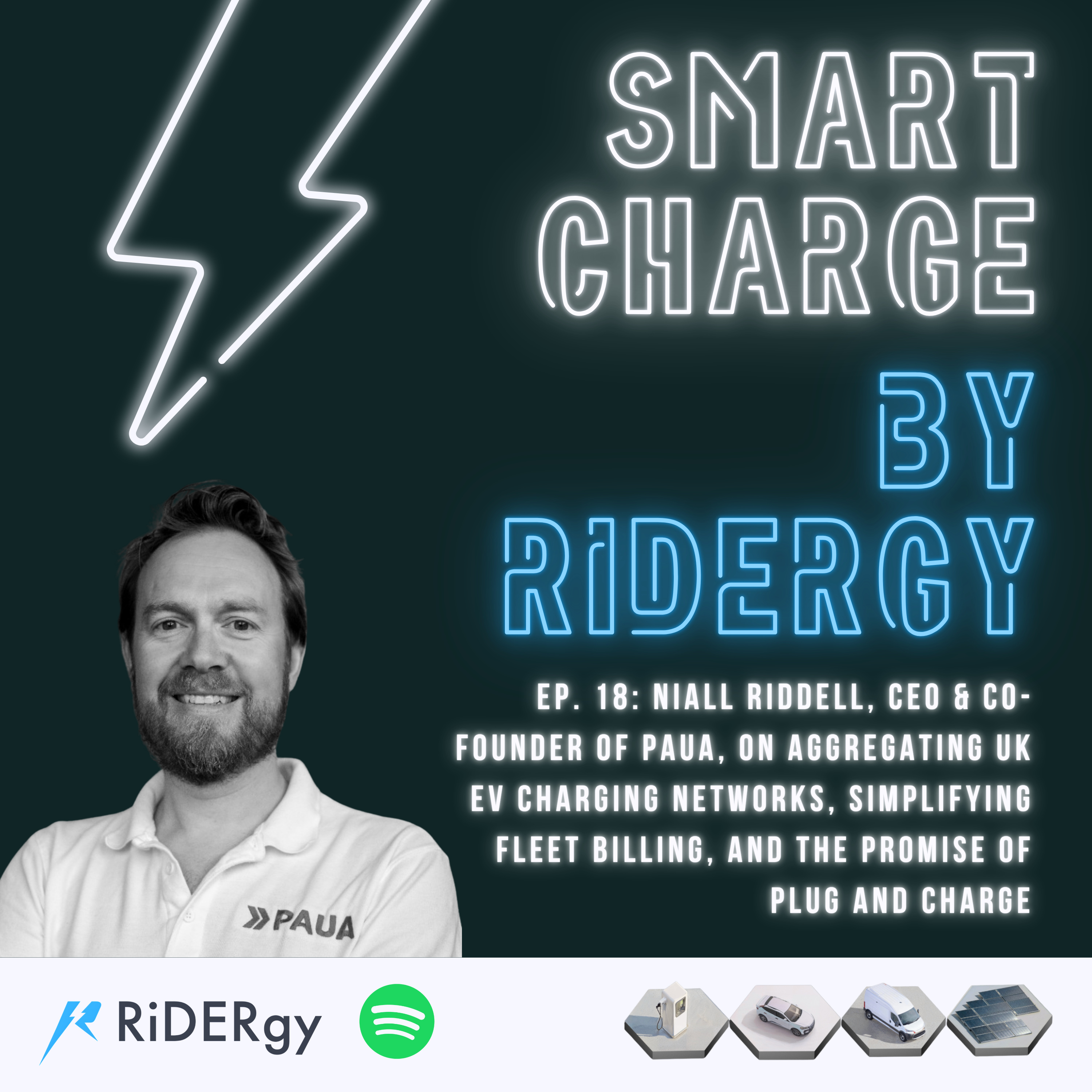
Ep. 18: Niall Riddell, CEO & Co‑Founder of Paua, on Aggregating UK EV Charging Networks, Simplifying Fleet Billing, and the Promise of Plug and Charge
Transcrição
Limpa a partir de uma transcrição automática. As traduções são geradas automaticamente e podem conter erros.
Bem-vindos ao podcast Smart Charge by RiDERgy. Sou Claudio Geyken, fundador e CEO da RiDERgy. Este é o vosso programa para aprender tudo sobre gestão de energia e inovação em carregamento inteligente para veículos elétricos e frotas.
Olá e bem-vindos ao episódio de hoje com Neil Riddell, cofundador e CEO da Paua, a startup sediada em Londres que está a redefinir como as empresas podem carregar frotas elétricas. Após 15 anos em grandes empresas de energia, incluindo o gigante francês EDF, e um MBA que o convenceu de que para aprender sobre negócios tinha de criar um negócio, Neil deixou o mundo corporativo em 2020 para lançar a Paua - P-A-U-A, não Power. Desde a sua estreia oficial, a Paua tornou-se o maior agregador de redes de carregamento de veículos elétricos do Reino Unido, reunindo mais de 60.000 conectores
de mais de 40 operadores de pontos de carregamento numa única solução de cartão e aplicação, conquistando o prémio de Start-up do Ano nos prémios EVIES 2023. Hoje, vamos explorar por que razão o carregamento público ainda custa mais do que o gasóleo, como os esquemas de salary sacrifice e os parecidos com a Tesla da BYD estão a remodelar as frotas do Reino Unido, e a promessa tentadora do plug and charge para tornar o carregamento tão simples como um Tesla num supercharger. Vamos começar.
Muito bem, Neil, como estás hoje? Obrigado por teres vindo ao podcast. Estou muito bem, muito obrigado pelo convite. Sim, e para os ouvintes que não te conhecem, talvez possas fazer uma pequena apresentação sobre ti. Sim, claro. Então olá, chamo-me Neil. Sou de uma empresa chamada Paua. Alguns de vocês que estão a ver online vão estar a pensar, porque é que este tipo não sabe soletrar? Sou o Neil, escrito N-I-A-L-L, e Paua escrito P-A-U-A.
Fornecemos uma solução de carregamento e pagamento para veículos elétricos aqui no Reino Unido. O meu percurso é que passei 15 anos em grandes empresas de energia, percebi que se realmente queria fazer a diferença, teria de ir fazê-lo por mim próprio. Então criámos a Paua em 2020, muito com a visão de simplificar a jornada para empresas com veículos elétricos. Obrigado por isso. E então estavas na EDF, penso que uma das maiores empresas de energia antes. Como passaste
da EDF para a ideia concreta de uma oportunidade de negócio? Esta é uma história bastante longa e complicada, mas vamos lá. Há duas ou três peças aqui. Uma das peças é que sou engenheiro de formação. Tive muita sorte - fui enviado para fazer um MBA em 2009, 2010, por um antigo chefe meu. Ele disse, vais aprender imenso. E uma das coisas que aprendi foi sobre
negócios, surpreendentemente. E saí do meu MBA a perceber que se realmente queria compreender negócios, provavelmente ia ter de construir um eu próprio. Então lá estava eu em 2010 a pensar, provavelmente deveria ser empreendedor. Levou 10 anos, mas ao longo desses 10 anos sentei-me e observei mercados e todas as coisas que achava que precisava de saber para construir um negócio. E aconteceu que eu não era particularmente bom a subir o mastro escorregadio
de uma grande empresa, e acabei dentro da equipa de inovação. Uma das coisas que estávamos a analisar na EDF dentro dessa área de inovação era veículos elétricos. Isto foi por volta de 2017, 2018. Claramente uma grande tendência, claramente muito interesse - alguns modelos interessantes a chegar ao mercado. Era a época do novo Renault Zoe, o Jaguar I-Pace foi lançado por essa altura, o Nissan Leaf de segunda geração. Então havia alguns veículos interessantes,
mainstream a surgir. Eu pensei, isto é muito interessante - quais são todos os desafios? Comecei a explorar esses desafios e percebi que este ecossistema de muitos, muitos operadores de pontos de carregamento diferentes na estrada, com aplicações diferentes, cartões diferentes, e uma experiência completamente fragmentada, significava que havia uma oportunidade ali. E pensei, na verdade, sabem que mais, talvez seja a altura certa para eu sair e ir construir o meu próprio negócio, e basicamente passar
de ser o que descrevíamos como empreendedor galinha para empreendedor. Qual é o conceito de empreendedor galinha? Talvez possas elaborar sobre isso. Então há duas coisas sobre o empreendedor galinha. Em primeiro lugar, há o conceito de galinha - és um pouco galinha, um pouco cobarde, tens demasiado medo para fazer funcionar. A outra é uma história que um amigo meu costumava contar, que é a ideia de uma loja de presunto e ovos, e tens
um porco e uma galinha a andar pela estrada. O porco e a galinha estão a ter uma conversa, e a galinha diz, acho que devíamos abrir um negócio - vamos fazer uma loja de presunto e ovos. E o porco vira-se para a galinha e diz, não acho que estejas totalmente envolvida. Vais apenas participar. Porque, em última análise, o porco tem de se sacrificar completamente para fornecer o presunto para a loja de presunto e ovos, enquanto a galinha só tem de participar fornecendo
os ovos. Então a ideia de empreendedor galinha é alguém que não está totalmente a participar, enquanto o porco está realmente totalmente envolvido. Adoro a história - as analogias são as melhores. E então agora és o porco, por assim dizer. O que torna a tua vida de porco? Muito boa. O que torna a minha vida de porco? Quer dizer, se voltarmos ao básico, aqui no Reino Unido ainda estamos apenas em cerca de
3% de todos os veículos na estrada a serem elétricos. Então meio que saímos daquela fase de early adopter - sabes, pessoas que estão a explorar, a inovar, é fixe, quero experimentar algo diferente - para o início da early majority. E há um vale da morte aí, onde as pessoas dizem, não é bom o suficiente, esperava que fosse como X e na verdade é como Y. Estamos a viver nesse mundo. Temos muitos condutores que estão confiantes, e
Eles fazem isso há alguns anos, foram alguns dos inovadores, e temos um grupo de condutores que simplesmente não estão impressionados com a forma como o mundo realmente funciona. Então, o que estamos a tentar fazer neste preciso momento - e é essa a lacuna que estamos a tentar colmatar - é fazer a transição dessa lacuna entre a expectativa do que o mundo deveria ser e o que realmente é. Temos este território perigoso onde realmente temos de nos provar à primeira parte
dessa maioria inicial de que somos capazes de lidar com a fiabilidade dos carregadores, a experiência no ponto de carregamento, a fraude, permitir que as pessoas carreguem em casa e ainda sejam reembolsadas de forma justa quando carregam em casa, permitir que as pessoas partilhem depósitos, simplificar e agilizar toda a questão de "onde está o carregador" - a experiência de encontrar, carregar e pagar. E isso é basicamente, se decompusermos, esse é o desafio com que lido todos os dias: como fazer com que pareça e torne
o mais fácil possível para os condutores encontrar, carregar e pagar na sua viagem. Então, para colocar isto em contexto - já estava ótimo - se tivesses de dar prioridades, quais são as maiores coisas que não te deixam dormir à noite? Desafios que enfrentas todos os dias, o cerne do teu negócio diário. Há duas formas de olhar para isso, duas maneiras de responder a essa pergunta. Uma é
como empreendedor a gerir uma pequena empresa, o que é que me mantém acordado à noite a operar neste mercado, e quais são os desafios que realmente enfrentamos? Como empreendedor, honestamente, o maior problema que enfrento no dia a dia é que tenho a síndrome do objeto brilhante. Tudo é empolgante, tudo é fixe, deveria dar um pouco de tempo a isto, um pouco de tempo àquilo - por isso estou constantemente a ser atraído entre: devemos falar sobre plug-in charge, ou deve ser tudo sobre
vehicle-to-grid, ou devemos estar a fazer mais flexibilidade energética? Temos essa dinâmica constante de conversa. Mas de uma perspetiva da indústria, penso que uma coisa a que temos realmente de estar atentos é o custo. Em última análise, saímos do adotante que disse: "Estou a fazer isto porque quero um Tesla, porque um Tesla é um símbolo de status, estou disposto a pagar um pouco mais para conduzir um Tesla", para um mundo onde as empresas comerciais estão a tomar decisões com base financeira. E
a parte que simplesmente ainda não resolvemos aqui no Reino Unido é que custa mais carregar em público do que custa um litro de gasóleo. E é aí que temos um problema real que precisamos de superar - seja através de economias de escala, alterações na tributação, olhando para as coisas numa base de custo total de propriedade. Seja qual for o método, precisamos de ajudar essas empresas que estão agora a começar a aproximar-se deste mercado e a dizer: "Sim, consigo ver que os veículos elétricos
estão a acontecer, mas parece bastante caro." Como os ajudamos a compreender como podem reduzir os seus custos, gerir os seus custos e, em última análise, dar-lhes um caso de negócio básico? E isso inclui os impactos operacionais de conduzir VEs. Como conseguem um caso de negócio que diga: "Sabes que mais, a coisa certa a fazer neste momento é comprar 100, 1000 carrinhas elétricas para que possa substituir a minha frota com elétricos hoje." Então, isso é muito esclarecedor. Apenas para colocar
novamente em contexto, um passo atrás: a Paua, em essência, penso, é um MSP, em termos de posicionamento no mercado. Talvez possas elaborar um pouco para os ouvintes - fizemos alguns episódios individuais, com Thomas Dava da Hubject, por exemplo; posso recomendar voltar a ouvir esse episódio. Mas sim, talvez possas elaborar sobre o vosso posicionamento e também dar uma
introdução à empresa de forma mais genérica. Sim, esse é um desafio muito bom porque, como acontece com qualquer indústria nova, particularmente onde a tecnologia está envolvida, adoramos os nossos TLAs - vamos meter imensos acrónimos de três letras e linguagem complexa para tentar descrever o que fazemos. Estive noutro podcast recentemente e fui repreendido por usar demasiados acrónimos de três letras. Efetivamente, poderíamos ser considerados um MSP, um Mobility Service Provider - fornecemos
serviços a pessoas em movimento. A forma como olhámos para o mercado é ligeiramente diferente. Tens efetivamente dois grupos amplos de clientes. Tens clientes B2C - business to consumer, direto para um indivíduo que está a conduzir - e tens clientes B2B, portanto um serviço business-to-business. Nesse caso, o nosso negócio fornece um serviço a outra empresa. Estamos predominantemente no negócio de servir as necessidades de carregamento de veículos elétricos de outras empresas. Não fazemos infraestrutura -
somos literalmente apenas um player de software, e agregamos muitos tipos de software em conjunto, seja em casa, no local de trabalho ou na estrada. Cada um destes é uma plataforma de software fragmentada, uma camada de software. Entras num depósito, podes encontrar algum Monta, algum Ampeco, algum BP - bem, a BP acabou de anunciar que está a sair do local de trabalho, por isso não há mais BP no local de trabalho - mas podes ter tido algum PodPoint ou outra coisa no teu local de trabalho. Em casa, podes
ter um Zappi, podes ter um carregador Indra, podes ter um carregador Wallbox. E depois, quando sais para a estrada, pela minha conta há 120 operadores de pontos de carregamento públicos, cada um deles com uma marca ligeiramente diferente, forma ligeiramente diferente de trabalhar - e essa é uma camada muito fragmentada. O que estamos a fazer é trazer integrações com cada uma destas camadas em conjunto, e claramente há muito trabalho a ser feito nessa área. Mas estamos a integrar a vários níveis para trazer
todos esses quilowatts-hora de dados de carregamento e dados de preços à superfície. Quando conseguimos trazer todos esses dados de preços à superfície, podemos então dizer às várias partes quem pagou por quê e se alguém deve dinheiro a outra pessoa. O desafio realmente grande aqui é quando conduzias um veículo a gasolina ou gasóleo, ias à bomba de gasolina, pagavas pela tua gasolina. Se era o teu veículo da empresa, o teu chefe pagava pela tua gasolina. De repente, quando carregas em casa, todo esse fluxo inverte-se. Estás
agora a carregar com a sua fatura pessoal de eletricidade, por isso está pessoalmente a pagar à empresa de eletricidade pela eletricidade que vai para o veículo da empresa. Isso é relativamente fácil de compreender: inverte-se o fluxo de pagamento e paga-se ao condutor pelo que usou em casa. Torna-se horrivelmente complicado quando esse veículo é usado tanto para uso pessoal como profissional. Então imagine um condutor de gestão intermédia. Recebeu um carro da empresa como benefício, disseram-lhe para conduzir até uma conferência no norte de Inglaterra, e lá
vai ele conduzir até ao norte de Inglaterra, regressa, paga para carregar em público, carregou um pouco em casa, e depois vai levar as crianças à praia no fim de semana. Quem paga por que parte da eletricidade que entrou em que veículo, e como é que - na minha linguagem - se divide esse dinheiro de modo a que todo o carregamento em casa, no local de trabalho e público seja devidamente atribuído, particularmente quando o carregamento público está a 85% e o carregamento em casa a 10%? Isso é
uma equação complexa. É uma equação complexa em que estamos a gastar muito tempo a automatizar, a capturar todos os dados, a atribuí-los corretamente, e a garantir que podemos depois conceber a resposta certa à questão de quem paga a quem por aquelas milhas profissionais que foram percorridas. E é aí que há muita diversão e jogos. Sim, muito bem descrito, penso eu. Sim, definitivamente tem uma forma carismática e simples de apresentar as coisas.
Não usou demasiado jargão aí. Espero que os ouvintes - estou disposto a usar jargão se alguém o quiser. Exatamente, sim. Penso que no Insider's Guide to Energy, o outro podcast que está a fazer, aí usa um pouco mais - há um lado mais geek também. É bastante agradável às vezes tornar-mo-nos um pouco geek porque depende de quem está a ouvir. Algumas pessoas dizem: "este tipo simplificou tanto, eu percebi
tudo isso." É tipo, na verdade há camadas naquele exercício de descascar a cebola que precisamos de percorrer à medida que nos tornamos mais tecnicamente conscientes. Uma das coisas que tenho de fazer constantemente é manter esta história a correr de como comunicamos com os clientes, comunicar com pessoas que são novas neste espaço. Tive uma situação no outro dia em que pela primeira vez estava a interagir com um cliente que nunca tinha feito nada em VE, e eu pensei, bem, como é que se faz isso,
como é que se junta essa história? Por isso sim, tive muita diversão e jogos. Sim, e também já é interessante que façam B2B, e que toda a camada de infraestrutura que descreveu seja especialmente para o espaço B2B. Portanto isso também, suponho, diferencia-vos dos grandes players que possam estar por aí, certo? As grandes utilities, alguns dos que trabalhou antes. Se tiver de descrever o USP também - que escolhe
as suas batalhas, por assim dizer. Sim, quero dizer, há muitas características em torno do negócio que são realmente importantes para nós. Sempre acreditámos fundamentalmente desde o início que ao juntar conjuntos de dados e informação, podemos fornecer uma camada de valor ao cliente que não se consegue na arena B2C. Quando se fala com um condutor individual na rua sobre a sua experiência de carregamento, eles procuram coisas como conveniência, o menor custo possível, torná-lo fácil. O que se pode fazer. Mas se o seu
cliente é apenas orientado pelo preço, então tudo o que está a fazer são descontos nas redes - essa é toda a proposta com que o cliente acaba. Na nossa arena de negócios, recebemos perguntas realmente complicadas como: "Estou a adotar HGVs elétricos. Onde os posso carregar?" E de repente precisa de ir classificar toda a infraestrutura de carregamento público e perguntar: quais são grandes o suficiente para lidar com um HGV? Onde é que vai? Quanto tempo vai estar lá? Precisa de reservar? Estes gajos conseguem lidar com reservas?
Como gerimos o pagamento? Tivemos alguns cenários em que os pontos de carregamento cortam num certo limite porque só dispensam cerca de 125 kWh. E se precisar de colocar 400 kWh no seu HGV, de repente tem de o carregar três vezes. Portanto há pequenas peculiaridades engraçadas que estamos a começar a descobrir à medida que resolvemos cada vez mais problemas dos nossos clientes empresariais. Sim, muito interessante. Penso que também descreveu num post recentemente onde
era tudo sobre o futuro dos MSPs e pagamentos diretos. Penso que isso mostra um pouco a complexidade, certo - que se o pagamento direto não resolve a questão de encontrar os carregadores certos para um HGV, sabe. Sim, há uma questão fascinante aqui porque, em teoria, um cartão de crédito pode pagar por qualquer coisa. E um cartão de crédito pode pagar por qualquer coisa, e isso introduz um elemento de risco para um negócio porque um negócio pode não querer dar a todos
os seus condutores um cartão de crédito. Então começa-se a falar sobre bloquear o seu cartão de crédito a certos códigos que são usados para certas atividades, como pagar apenas por carregamento. Infelizmente, o carregamento foi classificado como estacionamento em alguns lugares e noutros lugares foi classificado como combustível. Portanto, se o bloquear para carregamento, não funciona em todo o lado. E o cartão de crédito não lhe pode dizer quantos kWh são dispensados, onde está o carregador, qual pode ser a rota - perde-se toda essa
funcionalidade. A questão que então tem é: OK, então não vamos usar cartões de crédito, vamos fazer outra coisa. Como são essas camadas? E depois tem de começar a desemaranhar, bem, podia fazer um arranque de aplicação móvel, então vou enviar um sinal digital aqui do meu telefone para um servidor, que é o nosso servidor, outro servidor para o servidor do operador do ponto de carregamento, e daí para o ponto de carregamento real. Então agora tem muita conectividade que precisa de gerir. Agora isso tem falhas
e problemas e atrasos e essas coisas, portanto essa experiência pode não ser ótima. E se simplesmente usasses um cartão e chegasses e encostasses o cartão e começasse? Ótimo, há autenticação digital direta no carregador. Mas de repente pensas: oh, bem, esse cartão pode ser clonado, pode ser copiado, pode ser perdido. E todas essas questões começam a surgir. Acho que aquela com que estou entusiasmado, mas estamos apenas no limiar mas ainda não lá, é
a ISO 15118, que é a norma internacional para plug and charge. Também faz vehicle to grid, mas plug and charge é o que nos interessa. Plug and charge é um token no carregador, um token no carro, um aperto de mão entre os dois, e a experiência do condutor é muito, muito simplificada, muito parecida com a tua experiência de carregamento Tesla. Portanto, essa experiência de chegar, ligar, autenticar, simplifica essa experiência do condutor, cria uma camada de - qual é a palavra que procuro - segurança entre o condutor e o ponto de carregamento, e permite que parte desse ecossistema seja um pouco mais ágil. Portanto, é algo com que estamos entusiasmados, ainda não vimos a acontecer. Quando acontecer, acho que vai começar a traduzir-se em experiências mais suaves e contínuas, mas precisamos que muitas partes diferentes avancem para que isso funcione realmente. Faz sentido. Falando de geografias, acho que estás muito baseado no Reino Unido e focado no momento apenas no
Reino Unido. Faz sentido. Falando de geografias, acho que estás muito baseado no Reino Unido e focado no momento apenas no
mercado do Reino Unido. E, no entanto, tenho a certeza de que está familiarizado com outros mercados. Como compararia o mercado do Reino Unido, no que está a fazer em particular, com outras geografias? É uma pergunta realmente interessante, porque me fazem muito esta pergunta. Começaria por argumentar que o Reino Unido estava atrasado. Parte da razão pela qual existimos como empresa é porque a Europa no seu conjunto adotou uma mentalidade de roaming colaborativo desde cedo na sua
jornada. E, sabe, a norma OCPI que saiu dos Países Baixos - pode ver-se muito rapidamente que há uma influência muito europeia naquilo que estamos a tentar replicar aqui no Reino Unido. Somos uma ilha, comportamo-nos como ilhéus, por isso tinha de ser britânico, e depois, claro, tivemos estas empresas britânicas logo no início a dizer, não quero trabalhar com eles, não quero trabalhar
com eles, por isso tivemos bastante tensão e ainda temos isso, pelo que eu diria que somos um dos líderes de mercado em termos de agregação de todas as redes em conjunto. Estamos provavelmente a gerir cerca de 55 a 60% de todos os conectores de pontos de carregamento, talvez 80% nos carregamentos rápidos. Mas ainda temos tensão com certas partes do mercado que não acreditam nisto, não acham que seja a coisa certa a fazer e, portanto, o consumidor infelizmente é prejudicado pelos egos de alguns grandes
corporações. Como consequência, penso que há muito que podemos aprender com a Europa sobre a forma como trabalhamos em conjunto. Mas como país que compra automóveis, compramos bastantes carros. Conduzimos do lado errado da estrada, o que não nos ajuda nada. Isso significa que por vezes vemos o impacto da condução à direita versus condução à esquerda a afetar os fluxos de mercado de veículos. Por isso vemos que há um pouco
de atraso aí, mas em última análise como país comprador de automóveis estamos em 2.º ou 3.º lugar, penso, atrás da Alemanha e da França. A Alemanha e a França são obviamente enormes líderes de mercado neste espaço. Tudo o que vem da região do Benelux tem impulsionado muito esta dinâmica, portanto a Europa Ocidental como um todo está a avançar. A Noruega é uma história completamente à parte. Mas depois começamos a olhar para quais são os países atípicos agora que sabemos que
a Europa Ocidental está a mover-se e a adotar. Quais são os atípicos? Alguns países que tenho sob observação neste momento são a Espanha - penso que estão atrasados na transição e penso que vão acelerar bastante rapidamente - a Polónia, bastante interessante de observar porque a Polónia tem muitos compradores de automóveis, é um país de dimensão considerável, tem grandes distâncias a cobrir, mas penso que vamos ver algumas mudanças e transição na Polónia. E depois a Itália. Penso que a Itália é realmente
divertida. Não tem muitos operadores de pontos de carregamento, portanto quando estou a olhar para um mercado, procuro fragmentação, um desafio a superar, para unir redes. A Itália não tem isso, tem 2 ou 3 grandes players. Como consequência pode ser mais difícil para nós criar uma proposta de valor em Itália. Mas são 3 mercados pelos quais estou bastante interessado e intrigado nos próximos 6 a 12 meses. E não devemos esquecer que, em última análise, a Irlanda do Norte e a Irlanda partilham uma
fronteira física. Portanto a Irlanda é um mercado lógico para nós olharmos porque está mesmo ao lado. Também fala a língua certa, o que facilita as nossas vidas. Sim, interessante. E falando mais sobre a adoção de VE no Reino Unido, quais têm sido os impulsionadores no Reino Unido? Há as quotas de emissões de frotas na Europa e depois alguns incentivos. Talvez possas explicar o que existe. E também vi recentemente a BYD a ser, penso, o número
um no mercado europeu ultramarino. Há de repente BYDs por todo o lado? Como é a tua perceção do mercado e os outros impulsionadores? Sim, essa é uma ótima pergunta. Portanto, no início, a adoção inicial foi feita pelos adotantes iniciais porque era fixe. A escolha era limitada. Escolheram um dos dois ou três fabricantes que forneciam um carro elétrico que não se parecia com um G-Wiz ou uma pequena máquina de mobilidade. E rapidamente tinhas Zoes, o Nissan
Leaf e os Teslas na estrada, rapidamente seguidos pelo I-Pace. E durante muito tempo o mercado funcionou assim. O que vimos foi vários padrões de emissões a começar a aparecer. Portanto, atualmente os realmente importantes que estão a impulsionar a transição são o mandato ZEV, que exige que os fabricantes automóveis vendam uma certa quantidade de carros para lhes permitir atingir limiares baseados em emissões. E isso está a ter um impacto. Penso que é um pouco vago no espaço das carrinhas.
O governo do Reino Unido estabeleceu alguns objetivos relativamente à percentagem de vendas novas de automóveis e carrinhas. Os automóveis estão a acompanhar razoavelmente bem onde deveriam estar, mas parece que as carrinhas têm muito terreno a recuperar. Consequentemente, as carrinhas podem ser o problema mais difícil de resolver. Penso que o outro elemento que está realmente a impulsionar a transição é um mecanismo fiscal específico do Reino Unido. Chama-se salary sacrifice, e a forma como o salary sacrifice funciona é abdicar de
parte do salário bruto - sacrifica-se para o empregador - e em troca de sacrificar o salário bruto, o empregador dá-lhe acesso a um carro elétrico. O que isto significa é que o salário líquido diminui, mas como não se paga tanto imposto, a redução do salário líquido é menor do que se tivesse alugado ou adquirido esse carro por conta própria. Essa eficiência fiscal pode poupar até 20 ou 30% num carro, o que é uma quantia considerável. Portanto, como consequência de poupar esses 20 ou
30%, vimos muitas empresas adotar esquemas de salary sacrifice, o que levou a que muitos carros do tipo quadros intermédios entrassem no mercado. E se pensarmos bem, são um grupo perfeito para esse early adopter - logo a seguir aos inovadores, são um pouco mais abastados, têm um emprego estável numa grande empresa. E portanto a ideia de adquirirem Audi e-trons, o ecossistema do Jaguar I-Pace, os novos Renaults - estamos
a começar a ver todas estas coisas a fluir através desse mercado de salary sacrifice. E como mencionaste, a BYD está disponível em alguns destes esquemas. Penso que o que estou a notar é que o modelo de semelhança da BYD com a Tesla está a funcionar bastante. Caminha-se pela rua, vê-se um carro a aproximar-se e pergunta-se: é um Tesla ou é um BYD? Penso que houve algum alinhamento cruzado entre a aparência e a sensação da marca que significa que a BYD conseguiu
conquistar uma quota de mercado considerável aqui no Reino Unido. São acessíveis. Coloca-se num esquema de salary sacrifice, ficam ainda mais acessíveis. Está-se a comprar um veículo de alto desempenho com 250, 300, 400 milhas potencialmente de autonomia. E na verdade muitas pessoas vão sentar-se e dizer, sabes que mais, para a minha deslocação diária, porque não? Portanto penso que estamos a ver quadros intermédios e esquemas de salary sacrifice a impulsionar bastante a adesão. Mas penso que o espaço que provavelmente está a ficar para trás neste momento são
as carrinhas - grandes frotas a adotar grandes números de carrinhas. Penso que isso está a ter dificuldades. E depois o mais entusiasmante para mim, apenas devido à escala pura, é o governo do Reino Unido estar a fazer muito trabalho sobre o que chamam o programa ZEHI, que é o Zero Emission HGV and Infrastructure demonstrator. Portanto isso vai colocar várias centenas de veículos pesados de mercadorias elétricos na estrada, e estamos a começar a vê-los chegar - e são grandes máquinas. Portanto estamos a começar a ver alguns desses realmente grandes
veículos a chegar ao mercado agora mesmo. Bem, muito interessante. E também recentemente a Octopus anunciou uma parceria com a BYD que deu bastantes notícias internacionalmente - esta mensalidade de £300 onde se obtém um pacote V2G que torna a condução essencialmente gratuita. Não analisei os detalhes, mas como é que isso foi percebido no Reino Unido? Qual é a tua perceção pessoal? Mencionaste no início que lidas muito com V2G e smart charging tipo de
ideias. Qual é a tua opinião sobre isso, e especialmente o Reino Unido sendo talvez o melhor mercado do mundo para isso? Sim, vamos começar do princípio sobre V2G. Somos uma ilha. As ilhas são más para algumas coisas mas realmente boas para outras. Neste caso particular somos realmente bons para serviços auxiliares para a nossa rede elétrica. Portanto não temos uma ligação perfeita à Europa - temos interconectores, temos muita
geração, é mista, é variável, mas está numa ilha. Portanto vemos bastante variabilidade no nosso sistema elétrico. Também nos orgulhamos de ter uma fiabilidade muito alta nessa rede elétrica, e isso é apenas função do facto de pagarmos dinheiro decente às pessoas para fornecerem resposta de frequência, resposta de curto prazo, e em última análise a estabilidade que o nosso mercado precisa para manter as luzes acesas efetivamente. Significa que pagamos bastante dinheiro nestes
mercados, o que significa que de uma perspetiva de vehicle-to-grid, há uma parte considerável de receita associada a ser capaz de fornecer flexibilidade da bateria. Fizemos muito trabalho sobre isto durante o período 2018-2019. Numerosos ensaios do Innovate UK aconteceram - ensaios financiados pelo governo demonstrando elementos de vehicle-to-grid. Portanto quando a Octopus fez o seu anúncio, houve duas coisas que me passaram pela cabeça. Uma foi: brilhante, é isso que dissemos que
faríamos há cinco anos, e eles estão realmente a fazê-lo. Portanto é ótimo vê-lo ganhar vida no contexto do que deveria ser capaz de fazer. Sabes, essa peça do puzzle torna-o realmente bastante entusiasmante, porque agora de repente tens esta oportunidade de dizer, bem, na verdade, este mercado está a acontecer. Gostaria de ver alguns na estrada, gostaria de obter algum feedback real de clientes para realmente acreditar que o que eles estão a afirmar é
verdade. Mas são a Octopus, são capazes de fazer as coisas acontecerem, portanto estou entusiasmado com o que isso vai significar. A segunda coisa que me passou pela cabeça foi que obteve muito pouca atenção dos meios de comunicação principais. Obteve muitas notícias da indústria, obteve muitas redes sociais, e não pude deixar de pensar que foi muito proposital. Voltando a esta ideia do early adopter e do inovador, sabes, os inovadores são aqueles que ficam entusiasmados com esse tipo de proposição. Portanto quando isso
aconteceu, fiquei tipo, na verdade, há uma oportunidade realmente interessante aqui para colocar isto nas mãos dos inovadores, porque os inovadores vão queixar-se, mas quando um inovador se queixa diz: "Oh, seria ótimo se pudesses fazer isto e isto e aquilo," em vez de dizer: "É terrível, não funciona." Seria muito mais um exercício de feedback. Portanto acredito mesmo que os canais através dos quais foi comunicado
foram muito propositadas - as pessoas que reconhecem como é o valor são as pessoas que são os primeiros inovadores e vão obter valor disso. E estou entusiasmado por ver se vai realmente ter o impacto no mercado que penso que merece. Interessante. E como vês a oportunidade para vocês, como Paua, para V2G e smart charging? Quero dizer, como mencionaste no
início, há muitos desafios atualmente que vocês enfrentam, mas tenho a certeza de que também podem tentar aproveitar algumas destas frotas em casa, no lado empresarial, ou até em público - como estamos a ver em Amesterdão, penso, que já tem alguns pilotos interessantes em carregamento público para smart charging. Sim, tem altos e baixos, não tem? Se és uma empresa de entregas de encomendas, ou és um
veículo pesado a transportar carga de uma ponta do país à outra, o tempo que demora a carregar é um impacto operacional. Portanto, se chegas a um local e ligas para carregar porque vais de A para B, precisas de meter o máximo de energia possível naquele veículo naquele curto período de tempo para voltares à estrada, porque o tempo longe da estrada é tempo em que não estás a ganhar dinheiro. Volta para a estrada e faz o
trabalho. Portanto, se está dentro das horas operacionais, não vejo uma grande oportunidade para V2G no carregamento rápido. Também não vejo qualquer oportunidade para flexibilidade. Na verdade, dá-me o máximo que puderes enquanto estou aqui porque preciso de ir e continuar o meu trabalho do dia. Tudo o que está fora disso é válido. Então de repente pensas, aquele condutor de carrinha leva a carrinha para casa à noite e liga-a na rua e fez 110 ou 130 quilómetros e vai
carregar isso em 6 ou 7 horas a partir do carregador na rua. Ele vai dormir pelo menos 8 dessas horas, portanto tens uma hora, e sabes que é um pouco de pequeno-almoço e tempo - ele não vai trabalhar um dia de 18 horas. Então de repente pensas, na verdade, tenho um período de tempo decente para carregar este veículo. Smart charging na rua, smart charging em parques de estacionamento começa a fazer sentido. Sabes que mais, ele chegou a
casa às 16h30, 17h00, ligou - vamos deixá-lo ali um bocado, deixá-lo funcionar, e depois, sabes que mais, às 22h, 23h, a procura de energia está a diminuir, o preço está a baixar, vamos colocar aquele veículo a carregar. Dá-lhe o que precisa, e depois às 6 da manhã está totalmente carregado. Às 8 da manhã ele pega no veículo e lá vai. Isso é muito lógico. Também dá tempo suficiente
nessa janela para fazer um pouco de V2G? Possivelmente. Aqui é onde começa a parte divertida. É menos sobre a capacidade técnica para gerir a carga de energia e mais sobre as implicações comerciais. Porque agora aquele condutor ligou - e talvez não precisasse de carregar, talvez tenha ligado apenas porque lhe disseram. Quem obtém o benefício comercial? Vai para a empresa como proprietária do ativo, como a pessoa que disse ao condutor para ligar, e a empresa obtém o benefício
talvez através de um custo de carregamento mais barato? Ou vai para o condutor, e o indivíduo obtém o benefício? E penso que é aí que vamos ver algumas dinâmicas realmente interessantes a emergir. Podes ver um cenário onde alguém diz: "Vou aceitar um VE porque posso levá-lo para casa, posso ligá-lo, e vou receber todo o dinheiro - do meu veículo empresarial que eles pagaram, vou receber todo o dinheiro por carregá-lo à noite." O outro lado, onde
a empresa diz: "Ooh, vou mudar para VEs, dou-os a todos os meus condutores, eles vão conduzir e eu vou ter carregamento gratuito." Portanto, há aqui uma questão bastante interessante. É um pouco como nos velhos tempos quando tinhas um cartão de crédito e recebias pontos de companhias aéreas. Sabes, o condutor obtinha o benefício, ou a pessoa que pagava pelo cartão de crédito - sabes, transferir o benefício dos pontos da companhia aérea para o indivíduo.
Vamos ver a mesma coisa? Vai ser diferente ou não? A outra divertida é, digamos que vou trabalhar na minha carrinha, por acaso passo um dia no trabalho e recarrego a minha carrinha no trabalho. Depois conduzo para casa à noite e ligo-a. E por qualquer razão, acontece um evento de V2G nessa noite. Descarrego a minha bateria para a minha casa para reduzir a minha procura na rede.
E depois recarrega durante a noite. Mas também tenho uma relação com o meu chefe, que diz que quando carrego o meu veículo em casa, sou pago. Sou pago duas vezes? Uma vez por descarregá-lo e outra por reembolsar o condutor em casa? E esse fluxo monetário, esse valor do eletrão e esse valor da flexibilidade - penso que funciona a nível B2C, comercial, a nível individual. Penso que quando entras no mundo das empresas e na relação entre o proprietário do ativo
e o indivíduo que o liga, é aí que penso que há coisas realmente picantes para explorar. Ótimas anedotas, ótimos exemplos. Obrigado por isso, Neil. Como estamos a ficar sem tempo, talvez uma última mensagem que gostarias de dar aos ouvintes, e como podem contactar-te. Sim. Olá a todos, o meu nome é Neil. Estou em paua.com - um URL de quatro letras, que é bastante raro hoje em dia - e podem encontrar-me lá. Estou no LinkedIn se quiserem
procurar-me. E acho que se houvesse um pensamento final ou desejo que pudesse oferecer: se és um decisor político a ouvir isto e não conduzes um veículo elétrico, por favor não escrevas políticas sobre veículos elétricos até realmente conduzires um, porque realmente precisamos de reguladores e legisladores que compreendam a experiência real. Muito bem, muito obrigado, Neil, e que tenhas um bom resto do dia. Abraço, meu.
E isso leva-nos ao fim de mais um mergulho profundo no Smart Charge by RiDERgy. Um grande obrigado ao Neil por ter levantado o véu sobre a vida na Paua, onde cada dia é uma aula magistral em domar a fragmentação. Insights frescos da conversa de hoje: a síndrome do objeto brilhante na prática - entre carregamento plug-in, vehicle-to-grid e flexibilidade energética, Neil admite que o maior desafio de liderança é saber qual nova ideia brilhante seguir e qual deixar para o roteiro de amanhã. A arte da faturação fracionada: ouvimos
como o software da Paua captura cada kWh, seja em casa, no depósito ou na rede pública, e depois aloca algoritmicamente os custos ao pormenor da milha. Esse é o molho secreto que transforma dados confusos de mais de 120 operadores em faturas organizadas para empresas. Enigmas de cartões de crédito e peculiaridades dos pesados: quem diria que as transações de carregamento público são por vezes codificadas como estacionamento ou combustível num cartão corporativo? E para veículos pesados de mercadorias, pode ser necessário usar três carregadores separados para encher uma bateria, acrescentando dores de cabeça operacionais que a Paua está ocupada a
resolver. Estatuto de líder em roaming no Reino Unido: o Reino Unido lidera a Europa na agregação de redes. A Paua cobre até 60% de todos os conectores e quase 80% dos rápidos. Mas grandes operadores estabelecidos ainda resistem ao verdadeiro roaming - esses egos corporativos, avisa Neil, deixam os condutores a pagar o preço. No horizonte, para além da ISO 15118: plug and charge é apenas o início. O verdadeiro impacto no mercado de massas virá quando janelas de smart charging, tarifas dinâmicas e stacks completos de V2G convergirem, e quando os reguladores finalmente abrirem caminho. Se és apaixonado por eliminar a complexidade da
eletrificação de frotas, subscreve o Smart Charge by RiDERgy, deixa-nos uma avaliação e partilha as tuas próprias questões sobre roaming ou V2G no LinkedIn. Para ver a Paua em ação, vai a paua.com e segue o Neil no LinkedIn. Obrigado por ouvires. Continua a inovar, continua a carregar de forma mais inteligente, e apanhamos-te da próxima vez.
Welcome to the Smart Charge by RiDERgy podcast. This is Claudio Geyken, founder and CEO of RiDERgy. This is your show to learn about all things energy management and smart charging innovation for electric vehicles and fleets.
Hello and welcome to today's episode with Neil Riddell, co-founder and CEO of Paua, the London-based startup that's redefining how businesses can charge electric fleets. After 15 years in large energy utilities, including the French behemoth EDF, and an MBA that convinced him that to learn about business he had to create a business, Neil hung up his corporate boots in 2020 to launch Paua - that's P-A-U-A, not Power. Since its official debut, Paua has become the UK's largest EV charging network aggregator, stitching together over 60,000 connectors
from more than 40 charge point operators into a single card and app solution, earning Start-up of the Year at the EVIES 2023 awards. Today, we'll dig into why public charging still costs more than diesel, how salary sacrifice schemes and BYD's Tesla look-alikes are reshaping UK fleets, and the tantalizing promise of plug and charge to make charging as seamless as a Tesla on a supercharger. Let's get started.
Alright, Neil, how are you today? Thanks for making it to the podcast. I'm very well, thank you ever so much for inviting me along. Yes, and for the listeners who don't know you, maybe you can give a short intro about yourself. Yeah, absolutely. So hello, my name is Neil. I'm from a company called Paua. Some of you who are watching online will be going, why can't this guy spell? I'm Neil spelled N-I-A-L-L and Paua spelled P-A-U-A.
We provide an electric vehicle charging and payment solution here in the UK. My background is I spent 15 years in large energy utilities, realized that if I really wanted to make a difference, I was going to have to go and do it myself. So we set up Paua back in 2020, very much with the view of simplifying the journey for businesses with electric vehicles. Thanks for that. And so you were at EDF, I think one of the largest energy corporates before. How did you get
from EDF to the concrete idea of a business opportunity? This is quite a long, complicated story, but let's do it. There are two or three pieces in here. One of the pieces is I'm an engineer by training. I was very fortunate - I got sent to do an MBA back in 2009, 2010 by a former boss of mine. He said, you're going to learn loads of stuff. And one of the things I learned about
was business, surprisingly. And I came away from my MBA realizing that if I really wanted to understand business, I was probably going to have to build one myself. So there I was in 2010 going, I should probably be an entrepreneur. It took 10 years, but over those 10 years I sat and looked at marketplaces and all the things I thought I needed to know to build a business. And as it happened, I wasn't particularly good at climbing up the greasy pole
of a large corporate, and ended up inside the innovation team. One of the things we were looking at at EDF inside that innovation area was electric vehicles. This was sort of 2017, 2018. Clearly a big trend, clearly a lot of interest - some interesting models coming to market. It was the time of the new Renault Zoe, the Jaguar I-Pace got launched around about then, the second generation Nissan Leaf. So there were some interesting,
mainstream vehicles coming along. I was like, this is really cool - what are all the challenges? Started to open up those challenges and realized that this ecosystem of many, many different charge point operators out on the road, with different apps, different cards, and an entirely fragmented experience, meant there was an opportunity there. And I was like, actually, you know what, maybe the time is about right for me to step away and go and build my own business, and basically go
from being what we described as a chicken entrepreneur to an entrepreneur. What's the concept of a chicken entrepreneur? Maybe you can elaborate on that one. So there are two things about the chicken entrepreneur. Firstly, there's the concept of a chicken - you're a bit of a chicken, a bit of a coward, you're too scared to make it work. The other one is a story that a friend of mine used to tell, which is the idea of a ham and egg shop, and you've got
a pig and a chicken walking down the road. The pig and the chicken are having a conversation, and the chicken goes, I think we should open a business - we'll make a ham and egg shop. And the pig turns back to the chicken and goes, I don't think you'll be fully involved. You'll only be participating. Because ultimately, the pig has to fully sacrifice himself to provide the ham for the ham and egg shop, whereas the chicken only has to participate in providing
the eggs. So the idea of a chicken entrepreneur is someone who's not fully participating, whereas the pig is really getting fully involved. Love the story - the analogies are the best. And so now you are the pig, so to say. What makes your life a pig? Very good. What makes my life a pig? I mean, if we go back to the basics, here in the UK we're still only about
3% of all vehicles on the road being electric. So we've kind of broken out of that early adopter phase - you know, people who are exploring, innovating, it's cool, I want to try something different - into the beginning of the early majority. And there's a valley of death in there, where people go, it's not good enough, I expected it to be like X and it's actually like Y. We are living in that world. We've got a lot of drivers who are confident, and
They've been doing it a few years now, they were some of the innovators, and we've got a bunch of drivers who just aren't impressed by the way the world actually works. So what we're trying to do right at this moment - and that's the gap we're trying to bridge - is transition that gap between the expectation of what the world should be like and what it's actually like. We've got this dangerous territory where we've really got to prove ourselves to the first of
that early majority that we are capable of handling reliability of chargers, the experience at the charge point, fraud, enabling people to charge at home and still be fairly reimbursed when they charge at home, enabling people to share depots, simplifying and streamlining the whole "where is the charger" - the find, charge and pay experience. And that is basically, if you break it down, that is the challenge I'm dealing with every day: how to make it appear and make it
as easy as possible for the drivers to find, charge and pay on their journey. So to set this into context - it was great already - if you had to prioritise, what are the biggest things that don't let you sleep at night? Challenges that you're addressing every day, the core of your daily business. There are two ways I'd look at that, two ways to answer this question. One is
as an entrepreneur running a small business, what is it that keeps me awake at night operating in this marketplace, and what are the challenges that we really face? As an entrepreneur, honestly, the biggest issue I face day to day is I have shiny object syndrome. Everything is exciting, everything's cool, I should give a little bit of time to this, a little bit of time to that - so I'm constantly being drawn between: should we talk about plug-in charge, or should it all be about
vehicle-to-grid, or should we be doing more energy flexibility? We're having that whole constant dynamic of conversation. But from an industry perspective, I think the one thing that we've got to really keep an eye on is cost. Ultimately we've moved away from the adopter who has gone, "I'm doing this because I want a Tesla, because a Tesla's a status symbol, I'm happy to pay a bit more to drive a Tesla," into a world where commercial businesses are making financially based decisions. And
the bit that we just haven't solved here in the UK is it simply costs more to charge in public than it does for a litre of diesel. And that's where we've got a real problem we need to overcome - be it through economies of scale, changes to taxation, looking at things on a total cost of ownership basis. Whatever the method is, we need to help those businesses who are now starting to approach this marketplace and say, "Yeah, I can see electric vehicles
is happening, but it looks quite expensive." How do we help them understand how they can reduce their costs, manage their costs, and ultimately give them a basic business case? And that includes the operational impacts of driving EVs. How do they get a business case that says, "You know what, the right thing for me to do right now is buy 100, 1,000 electric vans so that I can replace my fleet with electric today." So that's very insightful. Just to put it
again in context, one step back: Paua in essence, I think, is an MSP, in terms of positioning in the market. Maybe you can elaborate a little bit for the listeners - we have done some one-on-ones in some episodes, with Thomas Dava from Hubject for example; I can recommend going back to relisten to that episode. But yeah, maybe you can elaborate on your positioning and also give a
bit of an introduction to the company more generically. Yeah, that's a really good challenge because, as with any new industry, particularly where technology is involved, we love our TLAs - let's get loads of three-letter acronyms in and complex language to try and describe what it is we do. I was on another podcast recently and got told off for using too many three-letter acronyms. In effect, we could be regarded as an MSP, a Mobility Service Provider - we provide
services to people on the go. The way we've looked at the market is slightly different. You've effectively got two broad groups of customers. You've got B2C customers - business to consumer, direct to an individual who's driving - and you've got B2B customers, so a business-to-business service. In that case, our business provides a service to another business. We're in the business predominantly of servicing other businesses' electric vehicle charging needs. We don't do infrastructure -
we're literally just a software player, and we aggregate many types of software together, be that in your home, in your workplace, or out on the road. Each of these is a fragmented software platform, a software layer. You go into a depot, you might find some Monta, some Ampeco, some BP - well, BP has just announced they're leaving workplace, so no BP in the workplace anymore - but you might have had some PodPoint or something else in your workplace. At home, you might
have a Zappi, you might have an Indra charger, you might have a Wallbox charger. And then when you get out on the road, by my count there are 120 public charge point operators, each of them with a slightly different brand, slightly different way of working - and that is a very fragmented layer. What we're doing is bringing integrations with each of these layers together, and clearly there's plenty of work to be done in that area. But we're integrating at multiple levels to bring
All that kilowatt hours of charging data and pricing data to the surface. When we can surface all of that pricing data, we can then tell the various parties who paid for what and whether someone else owes someone else money. The really big challenge in here is when you drove a petrol or diesel vehicle, you went to the petrol station, you paid for your petrol. If it was your company vehicle, your boss paid for your petrol. Suddenly, when you charge at home, that whole flow reverses. You're
now charging with your personal electricity bill, so you are personally paying the electricity company for the electricity that goes into your company vehicle. That's relatively easy to understand: you reverse the payment flow and you pay the driver for what they used at home. It becomes horribly complicated when that vehicle is used for both personal and business use. So imagine a middle management driver. They've been given a company car as a perk, they're told to drive to a conference in the north of England, so off
they drive to the north of England, they come back, they pay to charge in public, they charged it a bit at home, and then they go and take the kids to the seaside at the weekend. Who pays for what bit of electricity that went into whose vehicle, and how do you - in my language - slice and dice that money so that all of the home charging, workplace charging, and public charging is suitably allocated, particularly when public charging's at 85% and home charging's at 10%? That is
a complex piece of maths. It's a complex piece of maths that we're spending a lot of time automating, capturing all the data, allocating it correctly, and ensuring that we can then devise the right answer to the question of who pays whom for those business miles that were driven. And that in there is where there's a lot of fun and games. Yeah, very well described, I think. Yeah, you definitely have a charismatic and simple way of putting things.
You didn't use too much jargon there. I hope the listeners - I'm happy to use jargon if anyone wants it. Exactly, yeah. I think in the Insider's Guide to Energy, your other podcast that you're running, there you use a bit more - there's a more geeky side as well. It's quite nice to sometimes go a bit geeky because it depends on who's listening. Some people are like, "this guy simplified it so much, I understood
all of that." It's like, actually there are layers to that onion-peeling exercise we need to go through as we become more technically aware. One of the things I'm having to do constantly is keep this story running of how we communicate with customers, communicate with people who are new to this space. I had a situation the other day where for the first time I was engaging with a customer who'd never done anything in EV, and I was like, well, how do you do that,
how do you bring that story together? So yeah, I had lots of fun and games. Yeah, and it's already interesting as well that you do B2B, and that the whole infrastructure layer that you described is especially for the B2B space. So that's also, I guess, differentiating yourself from the larger players that might be out there, right? The large utilities, some of the likes you worked with before. If you have to describe the USP as well - that you choose
your battles, so to say. Yeah, I mean, there are a lot of features around business that are really important for us. We've always fundamentally believed since the beginning that by bringing data sets and information together, we can provide a layer of value to the customer that you can't in the B2C arena. When you speak to an individual driver on the street about their charging experience, they're after things like convenience, lowest cost possible, make it easy. Which you can do. But if your
customer is just price-driven, then all you're doing is discounts on networks - that's the entire proposition that the customer ends up with. In our business arena, we get really complicated questions like, "I'm adopting electric HGVs. Where can I charge them?" And suddenly you need to go and classify all of the public charging infrastructure and ask: which ones are big enough to handle an HGV? Where will it go? How long will it be there? Does it need to book? Can these guys handle booking?
How do we manage payment? We've had some scenarios where charge points will cut off at a certain limit because they will only dispense about 125 kWh. And if you need to put 400 kWh into your HGV, suddenly you've got to charge it three times. So there are funny little quirks that we're starting to discover as we solve more and more of our business customers' problems. Yeah, very interesting. I think you also described in one post recently as well where
it was all about the future of MSPs and direct payments. I think that shows a bit of the complexity, right - that if direct pay doesn't solve the issue of finding the right chargers for an HGV, you know. Yeah, there's a fascinating question here because, in theory, a credit card can pay for anything. And a credit card can pay for anything, and that introduces an element of risk for a business because a business might not want to give all
its drivers a credit card. So then you start talking about locking your credit card down to certain codes that are used for certain activities, like only pay for charging. Unfortunately, charging has been classified as parking in some places and in other places has been classified as fuel. So if you do lock it down to charging, it doesn't work everywhere. And the credit card can't tell you how many kWh are dispensed, where the charger is, what the route might be - you lose all that.
functionality. The question you then have is, OK, so let's not do credit cards, let's do something else. What do those layers look like? And then you have to start to unpick, well, you could do a mobile app start, so I'm going to send a digital signal here from my phone to a server, which is our server, another server to the charge point operator's server, and from there to the actual charge point. So now you've got lots of connectivity you need to handle. Now that has faults
and problems and delays and things, so that experience might not be great. What if you just did a card and you pulled up and you touched your card and it started? Great, there's direct digital authentication at the charger. But all of a sudden, you go, oh, well, that card could be cloned, it could be copied, it could be lost. And all those questions start to emerge. I think the one I'm excited about, but we're just on the cusp of but not quite there, is
ISO 15118, which is the international standard for plug and charge. It also does vehicle to grid, but plug and charge is what we're interested in. Plug and charge is a token on the charger, a token on the car, a handshake between the two, and the driver experience is much, much simplified, much like your Tesla charging experience. So that experience of pulling up, plugging in, authenticating, simplifies that driver experience, it creates a layer of - what's the word I'm looking
for - security between the driver and the charge point, and enables some of that ecosystem to be a bit slicker. So that's something we're excited about, haven't quite seen happening yet. When it does happen, I think it will start to translate into smoother, more seamless experiences, but we need a lot of different parties to move forward to make that really work. Makes sense. In talking geographies, I think you are very much based in the UK and focused at the moment only on the
UK market. And nevertheless, I'm sure you're familiar with other markets. How would you compare the UK market on what you're doing in particular with other geographies? It's a really interesting question because I get asked this a lot. I would start by arguing that the UK was behind. Part of the reason that we exist as a business is because Europe as a whole adopted a sort of collaborative roaming mindset from early on in its
journey. And, you know, the OCPI standard coming out of the Netherlands - you can quite quickly see that there's very much a European influence to what it is that we're trying to replicate here in the UK. We're an island, we behave like islanders, so it had to be British, and then of course we had these British companies early on going, I don't want to work with them, I don't want to work
with them, so we had quite a lot of tension and we still have that, whereby I would argue that we're one of the market leaders in terms of aggregating all the networks together. We're probably running about 55 to 60% of all the charge point connectors, maybe 80% in rapids. But we've still got tension with certain parties in the market who don't believe in this, don't think it's the right thing to do, and therefore the consumer unfortunately is disadvantaged by the egos of some large
corporations. As a consequence, I think there's a lot we can learn from Europe about the way that we work together. But as a country that buys cars, we buy quite a lot of cars. We do drive on the wrong side of the road, which doesn't help us at all. So it does mean that we sometimes see that impact of right-hand drive versus left-hand drive impacting the market flows of vehicles. So we do see there's a bit
of a laggard opportunity in there, but ultimately as a car-buying country we're 2nd or 3rd I think behind Germany and France. Germany and France are obviously huge market leaders in this space. Everything coming out of the Benelux region has driven a lot of this dynamic, so Western Europe as a whole is pushing forward. Norway is a whole other story in its own right. But you then start to look at what are the outlier countries now that we know that
Western Europe is moving and adopting. What are the outliers? A couple of countries I've got an eye on at the moment are Spain - I think they're behind in the transition and I think they're going to accelerate quite quickly - Poland, quite an interesting one to watch because Poland's got a lot of car buyers, it's a decent sized country, it's got large ranges to cover, but I think we're going to see some changes and transition in Poland. And then Italy. I think Italy's really
fun. It doesn't have a lot of charge point operators, so when I'm looking at a marketplace, I'm looking for fragmentation, a challenge to overcome, to bring networks together. Italy doesn't have that, it's got 2 or 3 big players. So as a consequence it might be harder for us to create a value proposition in Italy. But they're 3 markets which I'm quite interested and intrigued by over the next 6 to 12 months. And we mustn't forget that ultimately Northern Ireland and Ireland share a
physical border. So Ireland is a logical market for us to look at because it is right next door. It speaks the right language as well, which makes our lives easier. Yeah, interesting. And talking more about EV adoption in the UK, what have been the drivers in the UK? There's the fleet emission quotas in Europe and then some incentives. Maybe you can get through what's there. And I also recently saw BYD being, I think, the number
One overseas European market. Is there like suddenly BYDs everywhere? How is your perception of the market and the other drivers? Yeah, that's a cool question. So I mean, back in the beginning, the early adoption was done by the early adopters because it was cool. The choice was limited. They picked one of the two or three manufacturers that provided an electric car that didn't look like a G-Wiz or a little mobility machine. And quite quickly you had Zoes, the Nissan
Leaf, and the Teslas on the road, quickly followed by the I-Pace. And for a long time the market ran like that. What we've seen is various emission standards starting to appear. So currently the really big ones that are driving the transition are the ZEV mandate, which requires the automotive manufacturers to sell a certain amount of cars to enable them to hit emissions-based thresholds. And that is having an impact. I think it's a little bit vague in the van space.
The UK government has set some objectives about the percentage of new sales in cars and vans. Cars is tracking OK towards where it should be, but it looks like vans has got a lot of catching up to do. So as a consequence, vans might be the tricky one to solve. I think the other piece that's really driving the transition is a UK-specific tax mechanism. It's something called salary sacrifice, and the way that salary sacrifice works is you give up
some of your gross salary - you sacrifice it to your employer - and in return for sacrificing your gross salary, the employer gives you access to an electric car. What it means is your net salary goes down, but because you're not paying as much tax, the net salary reduction is less than if you had leased or acquired that car yourself. That tax efficiency can save up to 20 or 30% on a car, which is a good amount. So as a consequence of saving that 20 or
30%, we've seen a lot of companies adopt salary sacrifice schemes, which has led to a lot of sort of middle-management-type cars going into the marketplace. And if you think about it, they're a perfect group for that early adopter - just after innovators, they're a little bit wealthier, they've got a stable job with a large corporate employer. And therefore the idea of them taking on Audi e-trons, the Jaguar I-Pace type ecosystem, the new Renaults - you're
starting to see all of these things flowing through that salary sacrifice market. And as you mentioned, BYD is available on some of these schemes. I think what I'm noticing is the BYD Tesla lookalike model thing is quite at work. You walk down the street, you see a car coming towards you and you go, is it a Tesla or is it a BYD? I think there's been some cross-alignment between the brand look and feel that means that BYD has been able to
steal a decent market share here in the UK. They're affordable. You put them through a salary sacrifice scheme, they're even more affordable. You're buying a high-performance vehicle with 250, 300, 400 miles potentially of range. And actually a lot of people will sit and go, you know what, for my daily commute, why not? So I think we're seeing middle management and salary sacrifice schemes drive quite a lot of uptake. But I think the space that's probably lagging at the moment is
vans - big fleets adopting large numbers of vans. I think that's struggling. And then the exciting one for me, just because of pure scale, is the UK government's doing a lot of work on what they call the ZEHI programme, which is the Zero Emission HGV and Infrastructure demonstrator. So that will place several hundred electric heavy goods vehicles on the road, and we're starting to see them arriving - and they are big beasts. So we're starting to see some of those really big
vehicles hit the market right now. Well, very interesting. And also recently Octopus announced a partnership with BYD that made quite some news internationally - this £300 monthly fee where you get a V2G package which makes driving essentially free. I haven't looked into the details, but how was that perceived in the UK? What's your personal perception? You mentioned in the beginning that you're dealing a lot with V2G and smart charging type of
ideas. What's your take on that one, and especially the UK being maybe the best market in the world for those? Yeah, let's start from the beginning on V2G. We're an island. Islands are bad for some things but really good for others. In this particular case we're really good for ancillary services for our electricity network. So we don't have a perfect connection to Europe - we have interconnectors, we've got lots
of generation, it's mixed, it's variable, but it's on an island. So we see quite a lot of variability in our electricity system. We also pride ourselves on having very high reliability on that electricity network, and that is only a function of the fact that we pay decent money to people to provide frequency response, short-term response, and ultimately the stability that our market needs to keep the lights on effectively. It means that we pay quite a lot of money into
these markets, which means that from a vehicle-to-grid perspective, there's a decent chunk of revenue associated with being able to provide flexibility from your battery. We did a lot of work on this through the 2018–2019 period. Numerous Innovate UK trials have taken place - government-funded trials demonstrating elements of vehicle-to-grid. So when Octopus made their announcement, there were two things that went through my mind. One was: brilliant, that's what we said we'd
Five years ago, and they're actually doing it. So it's great to see it coming to life in the context of what it should be able to do. You know, that piece of the puzzle makes it really quite exciting, because now all of a sudden you've got this opportunity to go, well, actually, this marketplace is happening. I'd like to see some on the road, I'd like to get some real customer feedback to really believe that what they're stating is
true. But they're Octopus, they're capable of making stuff happen, so I'm excited by what that will mean. The second thing that went through my head was it got very little mainstream media. It got a lot of industry news, it got a lot of social media, and I couldn't help thinking that was very purposeful. Going back to this idea of the early adopter and the innovator, you know, the innovators are the ones who are excited by that kind of proposition. So when that
happened, I was kind of like, actually, there's a really interesting opportunity in here to push this into the hands of the innovators, because the innovators will complain, but when an innovator complains they go, "Oh, it'd be great if you could do this and this and that," rather than going, "It's terrible, it doesn't work." It would be much more of a feedback exercise. So I do believe that the channels that it was communicated
out to were very purposeful - that the people who recognise what the value looks like are the people who are the early innovators and will get value from it. And I'm excited to see whether it will really have the impact in the market that I think it deserves. Interesting. And how do you see the opportunity for you, as Paua, for V2G and smart charging? I mean, as you hinted at in
the beginning, there are plenty of challenges nowadays that you tackle, but I'm sure you can also try to leverage some of these fleets at home, on the business side, or even in public - as we're seeing in Amsterdam, I think, which has some nice pilots in public charging already for smart charging. Yeah, it's got swings and roundabouts, hasn't it? If you are a parcel delivery company, or you're an
HGV taking freight from one end of the country to the other, the time it takes to charge is an operational impact. So if you get to a location and you plug in to charge because you're going from A to B, you need to get as much juice in that vehicle as you possibly can in that short period of time to get back on the road, because the time away from the road is time you're not earning money. Get back on the road and do the
job. So if it's sat inside operational hours, I don't see a huge opportunity for V2G on rapid charging. I don't see any opportunity for flex either. In fact, give me as much as you can while I'm here because I need to go and get on with my day job. Everything outside of that is fair game. So you suddenly go, that van driver takes his van home at night and he plugs in on the street and he did 70 or 80 miles and he's going to
pull that in 6 or 7 hours from the on-street charger. He's going to go and sleep for at least 8 of those hours, so you've got an hour, and you know it's a bit of breakfast and time - he's not going to work an 18-hour day. So suddenly you go, actually, I've got a decent chunk of time to charge this vehicle. Smart charging on street, smart charging in car parks starts to make sense. You know what, he got back
home at 4:30, 5 o'clock, plugged in - let's just sit it there for a bit, let it run, and then, you know what, 10, 11 o'clock, energy demand is dropping, price is dropping, let's push that vehicle onto charge. Give it what it needs, and then by 6 o'clock in the morning he's fully charged. By 8 o'clock in the morning he picks the vehicle up and off he goes. That is very logical. Does it also give enough time in
that window to do a bit of V2G? Possibly. Here's where the fun bit begins. It's less around the technical capability to manage the energy load and more around the commercial implications. Because now that driver has plugged in - and maybe he didn't need to charge, maybe he just plugged in because he was told to. Who gets the commercial benefit? Does it go to the business as the asset owner, as the person who told the driver to plug in, and the business gets the benefit
maybe through cheaper cost of charging? Or does it go to the driver, and the individual gets the benefit? And I think that is where we're going to see some really interesting dynamics emerging. You can see a scenario where someone goes, "I'll take an EV because I can take it home, I can plug it in, and I'll get all the money paid to me - from my business vehicle that they paid for, I'll get all the money from charging it at night." The other side, where
the business goes, "Ooh, I'm going to switch to EVs, I give them to all my drivers, they're going to drive and I'm going to get free charging." So there's quite an interesting question in here. It's a bit like the old days when you had a credit card and you got airline points. You know, did the driver get the benefit, or the person paying for the credit card - you know, transfer the benefit of the airline points to the individual.
Are we going to see the same thing? Is it going to be different or not? The other fun one is, let's say I go to work in my van, I happen to spend a day at work and recharge my van at work. I then drive home at night and plug it in. And for whatever reason, a V2G event takes place that night. I discharge my battery into my home to reduce my demand on the grid.
And then it recharges overnight. But I also have a relationship with my boss, which says that when I charge my vehicle at home, I get paid. Do I get paid twice? Once for discharging it and once for reimbursing the driver at home? And that monetary flow, that value of the electron and that value of flexibility - I think it works at a B2C level, a commercial, an individual level. I think when you enter the world of businesses and the relationship between the asset
owner and the individual plugging it in, that's where I think some really spicy stuff to get stuck into. Great anecdotes, great examples. Thanks for that, Neil. As we're running out of time, maybe a last message you would like to give the listeners, and how they can reach you. Yeah. Hello everyone, my name's Neil. I'm at paua.com - a four-letter URL, which is quite rare these days - and you can find me over there. I'm on LinkedIn if you want
to hunt me down. And I guess if there was one final thought or wish that I could offer: if you're a policymaker listening to this and you don't drive an electric vehicle, please don't write policy on electric vehicles until you actually drive one, because we really need regulators and legislators who understand the real experience. All right, thanks a lot, Neil, and have a good rest of the day. Cheers, man.
And that brings us to the end of another deep dive on Smart Charge by RiDERgy. A big thank you to Neil for pulling back the curtain on life at Paua, where every day is a masterclass in wrestling fragmentation into submission. Fresh insights from today's chat: shiny object syndrome in practice - between plug-in charging, vehicle-to-grid, and energy flex, Neil admits the toughest leadership challenge is knowing which shiny new idea to chase and which to table for tomorrow's road map. The art of slice-and-dice billing: we
heard how Paua's software captures every kWh, whether at home, in the depot, or on the public network, and then algorithmically allocates costs down to the mile. That's the secret sauce that turns messy data from 120+ operators into neat invoices for businesses. Credit card conundrums and HGV quirks: who knew that public charging transactions are sometimes coded as parking or fuel on a corporate card? And for heavy goods vehicles, you may need three separate chargers to fill a battery, adding operational headaches that Paua is busy
smoothing out. UK roaming leader status: the UK leads Europe in network aggregation. Paua covers up to 60% of all connectors and nearly 80% of rapids. But large incumbents still resist true roaming - those corporate egos, Neil warns, leave drivers paying the price. On the horizon, beyond ISO 15118: plug and charge is just the beginning. True mass-market impact will come when smart charging windows, dynamic tariffs, and full V2G stacks all converge, and when regulators finally clear the runway. If you're passionate about stripping complexity from
fleet electrification, subscribe to Smart Charge by RiDERgy, leave us a review, and share your own roaming or V2G questions on LinkedIn. To see Paua in action, head to paua.com and follow Neil on LinkedIn. Thanks for listening. Keep innovating, keep charging smarter, and we'll catch you next time.
Notas do episódio
Ever wondered how a single card and app can connect you to over 60,000 charge points from more than 40 operators and turn messy kWh data into neat, mile-level invoices? In this episode we sit down with Niall Riddell, CEO and Co-Founder of Paua, to hear how he left a 15-year career at EDF to launch the UK’s largest EV charging network aggregator in 2020, why public charging still costs more than diesel, and how Paua’s slice and dice billing captures every kilowatt hour at home, depot and on the public network. We also cover - The credit-card quirks and HGV charging challenges Paua has smoothed out for fleets - The impact of salary-sacrifice schemes and the rise of BYD’s Tesla-style EVs - The promise of plug and charge under ISO 15118 and the future of vehicle-to-grid pilots Join us for a detailed look at the solutions shaping smarter, more seamless fleet electrification in the UK.