

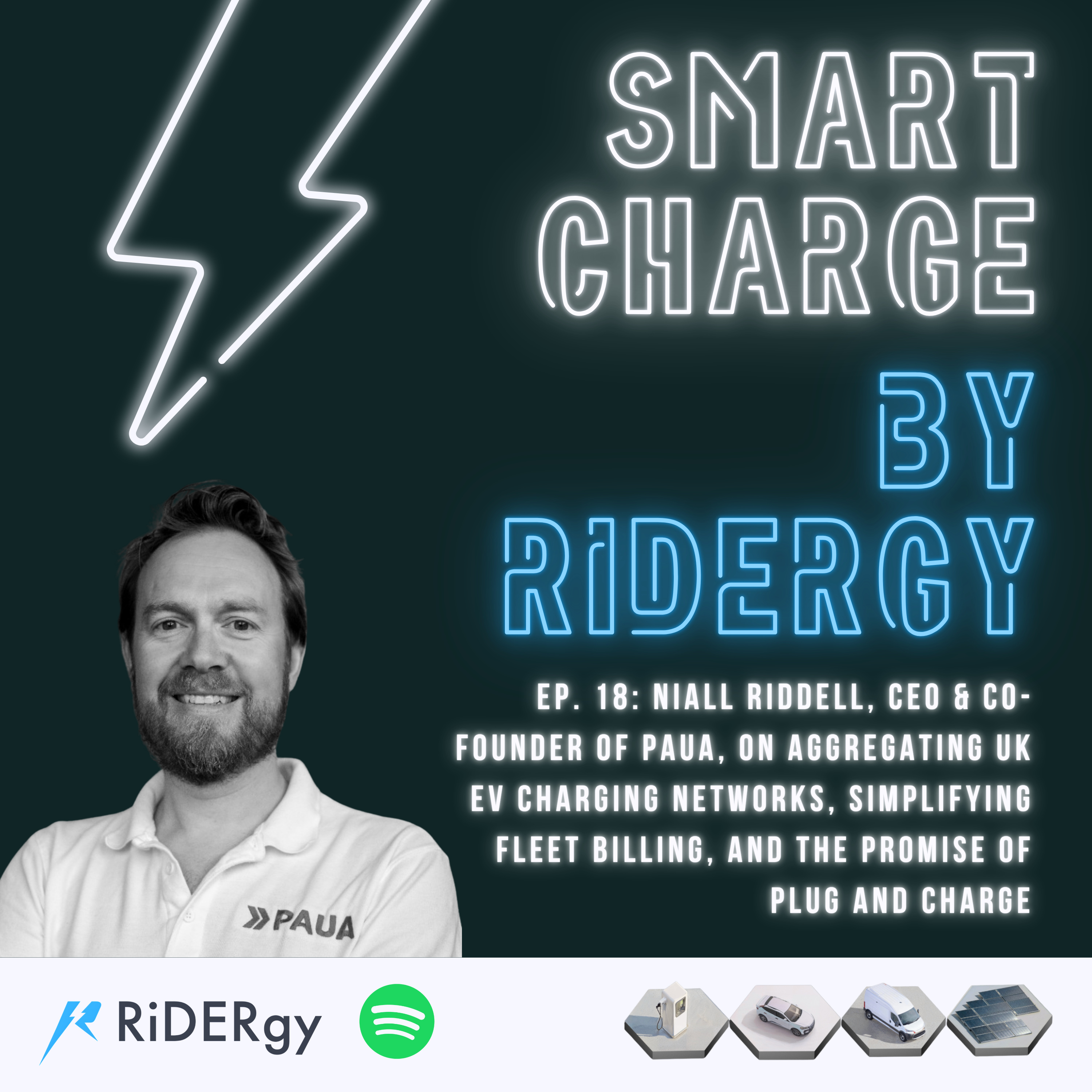
Ep. 18: Niall Riddell, CEO & Co‑Founder of Paua, on Aggregating UK EV Charging Networks, Simplifying Fleet Billing, and the Promise of Plug and Charge
文字记录
由机器转录整理而成。译文为机器翻译,可能存在错误。
欢迎来到 Smart Charge by RiDERgy 播客。我是 Claudio Geyken,RiDERgy 的创始人兼首席执行官。这是您了解电动汽车和车队能源管理及智能充电创新的节目。
大家好,欢迎收听今天的节目,我们邀请到了 Neil Riddell,伦敦初创公司 Paua 的联合创始人兼首席执行官,这家公司正在重新定义企业如何为电动车队充电。在大型能源公用事业公司工作了15年(包括法国巨头 EDF)之后,以及通过 MBA 学习让他确信要了解商业就必须创建一家企业,Neil 在2020年脱下西装创立了 Paua,是 P-A-U-A,不是 Power。自正式推出以来,Paua 已成为英国最大的电动汽车充电网络聚合商,将来自40多家充电桩运营商的超过60,000个充电接口
整合到一个单一的卡片和应用解决方案中,并在2023年 EVIES 奖项中获得年度初创企业奖。今天,我们将深入探讨为什么公共充电的成本仍然高于柴油,薪资牺牲计划和比亚迪的特斯拉同款车型如何重塑英国车队,以及即插即充技术的诱人前景,让充电像特斯拉在超级充电站一样无缝。让我们开始吧。
好的,Neil,你今天怎么样?感谢你来到播客。我很好,非常感谢你邀请我。是的,对于不了解你的听众,也许你可以简单介绍一下自己。好的,当然。大家好,我叫 Neil,来自一家名为 Paua 的公司。一些在线观看的人可能会想,这家伙为什么不会拼写?我是 Neil,拼写是 N-I-A-L-L,Paua 拼写是 P-A-U-A。
我们在英国提供电动汽车充电和支付解决方案。我的背景是在大型能源公用事业公司工作了15年,后来意识到如果我真的想有所作为,我必须自己去做。所以我们在2020年创立了 Paua,主要目的是简化企业使用电动汽车的过程。谢谢。我想你之前在 EDF 工作,那是最大的能源企业之一。你是如何
从 EDF 走到一个具体商业机会想法的?这是一个相当长且复杂的故事,但让我们来讲讲。这里有两三个部分。其中一个是我受过工程师培训。我很幸运,2009年、2010年的时候,我的前老板让我去读 MBA。他说,你会学到很多东西。我学到的其中一件事就是
商业,这并不奇怪。从 MBA 毕业后我意识到,如果我真的想理解商业,我可能必须自己建立一家公司。所以2010年我就在想,我应该成为一名企业家。这花了10年时间,但在这10年里,我坐下来研究市场和我认为建立企业需要知道的所有事情。碰巧的是,我在大公司爬升职阶梯方面并不特别擅长,
最后进入了创新团队。在 EDF 的创新领域,我们关注的其中一件事就是电动汽车。这大约是2017年、2018年。这显然是一个大趋势,引起了很多兴趣,一些有趣的车型进入市场。那时是新款雷诺 Zoe、捷豹 I-Pace 推出的时候,还有第二代日产聆风。所以有一些有趣的
主流车型出现。我想,这真的很酷,所有的挑战是什么?开始深入了解这些挑战后意识到,道路上有许多不同的充电桩运营商,使用不同的应用程序、不同的卡片,体验完全碎片化,这意味着存在机会。我想,实际上,也许现在是我离开并建立自己企业的合适时机,基本上就是
从我们所说的"鸡企业家"变成真正的企业家。"鸡企业家"的概念是什么?也许你可以详细说明一下。关于鸡企业家有两件事。首先,鸡的概念,你有点像鸡,有点胆小,太害怕让它成功。另一个是我朋友过去常讲的故事,就是火腿鸡蛋店的想法,有一只
猪和一只鸡走在路上。猪和鸡在交谈,鸡说,我觉得我们应该开一家店,我们开一家火腿鸡蛋店。猪转身对鸡说,我不认为你会完全投入。你只是参与而已。因为最终,猪必须完全牺牲自己来提供火腿鸡蛋店的火腿,而鸡只需要参与提供
鸡蛋。所以鸡企业家的概念是指没有完全参与的人,而猪则是真正完全投入。我喜欢这个故事,这些类比是最好的。所以现在你是猪,可以这么说。是什么让你的生活成为猪的生活?很好的问题。是什么让我的生活成为猪的生活?我的意思是,如果我们回到基础,在英国,道路上只有大约
3%的车辆是电动的。所以我们已经从早期采用者阶段,你知道,那些探索、创新、觉得很酷、想尝试不同东西的人,进入了早期大众的开始阶段。这中间有一个死亡谷,人们会说,这不够好,我期待它像 X 但实际上像 Y。我们生活在那个世界里。我们有很多自信的司机,并且
他们已经做了几年了,他们是一些创新者,而我们有一群司机对世界实际运作的方式并不满意。所以我们现在正在努力做的事情,这就是我们试图弥合的差距,就是过渡这个差距,即世界应该是什么样子的期望与它实际是什么样子之间的差距。我们处在一个危险的领域,我们真的必须向第一批
那些早期大众相信我们有能力处理充电桩的可靠性、充电点的体验、欺诈问题,让人们能够在家充电并在家充电时仍能得到公平的报销,让人们能够共享充电场站,简化和优化整个"充电桩在哪里"的问题,也就是查找、充电和支付的体验。基本上,如果你把它细分的话,这就是我每天在处理的挑战:如何让司机在旅途中尽可能轻松地找到充电桩、充电和支付。所以为了把这个放到背景中,这已经很好了,如果你必须排个优先级,什么是让你夜不能寐的最大问题?你每天都在应对的挑战,你日常业务的核心。有两种方式来看待这个问题,两种方式来回答这个问题。一种是
让司机在旅途中尽可能轻松地查找、充电和支付。所以为了把这个放到背景中,这已经很好了,如果你必须排个优先级,什么是让你夜不能寐的最大问题?你每天都在应对的挑战,你日常业务的核心。有两种方式来看待这个问题,两种方式来回答这个问题。一种是
作为一个经营小企业的创业者,在这个市场中运营时,到底是什么让我夜不能寐?我们真正面临的挑战是什么?作为创业者,说实话,我每天面临的最大问题是我有"闪亮物体综合症"。每件事都很令人兴奋,每件事都很酷,我应该在这件事上花一点时间,在那件事上花一点时间,所以我总是在纠结:我们应该谈论即插即充,还是应该全力关注
vehicle-to-grid(车网互动),还是我们应该更多地讨论能源灵活性?我们一直在进行这种不断变化的对话。但从行业角度来看,我认为我们真正需要密切关注的一件事是成本。最终,我们已经从那种"我这样做是因为我想要一辆特斯拉,因为特斯拉是身份象征,我愿意为驾驶特斯拉多付一些钱"的早期采用者,转向了一个商业企业基于财务考量做决策的世界。而
我们在英国还没有解决的问题是,在公共场所充电的成本实际上比一升柴油还要贵。这是我们需要克服的真正问题,无论是通过规模经济、税收改革,还是从总拥有成本的角度来看待问题。无论采用什么方法,我们都需要帮助那些现在开始进入这个市场的企业,让他们说:"是的,我能看到电动汽车
正在发生,但看起来相当昂贵。"我们如何帮助他们理解如何降低成本、管理成本,并最终给他们一个基本的商业案例?这包括驾驶电动汽车的运营影响。他们如何获得一个商业案例,让他们说:"你知道吗,我现在正确的做法是购买100辆、1000辆电动货车,这样我就可以今天用电动车替换我的车队。"所以这非常有洞察力。只是再把它放回
背景中,退后一步:Paua本质上,我认为,从市场定位来看是一个MSP。也许你可以为听众详细说明一下,我们在一些集中做过一对一访谈,比如与Hubject的Thomas Dava;我建议回去重新收听那一集。但是,也许你可以详细说明一下你们的定位,也更概括地介绍一下
公司。是的,这是一个很好的挑战,因为和任何新兴行业一样,特别是涉及技术的时候,我们喜欢我们的TLA,让我们加入大量三字母缩写词和复杂的语言来试图描述我们所做的事情。我最近在另一个播客上被批评使用了太多三字母缩写词。实际上,我们可以被视为一个MSP,即移动服务提供商,我们为移动中的人们提供
服务。我们看待市场的方式略有不同。你基本上有两大类客户群体。你有B2C客户,企业对消费者,直接面向驾驶的个人,你还有B2B客户,即企业对企业服务。在这种情况下,我们的业务是为另一家企业提供服务。我们主要从事为其他企业的电动汽车充电需求提供服务的业务。我们不做基础设施,
我们实际上只是一个软件参与者,我们将许多类型的软件整合在一起,无论是在你家中、在你的工作场所,还是在路上。这些都是碎片化的软件平台,一个软件层。你走进一个场站,你可能会发现一些Monta、一些Ampeco、一些BP,嗯,BP刚刚宣布他们要退出工作场所,所以工作场所不再有BP了,但你可能有过一些PodPoint或其他什么在你的工作场所。在家里,你可能
有一个Zappi,你可能有一个Indra充电器,你可能有一个Wallbox充电器。然后当你上路时,根据我的统计有120个公共充电点运营商,他们每个都有略微不同的品牌、略微不同的工作方式,这是一个非常碎片化的层面。我们正在做的是将与这些层面的集成整合在一起,显然在这个领域还有大量工作要做。但我们正在多个层面进行集成,以便将
所有这些千瓦时的充电数据和定价数据呈现出来。当我们能够呈现所有这些定价数据时,我们就可以告诉各方谁支付了什么,以及是否有人欠别人钱。这里真正的大挑战是,当你驾驶汽油或柴油车时,你去加油站,你支付你的汽油费。如果是你的公司车辆,你的老板为你的汽油买单。突然之间,当你在家充电时,整个流程就反过来了。你
现在用你个人的电费账单充电,所以你个人在向电力公司支付进入你公司车辆的电费。这相对容易理解:你逆转支付流程,向司机支付他们在家使用的电费。当这辆车既用于个人用途又用于商务用途时,情况就变得极其复杂了。所以想象一个中层管理人员司机。他们获得了一辆公司车作为福利,被告知要开车去英格兰北部参加一个会议,于是他们就
开车去了英格兰北部,回来后,他们付费在公共场所充电,也在家充了一点电,然后周末带孩子去海边。谁为哪部分进入谁的车辆的电费买单,以及你如何,用我的话说,分解这些钱,使得所有的家庭充电、工作场所充电和公共充电都得到适当分配,尤其是当公共充电占85%而家庭充电占10%时?这是
一个复杂的数学问题。这是一个复杂的数学问题,我们花费大量时间来自动化处理,捕获所有数据,正确分配,并确保我们能够为谁为那些商务里程向谁付款的问题设计出正确的答案。这里面有很多有趣的挑战。是的,我认为描述得非常好。是的,你绝对有一种有魅力且简单的表达方式。
你那里没有使用太多行话。我希望听众,如果有人想要的话,我很乐意使用行话。没错,是的。我认为在你正在运营的另一个播客《能源内幕指南》中,你使用了更多,那里也有更极客的一面。有时候变得有点极客是很不错的,因为这取决于谁在听。有些人会说,"这个人简化得太多了,我理解了
所有内容。"实际上,随着我们在技术上变得更加了解,我们需要经历的那个剥洋葱的过程是有层次的。我必须不断做的一件事就是保持这个故事的连贯性,即我们如何与客户沟通,如何与刚接触这个领域的人沟通。前几天我遇到了一种情况,我第一次与一个从未在电动汽车领域做过任何事情的客户打交道,我就在想,好吧,你该怎么做,
你如何把这个故事串联起来?所以是的,我经历了很多有趣的挑战。是的,同样有趣的是你做B2B业务,而且你描述的整个基础设施层特别针对B2B领域。所以我猜这也是让你自己与可能存在的更大玩家区别开来的地方,对吗?那些大型公用事业公司,一些你以前合作过的类似企业。如果你必须描述USP,你选择
你的战场,可以这么说。是的,我的意思是,围绕业务有很多对我们来说非常重要的特性。从一开始我们就始终坚信,通过将数据集和信息整合在一起,我们可以为客户提供一层在B2C领域无法提供的价值。当你与街上的个人司机谈论他们的充电体验时,他们追求的是便利性、尽可能低的成本、简单易用。这些你可以做到。但如果你的
客户只是受价格驱动,那么你所做的就是在网络上打折,这就是客户最终得到的全部主张。在我们的业务领域,我们会遇到非常复杂的问题,比如,"我正在采用电动重型卡车。我可以在哪里给它们充电?"突然你需要对所有公共充电基础设施进行分类并询问:哪些足够大可以处理重型卡车?它会去哪里?会停留多久?需要预订吗?这些人能处理预订吗?
我们如何管理付款?我们遇到过一些场景,充电桩会在某个限制处切断,因为它们只能分配大约125千瓦时。如果你需要向你的重型卡车中注入400千瓦时,突然你就得给它充三次电。所以有一些有趣的小怪癖,我们在解决越来越多业务客户的问题时开始发现。是的,非常有趣。我认为你最近在一篇帖子中也描述了
关于MSP和直接支付的未来。我认为这显示了一些复杂性,对吧,如果直接支付无法解决为重型卡车找到合适充电桩的问题,你知道的。是的,这里有一个引人入胜的问题,因为理论上,信用卡可以支付任何东西。信用卡可以支付任何东西,这给企业带来了一定的风险,因为企业可能不想给所有
司机都配备信用卡。所以你开始谈论将你的信用卡锁定到用于某些活动的特定代码,比如只支付充电费用。不幸的是,充电在某些地方被归类为停车,而在其他地方被归类为燃料。所以如果你确实将其锁定为充电,它并不是在所有地方都有效。而且信用卡无法告诉你分配了多少千瓦时,充电桩在哪里,路线可能是什么,你失去了所有这些
功能。然后你面临的问题是,好吧,那我们不用信用卡,我们用别的。那些层级看起来是什么样的?然后你必须开始拆解,好吧,你可以用手机应用启动,所以我将从我的手机向服务器发送一个数字信号,这是我们的服务器,另一个服务器到充电桩运营商的服务器,然后从那里到实际的充电桩。所以现在你需要处理大量的连接。现在这有故障
还有问题、延误和各种事情,所以那种体验可能不太好。如果你只是用一张卡,开到充电桩前刷卡就能启动呢?很好,充电桩上有直接的数字认证。但突然之间,你会想,哦,那张卡可能会被克隆,可能被复制,可能丢失。所有这些问题就开始出现了。我感到兴奋的一个方向,但我们还只是处在边缘还没完全实现的,是
ISO 15118,这是即插即充的国际标准。它也支持车网互动(V2G),但我们感兴趣的是即插即充。即插即充是充电桩上有一个令牌,车上有一个令牌,两者之间握手,驾驶员的体验就简化了很多,就像你的特斯拉充电体验一样。所以那种开车过来、插上充电枪、完成认证的体验,简化了驾驶员的体验,它在驾驶员和充电桩之间创造了一层,我在找什么词来着,安全性,并使整个生态系统的某些部分更加流畅。所以这是我们感到兴奋的事情,但还没真正看到发生。当它真的发生时,我认为会开始转化为更流畅、更无缝的体验,但我们需要很多不同的参与方共同推进才能真正实现。有道理。说到地理区域,我想你们主要是在英国,目前只专注于
英国市场。不过,我相信你对其他市场也很熟悉。你会如何将英国市场,特别是在你们所做的事情上,与其他地区进行比较?这是个非常有趣的问题,因为我经常被问到这个。我首先会说英国是落后的。我们作为一家公司存在的部分原因是,欧洲作为一个整体从早期就采用了一种协作漫游的思维方式
在其发展历程中。而且,你知道,OCPI标准来自荷兰,你很快就能看到,我们在英国试图复制的东西有着非常明显的欧洲影响。我们是个岛国,我们的行为方式像岛民,所以它必须是英国式的,然后当然我们早期有这些英国公司说,我不想和他们合作,我不想和他们合作
和他们合作,所以我们有相当多的紧张关系,我们现在仍然有这种情况,因此我会说我们在聚合所有网络方面是市场领导者之一。我们可能运营着所有充电桩接口的55%到60%左右,在快充方面可能达到80%。但我们仍然与市场上某些方面存在紧张关系,他们不相信这个,不认为这是正确的做法,因此不幸的是消费者因为一些大型企业的自负而处于不利地位
企业。因此,我认为我们可以从欧洲学到很多关于如何合作的经验。但作为一个购车国家,我们买的车相当多。我们确实在道路的错误一侧行驶,这对我们一点帮助都没有。所以这确实意味着我们有时会看到右舵与左舵的影响对车辆市场流动产生影响。所以我们确实看到那里有一点
落后的机会,但最终作为一个购车国家,我想我们排在德国和法国之后是第二或第三。德国和法国显然是这个领域的巨大市场领导者。来自比荷卢地区的一切都推动了很多这种动态,所以整个西欧都在向前推进。挪威是一个完全不同的故事。但你接着开始看,既然我们知道
西欧正在前进和采用,那么现在的异常值国家是哪些?我目前关注的几个国家是西班牙,我认为他们在转型中落后了,我认为他们会很快加速,波兰,是一个相当有趣的观察对象,因为波兰有很多购车者,它是一个规模不小的国家,有很大的覆盖范围,但我认为我们会在波兰看到一些变化和转型。然后是意大利。我认为意大利真的很
有趣。它没有很多充电桩运营商,所以当我在看一个市场时,我在寻找碎片化,要克服的挑战,将网络整合在一起。意大利没有这个,它只有2到3个大玩家。因此,我们可能更难在意大利创造一个价值主张。但这是我在接下来6到12个月里相当感兴趣和好奇的3个市场。我们也不能忘记,北爱尔兰和爱尔兰共享一个
实体边界。所以爱尔兰对我们来说是一个合乎逻辑的市场,因为它就在隔壁。它也说正确的语言,这让我们的生活更轻松。是的,有趣。再多谈谈英国的电动汽车采用情况,英国的驱动因素是什么?欧洲有车队排放配额,然后还有一些激励措施。也许你可以介绍一下有什么。我最近还看到比亚迪成为,我想是第一大
海外欧洲市场。是不是突然到处都是比亚迪?你对市场和其他驱动因素的看法是什么?是的,这是个很好的问题。我的意思是,在一开始,早期采用是由早期采用者完成的,因为它很酷。选择有限。他们从提供电动汽车的两三家制造商中挑选了一家,那些车看起来不像G-Wiz或小型代步机。很快你就在路上看到了Zoe、日产
聆风和特斯拉,紧随其后的是I-Pace。市场在很长一段时间里都是这样运行的。我们看到的是各种排放标准开始出现。所以目前真正推动转型的大标准是ZEV授权,它要求汽车制造商销售一定数量的汽车以使他们能够达到基于排放的门槛。这正在产生影响。我认为在货车领域它有点模糊。
我认为在货车领域它有点模糊。
英国政府已经设定了关于新车和货车销量中电动车比例的目标。轿车的进展还算符合预期,但货车看起来还有很多差距要追赶。因此,货车可能是更难解决的问题。我认为真正推动转型的另一个因素是英国特有的税收机制。它叫做薪资牺牲(salary sacrifice),薪资牺牲的运作方式是你放弃
一部分税前工资,你把它牺牲给雇主,作为牺牲税前工资的回报,雇主给你提供一辆电动车的使用权。这意味着你的税后工资会减少,但因为你缴纳的税更少了,税后工资的减少额度会小于你自己租赁或购买那辆车的费用。这种税收优惠可以为一辆车节省高达20%或30%的费用,这是相当可观的。因此,由于能节省这20%或
30%的费用,我们看到很多公司采用了薪资牺牲计划,这导致大量面向中层管理人员类型的车辆进入市场。如果你仔细想想,他们是早期采用者的完美群体,紧随创新者之后,他们相对更富裕一些,在大型企业雇主那里有稳定的工作。因此,他们选择奥迪e-tron、捷豹I-Pace这类车型生态系统、新款雷诺车型的想法,你正在
看到所有这些车型通过薪资牺牲市场涌现出来。正如你提到的,比亚迪在其中一些计划中也有提供。我注意到的是,比亚迪那种类似特斯拉的车型设计相当有效。你走在街上,看到一辆车迎面而来,你会想,这是特斯拉还是比亚迪?我认为品牌外观和感觉之间存在一些交叉对齐,这意味着比亚迪已经能够
在英国这里抢占相当可观的市场份额。它们价格实惠。你通过薪资牺牲计划获得它们,就更加实惠了。你买的是一辆高性能车辆,续航里程可能有250、300、400英里。实际上很多人会坐下来想,你知道吗,对于我的日常通勤,为什么不呢?所以我认为我们看到中层管理人员和薪资牺牲计划推动了相当多的采用率。但我认为目前可能落后的领域是
货车,大型车队采用大量货车。我认为这方面进展困难。然后对我来说令人兴奋的一个领域,仅仅因为其纯粹的规模,是英国政府在他们称为ZEHI项目上做了很多工作,即零排放重型货车和基础设施示范项目(Zero Emission HGV and Infrastructure demonstrator)。该项目将在道路上部署数百辆电动重型货车,我们开始看到它们到来,它们是大型设备。所以我们开始看到一些真正庞大的
车辆现在正进入市场。非常有意思。而且最近Octopus宣布了与比亚迪的合作伙伴关系,在国际上引起了相当大的关注,这个每月300英镑的套餐,你可以获得一个V2G包,使驾驶基本上变成免费。我还没有深入了解细节,但这在英国是如何被看待的?你个人的看法是什么?你在开头提到你大量处理V2G和smart charging类型的
想法。你对此有何看法,特别是英国可能是世界上这方面最好的市场?是的,让我们从V2G的起点说起。我们是一个岛国。岛国对某些事情不利,但对另一些事情真的很有利。在这种特殊情况下,我们在电网的辅助服务方面非常有利。所以我们与欧洲没有完美的连接,我们有互联线路,我们有大量的
发电,是混合的,是可变的,但它在一个岛上。所以我们的电力系统中看到相当多的变化。我们也为拥有非常高可靠性的电网而自豪,这仅仅是因为我们向人们支付可观的费用来提供频率响应、短期响应,以及最终我们的市场需要的稳定性,以有效地保持电力供应。这意味着我们向
这些市场投入了相当多的资金,这意味着从vehicle-to-grid的角度来看,能够从你的电池提供灵活性就有相当可观的收入。我们在2018-2019年期间在这方面做了大量工作。进行了众多Innovate UK试点项目,政府资助的试点项目,展示了vehicle-to-grid的各个方面。所以当Octopus发布公告时,我脑海中浮现出两件事。一是:太棒了,这就是我们说过的
五年前,而他们实际上正在做。所以很高兴看到它在应有的背景下成为现实。你知道,这部分拼图使它真的相当令人兴奋,因为现在突然之间你有了这个机会去说,实际上,这个市场正在发生。我想看到一些上路的车辆,我想得到一些真实的客户反馈,以真正相信他们所说的是
真实的。但他们是Octopus,他们有能力让事情发生,所以我对这意味着什么感到兴奋。第二件让我想到的事情是它在主流媒体上得到的关注很少。它得到了很多行业新闻报道,得到了很多社交媒体关注,我不禁认为这是非常有目的性的。回到早期采用者和创新者这个概念,你知道,创新者是那些对这类提议感到兴奋的人。所以当那个
消息发布时,我有点像,实际上,这里有一个非常有趣的机会,把这个推到创新者手中,因为创新者会抱怨,但当创新者抱怨时,他们会说,"哦,如果你能做这个、这个和那个就太好了",而不是说,"这太糟糕了,根本不起作用。"这更像是一个反馈练习。所以我确实相信它传播的
出发时是非常有目的性的,那些认识到价值所在的人,正是那些早期创新者,他们将从中获得价值。我很期待看到它是否真的能在市场上产生我认为它应有的影响。有意思。那么你如何看待Paua在V2G和智能充电方面的机会?我的意思是,正如你在
开始时提到的,现在有很多你们要应对的挑战,但我相信你们也可以尝试利用一些家庭、商业端的车队,甚至是公共充电,就像我们在阿姆斯特丹看到的,我想那里已经有一些不错的公共充电智能充电试点项目了。是的,这有利有弊,不是吗?如果你是一家快递公司,或者你是
一辆重型货车,要从国家的一端运货到另一端,充电所需的时间就是运营上的影响。所以如果你到了一个地点,因为要从A点到B点而插上充电器,你需要在那短时间内给车辆充尽可能多的电,以便重新上路,因为离开路上的时间就是你没有赚钱的时间。回到路上去干
活。所以如果是在运营时间内,我认为V2G在快速充电上没有太大机会。我也看不到任何灵活性的机会。事实上,在我停留的时候给我尽可能多的电,因为我需要去继续我的日常工作。除此之外的一切都可以考虑。所以你突然发现,那个货车司机晚上把车开回家,在街上插上充电器,他跑了70或80英里,他要
花6到7个小时从路边充电桩充电。他至少要睡8个小时,所以你还有一个小时的缓冲,而且你知道还有吃早餐和准备的时间,他不会工作18小时。所以突然间你发现,实际上,我有相当充裕的时间给这辆车充电。街边智能充电、停车场智能充电开始变得有意义。你知道吗,他在下午
4点半、5点钟回到家,插上充电器,让我们先把它放在那里一会儿,让它待着,然后,你知道吗,到10点、11点,能源需求下降,价格下降,我们就让那辆车开始充电。给它需要的电量,然后到早上6点他就充满电了。到早上8点他取车就可以出发了。这非常合理。这个时间窗口是否也足够
做一点V2G?可能吧。有趣的部分从这里开始。这不太关乎管理能源负荷的技术能力,更多的是关于商业影响。因为现在那个司机插上了充电器,也许他不需要充电,也许他只是因为被告知而插上的。谁获得商业利益?是作为资产所有者的企业获得,作为告诉司机插电的人,企业获得利益
也许是通过更便宜的充电成本?还是司机获得,个人获得利益?我认为这就是我们将看到一些非常有趣的动态出现的地方。你可以想象这样一个场景,有人说:"我会选择电动车,因为我可以把它带回家,可以插上充电,所有的钱都付给我,从他们付钱买的公司车辆上,我将获得所有晚上充电的收益。"另一方面,
企业说:"哦,我要换成电动车,我把它们给所有司机,他们会开车,而我将获得免费充电。"所以这里有一个相当有趣的问题。这有点像过去你有信用卡并获得航空里程积分的时候。你知道,是司机获得利益,还是付信用卡费的人,你知道,把航空里程积分的利益转给个人。
我们会看到同样的情况吗?会不会不同?另一个有趣的是,假设我开着货车去上班,碰巧在工作时待了一天并在工作地点给货车充电。然后我晚上开车回家并插上充电器。而不管出于什么原因,那天晚上发生了V2G事件。我把电池放电到我的家里,以减少我对电网的需求。
然后它在夜间重新充电。但我和老板也有一个协议,就是当我在家给车充电时,我会得到报销。我会得到两次钱吗?一次是放电,一次是在家报销司机?而这个资金流动,电子的价值和灵活性的价值,我认为它在B2C层面、商业层面、个人层面是行得通的。我认为当你进入企业的世界,以及资产
所有者和插电的个人之间的关系时,我认为那里有一些非常有意思的东西值得深入研究。很好的例子,很棒的案例。谢谢你,Neil。由于我们时间不多了,也许你想给听众留一个最后的信息,以及他们如何联系你。好的。大家好,我是Neil。我在paua.com,一个四个字母的URL,这在现在很少见,你可以在那里找到我。如果你想的话,我也在LinkedIn上,
你可以找到我。我想如果有一个最后的想法或愿望我可以提供的话:如果你是一位正在听这个节目的政策制定者,而你不开电动车,请在你真正开过一辆之前不要制定关于电动车的政策,因为我们真的需要理解真实体验的监管者和立法者。好的,非常感谢,Neil,祝你今天剩余时间愉快。谢谢,伙计。
这就来到了《Smart Charge by RiDERgy》又一期深度访谈的尾声。非常感谢Neil为我们揭开Paua日常工作的帷幕,在那里每一天都是与碎片化问题搏斗的大师课。今天对话中的新鲜洞察:实践中的"闪亮物体综合症",在即插即充、vehicle-to-grid和能源灵活性之间,Neil坦言最艰难的领导力挑战是知道该追逐哪个闪亮的新想法、又该把哪个留给未来的路线图。切分账单的艺术:我们
听到Paua的软件如何捕捉每一度电,无论是在家中、场站还是公共充电网络,然后通过算法将成本精确分配到每英里。这就是将来自120多家运营商的混乱数据转化为企业清晰账单的秘密武器。信用卡难题与重型货车的特殊性:谁能想到公共充电交易有时会在企业卡上被编码为停车费或燃油费?而对于重型货车,你可能需要三个独立的充电桩才能充满一块电池,这增添了Paua正在努力
解决的运营难题。英国漫游领导者地位:英国在欧洲网络聚合方面处于领先。Paua覆盖了高达60%的所有充电接口,以及近80%的快充桩。但大型现有运营商仍然抵制真正的漫游,Neil警告说,这些企业自负最终让驾驶员付出代价。展望未来,超越ISO 15118:即插即充只是开始。真正的大众市场影响将在smart charging时间窗口、动态电价和完整的V2G堆栈全部融合、以及监管机构最终扫清跑道时到来。如果你热衷于剥离
车队电动化的复杂性,请订阅《Smart Charge by RiDERgy》,给我们留下评论,并在LinkedIn上分享你自己关于漫游或V2G的问题。要了解Paua的实际运作,请访问paua.com并在LinkedIn上关注Neil。感谢收听。保持创新,保持更智能的充电,我们下次再见。
Welcome to the Smart Charge by RiDERgy podcast. This is Claudio Geyken, founder and CEO of RiDERgy. This is your show to learn about all things energy management and smart charging innovation for electric vehicles and fleets.
Hello and welcome to today's episode with Neil Riddell, co-founder and CEO of Paua, the London-based startup that's redefining how businesses can charge electric fleets. After 15 years in large energy utilities, including the French behemoth EDF, and an MBA that convinced him that to learn about business he had to create a business, Neil hung up his corporate boots in 2020 to launch Paua - that's P-A-U-A, not Power. Since its official debut, Paua has become the UK's largest EV charging network aggregator, stitching together over 60,000 connectors
from more than 40 charge point operators into a single card and app solution, earning Start-up of the Year at the EVIES 2023 awards. Today, we'll dig into why public charging still costs more than diesel, how salary sacrifice schemes and BYD's Tesla look-alikes are reshaping UK fleets, and the tantalizing promise of plug and charge to make charging as seamless as a Tesla on a supercharger. Let's get started.
Alright, Neil, how are you today? Thanks for making it to the podcast. I'm very well, thank you ever so much for inviting me along. Yes, and for the listeners who don't know you, maybe you can give a short intro about yourself. Yeah, absolutely. So hello, my name is Neil. I'm from a company called Paua. Some of you who are watching online will be going, why can't this guy spell? I'm Neil spelled N-I-A-L-L and Paua spelled P-A-U-A.
We provide an electric vehicle charging and payment solution here in the UK. My background is I spent 15 years in large energy utilities, realized that if I really wanted to make a difference, I was going to have to go and do it myself. So we set up Paua back in 2020, very much with the view of simplifying the journey for businesses with electric vehicles. Thanks for that. And so you were at EDF, I think one of the largest energy corporates before. How did you get
from EDF to the concrete idea of a business opportunity? This is quite a long, complicated story, but let's do it. There are two or three pieces in here. One of the pieces is I'm an engineer by training. I was very fortunate - I got sent to do an MBA back in 2009, 2010 by a former boss of mine. He said, you're going to learn loads of stuff. And one of the things I learned about
was business, surprisingly. And I came away from my MBA realizing that if I really wanted to understand business, I was probably going to have to build one myself. So there I was in 2010 going, I should probably be an entrepreneur. It took 10 years, but over those 10 years I sat and looked at marketplaces and all the things I thought I needed to know to build a business. And as it happened, I wasn't particularly good at climbing up the greasy pole
of a large corporate, and ended up inside the innovation team. One of the things we were looking at at EDF inside that innovation area was electric vehicles. This was sort of 2017, 2018. Clearly a big trend, clearly a lot of interest - some interesting models coming to market. It was the time of the new Renault Zoe, the Jaguar I-Pace got launched around about then, the second generation Nissan Leaf. So there were some interesting,
mainstream vehicles coming along. I was like, this is really cool - what are all the challenges? Started to open up those challenges and realized that this ecosystem of many, many different charge point operators out on the road, with different apps, different cards, and an entirely fragmented experience, meant there was an opportunity there. And I was like, actually, you know what, maybe the time is about right for me to step away and go and build my own business, and basically go
from being what we described as a chicken entrepreneur to an entrepreneur. What's the concept of a chicken entrepreneur? Maybe you can elaborate on that one. So there are two things about the chicken entrepreneur. Firstly, there's the concept of a chicken - you're a bit of a chicken, a bit of a coward, you're too scared to make it work. The other one is a story that a friend of mine used to tell, which is the idea of a ham and egg shop, and you've got
a pig and a chicken walking down the road. The pig and the chicken are having a conversation, and the chicken goes, I think we should open a business - we'll make a ham and egg shop. And the pig turns back to the chicken and goes, I don't think you'll be fully involved. You'll only be participating. Because ultimately, the pig has to fully sacrifice himself to provide the ham for the ham and egg shop, whereas the chicken only has to participate in providing
the eggs. So the idea of a chicken entrepreneur is someone who's not fully participating, whereas the pig is really getting fully involved. Love the story - the analogies are the best. And so now you are the pig, so to say. What makes your life a pig? Very good. What makes my life a pig? I mean, if we go back to the basics, here in the UK we're still only about
3% of all vehicles on the road being electric. So we've kind of broken out of that early adopter phase - you know, people who are exploring, innovating, it's cool, I want to try something different - into the beginning of the early majority. And there's a valley of death in there, where people go, it's not good enough, I expected it to be like X and it's actually like Y. We are living in that world. We've got a lot of drivers who are confident, and
They've been doing it a few years now, they were some of the innovators, and we've got a bunch of drivers who just aren't impressed by the way the world actually works. So what we're trying to do right at this moment - and that's the gap we're trying to bridge - is transition that gap between the expectation of what the world should be like and what it's actually like. We've got this dangerous territory where we've really got to prove ourselves to the first of
that early majority that we are capable of handling reliability of chargers, the experience at the charge point, fraud, enabling people to charge at home and still be fairly reimbursed when they charge at home, enabling people to share depots, simplifying and streamlining the whole "where is the charger" - the find, charge and pay experience. And that is basically, if you break it down, that is the challenge I'm dealing with every day: how to make it appear and make it
as easy as possible for the drivers to find, charge and pay on their journey. So to set this into context - it was great already - if you had to prioritise, what are the biggest things that don't let you sleep at night? Challenges that you're addressing every day, the core of your daily business. There are two ways I'd look at that, two ways to answer this question. One is
as an entrepreneur running a small business, what is it that keeps me awake at night operating in this marketplace, and what are the challenges that we really face? As an entrepreneur, honestly, the biggest issue I face day to day is I have shiny object syndrome. Everything is exciting, everything's cool, I should give a little bit of time to this, a little bit of time to that - so I'm constantly being drawn between: should we talk about plug-in charge, or should it all be about
vehicle-to-grid, or should we be doing more energy flexibility? We're having that whole constant dynamic of conversation. But from an industry perspective, I think the one thing that we've got to really keep an eye on is cost. Ultimately we've moved away from the adopter who has gone, "I'm doing this because I want a Tesla, because a Tesla's a status symbol, I'm happy to pay a bit more to drive a Tesla," into a world where commercial businesses are making financially based decisions. And
the bit that we just haven't solved here in the UK is it simply costs more to charge in public than it does for a litre of diesel. And that's where we've got a real problem we need to overcome - be it through economies of scale, changes to taxation, looking at things on a total cost of ownership basis. Whatever the method is, we need to help those businesses who are now starting to approach this marketplace and say, "Yeah, I can see electric vehicles
is happening, but it looks quite expensive." How do we help them understand how they can reduce their costs, manage their costs, and ultimately give them a basic business case? And that includes the operational impacts of driving EVs. How do they get a business case that says, "You know what, the right thing for me to do right now is buy 100, 1,000 electric vans so that I can replace my fleet with electric today." So that's very insightful. Just to put it
again in context, one step back: Paua in essence, I think, is an MSP, in terms of positioning in the market. Maybe you can elaborate a little bit for the listeners - we have done some one-on-ones in some episodes, with Thomas Dava from Hubject for example; I can recommend going back to relisten to that episode. But yeah, maybe you can elaborate on your positioning and also give a
bit of an introduction to the company more generically. Yeah, that's a really good challenge because, as with any new industry, particularly where technology is involved, we love our TLAs - let's get loads of three-letter acronyms in and complex language to try and describe what it is we do. I was on another podcast recently and got told off for using too many three-letter acronyms. In effect, we could be regarded as an MSP, a Mobility Service Provider - we provide
services to people on the go. The way we've looked at the market is slightly different. You've effectively got two broad groups of customers. You've got B2C customers - business to consumer, direct to an individual who's driving - and you've got B2B customers, so a business-to-business service. In that case, our business provides a service to another business. We're in the business predominantly of servicing other businesses' electric vehicle charging needs. We don't do infrastructure -
we're literally just a software player, and we aggregate many types of software together, be that in your home, in your workplace, or out on the road. Each of these is a fragmented software platform, a software layer. You go into a depot, you might find some Monta, some Ampeco, some BP - well, BP has just announced they're leaving workplace, so no BP in the workplace anymore - but you might have had some PodPoint or something else in your workplace. At home, you might
have a Zappi, you might have an Indra charger, you might have a Wallbox charger. And then when you get out on the road, by my count there are 120 public charge point operators, each of them with a slightly different brand, slightly different way of working - and that is a very fragmented layer. What we're doing is bringing integrations with each of these layers together, and clearly there's plenty of work to be done in that area. But we're integrating at multiple levels to bring
All that kilowatt hours of charging data and pricing data to the surface. When we can surface all of that pricing data, we can then tell the various parties who paid for what and whether someone else owes someone else money. The really big challenge in here is when you drove a petrol or diesel vehicle, you went to the petrol station, you paid for your petrol. If it was your company vehicle, your boss paid for your petrol. Suddenly, when you charge at home, that whole flow reverses. You're
now charging with your personal electricity bill, so you are personally paying the electricity company for the electricity that goes into your company vehicle. That's relatively easy to understand: you reverse the payment flow and you pay the driver for what they used at home. It becomes horribly complicated when that vehicle is used for both personal and business use. So imagine a middle management driver. They've been given a company car as a perk, they're told to drive to a conference in the north of England, so off
they drive to the north of England, they come back, they pay to charge in public, they charged it a bit at home, and then they go and take the kids to the seaside at the weekend. Who pays for what bit of electricity that went into whose vehicle, and how do you - in my language - slice and dice that money so that all of the home charging, workplace charging, and public charging is suitably allocated, particularly when public charging's at 85% and home charging's at 10%? That is
a complex piece of maths. It's a complex piece of maths that we're spending a lot of time automating, capturing all the data, allocating it correctly, and ensuring that we can then devise the right answer to the question of who pays whom for those business miles that were driven. And that in there is where there's a lot of fun and games. Yeah, very well described, I think. Yeah, you definitely have a charismatic and simple way of putting things.
You didn't use too much jargon there. I hope the listeners - I'm happy to use jargon if anyone wants it. Exactly, yeah. I think in the Insider's Guide to Energy, your other podcast that you're running, there you use a bit more - there's a more geeky side as well. It's quite nice to sometimes go a bit geeky because it depends on who's listening. Some people are like, "this guy simplified it so much, I understood
all of that." It's like, actually there are layers to that onion-peeling exercise we need to go through as we become more technically aware. One of the things I'm having to do constantly is keep this story running of how we communicate with customers, communicate with people who are new to this space. I had a situation the other day where for the first time I was engaging with a customer who'd never done anything in EV, and I was like, well, how do you do that,
how do you bring that story together? So yeah, I had lots of fun and games. Yeah, and it's already interesting as well that you do B2B, and that the whole infrastructure layer that you described is especially for the B2B space. So that's also, I guess, differentiating yourself from the larger players that might be out there, right? The large utilities, some of the likes you worked with before. If you have to describe the USP as well - that you choose
your battles, so to say. Yeah, I mean, there are a lot of features around business that are really important for us. We've always fundamentally believed since the beginning that by bringing data sets and information together, we can provide a layer of value to the customer that you can't in the B2C arena. When you speak to an individual driver on the street about their charging experience, they're after things like convenience, lowest cost possible, make it easy. Which you can do. But if your
customer is just price-driven, then all you're doing is discounts on networks - that's the entire proposition that the customer ends up with. In our business arena, we get really complicated questions like, "I'm adopting electric HGVs. Where can I charge them?" And suddenly you need to go and classify all of the public charging infrastructure and ask: which ones are big enough to handle an HGV? Where will it go? How long will it be there? Does it need to book? Can these guys handle booking?
How do we manage payment? We've had some scenarios where charge points will cut off at a certain limit because they will only dispense about 125 kWh. And if you need to put 400 kWh into your HGV, suddenly you've got to charge it three times. So there are funny little quirks that we're starting to discover as we solve more and more of our business customers' problems. Yeah, very interesting. I think you also described in one post recently as well where
it was all about the future of MSPs and direct payments. I think that shows a bit of the complexity, right - that if direct pay doesn't solve the issue of finding the right chargers for an HGV, you know. Yeah, there's a fascinating question here because, in theory, a credit card can pay for anything. And a credit card can pay for anything, and that introduces an element of risk for a business because a business might not want to give all
its drivers a credit card. So then you start talking about locking your credit card down to certain codes that are used for certain activities, like only pay for charging. Unfortunately, charging has been classified as parking in some places and in other places has been classified as fuel. So if you do lock it down to charging, it doesn't work everywhere. And the credit card can't tell you how many kWh are dispensed, where the charger is, what the route might be - you lose all that.
functionality. The question you then have is, OK, so let's not do credit cards, let's do something else. What do those layers look like? And then you have to start to unpick, well, you could do a mobile app start, so I'm going to send a digital signal here from my phone to a server, which is our server, another server to the charge point operator's server, and from there to the actual charge point. So now you've got lots of connectivity you need to handle. Now that has faults
and problems and delays and things, so that experience might not be great. What if you just did a card and you pulled up and you touched your card and it started? Great, there's direct digital authentication at the charger. But all of a sudden, you go, oh, well, that card could be cloned, it could be copied, it could be lost. And all those questions start to emerge. I think the one I'm excited about, but we're just on the cusp of but not quite there, is
ISO 15118, which is the international standard for plug and charge. It also does vehicle to grid, but plug and charge is what we're interested in. Plug and charge is a token on the charger, a token on the car, a handshake between the two, and the driver experience is much, much simplified, much like your Tesla charging experience. So that experience of pulling up, plugging in, authenticating, simplifies that driver experience, it creates a layer of - what's the word I'm looking
for - security between the driver and the charge point, and enables some of that ecosystem to be a bit slicker. So that's something we're excited about, haven't quite seen happening yet. When it does happen, I think it will start to translate into smoother, more seamless experiences, but we need a lot of different parties to move forward to make that really work. Makes sense. In talking geographies, I think you are very much based in the UK and focused at the moment only on the
UK market. And nevertheless, I'm sure you're familiar with other markets. How would you compare the UK market on what you're doing in particular with other geographies? It's a really interesting question because I get asked this a lot. I would start by arguing that the UK was behind. Part of the reason that we exist as a business is because Europe as a whole adopted a sort of collaborative roaming mindset from early on in its
journey. And, you know, the OCPI standard coming out of the Netherlands - you can quite quickly see that there's very much a European influence to what it is that we're trying to replicate here in the UK. We're an island, we behave like islanders, so it had to be British, and then of course we had these British companies early on going, I don't want to work with them, I don't want to work
with them, so we had quite a lot of tension and we still have that, whereby I would argue that we're one of the market leaders in terms of aggregating all the networks together. We're probably running about 55 to 60% of all the charge point connectors, maybe 80% in rapids. But we've still got tension with certain parties in the market who don't believe in this, don't think it's the right thing to do, and therefore the consumer unfortunately is disadvantaged by the egos of some large
corporations. As a consequence, I think there's a lot we can learn from Europe about the way that we work together. But as a country that buys cars, we buy quite a lot of cars. We do drive on the wrong side of the road, which doesn't help us at all. So it does mean that we sometimes see that impact of right-hand drive versus left-hand drive impacting the market flows of vehicles. So we do see there's a bit
of a laggard opportunity in there, but ultimately as a car-buying country we're 2nd or 3rd I think behind Germany and France. Germany and France are obviously huge market leaders in this space. Everything coming out of the Benelux region has driven a lot of this dynamic, so Western Europe as a whole is pushing forward. Norway is a whole other story in its own right. But you then start to look at what are the outlier countries now that we know that
Western Europe is moving and adopting. What are the outliers? A couple of countries I've got an eye on at the moment are Spain - I think they're behind in the transition and I think they're going to accelerate quite quickly - Poland, quite an interesting one to watch because Poland's got a lot of car buyers, it's a decent sized country, it's got large ranges to cover, but I think we're going to see some changes and transition in Poland. And then Italy. I think Italy's really
fun. It doesn't have a lot of charge point operators, so when I'm looking at a marketplace, I'm looking for fragmentation, a challenge to overcome, to bring networks together. Italy doesn't have that, it's got 2 or 3 big players. So as a consequence it might be harder for us to create a value proposition in Italy. But they're 3 markets which I'm quite interested and intrigued by over the next 6 to 12 months. And we mustn't forget that ultimately Northern Ireland and Ireland share a
physical border. So Ireland is a logical market for us to look at because it is right next door. It speaks the right language as well, which makes our lives easier. Yeah, interesting. And talking more about EV adoption in the UK, what have been the drivers in the UK? There's the fleet emission quotas in Europe and then some incentives. Maybe you can get through what's there. And I also recently saw BYD being, I think, the number
One overseas European market. Is there like suddenly BYDs everywhere? How is your perception of the market and the other drivers? Yeah, that's a cool question. So I mean, back in the beginning, the early adoption was done by the early adopters because it was cool. The choice was limited. They picked one of the two or three manufacturers that provided an electric car that didn't look like a G-Wiz or a little mobility machine. And quite quickly you had Zoes, the Nissan
Leaf, and the Teslas on the road, quickly followed by the I-Pace. And for a long time the market ran like that. What we've seen is various emission standards starting to appear. So currently the really big ones that are driving the transition are the ZEV mandate, which requires the automotive manufacturers to sell a certain amount of cars to enable them to hit emissions-based thresholds. And that is having an impact. I think it's a little bit vague in the van space.
The UK government has set some objectives about the percentage of new sales in cars and vans. Cars is tracking OK towards where it should be, but it looks like vans has got a lot of catching up to do. So as a consequence, vans might be the tricky one to solve. I think the other piece that's really driving the transition is a UK-specific tax mechanism. It's something called salary sacrifice, and the way that salary sacrifice works is you give up
some of your gross salary - you sacrifice it to your employer - and in return for sacrificing your gross salary, the employer gives you access to an electric car. What it means is your net salary goes down, but because you're not paying as much tax, the net salary reduction is less than if you had leased or acquired that car yourself. That tax efficiency can save up to 20 or 30% on a car, which is a good amount. So as a consequence of saving that 20 or
30%, we've seen a lot of companies adopt salary sacrifice schemes, which has led to a lot of sort of middle-management-type cars going into the marketplace. And if you think about it, they're a perfect group for that early adopter - just after innovators, they're a little bit wealthier, they've got a stable job with a large corporate employer. And therefore the idea of them taking on Audi e-trons, the Jaguar I-Pace type ecosystem, the new Renaults - you're
starting to see all of these things flowing through that salary sacrifice market. And as you mentioned, BYD is available on some of these schemes. I think what I'm noticing is the BYD Tesla lookalike model thing is quite at work. You walk down the street, you see a car coming towards you and you go, is it a Tesla or is it a BYD? I think there's been some cross-alignment between the brand look and feel that means that BYD has been able to
steal a decent market share here in the UK. They're affordable. You put them through a salary sacrifice scheme, they're even more affordable. You're buying a high-performance vehicle with 250, 300, 400 miles potentially of range. And actually a lot of people will sit and go, you know what, for my daily commute, why not? So I think we're seeing middle management and salary sacrifice schemes drive quite a lot of uptake. But I think the space that's probably lagging at the moment is
vans - big fleets adopting large numbers of vans. I think that's struggling. And then the exciting one for me, just because of pure scale, is the UK government's doing a lot of work on what they call the ZEHI programme, which is the Zero Emission HGV and Infrastructure demonstrator. So that will place several hundred electric heavy goods vehicles on the road, and we're starting to see them arriving - and they are big beasts. So we're starting to see some of those really big
vehicles hit the market right now. Well, very interesting. And also recently Octopus announced a partnership with BYD that made quite some news internationally - this £300 monthly fee where you get a V2G package which makes driving essentially free. I haven't looked into the details, but how was that perceived in the UK? What's your personal perception? You mentioned in the beginning that you're dealing a lot with V2G and smart charging type of
ideas. What's your take on that one, and especially the UK being maybe the best market in the world for those? Yeah, let's start from the beginning on V2G. We're an island. Islands are bad for some things but really good for others. In this particular case we're really good for ancillary services for our electricity network. So we don't have a perfect connection to Europe - we have interconnectors, we've got lots
of generation, it's mixed, it's variable, but it's on an island. So we see quite a lot of variability in our electricity system. We also pride ourselves on having very high reliability on that electricity network, and that is only a function of the fact that we pay decent money to people to provide frequency response, short-term response, and ultimately the stability that our market needs to keep the lights on effectively. It means that we pay quite a lot of money into
these markets, which means that from a vehicle-to-grid perspective, there's a decent chunk of revenue associated with being able to provide flexibility from your battery. We did a lot of work on this through the 2018–2019 period. Numerous Innovate UK trials have taken place - government-funded trials demonstrating elements of vehicle-to-grid. So when Octopus made their announcement, there were two things that went through my mind. One was: brilliant, that's what we said we'd
Five years ago, and they're actually doing it. So it's great to see it coming to life in the context of what it should be able to do. You know, that piece of the puzzle makes it really quite exciting, because now all of a sudden you've got this opportunity to go, well, actually, this marketplace is happening. I'd like to see some on the road, I'd like to get some real customer feedback to really believe that what they're stating is
true. But they're Octopus, they're capable of making stuff happen, so I'm excited by what that will mean. The second thing that went through my head was it got very little mainstream media. It got a lot of industry news, it got a lot of social media, and I couldn't help thinking that was very purposeful. Going back to this idea of the early adopter and the innovator, you know, the innovators are the ones who are excited by that kind of proposition. So when that
happened, I was kind of like, actually, there's a really interesting opportunity in here to push this into the hands of the innovators, because the innovators will complain, but when an innovator complains they go, "Oh, it'd be great if you could do this and this and that," rather than going, "It's terrible, it doesn't work." It would be much more of a feedback exercise. So I do believe that the channels that it was communicated
out to were very purposeful - that the people who recognise what the value looks like are the people who are the early innovators and will get value from it. And I'm excited to see whether it will really have the impact in the market that I think it deserves. Interesting. And how do you see the opportunity for you, as Paua, for V2G and smart charging? I mean, as you hinted at in
the beginning, there are plenty of challenges nowadays that you tackle, but I'm sure you can also try to leverage some of these fleets at home, on the business side, or even in public - as we're seeing in Amsterdam, I think, which has some nice pilots in public charging already for smart charging. Yeah, it's got swings and roundabouts, hasn't it? If you are a parcel delivery company, or you're an
HGV taking freight from one end of the country to the other, the time it takes to charge is an operational impact. So if you get to a location and you plug in to charge because you're going from A to B, you need to get as much juice in that vehicle as you possibly can in that short period of time to get back on the road, because the time away from the road is time you're not earning money. Get back on the road and do the
job. So if it's sat inside operational hours, I don't see a huge opportunity for V2G on rapid charging. I don't see any opportunity for flex either. In fact, give me as much as you can while I'm here because I need to go and get on with my day job. Everything outside of that is fair game. So you suddenly go, that van driver takes his van home at night and he plugs in on the street and he did 70 or 80 miles and he's going to
pull that in 6 or 7 hours from the on-street charger. He's going to go and sleep for at least 8 of those hours, so you've got an hour, and you know it's a bit of breakfast and time - he's not going to work an 18-hour day. So suddenly you go, actually, I've got a decent chunk of time to charge this vehicle. Smart charging on street, smart charging in car parks starts to make sense. You know what, he got back
home at 4:30, 5 o'clock, plugged in - let's just sit it there for a bit, let it run, and then, you know what, 10, 11 o'clock, energy demand is dropping, price is dropping, let's push that vehicle onto charge. Give it what it needs, and then by 6 o'clock in the morning he's fully charged. By 8 o'clock in the morning he picks the vehicle up and off he goes. That is very logical. Does it also give enough time in
that window to do a bit of V2G? Possibly. Here's where the fun bit begins. It's less around the technical capability to manage the energy load and more around the commercial implications. Because now that driver has plugged in - and maybe he didn't need to charge, maybe he just plugged in because he was told to. Who gets the commercial benefit? Does it go to the business as the asset owner, as the person who told the driver to plug in, and the business gets the benefit
maybe through cheaper cost of charging? Or does it go to the driver, and the individual gets the benefit? And I think that is where we're going to see some really interesting dynamics emerging. You can see a scenario where someone goes, "I'll take an EV because I can take it home, I can plug it in, and I'll get all the money paid to me - from my business vehicle that they paid for, I'll get all the money from charging it at night." The other side, where
the business goes, "Ooh, I'm going to switch to EVs, I give them to all my drivers, they're going to drive and I'm going to get free charging." So there's quite an interesting question in here. It's a bit like the old days when you had a credit card and you got airline points. You know, did the driver get the benefit, or the person paying for the credit card - you know, transfer the benefit of the airline points to the individual.
Are we going to see the same thing? Is it going to be different or not? The other fun one is, let's say I go to work in my van, I happen to spend a day at work and recharge my van at work. I then drive home at night and plug it in. And for whatever reason, a V2G event takes place that night. I discharge my battery into my home to reduce my demand on the grid.
And then it recharges overnight. But I also have a relationship with my boss, which says that when I charge my vehicle at home, I get paid. Do I get paid twice? Once for discharging it and once for reimbursing the driver at home? And that monetary flow, that value of the electron and that value of flexibility - I think it works at a B2C level, a commercial, an individual level. I think when you enter the world of businesses and the relationship between the asset
owner and the individual plugging it in, that's where I think some really spicy stuff to get stuck into. Great anecdotes, great examples. Thanks for that, Neil. As we're running out of time, maybe a last message you would like to give the listeners, and how they can reach you. Yeah. Hello everyone, my name's Neil. I'm at paua.com - a four-letter URL, which is quite rare these days - and you can find me over there. I'm on LinkedIn if you want
to hunt me down. And I guess if there was one final thought or wish that I could offer: if you're a policymaker listening to this and you don't drive an electric vehicle, please don't write policy on electric vehicles until you actually drive one, because we really need regulators and legislators who understand the real experience. All right, thanks a lot, Neil, and have a good rest of the day. Cheers, man.
And that brings us to the end of another deep dive on Smart Charge by RiDERgy. A big thank you to Neil for pulling back the curtain on life at Paua, where every day is a masterclass in wrestling fragmentation into submission. Fresh insights from today's chat: shiny object syndrome in practice - between plug-in charging, vehicle-to-grid, and energy flex, Neil admits the toughest leadership challenge is knowing which shiny new idea to chase and which to table for tomorrow's road map. The art of slice-and-dice billing: we
heard how Paua's software captures every kWh, whether at home, in the depot, or on the public network, and then algorithmically allocates costs down to the mile. That's the secret sauce that turns messy data from 120+ operators into neat invoices for businesses. Credit card conundrums and HGV quirks: who knew that public charging transactions are sometimes coded as parking or fuel on a corporate card? And for heavy goods vehicles, you may need three separate chargers to fill a battery, adding operational headaches that Paua is busy
smoothing out. UK roaming leader status: the UK leads Europe in network aggregation. Paua covers up to 60% of all connectors and nearly 80% of rapids. But large incumbents still resist true roaming - those corporate egos, Neil warns, leave drivers paying the price. On the horizon, beyond ISO 15118: plug and charge is just the beginning. True mass-market impact will come when smart charging windows, dynamic tariffs, and full V2G stacks all converge, and when regulators finally clear the runway. If you're passionate about stripping complexity from
fleet electrification, subscribe to Smart Charge by RiDERgy, leave us a review, and share your own roaming or V2G questions on LinkedIn. To see Paua in action, head to paua.com and follow Neil on LinkedIn. Thanks for listening. Keep innovating, keep charging smarter, and we'll catch you next time.
节目笔记
Ever wondered how a single card and app can connect you to over 60,000 charge points from more than 40 operators and turn messy kWh data into neat, mile-level invoices? In this episode we sit down with Niall Riddell, CEO and Co-Founder of Paua, to hear how he left a 15-year career at EDF to launch the UK’s largest EV charging network aggregator in 2020, why public charging still costs more than diesel, and how Paua’s slice and dice billing captures every kilowatt hour at home, depot and on the public network. We also cover - The credit-card quirks and HGV charging challenges Paua has smoothed out for fleets - The impact of salary-sacrifice schemes and the rise of BYD’s Tesla-style EVs - The promise of plug and charge under ISO 15118 and the future of vehicle-to-grid pilots Join us for a detailed look at the solutions shaping smarter, more seamless fleet electrification in the UK.