

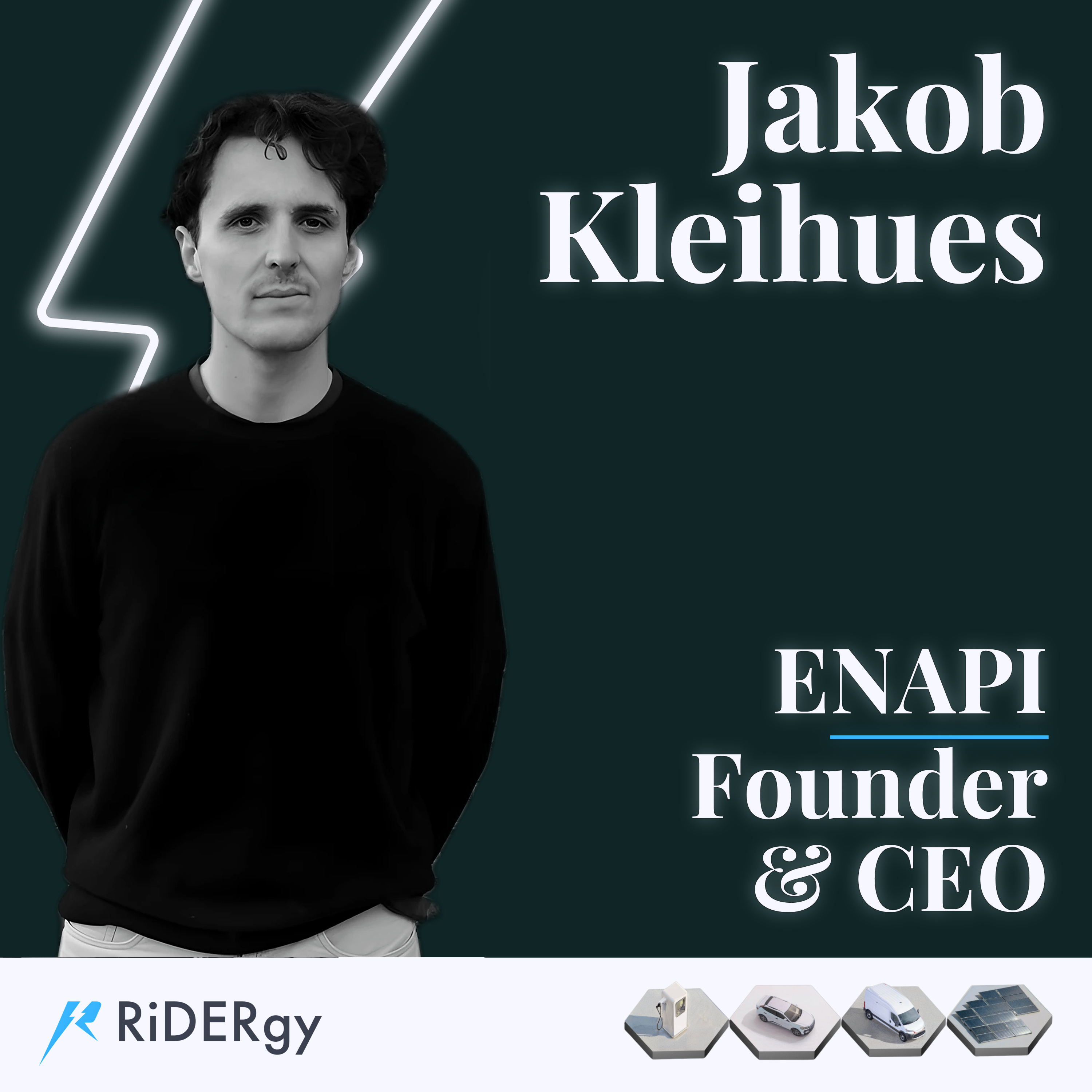
Jakob Kleihues, co‑founder of ENAPI
EV roaming, OCPI, financial clearing, uptime and AI native engineering
Transkript
Aus einem maschinellen Transkript bereinigt. Übersetzungen sind maschinell erstellt und können Fehler enthalten.
Willkommen beim Smart Charge by RiDERgy Podcast. Hier ist Claudio Geyken, Gründer und CEO von RiDERgy. Dies ist Ihre Show, um alles über Energiemanagement und Smart Charging Innovation für Elektrofahrzeuge und Fuhrparks zu erfahren. Verbinden Sie sich mit 450 Partnern und Sie bauen 450 Handshakes auf, oder Sie bauen einen auf. Das ist die Idee hinter Inopi, und mein Gast heute ist dessen Mitgründer, Jacob Clayhus. In 2,5 Jahren hat sein Unternehmen mehr als 1 Million Ladepunkte verbunden, und das mit einer Behauptung, die fast provokant klingt.
Die Konnektivität zwischen Ladepunktbetreibern und Mobilitätsdienstleistern sollte kostenlos sein. Das Geld, sagt er, wird woanders verdient. Wir sprechen darüber, wo, worüber Financial Clearing wirklich handelt, und darüber, wie ein sehr kleines Team seine Infrastruktur zu 99,998% der Zeit am Laufen hält. Lassen Sie uns einsteigen. Also, Jacob, schön, dass Sie heute hier sind. Wie geht es Ihnen? Ja, vielen Dank für die Einladung. Ja, ich bin ein bisschen gestresst, wie Sie wissen, ich war spät dran. Kein Problem, kam direkt vom Flughafen, aber ansonsten geht es mir gut. Vielen Dank.
Sie sind heute aus den Niederlanden angereist, also ich glaube, ich hatte noch keinen Gast, der am selben Tag so weit gekommen ist. Ja, genau, besonders weil ich wie Sie in Berlin zu Hause bin, also ist es seltsam. Aber jedenfalls, sehr gut und vielen Dank für die Einladung. Ja, und toll auch zu wissen, dass Sie ein echter Berliner sind, hier geboren, geboren und aufgewachsen, und Ihre Eltern auch. Das ist etwas, das ich nicht wusste, da ich auch hier in Berlin aufgewachsen bin. Ja, ich bin in Berlin aufgewachsen.
Ich habe ziemlich viele Jahre in anderen Städten überall in Europa gelebt – habe im Süden Deutschlands und in Kopenhagen studiert, dann kurz in London und in Amsterdam gearbeitet. Also ich kenne auch einige andere Orte, aber ich bin schon seit ziemlich vielen Jahren wieder in Berlin und baue Inopi auch von Berlin aus auf. Ja, und vielleicht können Sie ein bisschen mehr über Ihren Hintergrund erzählen. Ich habe auch beschlossen, von Berlin in den Süden Deutschlands zu gehen, lustigerweise, zum Studieren, aber ich denke, viele Berliner bleiben auch gern in Berlin.
Was war Ihre Motivation, in den Süden zu gehen und zu studieren? Ich meine, das ist ja eine Rückkehr zu meinem 18. Lebensjahr, richtig? Ich frage mich, ob ich mich überhaupt daran erinnern kann, warum das so war. Um ehrlich zu sein, denke ich, es war ein sehr natürliches „Lass uns so weit weg wie möglich gehen" – und vielleicht war mein Horizont damals ein bisschen auf Deutschland fokussiert, um ehrlich zu sein. Aber ja, also ich habe an der Zeppelin Universität in Friedrichshafen studiert, am Bodensee genau, und
ich hatte eine tolle Zeit dort. Um ehrlich zu sein, frage ich mich manchmal, wie viel ich eigentlich von dem, was ich an der Universität oder in der Schule generell gelernt habe, in meinem normalen Leben anwende, und es ist nahe bei null, aber ich habe definitiv meine engsten Freunde noch aus dieser Zeit, also ich würde es auf jeden Fall wieder tun. Was haben Sie studiert?
Es ist wie ein allgemeines Studienprogramm zwischen Soziologie, Politik, Kultur und Wirtschaft für das erste Jahr, und dann spezialisiert man sich – und ich habe mich auf Unternehmensführung und Wirtschaft fokussiert. Das war im Wesentlichen mein Studium am Bodensee, und dann bin ich für einen ziemlich Standard Master in Betriebswirtschaft an die Copenhagen Business School für meinen Master gegangen.
Und natürlich dazwischen viele Praktika bei verschiedenen Startups und verschiedenen Unternehmen. Ich habe nie – und wir haben kurz darüber gesprochen, bevor wir hier mit der Aufnahme angefangen haben – für ein großes Unternehmen gearbeitet, also im Wesentlichen habe ich keine Erfahrung mit Konzernen und wie es ist, für Konzerne zu arbeiten, und deshalb lerne ich, denke ich, fortlaufend viel darüber, wie diese Organisationen funktionieren. Aber generell, ja, das ist im Wesentlichen, was ich studiert habe. Und was haben Sie in Ihren früheren Jobs gemacht?
Wie gesagt, ich habe viele Praktika in verschiedenen Unternehmen gemacht. Es gab ein Unternehmen, das vielleicht für diesen Podcast auch interessant war – da war Climate-KIC. Ich habe ein Praktikum bei Climate-KIC gemacht.
Das war auf dem EUREF-Campus, wo mittlerweile offensichtlich viele bekannte europäische und deutsche Unternehmen ihren Hauptsitz haben, aber ja, damals hatten sie dort eine Green Garage und sie haben im Wesentlichen einige Startups dort integriert, was sehr spannend war, und ich war
einfach Teil des Teams dort und habe versucht, Gründern zu helfen, Dinge erledigt zu bekommen, im Wesentlichen. Das war vielleicht ein interessanter erster Schritt, aber ich denke, der erste Schritt, der wirklich relevant für meine zukünftige Karriere war, war bei Project A Ventures, wo ich 2018 ein Praktikum gemacht habe. Es war sehr intensiv, und was ich daran geliebt habe, ist,
Sie sprechen mit Leuten, die begeistert sind von dem, was sie jeden Tag tun, weil Sie mit Gründern sprechen, und ich denke, das war es, was ich in vielen anderen Positionen, die ich vorher innehatte, vermisst hatte. Deshalb habe ich entschieden – da ich bei InnoEnergy war, also auch der andere Kick: Climate-KIC war zu breiteren Klimathemen und InnoEnergy sehr stark zu Energie – ich konnte auch die Energie der Gründer spüren, die wir unterstützt haben, also ich kann den Punkt total nachvollziehen.
Ja, genau. Und dann habe ich entschieden, okay, schnelllebiges Umfeld, ich habe viel gelernt, ich langweile mich überhaupt nicht und die Leute um mich herum langweilen sich nicht, also lasst uns etwas mehr Zeit hier verbringen und im Wesentlichen für Venture Capital Fonds arbeiten. Und das habe ich 4,5 Jahre lang gemacht, also eigentlich ziemlich lange. Immer in den frühesten Phasen, also im Wesentlichen Startups, die nichts hatten oder fast nichts – im Wesentlichen die Gründer selbst und ihr Engagement, etwas Großes aufzubauen – und versuchen herauszufinden: haben sie Chancen, es tatsächlich zu schaffen, richtig?
Super spannende Zeit. Was haben Sie gelernt, um das unterscheiden zu können – und vielleicht ist das heute auch relevant für Ihr Gründersein? Ich meine, es ist schwer, das so herunterzubrechen wahrscheinlich, aber ich denke, eine Sache, von der ich glaube, dass ich sie gelernt habe, ist, dass viele Startups – in Startups zu investieren ist im Wesentlichen in einen potenziellen Ausreißer zu investieren, also in ein Unternehmen, das deutlich mehr Geld zurückgibt als jedes andere Unternehmen in der Branche.
Also, man möchte in etwas investieren, das das Potenzial hat, wirklich, wirklich groß zu werden, richtig? Und ich denke, was man ziemlich schnell lernt, ist, dass jeder eine Art riesigen Anreiz hat, das zu tun – basierend auf Daten und historischen Leistungen anderer Unternehmen. Aber viele dieser Ausreißer folgen tatsächlich nicht dem normalen Pfad anderer Startups – denn sonst würden sie nichts anderes machen und wären deshalb kein Ausreißer, oder?
Vielleicht ist das zu vereinfacht, aber viele der spannendsten Unternehmen, denke ich, werden aus ersten Prinzipien heraus aufgebaut, ohne zu versuchen, ein anderes Unternehmen zu imitieren. „Wir sind das Airbnb für Telefon-Sharing" oder so etwas, richtig? Wie verrückt langweilig, oder? Ich versuche nicht zu fluchen. Das war also ein bisschen das, was ich für mich selbst gelernt habe: Denk bis zu einem gewissen Grad selbst, denn höchstwahrscheinlich kann das erfolgreicher sein, wenn du es wagst, selbst zu denken, als wenn du es nicht tust, richtig?
Und ich denke, das war eine der Sachen. Die andere Sache war: Es geht definitiv zu einem gewissen Grad darum, hart zu arbeiten und den Kontext verstehen zu können, aber vieles beim Gründen und Skalieren eines Unternehmens ist auch Glück und Energie, richtig – wie viel Energie bin ich in der Lage und bereit, jeden einzelnen Tag zu investieren.
Und ich denke, das ist etwas, das wir auch gelernt haben. Was ich auch in der Venture-Capital-Arbeit gelernt habe – Idee versus Umsetzung, was ich gesehen habe, Sie hatten dazu einen Punkt; ich erinnere mich nicht, ob es in einem Blogbeitrag oder in einem Social-Media-Post war. Vielleicht können Sie näher erläutern, wie Sie das auch in Ihrem Alltag anwenden? Und dann kommen wir darauf zurück, wie Sie die Idee bekommen haben und ob Sie überhaupt vom ursprünglichen Konzept abgewichen sind. Ja, ich bin immer wieder überrascht, wie wenig wir tatsächlich pivotiert haben, um ehrlich zu sein, aber wir können total darüber sprechen.
Aber ja, ich meine, Sie haben über Umsetzung gesprochen, und ich denke, unsere Sichtweise darauf als RiDERgy-Team wäre: Wir sind die Herausforderer in einer Branche, richtig? Als Startup kommt man in diese Branche, man hat im Wesentlichen kein Logo, man hat keine Marke, man hat kein Team, und man hat am Anfang nicht einmal Kapital. Im Wesentlichen ist die ganze Welt gegen einen, richtig? Und das eine, was man potenziell hat, ist Umsetzung, richtig?
Denn man wird immer schneller sein, man wird immer in der Lage sein, schneller zu reagieren, und man wird sich immer mehr kümmern als die Unternehmen, die bisher die etablierten Anbieter sind, richtig? Und deshalb, ich meine, wir stehen vor vielen Situationen.
Zum Beispiel diese Stealth-Startups, die aus dem Stealth-Modus herauskommen und sich launchen – ich habe das nie verstanden, richtig, denn aus unserer Perspektive geht es nur um Umsetzung, und ich bin glücklich, im Wesentlichen mit jedem zu teilen, was wir hier aufzubauen versuchen und all die Geheimnisse, die wir haben, richtig. Denn worauf es ankommt, ist, dass wir besser umsetzen müssen als alle anderen, richtig? Und ich sehe, dass das in dieser Branche oft passiert. Zum Beispiel werden wir oft gebeten,
Geheimhaltungsvereinbarungen zu unterzeichnen, was etwas ist, zu dem wir offen sind, und wir haben viele NDAs – ich muss immer vorsichtig sein, welche Namen ich irgendwo nenne – aber lange Rede kurzer Sinn, wir haben nie ein Unternehmen um ein NDA gebeten, richtig, aus demselben Grund: Am Ende des Tages wird es auf die Umsetzung ankommen und nicht darauf, wer was über Geheimnisse weiß, über die man eine Idee hat oder so etwas. Und was ist gute Umsetzung für Sie?
Also, wenn Sie müssten – die ersten Dinge, die Ihnen in den Sinn kommen, wo Sie sagen, ja, das ist definitiv das, was wir glauben, dass es gute Umsetzung ist, die wir jeden Tag im Team fördern. Ja, ich meine, vielleicht klingt das jetzt ein bisschen zu einfach, aber was das ist, ist Fokus, richtig. Zu wissen, was man in der Wertschöpfungskette besitzen möchte, und dann zehnmal besser zu sein als alle anderen darin, das zu besitzen und aufzubauen, richtig?
Und es klingt einfach, aber in dieser Branche – ich meine, wir arbeiten inzwischen, und wir werden wahrscheinlich später darüber sprechen – mit der überwiegenden Mehrheit der Branche zusammen, haben Verträge mit ihnen oder haben sie in der Produktion ongeboardet, richtig? Besonders in Europa. Und jeder hat Probleme, und wir lieben es, davon zu hören, richtig, weil es wirklich manchmal überraschend schwer ist, qualitativ gutes Feedback darüber zu bekommen, was wir für sie lösen könnten, richtig?
Und gleichzeitig müssen wir zu 90, 95 Prozent dieser Anfragen und Ideen, die wir haben, Nein sagen, um uns auf das konzentrieren zu können, was wir tatsächlich selbst umsetzen wollen, richtig? Und nur wenn wir diesen Fokus tatsächlich erreichen können, können wir im nächsten Schritt tatsächlich umsetzen, denn dann wissen wir, was unsere Mission ist, richtig? Und so ja, meine einfache Antwort wäre Fokus. Und vielleicht würde ich hinzufügen, dass wir ein wahnsinniges Team haben, richtig? Also, das ist ein Team, das remote-first für das Engineering-Team ist.
Und im Wesentlichen hatten meine Mitgründer und ich etwa 5 Leute im Kopf, die wir an Bord holen wollten, als wir anfingen, sozusagen am Tag nachdem wir unsere erste Finanzierungsrunde unterzeichnet hatten und wussten, okay, wir können einige Leute einstellen. Wir hatten im Wesentlichen 5 Profile im Kopf und 4 davon haben wir in der Zwischenzeit ongeboardet. Für uns ist es also bis zu einem gewissen Grad das Traumteam, und ich denke, das hilft auch bei der Umsetzung, richtig, weil alle in dieselbe Richtung drücken, und jeder.
Sich selbst pusht, aber auch eine zielorientierte Art hat, zusammenzuarbeiten, richtig? Wir können uns also auch sagen, okay, das war nicht gut, richtig? Und bisher, ja, haben wir einfach viel Spaß bei der Zusammenarbeit. Ich denke, das ist die zweite Sache. Also Fokus und Spaß daran haben, mit großartigen Leuten zu arbeiten. Macht Sinn. Nein, ich kann das total nachvollziehen. Und bevor wir in einer Sekunde tief in Inapi einsteigen, wie sind Sie – ich weiß, Sie haben für Bonnet gearbeitet – wie sind Sie zu Bonnet oder in die E-Mobility-Branche gekommen? Was war der Weg? Ja.
Ich meine, Bonnet – vielleicht kennen einige Leute, die das hier hören, die Marke – Bonnet ist ein Unternehmen, ich will jetzt wirklich nicht lügen, aber es ist ein EMSP, der, würde ich denken, etwa 2020 oder so gegründet wurde, aus dem Imperial College London heraus, von zwei großartigen Gründern, Patrick und Elliott, die buchstäblich aus einem Universitätsprojekt heraus einen EMSP gestartet haben, weil sie sagten, okay, da draußen gibt es keine schicken EMSPs mit einer guten Marke, richtig?
Und ich habe sie recht früh kennengelernt – ich glaube, etwa 4–5 Monate nach ihrem Start –, weil sie sich um Finanzierung bei dem Venture-Capital-Fonds beworben haben, für den ich damals gearbeitet habe, und ich bin in einen Call mit ihnen eingestiegen. Im Grunde haben wir den Deal gemacht, eine recht kleine Investition, und ich habe angefangen, mit dem Team zusammen das Unternehmen aufzubauen, und in dieser Zeit haben wir, glaube ich, ziemlich viel Zeit miteinander verbracht.
Sie hatten definitiv Schwierigkeiten, die nächste Runde zu finanzieren und so weiter, und wir haben viel daran gearbeitet, das hinzubekommen. Und dann kam plötzlich immer so ein kleiner Aufholeffekt, oder? Im Grunde wollten dann alle investieren, weil das Unternehmen ziemlich schnell gewachsen ist. Sie haben Geld von Lightspeed und Google Ventures aufgenommen, ziemlich bekannten und renommierten Investoren, und dann haben mich Patrick und Elliott gebeten, Vollzeit an Bord zu kommen, und das habe ich dann gemacht. Ich möchte jetzt nicht ins Detail gehen, was bei Bonnet passiert ist.
Das Unternehmen wurde etwas später – etwa 1,5 Jahre später – an Over Energy verkauft, und heute arbeitet das Team als Overdrive, ebenfalls ein großartiges Team. Aber als die Übernahme stattfand, wusste ich bereits, dass ich nicht für einen Großkonzern im Vereinigten Königreich arbeiten wollte, und außerdem hatte ich dieses Konnektivitätsproblem, das sie mit Inapi zu lösen versuchten, aus erster Hand erlebt, sowohl aus kommerzieller Sicht als auch in gewissem Maße aus technischer Sicht. Und deshalb bin ich gegangen und habe Inapi gegründet.
Ja, und lassen Sie mich vielleicht einfach etwas Kontext geben, die Szene setzen, damit wir auf dem gleichen Stand sind. Also das Konnektivitätsproblem, soweit ich es verstehe – und bitte ergänzen oder korrigieren Sie mich, falls mir etwas fehlt –, das Sie identifizieren, ist: Es gibt eine Menge Akteure in der Branche. Wir haben CPOs, wir haben MSPs, das sind meiner Meinung nach die wichtigsten Rollen. Und unterhalb der CPOs gibt es CPMSs, also die Software, die CPOs verwenden.
Und dann gab es traditionell Roaming-Hubs, die geschaffen wurden, um diese verschiedenen Akteure zu verbinden. Ich kenne die genaue Anzahl der CPOs und MSPs nicht, die es gab und die es jetzt gibt, aber sie ist beträchtlich. Vielleicht können Sie uns auf den neuesten Stand bringen, falls Sie die Zahlen griffbereit haben. Und diese Konnektivitätsschicht von traditionellen Hubs – das ist das, was Sie identifizieren – da gibt es ziemlich viele Probleme damit, oder viele Möglichkeiten, wie es besser gemacht werden kann, und das ist es im Wesentlichen, was Inapi aufbaut, richtig?
Und vielleicht können Sie jetzt etwas detaillierter darauf eingehen. Ja, also vielleicht zunächst einmal – weil ich denke, als Branche machen wir das nicht oft genug – schauen wir es uns aus Kundensicht an, richtig, also aus der Perspektive eines E-Autofahrers. Der E-Autofahrer möchte genaue Daten über die Verfügbarkeit von Ladepunkten, richtig, und dann möchte er den niedrigsten möglichen Preis zahlen. Und so funktioniert öffentliches E-Laden heute definitiv nicht, richtig? Und jetzt können wir darauf eingehen, OK, warum ist das so, richtig?
Und ich denke, man kommt ziemlich schnell zu der Erkenntnis: OK, es gibt sehr viele verschiedene Unternehmen in dieser Branche. Wie Sie bereits ausgeführt haben, gibt es verschiedene Rollen, richtig, wie CPO, CPMS, EMSP, was auch immer. Es gibt auch fragmentierte Märkte, also gibt es sehr viele verschiedene CPOs und sehr viele verschiedene strategische Interessen auf dem Markt. Aber lange Rede, kurzer Sinn: Diese Unternehmen müssen auf effiziente Weise zusammenarbeiten, damit diese Kundenerfahrung tatsächlich im großen Maßstab funktioniert.
Bei Bonnet haben wir ziemlich schnell gelernt, dass das nicht im großen Maßstab funktioniert. Wir waren also ein sehr klassischer EMSP und wollten im Grunde zu allen relevanten CPOs in Europa eine Verbindung herstellen. Damals, es war Sommer 2022, gab es im Wesentlichen zwei Möglichkeiten der Verbindung. Was ich Legacy-Roaming-Hubs nennen würde – Plattformen, die vor 14, 15 Jahren Pioniere waren – versuchten im Grunde, die Kommunikation zwischen CPOs und EMSPs auf dem Markt zu standardisieren.
Als ich in dieser Branche anfing, machten sie immer noch etwa 80 % der Integrationen, aber bereits nur noch 20 % der Transaktionen, weil die großen Volumen-Integrationen – der große EMSP mit dem großen CPO – bereits begonnen hatten, bilateral zu gehen, bilaterale OCPI-Integrationen aufzubauen. Und das ist im Wesentlichen die zweite Option: Legacy-Roaming-Hubs und bilaterale OCPI-Integrationen. Bei Bonnet dachten wir anfangs, OK, warum nicht mit den Hubs arbeiten?
Die Alternative, wie gesagt, war bilaterale OCPI-Integration, also begann Bonnet viele bilaterale OCPI-Integrationen aufzubauen – ich glaube, über 50. Was ich mich erinnere, ist, dass im Durchschnitt etwa 10 davon immer ausgefallen waren, und das lag nicht an Bonnet. Sie hatten erstklassige Technik. Der Grund waren nicht einmal technische Probleme, sondern eher betriebliche Probleme.
Zum Beispiel: Etwas funktioniert nicht, ein Konflikt funktioniert nicht, einige Tokens wurden nicht synchronisiert, eine kleine Interpretation der OCPI-Protokollimplementierung hat nicht funktioniert. Und dann brauchen Sie die andere Person auf der anderen Seite, um das zu debuggen.
Lassen Sie uns dort kurz innehalten, weil ich denke, es ist vielleicht nicht so offensichtlich für jeden, der keine tiefe IT-Integrations-Person ist. Es gibt zwei Seiten dieser Integration – zwei Systeme, die sich integrieren müssen, und zwei Software-Ebenen, die sich integrieren müssen.
Es gibt ein Protokoll – OCPI – und ich glaube, es gibt noch ein paar mehr, aber die Hubs verwalten diese Protokolle. Korrigieren Sie mich, wenn ich falsch liege, aber OCPI ist sozusagen das freie, unabhängige. Und darin, wie in vielen anderen Protokollen – und ich denke, OCPP steht vor dem gleichen Problem, wo der Lader mit dem Charge Point Management System spricht, aber das ist nicht wirklich der Kernfokus dieses Podcasts – gibt es die Frage der Interpretation und Implementierung des Protokolls.
Wenn ein Stakeholder Dinge vermasselt, dann gerät das Ganze aus dem Ruder. Habe ich das richtig formuliert? Irgendwie, genau. Also lassen Sie mich vielleicht eine kleine historische Aufschlüsselung geben – und ich werde definitiv in manchen Punkten falsch liegen. Ich bin seit fünf Jahren in dieser Branche, und ich denke, ich verstehe sie inzwischen ziemlich gut, aber damals hatte ich keine Ahnung, was vorher passiert war.
Aber lange Rede, kurzer Sinn: Es gibt diese Plattformen, die damals versuchten, die Kommunikation zu standardisieren, wie gesagt, als Pioniere in dieser Branche. Und sie begannen
die im Wesentlichen Protokolle definierten, um es zu standardisieren. Hubject kam mit OICP – vielleicht gab es vorher schon etwas, aber das ist das, was wir kennen. Gireve kam mit eMIP, ich glaube, e-Clearing kam mit OCHP, hauptsächlich aus den Niederlanden. Und ich denke, weil mein Mitgründer Dennis Lauman einer der ursprünglichen Autoren von OCPI war, gab es diese Bereitschaft, insbesondere unter Ladepunktbetreibern, unabhängig zu werden und im Wesentlichen ein Protokoll zu starten, das unabhängig von diesen kommerziellen, nicht neutralen Akteuren ist.
Deshalb wurde die EV Roaming Foundation gegründet – wir sind heute Teil der EV Roaming Foundation, ebenso wie viele andere relevante Akteure dieser Branche. Was die EV Roaming Foundation macht, ist Menschen zusammenzubringen, um den OCPI-Standard zu definieren. Die heute relevantesten OCPI-Versionen sind OCPI 2.1.1 und 2.2.1. Es gibt OCPI Version 2.3.0, die bereits veröffentlicht wurde und von sehr wenigen Akteuren implementiert ist – ich spreche gerne ausführlich darüber. Aber im Wesentlichen ist OCPI die Antwort vieler
Ladepunktbetreiber, die unabhängig von proprietären Protokollen werden wollten. Das ist also das zentrale Open-Source-Protokoll, und offensichtlich haben die Plattformen, die ich gerade erwähnt habe, OCPI inzwischen übernommen. Aus unserer Sicht wird es sehr wohl zum Standard – nicht nur in Deutschland oder Europa, sondern tatsächlich weltweit. Ich habe kürzlich eine Statistik gelesen, dass mehr als 95 Prozent der öffentlichen Ladepunkte außerhalb Chinas tatsächlich OCPP-Daten kommunizieren, und die überwiegende Mehrheit dieser Ladepunkte könnte auch das OCPI-Protokoll verwenden.
Das ist, denke ich, die übergeordnete Zusammenfassung dieser Protokolle. Und OCPI – um nur Ihre Frage zu beantworten – wurde ursprünglich mit der Idee gestartet, bilaterale Integrationen aufzubauen. Nun, ich denke, in Ihrer einleitenden Vorstellung haben Sie bereits gesagt, dass die Märkte für Ladepunktbetreiber und EMSPs fragmentiert sind. Es gibt Hunderte von Akteuren auf beiden Marktseiten, und wenn Sie 3 Akteure auf der Ladepunktbetreiber-Seite und 3 auf der EMSP-Seite hätten, ist es ziemlich einfach: Jeder verbindet sich mit jedem anderen und Sie haben 9 Integrationen.
Wenn Sie aber 500 Akteure auf der MSP-Seite und 500 Akteure auf der Ladepunktbetreiber-Seite haben, dann sind es 250.000 bilaterale Integrationen. Und ich denke, da fangen Sie bereits an zu verstehen: OK, das sind alles Integrationen, die einen Handshake benötigen, sie müssen eingerichtet werden, sie müssen getestet werden, und dann müssen sie gewartet werden. Und jetzt sprechen wir von vielen verschiedenen Versionen von OCPI, die offensichtlich nicht miteinander interoperabel sind. Es wird also sehr, sehr unübersichtlich, sehr, sehr schnell – lassen Sie es mich so ausdrücken.
Ich denke also, womit die Branche konfrontiert war – um zurückzukommen, als ich in die Branche eintrat – war im Wesentlichen: Ich glaube, Konnektivität sollte ein Gebrauchsgut sein, sollte ein frei verfügbares Gut sein, aber tatsächlich ist es ein ständiger Schmerz, und so weiter.
Und das ist der Hauptgrund für uns bei Bonnet, wo wir große Schwierigkeiten hatten, ein wirklich gutes Kundenerlebnis zu liefern, und die meisten Kosten kamen daher – sogar indirekte Kosten. Zum Beispiel entstanden Kundenbetreuungskosten genau wegen dieser Konnektivitätsprobleme, und deshalb sagte ich: OK, es muss einen besseren Weg geben, das zu tun, und begann, in andere Branchen zu schauen.
Ja, es war Sommer '22, als ich mich an meine beiden Mitgründer wandte und im Wesentlichen darüber nachdachte, wie ein Modell aussehen würde, das die riesigen Vorteile einer einzigen Integration und gleichzeitig gute Datenqualität ohne signifikante Transaktionskosten zusammenbringt. Die Antwort darauf liegt in KI, aber ich denke, da kommen wir jetzt hin. Ja, lassen Sie uns einsteigen.
Das ist ein separates Segment, aber da Sie die Mitgründer erwähnt haben – eines, was mich beeindruckt hat, auch weil es persönlich gesprochen ziemlich lange gedauert hat, meinen Mitgründer zu finden – ich finde, dass es besonders schwierig ist, technische Mitgründer zu finden, da wir beide CEOs sind. Und Sie haben es geschafft, wenn ich mich richtig erinnere, Sie hatten eine Person im Kopf.
Mit der Sie wirklich das Unternehmen mitgründen wollten, und es stellt sich heraus, dass diese Person ja gesagt hat, was ziemlich beeindruckend ist – oder unglaublich. Wie lief diese Geschichte ab? Können Sie näher auf das Mitgründer-Matching eingehen, das als Fundament für das Unternehmen so wichtig ist? Ja, also ich meine, ich hatte das Problem erlebt. Ich hatte viele Roaming-Verträge verhandelt. Ich hatte versucht, viele Probleme mit Konnektivität auf der kommerziellen Seite bis zu einem gewissen Grad zu eskalieren.
Aber ich wusste, was wir nicht bauen wollten; es war mir nicht super offensichtlich, ob wir es überhaupt so bauen könnten, wie ich es mir vorgestellt hatte. Was ich also als allerersten Schritt tat, war im Wesentlichen ein Memo zusammenzustellen – vielleicht ein wenig alte Investor-Denkweise, aber ein Memo darüber, was dieses Unternehmen tun würde, etwa 5 Seiten oder so. Ich muss danach wieder suchen; es ist irgendwo auf meinem Computer. Und ich habe dies im Wesentlichen an, ich glaube,
vier oder 5 Personen geschickt. Um ehrlich zu sein, habe ich einfach Kaltakquise gemacht. Ich habe buchstäblich auf GitHub nachgeschaut, wer das OCPI-Protokoll geschrieben hat, und was man dann findet – ich hoffe, ich kann diese Namen hier nennen – ist im Wesentlichen Olga Vanier, Patrick Rademakers und Dennis Lauman. Immer unter den drei Namen, die die Paten sind.
Ich liebe das – das ist wahrscheinlich aus einem meiner Pitch Decks – die Paten von OCPI, ja, genau. Und ich wollte tatsächlich mit allen dreien sprechen. Ich sprach auch mit Olga, aber dann trafen Dennis und ich uns und hatten ein lustiges, zufälliges zweites Treffen in Aachen bei einer e-clearing-Veranstaltung.
Und ich kann mich nur daran erinnern, dass wir beide schon ziemlich begeistert von dem Memo waren, und wir nutzten diese zwei Tage in Aachen im Wesentlichen, um uns in einem Raum einzuschließen und darüber nachzudenken, wie das gebaut werden könnte und wie wir das tun könnten. Nun, Dennis war damals noch Managing Partner, glaube ich, so nannten sie ihn, bei Ihoma – ich glaube, eine der führenden Tech-Beratungen in der Branche. Er hatte zuvor viele CPMSs gebaut und hatte dort auch ein wirklich talentiertes Team, und daher war es für ihn nicht einfach auszusteigen.
Für mich war es ziemlich klar, dass ich dieses Unternehmen gründen wollte. Im Grunde haben wir etwa 3–4 Monate lang sehr intensiv neben unseren Hauptjobs gearbeitet, und dann kamen wir an einen Punkt, an dem ich sagte: Okay, lass uns das für 3–4 Monate versuchen. Wenn wir bis Ende Q1 '23 nicht finanziert haben, gehst du wieder zurück zu deinem Job. Und so haben wir angefangen. Ich denke, was viele Investoren immer sagen, ist, dass ein Gründerteam, bei dem sich die Gründer nicht aus der täglichen Arbeit kennen oder bei dem sie nicht befreundet sind, im Grunde riskant ist.
Und wir hatten sogar einen Typen, der in unserer ersten Runde abgesagt hat, obwohl wir viele Investoren hatten, die investieren wollten, aber er sagte nein – genau wegen dieser Stimmung, dass wir uns nicht gut genug kennen würden – und wir überlegten, ihm jedes Jahr eine Weihnachtskarte zu schicken. Wir arbeiten jetzt zusammen, weil wir uns so nahestehen. Also kurz gesagt, Dennis ist großartig. Er ist in den Niederlanden ansässig, und deshalb war für mich von Anfang an zu 100 % klar, dass wir das remote-first aufbauen würden.
Wir versuchen, das kommerzielle Team in Berlin aufzubauen, aber alles andere ist sozusagen remote-first. Aber nein, es ist wirklich so, dass wir von den ersten Tagen an einander vertrauen, einander lieben, und ja, wir haben inzwischen viel zusammen erlebt, also bin ich ziemlich begeistert davon. Eine sehr coole Hintergrundgeschichte – ich denke, inspirierend für Gründer da draußen. Und Sie sagten, Sie haben das Unternehmen mehr oder weniger Ende 2022 gegründet.
Richtig, ja, wir haben das Unternehmen offiziell im Januar 23 eingetragen, denke ich, und wir hatten bereits das Term Sheet unterschrieben – im Grunde hatten wir schon im Dezember 22 mit Investoren gesprochen. Also ja, es ging super schnell. Es waren buchstäblich zwei Wochen, nachdem wir mit dem Fundraising begonnen hatten; wir hatten etwa fünf, sechs Term Sheets und mussten uns entscheiden. Und dann haben wir die allererste Finanzierungsrunde buchstäblich auf Basis eines Pitch Decks aufgebracht, mit Project A Ventures und Seedcamp aus London.
Ja, und das war eine 2,5-Millionen-Runde, richtig? Und dann war Januar 25 eine 7,5-Millionen-Runde. Ja, also ich denke angekündigt – ich denke, das wurde mehr oder weniger im November, Dezember besprochen – sorry, nein, 2023. Ja, verstehe ich das jetzt richtig? Nein, 24, natürlich – das war Januar 24, Entschuldigung. Wir lagen die ganze Zeit ein Jahr daneben. Also Januar 24 sind wir gestartet, und im Januar 24 haben wir auch unsere 2,55-Millionen-Pre-Seed-Runde angekündigt.
Und dann haben wir im Januar 25 unsere Seed-Runde von 7,5 Millionen angekündigt, die wir im Dezember 24 abgeschlossen hatten. Im Grunde 10 Monate nachdem wir unsere erste Runde aufgebracht hatten, haben wir eine weitere Runde aufgebracht. Ja, die Zeit fliegt. Und dann habe ich gelesen, dass Sie bis Ende 2025 600.000 Ladepunkte angeschlossen hatten, aber jetzt war der aktuellste Post, glaube ich, schon bei etwa 850 oder so.
Um ehrlich zu sein, keine bösen Gefühle, weil es sich schnell bewegt, aber wenn das hier herauskommt, kann ich das schon sagen – wir kündigen jetzt eine Million angeschlossene Ladepunkte im Produktivbetrieb an. Und tatsächlich sind wir bereits bei 1.050.000, also ja, wir wachsen einfach super schnell. Wir haben seit unserem Start mehr als 450 Partner an Bord geholt. Das sind im Durchschnitt, wenn man das über 2,5 Jahre rechnet, ein bisschen mehr seit wir mit dem Onboarding begonnen haben, ungefähr 2 pro Woche oder so, ein bisschen mehr.
Und das geschieht buchstäblich mit einem Teammitglied, das hauptsächlich das macht – natürlich können auch andere helfen, aber im Grunde ist es eine Person, die mehr oder weniger Vollzeit testet, onboarded und auf der technischen Seite vorantreibt, und der Rest ist weitgehend automatisiert. Ich denke, das ist einer der Gründe, warum wir so schnell wachsen konnten. Das Timing war perfekt, als wir anfingen: Es war buchstäblich genau die Zeit, in der die Leute die alten Roaming-Hubs satt hatten.
Sie stießen auf Probleme beim Aufbau bilateraler Integrationen, und sie hatten eine OCPI-fähige API, sodass wir sie im Grunde sofort ohne nennenswerte Reibung anbinden konnten. Und natürlich, wenn man 450 Handshakes aufbaut, stößt man auf viele – ich möchte nicht urteilen, aber – vielleicht ein bisschen seltsame Interpretationen und Implementierungen von OCPI. Das ist das große Problem mit OCPI: Es ist im Grunde auf viele verschiedene Arten implementierbar, sagen wir es mal so.
Und wir haben Workarounds gebaut, sodass wir inzwischen selten Implementierungszeiten von mehr als ein bis zwei Wochen sehen. Vielleicht ist das eine dumme Frage, aber da ich nicht so tief drin bin, wird es interessant sein, das besser zu verstehen. Also grundsätzlich kann die API-Qualität eines der Stakeholder die Dinge durcheinanderbringen. Indem Sie sich irgendwie zwischen die Stakeholder positionieren und sicherstellen, dass die Konnektivität gut funktioniert – wenn trotzdem ein Stakeholder es vermasselt, wie verhindern Sie diese Pannen?
Können Sie sie schneller identifizieren, oder wie ist Ihre Rolle – sozusagen – wie ermöglichen Sie, dass die Pannen nicht auftreten? Ich denke, das Offensichtliche, vielleicht die naheliegende Wertaussage, die wir hier haben, ist, dass Sie nicht mehr 450 Handshakes machen, sondern einen – mit RiDERgy – und dann können Sie von dort aus im Grunde ohne zusätzlichen technischen Aufwand skalieren.
Sie gehen einfach in unser Portal, klicken auf „Ich möchte ihnen ein Angebot senden", senden ihnen ein Angebot, und wenn sie akzeptieren, werden Ihre POI-Daten als CPO an den MSP gepusht und Sie können die Token vom EMSP ziehen – super unkompliziert, sehr wenig technischer Aufwand. Aber um Ihre Frage zu beantworten, ich denke, das ist wichtig: Wir spielen eine riesige Rolle bei der Harmonisierung der OCPI-APIs unserer Partner. OCPI ist in verschiedene Module aufgeteilt, und nicht jedes einzelne dieser Module ist notwendig, damit eine Verbindung funktioniert.
Als wir anfingen, hatten zum Beispiel viele unserer Partner das sogenannte Tariffs-Modul noch nicht implementiert, sodass es ihnen im Grunde schwerfiel, die Tarife automatisch miteinander zu kommunizieren. Das erzeugt Reibung, und deshalb motivieren wir immer alle dazu, tatsächlich das gesamte OCPI-Protokoll zu implementieren. Das gesagt, denke ich, spielen wir eine große Rolle bei der Harmonisierung in dem Sinne, dass uns viele EMSPs sagen, dass sie innerhalb von NAP deutlich bessere Erfolgsraten haben als bei bilateralen OCPI-Integrationen.
Und ich denke, das ist kontraintuitiv, oder? Viele Leute in der Branche denken: Ah, aber ich füge einen zusätzlichen Stakeholder in die Kette ein, das wird mehr Reibung erzeugen, es gibt eine weitere Partei – aber so funktioniert es in der Realität einfach nicht. Wir haben ein sehr ausgeklügeltes Warnsystem, mehr als 90 % unserer Customer-Success-Interaktionen sind ausgehend und nicht eingehend. Wir sind also tatsächlich diejenigen, die die Daten bereinigen und den Partnern helfen, ihre Sachen in den Griff zu bekommen.
Und als nächsten Schritt sehen wir daher viele sehr erfolgreiche Transaktionen. Ein weiteres Problem, das man bei bilateralen Integrationen häufig sieht, sind zum Beispiel fehlgeschlagene Synchronisierungsjobs. Irgendein Token kommt nicht beim CPO an und daher kann dieser die Session nicht autorisieren, wenn das Token dort laden möchte, oder irgendeine EVSE ist irgendwie nicht in der mobilen Anwendung eines EMSP, und man fragt sich warum.
Was wir Partnern dabei helfen, ist Transparenz über den Erfolg ihrer Synchronisierungsjobs zu erhalten und Flexibilität darüber zu bekommen, wie sie synchronisieren möchten – wollen sie die Daten pushen oder pullen, wann wollen sie das tun, welche Frequenz soll es haben und so weiter. All diese Dinge helfen der gesamten Branche, die Konnektivität zu optimieren. Und ich denke, warum ich so viel Gewicht darauf lege, ist: NAP wurde von Tag eins an nicht gebaut, um die Legacy-Hubs zu ersetzen.
Wir wachsen auch teilweise, weil Leute von ihnen migrieren, aber unsere direkteste Konkurrenz sind nicht diese Legacy-Hubs. Unsere direkteste Konkurrenz sind bilaterale OCPI-Integrationen, weil dort die großen Volumen liegen, und unser Anspruch ist, dass 100 % der Volumen eines bestimmten CPO oder EMSP migriert werden. Jetzt weiß ich natürlich, dass das Zeit braucht und viel Vertrauen in der Branche. Aber dafür sind wir da, und so haben wir NAP von Tag eins an aufgebaut.
Es ist also super wichtig für uns, dass zum Beispiel Erfolgsquoten für NAP-Integrationen höher sind als in einem bilateralen Setup, und dass die Leute verstehen, dass dies tatsächlich die neue Normalität für die Zukunft ist. Und was für uns auch super wichtig ist, ist, dass wir die ersten bilateralen Integrationen sehen, die zu NAP migriert werden – es ist eine Sache, all die Logos zu onboarden, aber es ist eine andere Sache, sie dazu zu bringen, alle Integrationen zu NAP zu migrieren, und da kommen wir gerade hin. Also ja.
Und ein Stakeholder oder Verbindungstyp, über den wir noch nicht gesprochen haben, von dem ich denke, dass er in der Branche recht verbreitet ist, sind die Plattformen – was meiner Meinung nach hauptsächlich die Backends sind, die CPMSs –, die ebenfalls Integrationen ermöglichen. Wie schauen Sie auf diesen Stakeholder-Typ, und vielleicht können Sie sogar sagen, welcher Anteil der Integrationen über Plattformen erfolgt und welcher über bilaterale Roaming-Hubs und jetzt in NAP? Das ist eine gute Frage. Nein, wenn es schwierig ist, ich weiß, manchmal bin ich einfach zu voreilig.
Was mir in den Sinn kommt, wenn ich darüber nachdenke, ist unser Pitch Deck für die Pre-Seed-Runde im Januar '24. Das war im Wesentlichen dort, wo wir ein bisschen Kundensegmentierung gemacht haben, und wir sagten im Wesentlichen, die Ladepunktbetreiberseite – die Angebotsseite, wenn Sie so wollen, in unserem Modell – kann in drei verschiedene Unternehmensgruppen unterteilt werden.
Die erste sind strategische multinationale Akteure: Öl- und Gasunternehmen, Energieversorger, Automobilhersteller, OEMs – im Wesentlichen Unternehmen, die ein strategisches Interesse an diesem Markt haben, die sehr tiefe Taschen haben und dazu neigen, sich etwas langsam zu bewegen, obwohl wir alle lieben, die mit uns zusammenarbeiten. Der zweite Bereich sind im Wesentlichen die wahrscheinlich fähigsten Akteure in der Branche heute, und das sind die von Infrastrukturfonds unterstützten Joint Ventures und Startups in dieser Branche.
Sie sind wirklich gut darin, ihre Daten zu nutzen, sie sind wirklich daran interessiert, ihre Prozesse zu optimieren. Gute Beispiele dafür sind die Charging League, Fastned, Atlante, Ionity, Electra, Power Dot – solche Akteure kommen einem in den Sinn.
Diese Akteure haben tendenziell nicht die größten Netzwerke, aber sie haben viele Transaktionen, weil sie wirklich hochwertige Netzwerke sind und weil sie wirklich schnell skalieren. Und dann ist der letzte Bereich, denke ich, der Long Tail, der durch Charge Point Management Systeme aggregiert wird. Genau – und wie das aussieht, ist.
Diese Charge Point Management Systeme fungieren als Vertragspartner mit EMSPs, für uns sind sie also der CPO, wenn Sie es so sehen wollen, weil sie die Roaming-Verträge mit dem EMSP haben und sie im Wesentlichen die MSPs auch in Rechnung stellen und das Geld danach auf die CPOs verteilen. Für uns ist der Stakeholder oder der Akteur, mit dem wir integriert sind, das Charge Point Management System. Sie haben auch das Konto bei NAP, wenn sie der Vertragspartner für den MSP sind.
Also wonach wir immer schauen ist: Es ist uns wirklich egal, wer Sie im Wesentlichen sind. Sind Sie die Partei im Roaming-Vertrag? Und wenn Sie es sind, sind Sie unser Kunde. Wir arbeiten mit vielen CPMSs – wir haben inzwischen mit mehr oder weniger allen Partnerschaften angekündigt, wir sind sehr eng mit ihnen. Ich möchte nicht lügen, aber ich denke, es gibt kein CPMS, mit dem wir keine Integration in Europa haben. Offensichtlich kann man die CPMSs wieder in ein bisschen ältere, ein bisschen langsamer bewegende Startups und so weiter segmentieren.
Ich möchte das jetzt nicht tun, weil wir, wie gesagt, mit allen zusammenarbeiten, aber es gibt dort eine Menge erstaunliche Technologie und eine Menge erstaunliche Unternehmen und Menschen, mit denen wir zusammenarbeiten. Und im Wesentlichen, wenn ich es richtig verstehe, wenn Sie über die Integration zwischen CPOs und MSPs sprechen, integrieren Sie die CPMS-Implementierung von OCPI, richtig? Genau. Ich meine, die CPOs haben ihr Ende in der Komplexität. Es gibt CPOs, die ihr eigenes CPMS bauen – es gab vor vielleicht zwei oder drei Jahren einen kleinen Trend.
Dann gibt es CPMSs, die nur Charge-Point-Management-Systeme sind, also im Wesentlichen Software-as-a-Service-Unternehmen, und sie besitzen niemals die Roaming-Verträge. Aus unserer Sicht oft im Interesse des CPO, dann gibt es einige CPMSs, die im Wesentlichen eine lange Geschichte darin haben, die gesamte finanzielle Abrechnung und die gesamte schwere Arbeit für ihre CPO-Kunden zu erledigen. Und alle haben ihre Daseinsberechtigung.
Es ist also wirklich komplex, aber Sie haben recht – letztendlich haben wir technische Integrationen und verbinden uns daher mit Charge-Point-Management-Systemen. Aber wie gesagt, es gibt sehr große Ladepunktbetreiber, die ihr eigenes Charge-Point-Management-System haben, und es gibt sehr kleine Ladepunktbetreiber, die auch ihr eigenes Charge-Point-Management-System haben, dieser Markt hat also alle verschiedenen Ausprägungen. Und was das Geschäftsmodell betrifft, denke ich, Sie haben es bereits angedeutet: Konnektivität sollte kostenlos sein.
Ich verstehe also, das ist auch ein grundlegender Unterschied zwischen EAI oder anderen Akteuren, die versuchen, dasselbe zu tun wie EAI, wo Konnektivität nicht kostenlos ist. Und ich verstehe, Ihr Geschäftsmodell basiert vollständig auf der finanziellen Abrechnung. Vielleicht können Sie diesen Abrechnungsaspekt näher erläutern und wie Sie es besser machen als andere Akteure, die sich auf die Abrechnungsaspekte konzentrieren.
Ich denke, ich habe kurz darauf hingedeutet: von Tag eins an – und das ist auch, worüber ich immer überrascht bin, dass wir unsere Identität und Mission seit Tag eins nicht wirklich verändert haben – von Tag eins an war unser Anspruch, bilaterale Direktintegrationen, direkte OCPI-Integrationen zu ersetzen, weil sie für uns bei Bonnet nicht im großen Maßstab funktionierten. Manche Leute sagen uns, sie funktionieren, manche sagen, sie funktionieren überhaupt nicht.
Aber kurz gesagt, wenn Sie sich Erfolgsraten und alles Beteiligte ansehen, sollte Konnektivität ein Grundgut sein. Und es ist heute kein Grundgut, weil jeder ein Tech-Team hat, das dort sitzt und Daten kontrolliert, jeder baut seine eigenen etwas lückenhaften Validierungen intern auf, sie müssen sich Ladedetaildatensätze ansehen und im Wesentlichen relevante Transaktionsdaten zur Analyse aufbauen – und all das funktioniert nicht.
Und wir haben immer gesagt, wir wollen Produkte für 100 % der Volumina eines CPO oder EMSP bauen, nicht für den Long Tail. Und wenn Sie das sagen, müssen Sie sich ansehen, warum sie 80 % ihrer Transaktionen über bilaterale Integrationen vermitteln. Für uns ist der Grund ziemlich offensichtlich: erhebliche Transaktionskosten. Wenn Sie Transaktionskosten für Konnektivität berechnen, dann haben die Leute einen Anreiz, bilateral zu gehen. Denn selbst wenn Sie nur 5 Cent pro Session berechnen –
– bei 1 Million Ladevorgängen pro Monat gibt es einen ziemlich offensichtlichen erheblichen Anreiz, bilateral zu gehen. Und daher wird es aus unserer Sicht in einem Massenmarkt in der Zukunft keine Konnektivitätskosten geben. Niemand, der für Konnektivität Gebühren erhebt, wird in Zukunft gewinnen können. Ich denke, das war vor 2,5 oder 3 Jahren, als wir anfingen, ein bisschen überraschend für den Markt, aber mittlerweile stimmt die große Mehrheit des Marktes uns darin zu.
Und dann ist die offensichtliche Frage: Wie machen wir Konnektivität, denn, wie bereits erwähnt, bilaterale Integrationen skalieren nicht? Also wie machen wir Konnektivität, und was ist das nächstgrößte Problem? Ich denke, unsere Antwort darauf ist: Lasst uns Konnektivität zur Ware machen, sie zu einem frei verfügbaren Gut machen, sicherstellen, dass jeder, der auch nur eine Engineering-Stunde in interne Konnektivität investiert, die er nicht investieren müsste, im Wesentlichen Zeit und Geld verschwendet – weil er in etwas investieren sollte, wo er Differenzierung aufbauen kann.
Es ist ein Grundgut, es ist kostenlos, richtig? Und dann schauen wir uns das nächstgrößte Problem an, und aus unserer Sicht ist das nächstgrößte Problem die finanzielle Abrechnung. CPOs haben es sehr schwer, im Wesentlichen bezahlt zu werden, und EMSPs haben es sehr schwer, Ladedetaildatensätze zu validieren, relevante Transaktionsdaten zu erschließen, dann Rechnungen zu genehmigen und sie auf skalierbare Weise zu bezahlen, richtig? Die größten EMSPs da draußen erhalten etwa 450 Rechnungen jeden Monat, richtig?
Und eigentlich nicht jeden Monat, sondern alle 2, 4, 6, 8, 12 Wochen, manchmal mit CDRs, ohne CDRs, verschiedene Währungen, verschiedene Mehrwertsteuersätze. Es ist chaotisch, und das ist es, was wir hier angehen. Warum haben wir nun einen unfairen Vorteil, das zu lösen? Wir haben nur dann einen unfairen Vorteil, das zu lösen, wenn wir die Transaktion tatsächlich vermitteln, richtig? Denn was wir tun können, ist, wir können die Transaktion auf einer anderen Ebene validieren als horizontale Akteure, die dies in vielen verschiedenen Branchen tun, richtig? Weil wir uns die Ladedetaildatensätze ansehen können, die in Rechnung gestellt werden, und sagen können:
Hey, es gibt da einige CDRs, bei denen wir die Session nicht autorisiert haben, das ist nicht passiert – oder wir können sagen, hey, es fehlen einige CDRs, oder es gibt einige doppelte CDRs mit unterschiedlichen CDR-IDs, aber wir wissen das, weil wir die Session autorisiert haben, richtig? Und es gibt Millionen von Details, die wir validieren können, aber kurz gesagt, nur weil wir die Transaktion vermitteln, können wir tatsächlich das beste Produkt für finanzielle Abrechnung da draußen bauen. Unsere feste Überzeugung ist, dass die große Mehrheit des Marktes
ihre finanzielle Abrechnung in Zukunft nicht selbst machen wird. Gerade jetzt sind es lückenhafte, interne Prozesse, die auf CSV-Dateien und so weiter basieren, gegen die wir mit unserem Produkt für finanzielle Abrechnung konkurrieren. Aber in Zukunft wird das komplexer werden, weil wir variable Preisgestaltung haben werden, wir werden Rabatte haben – es gibt viele Dinge, die dem Komplexität hinzufügen.
Und es macht keinen Sinn, dass 450 Unternehmen in Europa ihre eigene Lösung intern aufbauen, richtig, und hier kommen wir ins Spiel. Die Abrechnung wird also meist intern durchgeführt, oder es gibt Dritte, die es mit, sagen wir, Legacy-Technologie machen – das wäre die
Ich möchte nicht so wertend über Legacy-Technologie sein, aber was ich sagen kann, ist – wie immer, und ich denke, das ist ein durchgängiges Thema in unserem bisherigen Gespräch –, dass es in dieser Branche offensichtlich alles gibt: Leute, die es selbst machen, Leute, die es mit irgendwelchen zufälligen Unternehmen von außen machen, Leute, die es einfach überhaupt nicht tun und im Grunde Rechnungen bezahlen, wie sie kommen, ohne irgendetwas zu validieren, richtig?
Es gibt also wirklich alles – wir sind auf alles gestoßen. Aber es ist definitiv ein offensichtliches Problem, mit dem jeder konfrontiert ist, und Sie können mit jedem CPO und EMSP da draußen sprechen, sie werden bestätigen, dass die Validierung abrechnungsrelevanter Transaktionsdaten, dann die Freigabe von Zahlungen und dann die Zahlungen selbst super manuelle Prozesse sind.
Ja, das kann ich auch aus Gesprächen bestätigen, die ich geführt habe. Und Sie haben einen beeindruckenden KPI erwähnt: 99,998 % Uptime und unter 20 Millisekunden Latenz im Jahr 2025, was ziemlich beeindruckend ist. Wie können Sie solch großartige KPIs erreichen? Ich verstehe, dass Sie damit gegen Legacy-Technologie antreten – starke Argumente, die für die Einführung Ihrer Technologie sprechen. Ja, ich denke, was sehr wahr ist und ein einfaches Argument darstellt, ist ein wahnsinnig talentiertes Team, richtig?
Wir sind immer noch ein sehr kleines Team, und wir sind uns dessen sehr bewusst, richtig? Wir glauben, dass wir, wenn wir ein Intermediär sind und keine Konnektivitätskosten berechnen wollen, dies mit einem sehr schlanken Team aufbauen können. Gleichzeitig haben wir unglaubliche Talente im Team. Die andere ehrliche Antwort ist: Im Gegensatz zu den Legacy-Hubs, über die ich gerade gesprochen habe,
haben wir nicht vor 14 Jahren angefangen – wir haben 2024 angefangen. Unsere Cloud-Infrastruktur ist wahrscheinlich das Herzstück unseres Produkts; es ist modernste Technologie, und so können wir das erreichen. Eine Sache, die ich teilen möchte, ist auch, dass wir im Gegensatz zu den meisten Akteuren da draußen unsere Uptime tatsächlich jederzeit veröffentlichen, sodass jeder zu status.api.com gehen und die Uptime unserer Infrastruktur sowohl in den USA als auch in Europa sehen kann.
Wir machen uns selbst rechenschaftspflichtig, indem wir dies öffentlich machen, und bisher hat das wirklich gut funktioniert. Super zufrieden mit dem Team, und ich denke, es gibt viele Gründe dafür – es ist, um ehrlich zu sein, viel Arbeit involviert. Und auch viel KI. Da es das Gebot der Stunde ist, beschäftigt es mich jeden Tag. Wie schauen Sie auf KI als wahrscheinlich ein KI-natives Unternehmen?
Also, zunächst einmal, ja, richtig. Ich denke – ich müsste es nicht noch einmal nachschlagen –, aber ich glaube, seit etwa dem 15. oder 16. Januar 2026, als ein neues Modell von Claude auf den Markt kam – Sonnet, war es das? Ja, so etwas in der Art. Wie auch immer, ich denke, mehr als 94 % unseres Produktionscodes wurden von KI geschrieben. Offensichtlich hat es uns wahnsinnig beschleunigt, und das hilft definitiv, richtig?
Was ich allerdings auch sagen werde, ist: Wir sind nicht Ihr nächstes KI-Raketenschiff-Unternehmen, das einfach alles, was ihm in den Weg kommt, in einen Pull Request wirft und loslässt, richtig? Und dafür gibt es einen sehr guten Grund. Wenn Sie im Wesentlichen als Unternehmen, als Startup, Vertrauen bei großen Konzernen aufbauen wollen, ist das eine, wonach sie suchen werden: Funktioniert dieses Produkt, richtig?
Und Sie können es sich einfach nicht leisten, wenn Sie infrastrukturrelevant für CPOs und EMSPs sind und das direkt ROI-relevant ist, für 20 Minuten oder eine Stunde ausgefallen zu sein, wie es bei den Legacy-Hubs manchmal der Fall ist. Das ist einfach etwas, das wir uns als Startup nicht leisten können. Und daher gibt es Teile unseres Produkts – und unsere Ingenieure sind sich dessen sehr bewusst –, die wir nur mit äußerster Sorgfalt anfassen, und wo KI hilfreich ist, aber offensichtlich nicht den wirklich wichtigen zweiten, dritten und vierten Blick von Menschen ersetzt, richtig?
Das ist also der eine Kommentar, aber ja, KI ist definitiv ein großes Thema für uns, das uns offensichtlich ermöglicht. Und dann, vielleicht zu guter Letzt, auf der kommerziellen Seite – es ist verrückt, oder? Ich meine, heute verbringt einer meiner Mitgründer viel Zeit im Produkt, aber er ist auch ziemlich in Kundenkontakte involviert. Aber abgesehen davon sind es ich und unser neu eingestellter Director of Growth, Dennis Daniel Brown, vormals ChargePoint.
Er kümmert sich um unsere kommerzielle Skalierung. Mittlerweile arbeiten wir mit der überwiegenden Mehrheit der Branche zusammen, aber wir haben keine verrückten Outbound-Kampagnen durchgeführt, um sie zu erreichen, weil es einfach nicht funktioniert. Ich war mehr oder weniger allein auf der kommerziellen Seite, und KI hilft sehr. Das ist also eine weitere Dimension. Aber damit – wer noch nie mit mir gesprochen hat, bitte melden Sie sich, besonders CPOs und EMSPs.
Wir sind manchmal überrascht von einigen der Akteure, besonders in der spanischen Region, Frankreich, aber auch in den nordischen Ländern, die noch nie von uns gehört haben und ein bisschen so sind wie: „Ah, okay, das klingt interessant" – und wir sind so: Ja, gut, lass uns sprechen. Also ja, ich würde gerne sprechen. Und Sie haben in der Vergangenheit gesagt, dass es ein Problem mit der Zusammenarbeit in der Branche gibt, dass Sie das Gefühl haben, wir sollten mehr zusammenarbeiten. Was meinten Sie damit?
Um ehrlich zu sein, weiß ich nicht, in welchem Kontext ich das gesagt habe. Ich bin manchmal überrascht, wie offen die Leute für Zusammenarbeit sind, aber ich denke, es gibt für uns nur sehr wenige Alternativen. Die meisten Unternehmen sind nicht wie Tesla, das im Wesentlichen eine Full-Stack-Lösung von Hardware über Charge Point Operator über CPMS über EMSP bis hin zu im Wesentlichen einem Auto, Stecker und Ladegerät hat und so weiter. Es gibt nur Tesla, im Wesentlichen. Und abgesehen davon müssen die Leute zusammenarbeiten und kooperieren, also denke ich nicht, dass es wirklich eine Option ist, das nicht zu tun.
Also ja, ich bin mir nicht sicher, wann ich das gesagt habe, aber ich stimme zu – so viel Zusammenarbeit wie möglich ist hilfreich für die Branche, denke ich. Und dann gab es einen Post, den Sie gemacht haben, und vielleicht können Sie mit Ihren eigenen Worten noch einmal erläutern: Es geht um „Größe des Kuchens über Stück des Kuchens", wenn Sie sich an Ihren Blogpost erinnern. Ja, also aus unserer Perspektive – und um ehrlich zu sein, kann ich das in der überwiegenden Mehrheit der Gespräche, die ich führe, spüren –, wenn die Branche gewinnt, gewinnen alle. Und das ist unsere Denkweise. Wir versuchen nicht, einen Konkurrenten zu töten. Diesel ist der Feind.
Ja, genau. Diesel ist der Feind. Die Tankerkarte ist der Feind in Deutschland. Letztendlich wollen wir eine Rolle dabei spielen, die grüne Mobilitätsrevolution zu ermöglichen, und wir sind einfach noch nicht da. Ich meine, 17% Wachstum klingt gut für eine alteingesessene Branche, aber verdammt – wir müssen diese Transformation zum Erfolg führen.
Und wenn die gesamte Branche sich darauf konzentriert, werden wir es viel schneller schaffen und jeder wird davon profitieren. Das meine ich damit. Wir optimieren nicht darauf, ich weiß nicht, ein anderes Unternehmen zu vernichten oder irgendeinen bestimmten Prozentsatz zu erobern – wir wollen nur sicherstellen, dass wir tatsächlich die Konnektivität für die Branche lösen, um ihr beim Skalieren zu helfen.
Und ich denke, bisher hat uns diese Denkweise sehr dabei geholfen, die richtigen Dinge zu tun. Das macht oft Sinn. Und dann lasst uns über Preisgestaltung sprechen, ein Thema, an dem ich besonders im Smart-Charging- und Flexibilitätsbereich interessiert bin, das dann zum Schluss kommt. Sie haben auch darüber geschrieben – dass es verschiedene Hebel gibt, die CPOs spielen könnten: Volumenanreize, Flottenpreise und andere Arten von Zuschlägen auf Verkehrsrouten zu Aggregatoren.
Vielleicht können Sie ausführen, wie Ihre Sicht auf die Zukunft der Preisgestaltung ist, die derzeit – das weiß wahrscheinlich jeder – noch ziemlich statisch ist. Sie hängt hauptsächlich von der Ladegeschwindigkeit ab; wenn es ein DC-Lader ist, ist sie normalerweise höher, aber es gibt nicht allzu viele dynamische Tarife. Wohin sehen Sie die Branche gehen? Und vielleicht auch, als Überleitung zur Flexibilität, wie würde die ideale Preisgestaltung aussehen, falls Sie dazu Gedanken haben?
Ich habe kürzlich eine Statistik gehört – und einen Vortrag, oder das Verkehrsministerium, oder wie auch immer es heißt – über Flexibilität sprechen hören. Das wäre doch spannend, stelle ich mir vor, oder? Und ich hatte so ein bisschen diese Angela-Merkel-„Internet"-Erinnerung. Ich weiß nicht, ob Sie wissen, was ich meine, aber im Grunde ist es für uns ziemlich offensichtlich, oder? Ich habe eine Statistik gelesen – ich muss das nochmal nachschlagen – aber so etwas wie 75% der Batteriekapazität bis 2030 sind Elektroautos, die herumfahren, richtig?
Wie können wir dieses Potenzial tatsächlich heben, oder? Diesen Schatz heben. Und ich denke, viele sehr kluge Leute, Sie eingeschlossen, verbringen im Grunde viel Zeit mit dieser Frage, richtig? Wir fangen an, und ich denke, ich komme ein bisschen auf diesen Fokuspunkt zurück, oder? Wir könnten jetzt viel darüber nachdenken, wie wir das umsetzen, wie wir das orchestrieren können, und so weiter, richtig. Das ist nicht, womit ich meine Zeit gerade verbringe. Womit wir unsere Zeit verbringen, ist: Wie können wir
Unternehmen, mit denen wir arbeiten, dabei helfen, das Geschäftsmodell zu betreiben, das sie betreiben wollen, denn sonst haben sie wieder einen Anreiz, bilateral zu gehen, wenn sie nicht tun können, was sie tun wollen, richtig? Und viele von ihnen wollen eine Menge Dinge ausprobieren. Ich denke, das beginnt mit variablen Preisen, oder? Ich meine, ein sehr einfacher Start wären zwei verschiedene Preise am Tag, Nachttarife, da da da – das kann über das Tarifmodul kommuniziert werden, wie gesagt, die erste Herausforderung, oder, bei der wir helfen müssen.
Aber dann sehen wir natürlich auch zum Beispiel bei Schwerlastfahrzeugen ziemlich viele Rabatte, weil es für CPOs ziemlich attraktiv ist, oder? Also wie setzt man diese Rabatte um? Weil es wirklich unübersichtlich wird – was wir in der Branche oft sehen, ist, dass Ladebetreiber einfach 10% Rabatt auf die Rechnung gewähren. Aber sobald dann der CDR sozusagen angefochten wird, bricht plötzlich das ganze Ding zusammen, offensichtlich, oder?
Man möchte das also auf die OCPI-Ebene und auf die Charge-Detail-Record-Ebene bringen, um wirklich Kontrolle haben zu können, richtig? Und das ermöglichen wir für viele Unternehmen. Was wir heute implementiert haben, ist das, was wir Rabatte nennen – ich kann theoretisch auch einen Aufschlag hinzufügen – aber im Wesentlichen ermöglichen wir CPOs damit, einen Rabatt für einen bestimmten Partner zu definieren, richtig?
Unser System bewertet dann das Tarifmodul neu, fügt dem Tarifmodul einen Routing-Header für den spezifischen Partner hinzu, dem sie einen Rabatt gewähren wollen, und bewertet dann auch die CDRs neu, sodass der EMSP die korrekt bewerteten CDRs von ihnen erhält. Das ist ein Produkt, das wir heute nativ unterstützen, und es ist ein potenziell ziemlich spannendes Produkt. Aber ich denke, um zu Ihrer nächsten Frage überzugehen, das ist ein bisschen ausgefallener gedacht.
Ich meine, ich habe immer das Gefühl, dass das, was gut klingt, im Wesentlichen ist: Wie setzen wir ein Anreizsystem über einen Preismechanismus vom Energieanbieter über die gesamte Kette bis zum EV-Fahrer um, richtig? Mit offensichtlich dem Ziel, dass der EV-Fahrer auf das Preissignal reagiert.
Und ich denke, das ist Zukunftsmusik, bei der wir gerne eine Rolle spielen, aber im Moment ist unser klarer Fokus darauf, unsere Partner zu befähigen. Man könnte sagen, Sie befähigen es durch bessere Implementierung der Konnektivität von CPOs und Implementierung bestimmter Module wie des Preismoduls auf bessere Weise – das ist letztendlich auch die Grundlage für ausgefallenere Sachen, wenn Sie so wollen. Zu 100% einverstanden, richtig? Es ist ein bisschen so, als wenn man in die USA geht, zum Beispiel – es ist ein superaufregender Markt, es gibt viele superinteressante Leute, mit denen wir dort gerade arbeiten, richtig?
Wenn alle über autonomes Fahren sprechen – und wir stimmen natürlich zu, richtig – aber unser Fokus-Mindset ist immer: OK, aber was ist damit, die Ladetransaktion heute zum Funktionieren zu bringen, richtig? Und ich denke, indem wir so denken, schaffen wir es tatsächlich, das zu ermöglichen, also ich könnte nicht mehr zustimmen. Ja, übrigens habe ich Ihre Reise in die USA gesehen, die auch ziemlich kürzlich war, und Sie haben auch erwähnt, dass autonomes Fahren ein großer Teil der Reise war.
Sie sind also bereits in den USA als Lösung aktiv. Gibt es – Sie haben auch gesagt, dass es ziemlich viele Unterschiede gibt – aber für Sie als Produkt, würden Sie sagen, gibt es einen großen Unterschied, jetzt in den USA zu operieren im Vergleich zu Europa? Ja, unser Produkt ist theoretisch skalierbar
weltweit heute, richtig. OCPP ist ein Standard, und dann ist OCPI zu einem gewissen Grad auch ein Standard, und wir haben eine nordamerikanische Infrastruktur aufgebaut und sind gerade aktiv dabei, Partner zu integrieren. Es ist noch früh, aber wir haben bereits – ich möchte nicht lügen – ich glaube, so etwa 13 Verträge unterzeichnet und etwa 8 Partner oder so integriert.
Wir haben eine Person an Bord geholt, mit der ich schon immer arbeiten wollte, Daniel Brown, ehemaliger Global Head of Roaming bei ChargePoint, und er leitet unsere US-Aktivitäten sowie die UK-Aktivitäten. Er war kürzlich dort. Ich war ziemlich oft dort, weil wir auch unsere Seed-Runde von einem US-Venture-Capital-Fonds aufgenommen haben – Voyager Ventures genau, wahrscheinlich der führende
Sie wollen nicht, dass ich transatlantisch sage, aber der führende Klima-VC – ich glaube, jetzt wollen sie es nicht mehr Klima nennen, jetzt ist es Resilienz oder so etwas – aber jedenfalls, ich glaube, ich bin Teil der Community. Es sind großartige Leute, die Elektrizität und Elektronen besser verstehen als alle anderen, die ich getroffen habe, und die genau wie die beiden anderen VCs, die in uns investiert haben, an finanziellen Erträgen interessiert sind.
Was ich dazu sagen möchte, ist, dass wir keine strategischen Investoren haben, richtig? Es gibt also niemanden, der mir sagen wird: „Hey Jacob, kannst du bitte dies und das bauen, weil dieses große Unternehmen das gerne hätte." Und das ist so wichtig für uns, um neutral zu sein und uns ausschließlich auf finanzielle Erträge zu konzentrieren. Sie sind großartig, und deshalb verbringe ich viel Zeit in den USA. Wir mögen es sehr in den USA. Es ist anders, aber ich denke, unser Produkt ist sozusagen sofort skalierbar.
Ich denke, der Hauptunterschied – und das ist ein interessanter – ist, dass wir niemanden zwingen wollen, auch nicht in Europa. Die grundlegende Idee eines AP ist, dass Sie Ihre eigenen Verträge und Konditionen besitzen und daher die Kontrolle haben. In den USA ist dieses Argument noch wichtiger, weil niemand zu Roaming oder ähnlichem gezwungen werden möchte.
Wir glauben, dass es eine gute Idee ist, mit anderen Partnern zusammenzuarbeiten, um Ihre Auslastung und Ihre Unit Economics zu optimieren – aber wir geben Ihnen die Infrastruktur, wenn Sie sie wollen, und Sie behalten die Kontrolle. Das ist sehr wichtig in den USA, und das ist etwas, das wir gelernt haben. Und ich denke, es läuft wirklich gut. Sie sind also jetzt überall auf der Welt offen für Geschäfte? Sie erwischen mich bei einer guten Frage, denn ich spreche viel über Fokus und die ehrliche Antwort ist wahrscheinlich ja.
Es gibt eine Welt, in der wir zu einigen Dingen nein sagen, die gerade wirklich außerhalb unseres Rahmens liegen. Aber vielleicht einen Schritt zurück und über unsere Wachstumsmuster nachdenken: Viele Startups haben ein Stadt-zu-Stadt-, Land-zu-Land-, Region-zu-Region-, Währung-zu-Währung-Wachstumsmuster. So wachsen wir nicht. Wir wachsen Netzwerk zu Netzwerk, und wenn Ionity, mit Ladepunkten in 24 Ländern, mir sagt: „Hey Jacob, kannst du bitte diese fünf EMSPs in dem neuen Land integrieren, in das ich eintrete?"
Dann mache ich das natürlich. Das ist die Natur der Sache, und das hat uns auch dazu gebracht, Partner in den USA zu integrieren, aber auch Partner in Australien, Neuseeland und anderen Regionen zu integrieren.
Es ist also ein vorsichtiges – es ist ein Ja – und lasst uns den Fokus behalten. Gestern war ich auf einer Konferenz, wo ein führendes Thema elektrische LKW waren, bei der nationalen Leitstelle – dem Elektromobilitätsverband, der mit der Regierung verbunden ist – also sind elektrische LKW gerade ein ziemlich heißes Thema.
Betrifft es Ihr Geschäft in irgendeiner Weise, wie Buchung oder MCS? Ja, wir haben zum Beispiel eine Funktion, die wir OCPI-Versionsinteroperabilität nennen, wo wir es verschiedenen Partnern ermöglichen, über OCPI 2.2.1 mit uns verbunden zu sein und dann mit Partnern zu roamen, die auf 2.1.1 sind. Das ist ziemlich hilfreich für einige Partner, die noch bei 2.1.1 feststecken. Jetzt gibt es eine neue Version von OCPI, und ich bin nicht der OCPI-Experte – von unseren etwa 20 Teammitgliedern kennen es wahrscheinlich
11 besser als ich, vielleicht sogar 15. Aber was ich sagen kann, ist, dass OCPI 2.3.0 im Wesentlichen zwei Hauptfunktionen hat, die nach unserer bisherigen Erfahrung die Akzeptanz vorantreiben. Zum einen haben Sie im Locations-Modul mehr Möglichkeiten, anspruchsvollere Daten zu kommunizieren – zum Beispiel, wie groß der Ladeplatz ist und solche Dinge. Und zweitens das Buchungsmodul. Das Buchungsmodul ist im Wesentlichen ein Add-on, das es Ihnen ermöglicht, einen Slot in der Zukunft zu buchen.
Wir glauben, dass das für Logistikunternehmen sehr relevant ist und besonders relevant für Behind-the-Fence-Ladesituationen. Aber beim öffentlichen Laden sagen mir zumindest viele der Leute, mit denen ich darüber gesprochen habe, dass sie nicht wirklich im großen Maßstab daran glauben, weil es potenzielle betriebliche Probleme gibt – zum Beispiel steht gerade ein anderes Auto dort, also was machen wir?
Solche Dinge machen es manchmal ziemlich komplex, eine wirklich gute Kundenerfahrung rund um Buchungen zu liefern. Wir sind Teil der EVRoaming Foundation, wir sind Fans des neuen Protokolls – verstehen Sie mich nicht falsch – aber was ich sage, ist, dass wir nicht viel Zeit mit Buchungen verbringen, und für öffentliches Laden, wo heute unser Fokus liegt, haben wir nicht das Gefühl, dass es gerade ganz oben auf der Liste steht. Schwere Nutzfahrzeuge sind jedoch absolut im Fokus, und wir haben die wichtigsten Akteure im Bereich integriert.
Ich möchte jetzt keine Namen nennen, aber sowohl auf der EMSP- als auch auf der CPO-Seite haben wir, glaube ich, alle Akteure angebunden, und wir freuen uns, dass sie über uns roamen. Warum ist es interessant? Wegen enormer Volumina und weil LKW immer fahren und daher auch viel laden müssen.
Vielleicht noch ein letzter Kommentar dazu: Als ich vor 5 Jahren in die Branche eingestiegen bin, gab es noch viele Akteure in dieser Branche, die herumliefen und sagten: „Ja, Wasserstoff – für Personenwagen ist vielleicht jetzt elektrisch die neue Normalität, aber Wasserstoff für LKW, da bin ich mir ziemlich sicher." Und Bayern hat irgendwelche Wasserstoff-Ideen rund um Mobilität mit 200 Millionen oder was auch immer gefördert, richtig?
Und es ist manchmal einfach ziemlich lustig, einen Schritt zurückzutreten und sich das noch einmal anzuschauen und zu sehen, wie diese Branche nun so offensichtlich ebenfalls auf Elektrifizierung setzt. Und vielleicht, ich meine, für uns ist das der Grund, warum es manchmal frustrierend ist, über Dinge zu diskutieren wie – ich weiß nicht – wir haben diese Schlagworte in der deutschen Politik wie „Technologieoffenheit", und man denkt sich einfach nur...
Ja, in Ordnung, wir können das offen halten und noch mehr Boden verlieren, als wir bereits verloren haben, weil es aus grundlegenden Prinzipien heraus so offensichtlich ist, dass Elektromobilität gewinnen wird. Und noch einmal, das ist eine der wichtigsten Botschaften, die ich vermitteln möchte: die Größe des Kuchens statt des Kuchenstücks. Bitte, lassen Sie uns alle verstehen, dass es keine Alternative gibt und sich das auch nicht ändern wird. Lassen Sie uns loslegen. Und es gibt viele Menschen in Deutschland und Europa, die das noch nicht verstanden haben.
Ja, und wenn wir einfach in die Zukunft schauen – die letzte Frage, bevor wir auf einer persönlichen Note enden – bidirektionales Laden: Sehen Sie es im öffentlichen Laden oder nur im privaten Laden? Und jetzt, wo Sie sich klar auf öffentliches Laden konzentrieren, sehen Sie für Enapi auch eine große Rolle im privaten Laden?
Ja, Fokus, richtig. Ich denke nicht allzu viel darüber nach – nun ja, doch natürlich. Ich kann Ihnen nur sagen, was ich aus unseren Gesprächen mit C-Levels bei mehr oder weniger allen relevanten CPOs höre, und ich glaube, sie denken ziemlich aktiv darüber nach, auch für öffentliche Ladepunkte. Und das ist für mich interessant zu hören, denn offensichtlich ist ihre Identität ja der Verkauf von Elektronen, nicht wahr?
Und jetzt gehen sie plötzlich dazu über: „OK, wir optimieren nicht die Auslastung, wir handeln tatsächlich gewissermaßen mit Flexibilität" – und da denkt man, OK, da gibt es einige offene Fragen, richtig? Wie das umgesetzt werden soll, wissen wir nicht, aber wir glauben, es ist zumindest etwas, womit sich öffentliche CPOs beschäftigen. Und zu Ihrer Frage...
Ich denke, für viele dieser Konnektivitätsthemen sind wir ihr bevorzugter Partner für Gespräche, und wir diskutieren sehr gerne mit ihnen, wie bestimmte Ideen umgesetzt werden können. Und für privates Laden – ja, natürlich. Wir haben bereits viele private Ladepunkte angebunden. Wir wissen, dass Roaming offensichtlich auch für private Ladepunkte ein Thema ist, und wir glauben, dass wir heute ganz offensichtlich die beste Lösung für Konnektivität sind, und zwar sowohl für öffentliche als auch für private, richtig?
Warum spreche ich nicht viel darüber, und warum wende ich mich derzeit nicht an CPMS, die auf private Ladepunkte und Ladepunkte hinter dem Zaun fokussiert sind? Fokus, richtig. Ich kann nicht alles machen, und ich denke, wir wollen Netzwerkeffekte nutzen. Wir sehen diese Netzwerkeffekte im öffentlichen Elektrofahrzeugladen gerade sehr deutlich, und darauf wollen wir aufbauen. In Ordnung.
Und ich weiß nicht, ob Sie tatsächlich ein Elektrofahrzeug fahren, aber wenn Sie eine lustige oder auch eine schlechte öffentliche Ladegeschichte teilen müssten – und vielleicht eine sehr angenehme? OK, das ist eine gute Frage. Also zunächst einmal habe ich derzeit kein Auto, aber tatsächlich stehen mir in Berlin zwei Elektroautos zur Verfügung. Mein Vater fährt einen Honda, mein Bruder fährt einen Tesla, und ich habe beide Autos offensichtlich oft für Ladevorgänge genutzt. Ich denke, die erfreulichste, um es herunterzubrechen, ist...
Ja, wie heißt das – im Wesentlichen eine Fahrt, die wir bei einem unserer Teamtreffen in Berlin gemacht haben, wo die meisten unserer Teammitglieder nach Berlin kamen. Unser neues Teammitglied Daniel Brown hat im Wesentlichen eine Tour mit uns durch Berlin von Ladepunkt zu Ladepunkt gemacht, und unsere Ingenieure haben natürlich ihre Computer mitgenommen und alles ein bisschen getrackt, und das hat Spaß gemacht. Das war sehr schön – zwei Autos, acht Leute, die einfach Spaß hatten. Und dann, habe ich eine schlechte Geschichte? Um ehrlich zu sein, ich höre natürlich überall von schlechten Geschichten, richtig?
Ich meine, ich erzähle meiner Familie oder Freunden meiner Familie oder meinen Eltern oder Investoren – ich sage ihnen, Konnektivität funktioniert nicht wirklich gut, und mehr oder weniger, ich würde sagen 90 % der Leute, denen ich das erzähle, sagen: „Ja, das stimmt. Ich war einmal irgendwo im Urlaub, ich hatte ein Elektroauto, und es war wirklich furchtbar." Und ich habe in den letzten zwei Wochen wieder ungefähr 20 solcher Geschichten gehört. Also ja, ich freue mich darauf, das zu beheben, aber ich möchte nicht noch mehr Geschichten hinzufügen.
Nun dann, damit enden wir mit einer guten positiven Note – Sie tun Ihr Bestes, um es sehr schnell zu beheben, da bin ich sicher. Vielen Dank, Jago, für Ihre harte Arbeit und dafür, dass Sie heute hier waren. Vielen herzlichen Dank. Danke für die Einladung. Drei Dinge bleiben mir aus diesem Gespräch im Gedächtnis. Erstens, der Preis der Konnektivität. Selbst eine Gebühr von 5 Cent pro Ladevorgang summiert sich bei 1 Million Ladevorgängen im Monat, und das gibt Partnern allen Grund, stattdessen ihre eigenen direkten Verbindungen aufzubauen. Jacobs Schlussfolgerung: Niemand, der für Konnektivität Gebühren erhebt, wird langfristig gewinnen. Zweitens, Clearing.
Weil Enapi die Transaktion selbst vermittelt, kann es in Rechnung gestellte Ladedatensätze mit den Ladevorgängen vergleichen, die es tatsächlich autorisiert hat, und Duplikate oder fehlende Datensätze finden. Drittens, KI. Mehr als 94 % von Enapis Produktionscode wird mittlerweile mit KI geschrieben, doch die Teile, die nicht ausfallen dürfen, werden nur mit äußerster Sorgfalt angefasst, und die Verfügbarkeit ist öffentlich für jeden einsehbar. Jacobs Wort für all das ist Fokus. Vielen Dank, dass Sie Smart Charge by RiDERgy gehört haben. Wenn diese Episode nützlich war, teilen Sie sie mit jemandem, der an Ladeinfrastruktur arbeitet, oder geben Sie uns eine 5-Sterne-Bewertung. Bis zum nächsten Mal.
Welcome to the Smart Charge by RiDERgy podcast. This is Claudio Geyken, founder and CEO of RiDERgy. This is your show to learn about all things energy management and smart charging innovation for electric vehicles and fleets. Connect to 450 partners and you build 450 handshakes, or you build one. That is the idea behind Inopi, and my guest today is its co-founder, Jacob Clayhus. In 2.5 years, his company has connected more than 1 million charge points, and it did so with a claim that sounds almost provocative.
Connectivity between charge point operators and mobility service providers should be free. The money, he says, is made somewhere else. We talk about where, about what financial clearing really involves, and about how a very small team keeps its infrastructure running at 99.998% of the time. Let's get into it. Right, Jacob, nice that you are here today. How are you? Yeah, thank you so much for the invite. Yeah, I'm a little bit stressed, as you know, I was late. No worries, rushing from the airport, but other than that I'm fine. Thank you so much.
You made it in from the Netherlands today, so I think I didn't have a guest that made it so far in the same day. Yeah, exactly, especially because I'm home in Berlin as you are, so it's strange. But anyways, very good and thank you so much for the invite. Yeah, and great to also know that you are a true Berliner, born here, born and raised, and your parents as well. It's something I didn't know, as I also was raised here in Berlin. Yeah, I grew up in Berlin.
I lived for quite a lot of years in other cities all across Europe - studied in the south of Germany and in Copenhagen, then worked in London for a short time and in Amsterdam. So I kind of know some other places as well, but I'm back in Berlin for quite a lot of years already now and building Inopi from Berlin as well. Yeah, and maybe you can share a little bit more about your background. I also decided to go from Berlin to the south of Germany, funny enough, to study, but I think a lot of Berliners like to stay in Berlin as well.
What was your motivation to go to the south and to study? I mean, this is going back to when I was 18, right? I wonder if I can even recollect why that was. To be honest, I think a very natural "let's go as far away as possible" - and maybe my horizon back then was a little bit Germany-focused, to be honest. But yeah, so I studied at Zeppelin University in Friedrichshafen, on the Lake of Constance exactly, and
I had a great time there. To be honest, I sometimes wonder how much I'm actually applying from what I learned at university or school in general in my normal life, and it's close to zero, but I definitely have my closest friends from that time still, so I very much would do it again. What did you study?
It's like a general studies program between sociology, politics, culture and economics for the first year, and then you focus - and I focused on corporate management and economics. That was essentially my study at the Lake of Constance, and then I went for a pretty standard Master in Business Administration at Copenhagen Business School for my master's.
And obviously in between, a lot of internships at different startups and different companies. I never worked - and we briefly spoke about that just before we started taping here - for a big company, so I essentially don't have any experience with corporates and how it is working for corporates, and that's why I think I'm on an ongoing basis learning a lot about how these organizations work. But in general, yeah, that is essentially what I studied. And what did you do in your past jobs?
As I said, I did a lot of internships in different companies. There was one company that was maybe interesting for this podcast as well - there was a Climate-KIC. I did an internship at Climate-KIC.
That was at the EUREF Campus, where obviously a lot of well-known European and German companies are headquartered by now, but yeah, back then they had a green garage there and they essentially incorporated some startups there, which was very exciting and I was
just part of the team there trying to help founders get things done essentially. That was maybe an interesting first step, but I think the first step that was really relevant for my future career was at Project A Ventures, where I did an internship in 2018. It was very intense, and what I loved about it is
you're talking to people who are excited about what they're doing every day, because you're talking to founders, and I think that was what I had missed in a lot of other positions I held before. That's why I decided - as I was at InnoEnergy, so also the other kick: Climate-KIC was on broader climate topics and InnoEnergy very much on energy - I could also feel the energy of the founders we were supporting, so I can totally relate to the point.
Yeah, exactly. And then I decided, OK, fast-paced environment, I learned a lot, I'm not bored at all and the people around me are not bored, so let's spend some more time here and essentially start working for venture capital funds. And I did that for 4.5 years, so actually quite some time. Always in the earliest stages, so essentially startups that had nothing, or close to nothing - essentially the founders themselves and their commitment to build something big - and trying to figure out: do they have chances to actually make it, right?
Super exciting time. What did you learn, to be able to distinguish that - and maybe that is also relevant today for your being a founder? I mean, it's hard to break it down like that probably, but I think one thing I believe I learned is that a lot of startups - investing into startups is essentially investing into a potential outlier, as in a company that returns significantly more money than any other company in the industry.
So what you want to invest into is something that has the potential to become really, really big, right? And I think what you learn quite quickly is that everyone has a kind of huge incentive to do that based on data and historic performances of other companies, but a lot of these outliers are actually not following the normal path of other startups - because otherwise they wouldn't do something different and therefore wouldn't be an outlier, right?
Maybe that's oversimplifying, but a lot of the most exciting companies I think are built from first principles, without trying to mimic another company. "We are the Airbnb for phone sharing" or something like that, right? How crazy boring, right? I'm trying not to swear. So that was a little bit of what I learned for myself: think for yourself to a certain extent, because most likely if you dare to think for yourself, this can be more successful than if you don't, right?
And I think that was one of the things. The other thing was: it's definitely to some extent about working hard and being able to understand the context, but a lot of starting and scaling a company is also luck and energy, right - how much energy am I able and willing to invest every single day.
And I think that's something we also learned. What I also learned working in venture capital - idea versus execution, which I saw you had a point on; I don't remember if it was in a blog post or in a social media post. Maybe can you elaborate on how you apply it in your day-to-day as well? And then we will come back to how you got the idea, and whether you pivoted from the initial concept at all. Yeah, I'm always surprised how little we actually pivoted, to be honest, but we can totally speak about that.
But yeah, I mean, you spoke about execution, and I think what our view on this as a RiDERgy team would be is: we are the challengers in an industry, right? As a startup you get into this industry, you essentially have no logo, you have no brand, you have no team, and you don't even have capital in the beginning. Essentially the entire world is against you, right? And the one thing that you potentially have is execution, right?
Because you will always be faster, you will always be able to react quicker, and you will always care more than the companies that are so far the incumbents, right? And therefore I mean we face a lot of situations.
For example, these stealth startups that come out of stealth and launch themselves - I never understood this, right, because from our perspective it's all about execution, and I'm happy to share with anyone essentially what we are trying to build here and all of the secrets that we have, right. Because what it comes down to is we need to execute better than everyone else, right? And I see that happening a lot in this industry. For example, we are asked a lot
to sign non-disclosure agreements, which is something we are open to do, and we do have a lot of NDAs - I always need to be careful what names I drop anywhere - but long story short, we never asked any company for an NDA, right, for the same reason: at the end of the day, execution is going to matter, and not who knows what about secrets that you have an idea about or something like that. And what is good execution for you?
Like, if you had to - the first things that come to mind where you say, yeah, this is definitely what we believe is good execution that we foster every day in the team. Yeah, I mean, maybe that sounds a little bit too easy now, but what that is, is focus, right. Knowing what you want to own in the value chain and then being 10x better than everyone else in owning that and building that, right?
And it sounds easy, but in this industry - I mean, we are by now, and we'll probably speak about that later - working with, have contracts with, slash have onboarded in production, like the vast majority of the industry, right? Especially in Europe. And everyone has problems, and we love to hear about them, right, because it's really sometimes surprisingly hard to get good quality feedback on what it is that we could solve for them, right?
And at the same time, we need to say no to 90, 95% of these requests and ideas that we have, to be able to focus on what we actually want to execute on our own, right? And only if we can actually get this focus in can we actually execute in the next step, because then we know what our mission is, right? And so yeah, my easy answer would be focus. And maybe what I would add to that is we have an insane team, right? So this is a team that is remote-first for the engineering team.
And essentially my co-founders and I had like 5 people in mind who we wanted to bring on board when we started, like the day after we signed our first funding round and knew, OK, we can hire some people. We essentially had 5 profiles in mind and 4 of them we onboarded in the meantime. So for us it's like the dream team to a certain extent, and I think that also helps to execute, right, because everyone is pushing in the same direction, and everyone.
Pushes themselves, but also has a goal-oriented way of working together, right? So we can also tell each other, OK, this was not good, right? And so far, yeah, just have a lot of fun working together. I think that's the second thing. So focus and having fun working with great people. Makes sense. No, I can totally relate. And before we deep-dive into Inapi in a sec, how did - I know you worked for Bonnet - how did you get into Bonnet or into the e-mobility industry? What was the path? Yeah.
I mean, Bonnet - maybe for some people who are listening to this they know the brand - Bonnet is a company, I really don't want to lie now, but it's an EMSP that was started, I would think around 2020 or something like that, out of Imperial College London, by two amazing founders, Patrick and Elliott, who literally out of a university project started an EMSP because they said, OK, out there there's no fancy MSPs with a good brand, right?
And I got to know them quite early - I think maybe 4–5 months into their journey - because they applied for funding from the venture capital fund I used to work for, and I hopped on a call with them. Essentially we did the deal, like quite a small investment, and I started working with the team to build the company, right, and in this time I think we spent quite some time together.
They definitely struggled to raise the next round and so on, and we worked a lot to kind of get that done. And then suddenly it's always like a little bit of a catch-up effect, right? Essentially everyone wanted to invest because the company grew quite quickly. They raised money from Lightspeed and Google Ventures, quite well-known and renowned investors, and then Patrick and Elliott asked me to come on board full-time, and that's what I did. I mean, I don't want to get into the details of what happened at Bonnet.
The company was, a little bit later - like 1.5 years later - sold to Over Energy, and today the team works as Overdrive, amazing team as well. But when the acquisition happened, I already knew I wouldn't want to work for a big corporation in the UK, and also I had experienced this connectivity pain they were trying to solve with Inapi firsthand, both from a commercial but also to a certain extent from a technical point of view. And that's why I left and started Inapi.
Yeah, and then maybe let me just set some context, set the scene, so that we're on the same ground. So the connectivity problem, as far as I understand - and please elaborate or correct me if I'm missing something - that you identify is: there are plenty of players around in the industry. We have CPOs, we have MSPs, those are the most important roles I would say. And underneath the CPOs there are CPMSs, so that's the software that CPOs use.
And then there were traditionally roaming hubs that were created to connect those different players. I don't know the exact number of CPOs and MSPs there was and that there is right now, but it's significant. Maybe you can update us if you have them on top of your mind. And so this connectivity layer from traditional hubs - that's what you identify - there are quite a lot of issues with it, or a lot of ways that it can be done better, and that's what Inapi is essentially building, right?
And maybe you can elaborate now with a bit more detail. Yeah, so maybe first of all - because I think as an industry we're not doing this often enough - maybe look at it from a customer point of view, right, like an EV driver point of view. The EV driver wants accurate data about the availability of charge points, right, and then they want to pay the lowest possible price. And that's very much not how public EV charging works today, right? And now we can get into, OK, why is that, right?
And I think you quite quickly arrive at: OK, there's a lot of different companies in this industry. As you already elaborated, there's different roles, right, like CPO, CPMS, EMSP, whatever. There's also fragmented markets, so there's a lot of different CPOs and a lot of different strategic interests in the market. But long story short, these companies need to work together in an efficient way to make this customer experience actually work at scale.
At Bonnet, what we learned quite quickly is this is not working at scale. So we were a very classic EMSP and essentially wanted to connect to all relevant CPOs in Europe. Back then, it was summer 2022, and there were essentially two ways to connect. What I would call legacy roaming hubs - platforms that were pioneers 14, 15 years ago - essentially trying to standardize the communication between CPOs and EMSPs in the market.
When I started in this industry, they still did something like 80% of the integrations, but already only 20% of the transactions, because the big volume integrations - the big EMSP with the big CPO - had already started to go bilateral, build bilateral OCPI integrations. And that's essentially the second option: legacy roaming hubs and bilateral OCPI integrations. At Bonnet, in the beginning, we thought, OK, why not work with the hubs?
The alternative, as I said, was bilateral OCPI integration, so Bonnet started building a lot of bilateral OCPI integrations - I think over 50. What I can recall is that on average around 10 of those were always down, and that was not because of Bonnet. They had amazing tech. The reason was not even technical issues but more operational issues.
Like, something doesn't work, some conflict doesn't work, some tokens weren't synced, some small interpretation of the OCPI protocol implementation didn't work. And then you need the other person on the other side to debug that.
Let's stop there for a second, because I think it might not be so obvious for everyone who isn't a deep IT integrations person. There are two sides to this integration - two systems that need to integrate and two software layers that need to integrate.
There's a protocol - OCPI - and I think there are a couple more, but the hubs are managing those protocols. Correct me if I'm wrong, but OCPI is, let's say, the free independent one. And in it, like in many other protocols - and I think OCPP faces the same issue, where the charger talks to the charge point management system, but that's not really the core focus of this podcast - there is the question of the interpretation and the implementation of the protocol.
If one stakeholder messes things up, that's when things go sideways. Am I correct in putting it this way? Kind of, exactly. So let me give maybe a little bit of a historic breakdown - and I'm definitely going to be wrong in some ways. I've been in this industry for five years, and I think I understand it quite well by now, but back then I had no idea what happened before that.
But long story short, there are these platforms that back then tried to standardize communication, as I said, as pioneers in this industry. And they started
essentially defining protocols to standardize it. So Hubject came up with OICP - maybe there was something before it, but that's what we know. Gireve came up with eMIP, I think e-Clearing came up with OCHP, mainly out of the Netherlands. And I think because my co-founder Dennis Lauman was one of the original authors of OCPI, there was this willingness, especially among charge point operators, to become independent and essentially launch a protocol that is independent of these commercial, non-neutral players.
That's why the EV Roaming Foundation was launched - we are part of the EV Roaming Foundation today, as are a lot of other relevant players in this industry. What the EV Roaming Foundation does is bring people together to define the OCPI standard. The most relevant OCPI versions today are OCPI 2.1.1 and 2.2.1. There is OCPI version 2.3.0, already launched and implemented by very few players - happy to speak about that in detail. But essentially OCPI is the answer of a lot of
CPOs wanting to become independent of proprietary protocols. So that's the core open-source protocol, and obviously the platforms I just mentioned have adopted OCPI by now. From our perspective it very much becomes the standard - not only in Germany or Europe but actually across the world. I read a stat recently that more than 95% of public charge points outside of China actually communicate OCPP data, and the vast majority of those charge points could also use the OCPI protocol.
So that is, I think, the high-level summary of these protocols. And OCPI - to just answer your question - was launched initially with the idea of building bilateral integrations. Now, I think in your initial introduction you already said the markets for charge point operators and EMSPs are fragmented. There are hundreds of players on both of these market sides, and if you would have 3 players on the CPO side and 3 on the EMSP side, it's quite easy: everyone connects with each other and you have 9 integrations.
Now, if you have 500 players on the MSP side and 500 players on the CPO side, then it's 250,000 bilateral integrations. And I think there you already start understanding: OK, these are all integrations that need a handshake, they need to be set up, they need to be tested, and then they need to be maintained. And now we are talking about a lot of different versions of OCPI that are obviously not interoperable with each other. So it gets very, very messy, very, very quickly - let me put it like that.
So I think what the industry faced - to go back to when I entered the industry - was essentially: I believe connectivity should be a commodity, should be a freely available good, but actually it's a constant pain, and so on.
And that's the main reason for us at Bonnet where we had a hard time delivering a really good customer experience, and most of the costs came from that - even indirect costs. For example, customer success costs were created because of exactly these connectivity issues, and that's why I said, OK, there needs to be a better way to do that, and started looking into other industries.
Yeah, it was summer '22 when I reached out to my two co-founders and essentially started thinking about what a model would look like that would bring together the huge advantages of one single integration and, at the same time, good data quality without significant transaction costs. The answer to that is in AI, but I guess we'll get there now. Yeah, let's get into it.
This is a separate segment, but as you mentioned the co-founders - one thing that struck me, also because personally speaking it took me quite some time to find my co-founder - I find that especially finding technical co-founders, as we are both CEOs, is very difficult. And you managed, if I remember correctly, you had like one person in mind.
That you really wanted to co-found the company with, and it turns out that this person said yes, which is quite impressive - or incredible. How did that story go? Can you elaborate on the co-founder matching, which is so important as a foundation for the company? Yeah, so I mean I had experienced the problem. I had negotiated a lot of roaming contracts. I had tried to escalate a lot of problems with connectivity on the commercial side to a certain extent.
But I knew what we wouldn't want to build; it wasn't super obvious to me whether we could even build it the way I had envisioned. So what I did as a very first step was essentially put together a memo - maybe a little old investor mindset, but a memo on what this company would do, like 5 pages or something. I need to search for it again; it's somewhere on my computer. And I essentially sent this to, I think,
four or 5 people. To be honest, I just did cold outreach. I literally looked up on GitHub who wrote the OCPI protocol, and what you find then - I hope I can say these names here - is essentially Olga Vanier, Patrick Rademakers, and Dennis Lauman. Always among the three names that are the godfathers.
I love that - that's probably from one of my pitch decks - the godfathers of OCPI, yeah, exactly. And I actually wanted to speak to all three of them. I spoke to Olga as well, but then Dennis and I met and had a funny, coincidental second meetup in Aachen at an e-clearing event.
And I can just remember we were already both quite excited about the memo, and we essentially used those two days in Aachen to lock ourselves in a room and think about how this could be built and how we could do that. Now, Dennis back then was still a managing partner, I think they called him, at Ihoma - I think one of the leading tech consultancies in the industry. He had built a lot of CPMSs before and had a really talented team there as well, and therefore it wasn't easy for him to drop out.
For me it was quite obvious that I wanted to start this company. So essentially I think we worked for 3–4 months quite intensively next to our day jobs, and then we came to a point where I said, OK, let's try this for 3–4 months. If we haven't raised until end of Q1 '23, then you go back to your job. And that's how we started. I think what a lot of investors always say is that a founding team where the founders don't know each other from daily work, or where they're not friends, is essentially risky.
And we even had this one guy who said no in our first round, where we had a lot of investors who wanted to invest but said no because of exactly those vibes - like that we didn't know each other well enough - and we were considering sending him a Christmas card every year. We work together now because we are so close. So long story short, Dennis is amazing. He's based out of the Netherlands, and that's why I was always 100% clear that we would build this remote first.
We are trying to hire the commercial team in Berlin, but everything else is kind of remote first. But no, it's really like on the first days we trust each other, love each other, and yeah, we've experienced a lot together now, so quite excited about it. Very cool background story as well - I think inspiring for founders out there. And so you said you created the company more or less at the end of 2022.
Right, yeah, so we officially incorporated the company I think January 23, and we had already signed the term sheet - essentially had talked to investors in December 22. So yeah, it was super quick. It was literally two weeks after we started fundraising; we had like five, six term sheets and had to decide. And then raised the very first funding round literally based on a pitch deck, with Project A Ventures and Seedcamp from London.
Yeah, and that was a 2.5 million round, right? And then January 25 was a 7.5 million round. Yes, so I think announced - I think that was more or less discussed in November, December - sorry, no, 2023. Yeah, am I getting this right now? No, 24, of course - this was January 24, sorry. We were one year off the entire time. So January 24 we launched, and in January 24 we also announced our 2.55 million pre-seed round.
And then announced in January 25 our seed round of 7.5 million that we had closed in December 24. So essentially 10 months after we raised our first round, we raised an additional round. Yeah, time flies. And then I read that you had 600,000 charge points connected by the end of 2025, but now I think the most recent post was like 850 already, something like that.
To be honest, no hard feelings because it's moving fast, but when this is coming out I can say that already - we're now announcing a million charge points connected in production. And actually we are already at 1,050,000, so yeah, we're just growing super fast. We've onboarded more than 450 partners since we started. That's, on average if you calculate that across 2.5 years, a little bit more since we started onboarding, roughly 2 per week or something like that, a little bit more.
And that is literally with one team member who's mainly doing that - of course others can help as well, but essentially one person who's more or less full time testing, onboarding and pushing on the technical side, and the rest is widely automated. I think that's one of the reasons why we were able to grow so fast. The timing was perfect when we started: it was literally exactly the time where people were fed up with the legacy roaming hubs.
They ran into issues with building bilateral integrations, and they had an OCPI-ready API, so essentially we could connect them right away without any significant friction. And of course, building 450 handshakes, you come across a lot of - I don't want to judge, but - maybe a little bit weird interpretations and implementations of OCPI. That's the big problem with OCPI: it's essentially implementable in many different ways, let's say like that.
And we've built workarounds, so by now we rarely see implementation times of more than one to two weeks. Maybe that's a stupid question, but as I'm not so deep into that it will be interesting to understand better. So fundamentally the API quality of one of the stakeholders can mess things up. By positioning yourself somehow in between the stakeholders and ensuring that connectivity works well - still, if one stakeholder messes it up, how do you prevent those mess-ups?
Are you able to identify them quicker, or how is your role - so to say - how are you enabling that the mess-ups don't occur? I think the obvious, maybe low-hanging-fruit value proposition we have here is you're not doing 450 handshakes anymore, you're doing one - with RiDERgy - and then you can scale from there essentially without any additional technical overhead.
You just go into our portal, click "I want to send them an offer," send them an offer, and if they accept, your POI data as a CPO gets pushed to the MSP and you can pull the tokens from the EMSP - super straightforward, very little technical overhead. But to answer your question, I think that's important: we play a huge role in harmonizing the OCPI APIs of our partners. OCPI is set up in different modules, and not every single one of those modules is necessary to make a connection work.
So when we started, a lot of our partners, for example, had not implemented the so-called tariffs module yet, so they essentially had a hard time automatically communicating the tariffs with each other. This creates friction, and therefore what we always kind of motivate everyone to do is to actually implement the entire OCPI protocol. Having said that, I think we play a huge role in harmonizing in that sense that a lot of EMSPs tell us that they have significantly better success rates within NAP than they have in bilateral OCPI integrations.
And I think that's counterintuitive, right? A lot of people in the industry are like, ah, but I'm adding an additional stakeholder in the chain, like it's going to create more friction, there's another party - but this is just not how it works in reality. We have a very sophisticated alerting system, more than 90% of our customer success interactions are outbound and not inbound. So we actually are the ones cleaning up the data and helping partners to get on top of their shit.
And as a next step, we therefore see a lot of very successful transactions. Another issue that you see a lot in bilateral integrations is, for example, sync jobs failing. Some token doesn't arrive at the CPO and therefore it cannot authorize the session when the token tries to charge there, or some EVSE somehow isn't in the mobile application of an EMSP, and you wonder why.
What we help partners to do is to get visibility into the success of their sync jobs, and to get flexibility into how they want to sync - do they want to push or pull the data, when do they want to do this, what is the cadence, and so on. All of these things help the entire industry to streamline connectivity. And I think why I'm putting so much emphasis on this is: NAP from day one wasn't built to replace the legacy hubs.
We are growing also in part because people are migrating from them, but our most direct competition is not these legacy hubs. Our most direct competition is bilateral OCPI integrations, because that's where the big volumes are, and our ambition is that 100% of the volumes of one specific CPO or EMSP are migrated over. Now obviously I know this is going to take time and a lot of trust in the industry. But this is what we're here for, and that's how we have built NAP from day one.
So it's super important for us that, for example, success rates for NAP integrations are higher than in a bilateral setup, and that people understand that this is actually the new normal going forward. And what is also super important for us is that we see the first bilateral integrations being migrated to NAP - it's one thing to onboard all of the logos, but it's another thing to make them migrate all of the integrations to NAP, and we're getting there right now. So yeah.
And one stakeholder or connection type that we haven't talked about, that I think is quite common in the industry, is the platforms - which I think are mostly the backends, the CPMSs - that are also facilitating integrations. So how do you look at that stakeholder type, and maybe you're even able to say which share of the integrations is done via platforms and which one is done via bilateral roaming hubs and now in NAP? That's a good question. No, if it's difficult, I know sometimes I'm just getting ahead of myself.
What comes into my head when thinking about that is our pitch deck for the pre-seed round in January '24. That was essentially where we did a little bit of a customer segmentation, and we essentially said the charge point operator side - the supply side, if you want, in our model - can be separated into three different groups of companies.
The first one is strategic multinational players: oil and gas companies, utilities, car manufacturers, OEMs - essentially companies that have a strategic interest in this market, that have very deep pockets and tend to be slightly slow-moving, although we love all of them who are working with us. The second bucket is essentially the most capable players probably in the industry today, and that is the infrastructure fund-backed joint ventures and startups in this industry.
They are really good at leveraging their data, they are really interested in optimizing their processes. Good examples of that are the Charging League, Fastned, Atlante, Ionity, Electra, Power Dot - those kind of players come to mind.
These players tend to not have the biggest networks, but they have a lot of transactions because they are really high-quality networks, and because they are scaling really fast. And then the last bucket I think is the long tail being aggregated through charge point management systems. So exactly - and how that looks like is.
These charge point management systems act as the contractual partner with EMSPs, so for us they are the CPO, if you want to think of it like that, because they have the roaming contracts with the EMSP and they essentially invoice the MSPs as well and distribute the money between the CPOs afterwards. So for us, the stakeholder or the player we are integrated with is the charge point management system. They also have the account with NRP if they are the contractual partner for the MSP.
So what we always look for is: we really don't care who you are essentially. Are you the party in the roaming contract? And if you are, you are our customer. We work with a lot of CPMSs - we have partnerships announced with more or less all of them by now, we're very close with them. I don't want to lie, but I think there's no CPMS that we don't have any integration with in Europe. Obviously, the CPMSs you can again segment into a little bit older, a little bit slower-moving startups and so on.
I don't want to do that now because, as I said, we work with all of them, but there's a lot of amazing technology and a lot of amazing companies and people that we're working with there. And essentially, if I understand correctly, when you talk about integrating between CPOs and MSPs, you're integrating the CPMS implementation of OCPI, right? Exactly. I mean, the CPOs have their end in complexity. There are CPOs who build their own CPMS - there was a little bit of a trend maybe two or three years ago.
Then there are CPMSs who are just charge point management systems, so essentially software-as-a-service companies, and they don't own the roaming contracts, never. From our perspective, oftentimes in the interests of the CPO, then there are some CPMSs who essentially have a long history in doing the entire financial clearing and the entire heavy lifting for their CPO customers. And all of them have a right to exist.
So it's really complex, but you're right - after all, we have technical integrations and therefore we connect to charge point management systems. But as I said, there are very big charge point operators who have their own charge point management system, and there are very small charge point operators who also have their own charge point management system, so this market has all different flavors. And talking about the business model, I think you already hinted at it: connectivity should be free.
So I understand this is also a fundamental difference between EAI or other stakeholders trying to do the same thing that EAI does, where connectivity is not free. And I understand your business model is entirely based on the financial clearing. Maybe you can elaborate on this clearing aspect and how you do it better than other stakeholders that are focusing on the clearing aspects.
I think I hinted briefly towards this: from day one - and that's also where I'm always surprised that we haven't really changed our identity and mission since day one - from day one, our ambition was to replace bilateral direct integrations, direct OCPI integrations, because they didn't work at scale for us at Bonnet. Some people tell us they work, some people say they don't work at all.
But long story short, if you look at success rates and everything involved, connectivity should be a commodity. And it's not a commodity today, because everyone has a tech team sitting there controlling data, everyone builds their own slightly scrappy validations in-house, they need to look at charge detail records and essentially build relevant transaction data to analyse - and all of this doesn't work.
And we always said we want to build product for 100% of the volumes of a CPO or EMSP, not for the long tail. And if you say that, you need to look at why they broker 80% of their transactions through bilateral integrations. For us, the reason is quite obvious: significant transaction costs. If you charge transaction costs for connectivity, then people have an incentive to go bilateral. Because even if you only charge 5 cents a session -
- at 1 million charging transactions a month, there's quite an obvious significant incentive to go bilateral. And therefore, from our perspective, in a mass market in the future, there won't be any connectivity costs. No one who charges for connectivity will be able to win in the future. I think this was a little bit surprising to the market 2.5 or 3 years ago when we started, but by now the vast majority of the market agrees with us on that.
And then the obvious question is: how do we do connectivity, because, as already stated, bilateral integrations don't scale? So how do we do connectivity, and what is the next biggest problem? I think our answer to that is: let us commoditize connectivity, make it a freely available good, make sure that everyone who invests even one engineering hour into internal connectivity that they wouldn't need to invest is essentially wasting time and money - because they should be investing into something where they can build differentiation.
It's a commodity, it's free of charge, right? And then let's look at the next biggest problem, and from our perspective, the next biggest problem is financial clearing. CPOs have a very hard time essentially getting paid, and EMSPs have a very hard time validating charge detail records, opening relevant transaction data, then approving invoices and paying them in a scalable way, right? The biggest EMSPs out there, they receive like 450 invoices every month, right?
And actually not every month, but every 2, 4, 6, 8, 12 weeks, sometimes with CDRs, without CDRs, different currencies, different VAT rates. It's messy, and this is what we are tackling here. Now, why do we have an unfair advantage to solve that? We only have an unfair advantage to solve that if we actually broker the transaction, right? Because what we can do is we can validate the transaction at a different level than horizontal players who are doing this in many different industries could, right? Because we can look at the charge detail records that are invoiced and can say:
hey, there are some CDRs on there where we didn't authorize the session, this didn't happen - or we can say, hey, there are some missing CDRs, or there are some duplicate CDRs with different CDR IDs, but we know that because we authorized the session, right? And there are millions of details we can validate, but long story short, only because we broker the transaction can we actually build the best financial clearing product out there. Our strong belief is that the vast majority of the market
won't be doing their financial clearing themselves in the future. Right now it's scrappy, in-house processes based on CSV files and so on that we are competing against with our financial clearing product. But in the future this is going to get more complex because we'll have variable pricing, we'll have discounts - there are a lot of things that add complexity to this.
And it doesn't make sense that 450 companies in Europe build their own solution in-house, right, and this is where we come in. So the clearing is mostly done in-house, or there are third parties doing it with, let's say, legacy tech - that would be the
- I don't want to be so judgy about legacy tech, but what I can say is, as always, and I think that's a steady theme throughout our talk so far, obviously there's everything in this industry: people who do it themselves, people who do it with some random companies from outside, people who just don't do it at all and essentially pay invoices however they come and don't validate anything, right?
So there's really everything - we've come across everything. But it's definitely an obvious problem that everyone faces, and you can talk to every CPO and EMSP out there, they'll agree that the validation of billing-relevant transaction data, then the approval of payments, and then the payments themselves are super manual processes.
Yeah, I can confirm as well from conversations I've had. And you mentioned an impressive KPI: 99.998% uptime and under 20 milliseconds latency in 2025, which is quite impressive. How are you able to achieve such great KPIs? I understand that's what you are competing against legacy tech with - strong arguments to be made to adopt your technology. Yeah, so I think what is very much true and an easy argument is an insanely talented team, right?
We are still a very small team, and we are very conscious about that, right? We believe that if we're an intermediary and we don't want to charge connectivity costs, we can build this with a very lightweight team. At the same time, we have incredible talent on the team. The other honest answer is, in contrast to the legacy hubs I just spoke about, right,
we didn't start 14 years ago - we started in 2024. Our cloud infrastructure is probably the heart of our product; it's state-of-the-art technology, and that's how we can achieve that. Also, one thing I want to share is that, in contrast to most of the players out there, we actually publish our uptime at all times, so everyone can go to status.api.com and see the uptime of our infrastructure both in the US and in Europe.
We hold ourselves accountable by making this public, and so far this has been working really well. Super happy with the team, and I think there are many reasons for that - there is a lot of work involved, to be honest. And also a lot of AI. As it's the name of the game, it's on my mind every day. How are you looking at AI as, probably, an AI-native company?
So, first of all, yes, right. I think - I wouldn't need to look it up again - but I believe since around January 15th or 16th, 2026, when a new model of Claude was launched - Sonnet, was it? Yeah, something like that. Anyway, I think more than 94% of our production code was AI-written. Obviously it sped us up like crazy, and definitely this helps, right?
What I will also say though is: we are not your next kind of AI rocket ship company that just throws whatever comes their way into a pull request and lets go, right? And there's a very good reason for that. If you essentially want to build trust with big corporations as a company, as a startup, the one thing that they will look for is: is this product working, right?
And you just cannot afford, if you are infrastructure-relevant for CPOs and ESPs and that is direct ROI-relevant, to be down for 20 minutes or an hour like the legacy hubs sometimes are. This is just something we cannot afford as a startup. And therefore there are parts of our product - and our engineers are very aware of that - that we only touch with utmost care, and where AI is helpful but obviously not kind of replacing the really important second, third and fourth look from humans, right?
So that's the one comment, but yeah, AI is definitely a huge topic for us, obviously enabling us. And then, maybe last but not least, on the commercial side - it's crazy, right? I mean, today one of my co-founders spends a lot of time in product, but he's also quite involved with customers. But other than that, it's me and our newly hired Director of Growth, Dennis Daniel Brown, from former ChargePoint.
He is handling our commercial scaling. So by now we work with the vast majority of the industry, but we haven't run crazy outbound campaigns to reach them, because it just doesn't work. I was more or less alone on the commercial side, and AI helps a lot. So that's another dimension. But with that - whoever has never talked to me in the past, please reach out, especially CPOs and MSPs.
We are sometimes surprised by some of the players, especially in the Spanish region, France, but also in the Nordics, who have never heard of us and are a little like, "ah, OK, this sounds interesting" - and we're like, yeah, alright, let's talk. So yeah, I'd love to talk. And you said in the past that there's a problem with collaboration in the industry, that you feel like we should collaborate more. What did you mean by that?
To be honest, I don't know in what context I said that. I'm sometimes surprised by how open people are for collaboration, but I think there are very few alternatives for us. Most companies are not like Tesla, which essentially has a full-stack solution from hardware to charge point operator to CPMS to EMSP to essentially a car, plug and charger, and so on. There's only Tesla, essentially. And other than that, people have to collaborate and cooperate, so I don't think it's really an option not to.
So yeah, not sure when I said that, but I agree - as much collaboration as possible is helpful for the industry, I think. And then there was a post you made, and maybe you can elaborate in your own words again: it's "size of the pie over slice of the pie," if you remember your blog post. Yeah, so from our perspective - and to be honest, I can feel this in the vast majority of the conversations I have - if the industry wins, everyone wins. And that is our mindset. We're not trying to kill a competitor. Diesel is the enemy.
Yeah, exactly. Diesel is the enemy. The Tankerkarte is the enemy in Germany. At the end of the day we want to play a role in enabling the green mobility revolution, and we're just not there yet. I mean, 17% growth sounds good for an old-school industry, but what the hell - we need to make this transformation work.
And if the entire industry is focused on that, we'll make it work much quicker and everyone will benefit from that. That is what I mean by that. We are not optimizing to, I don't know, kill another company or capture some specific percentage - we just want to make sure that we actually solve connectivity for the industry to help it scale.
And I think so far this mindset has helped us quite a lot to do the right things. That often makes sense. And then let's talk pricing, which is a topic I'm also particularly interested in in the smart charging and flexibility space, which will come as a last bit. You also wrote about it - that there are different levers that CPOs could play: volume incentives, fleet rates, and other types of surcharges on traffic routes to aggregators.
Maybe you can elaborate what your view is on the future of pricing, which right now - everybody probably knows - is still quite static. It's mostly dependent on charging speed; if it's a DC charger it's usually higher, but not too many dynamic rates. Where do you see the industry going? And maybe also, as a segue to flexibility, what would the ideal pricing look like, if you have any thoughts on that?
I recently heard a static - and a talk, or the Museum talk about the transportation ministry, or whatever it's called - talk about flexibility. This would be exciting, I imagine, right? And I had a little bit of this kind of Angela Merkel "internet" kind of remembrance. I don't know if you know what I mean, but essentially, for us it's quite obvious, right? I read a stat - I need to look this up again - but something like 75% of the battery capacity until 2030 is electric cars driving around, right?
How can we actually lift this potential, right? Lift this treasure. And I think a lot of very smart people, you included, essentially spend a lot of time on this question, right? We are starting, and I think I'm coming back a little bit to this focus point, right? We could now be thinking a lot about how do we implement that, how can we orchestrate that, whatever, right. This is not where I'm spending my time right now. Where we are spending our time is: how can we help
companies that we are working with to run the business model that they want to run, because otherwise they again will have an incentive to go bilateral if they cannot do what they want to do, right? And a lot of them want to test out a lot of things. I think this starts with variable prices, right? I mean, a very easy start would be two different prices a day, nighttime pricing, da da da - this can be communicated through the tariff module, as I said, the first challenge, right, that we need to help
But then, obviously, what we also see is, for example, for heavy-duty vehicles, quite a lot of discounts, because it's quite attractive for CPOs, right? So how do you implement these discounts? Because it gets really messy - what we see in the industry a lot is charging operators just applying a 10% discount to the invoice. But then once the CDR is kind of challenged, suddenly the whole thing kind of breaks, obviously, right?
So you want to get this to the OCPI level, and to the charge detail record level, to be able to really have control, right? And that's what we're enabling for a lot of companies. So what we have in place today is what we call discounts - I can also theoretically add a surplus - but essentially what we do there is we enable CPOs to define a discount for a given partner, right?
Our system then re-rates the tariff module, adds a routing header to the tariff module for the specific partner that they want to give a discount to, and then also re-rates the CDRs, so that the EMSP receives the correctly rated CDRs from them. This is a product we natively support today, and it's quite an exciting product potentially. But I think, to go over to your next question, this is a little bit more fancy thinking.
I mean, I always feel like what sounds good is essentially: how do we implement an incentive scheme via a price mechanism from the energy provider, throughout the chain to the EV driver, right? With obviously the goal that the EV driver reacts to the price signal.
And I think this is future music where we are happy to play a role, but right now our clear focus is on enabling our partners. One could say you enable it through better implementation of connectivity of CPOs and implementation of certain modules like the pricing module in a better way - this also is the foundation, at the end of the day, for fancier stuff if you want. 100% agreed, right? It's a little bit like if you go to the US, for example - it's a super exciting market, there are a lot of super interesting people who we are working with there right now, right?
Like, when everyone is talking about autonomous driving - and we agree, obviously, right - but our focus mindset is always: OK, but what about making the charging transaction today work, right? And I think by thinking like that we actually get to enable that, so I couldn't agree more. Yeah, by the way, I saw your trip to the US, which was quite recent as well, and you also mentioned autonomous driving being a big part of the trip as well.
So you are active already in the US as a solution right now. Is there - you also said that there are quite a lot of differences - but for you as a product, would you say there is a big difference now to operate in the US compared to Europe? Yeah, our product is theoretically scalable
across the world today, right. OCPP is a standard, and then OCPI is to a certain extent a standard as well, and we have launched a North American infrastructure and we are actively onboarding partners right now. It's still early, but we already have signed - I don't want to lie about it - I think it's something like 13 contracts now and onboarded like 8 partners or something like that.
We have brought on board a person I always wanted to work with, Daniel Brown, former global head of roaming at ChargePoint, and he's leading our US efforts as well as the UK efforts. He was recently there. I was there quite a lot because we also raised our seed round from a US venture capital fund - Voyager Ventures exactly, probably the leading
They always don't want me to say transatlantic, but the leading climate VC - I think now they don't want to call it climate anymore, now it's resilience or something like that - but anyway, I think I'm part of the community. They're amazing people who understand electricity and electrons better than anyone else I've met, and who are exactly as the other two VCs that are invested in us interested in financial return.
What I want to say about that is we don't have any strategic investors, right? So there's no one who will tell me, "Hey Jacob, can you please build this and that because this big company would want that." And that's so important for us to be neutral and to be solely focused on financial return. They're amazing, and that's why I spend a lot of time in the US. We like it a lot in the US. It's different, but I think our product is kind of scalable right away.
I think the main difference - and this is an interesting one - is we don't want to force anyone, also not in Europe. The very idea of an AP is you own your own contracts and commercials and therefore you have control. In the US that argument is even more important because no one wants to be forced into roaming or anything like that.
We believe that to optimize your utilization and your unit economics, it's a good idea to work with other partners - but we give you the infrastructure if you want it, and you keep control. That's very important in the US, and that's something we learned. And I think it's going really well. So you're open for business everywhere in the world right now? You're taking me at a good one, because I speak a lot about focus and the honest answer is probably yes.
There's a world where we say no to some things that are really out of our scope right now. But maybe to take a step back and think about our growth patterns: a lot of startups have a city-to-city, country-to-country, region-to-region, currency-to-currency growth pattern. That's not how we grow. We grow network to network, and if Ionity, with charge points in 24 countries, tells me, "Hey Jacob, can you please onboard these five EMSPs in the new country that I'm entering?"
Obviously I'm doing it. So that's the nature of it, and that's also what brought us to onboarding partners in the US, but also to onboarding partners in Australia, New Zealand, and other regions.
So it's a careful - it's a yes - and let's keep the focus. Yesterday I was at a conference where one leading topic was electric trucks, at the national Leitstelle - the electric mobility association linked to the government - so electric trucks are quite a hot topic right now.
Does it affect your business in some way, like booking or MCS? Yeah, so we have a feature for example that we call OCPI version interoperability, where we enable different partners to be connected to us via OCPI 2.2.1 and then roam with partners who are on 2.1.1. That is quite helpful for some partners who are still stuck with 2.1.1. Now there's a new version of OCPI, and I'm not the OCPI expert - out of our roughly 20 team members, probably
11 know it better than me, maybe even 15. But what I can say is OCPI 2.3.0 essentially has two main features driving adoption from our experience so far. On the one hand, in the locations module you have more ability to communicate more sophisticated data - for example, how big is the charging lot and things like that. And secondly, the booking module. The booking module is essentially an add-on that lets you book a slot in the future.
We believe that is highly relevant for logistics companies and especially relevant for behind-the-fence charging situations. But in public charging, at least a lot of the people I've discussed it with tell me they don't really believe in it at scale, because there are potential operational issues that arise - for example, there's another car parked there right now, so what do we do?
Those kinds of things make it quite complex to deliver a really good customer experience around booking sometimes. We're part of the EVRoaming Foundation, we're fans of the new protocol - don't get me wrong - but what I'm saying is we don't spend a lot of time on booking, and for public charging, where today our focus is, we don't feel like it's top of mind right now. Heavy duty vehicles, though, are totally top of mind, and we have onboarded the core players in the field.
I don't want to name names now, but both on the EMSP and CPO sides I think we have all of the players connected, and we're happy for them to roam through us. Why is it interesting? Because of crazy volumes, and because trucks are always driving and therefore also need to charge a lot.
So maybe last comment on that: when I entered the industry 5 years ago, there was still a lot of players in this industry running around saying, "Yeah, hydrogen - for passenger cars maybe electric is now going to be the new normal, but hydrogen for trucks I'm pretty sure." And Bavaria was kind of funding some hydrogen ideas around mobility with 200 million or whatever, right?
And it's just quite funny sometimes to take a step back and look at this again and see how this industry is now so obviously going for electrification as well. And maybe, I mean, for us that is the reason why it's sometimes frustrating to discuss things like - I don't know - we have these buzzwords in German politics like "Technologieoffenheit," openness for technology, and you're just like...
Yeah, alright, we can keep this open and kind of lose even more ground than we already have, because it's so obvious from first principles that electric mobility is going to win. And again, that's one of the big messages I want to put out there: size of the pie rather than slice of the pie. Please, let's all understand there's no alternative and it's also not going to change. Let's go. And there are a lot of people in Germany and Europe who haven't understood this.
Yeah, and just looking at the future - the last question before we end on a personal note - bidirectional charging: do you see it in public charging or only in private charging? And now that you focus clearly on public charging, do you see a big role for iapi also in private charging?
Yes, focus, right. I don't think about it too much - well, I do obviously. I can just tell you what I hear from our talks with C-levels at more or less all relevant CPOs out there, and I think they're thinking about it quite actively, also for public charge points. And that's interesting for me to hear, because obviously their identity is selling electrons, right?
And now suddenly they're going into, "OK, we're not optimizing utilization, we're actually kind of trading flexibility" - and it's like, OK, there are some open questions there, right? How this is going to be implemented, we don't know, but we do believe it's at least something that public CPOs spend time with. And for your question...
I think for a lot of these connectivity topics, we are their preferred partner to talk to, and we are very happy to discuss with them how to implement certain ideas. And for private charging - yeah, of course. We already have a lot of private charge points connected. We know that roaming is obviously a topic for private as well, and we believe that we are quite obviously the best solution out there for connectivity today, and that's both for public and private, right?
Why am I not talking about it a lot, and why am I not reaching out to CPMSs who are focused on private charge points and behind-the-fence charge points right now? Focus, right. I can't do everything, and I think we want to leverage network effects. We very clearly see these network effects in public EV charging right now, and we want to leverage on that. Alright.
And I don't know if you actually drive an electric vehicle, but if you had to share a funny, or also a bad, public charging story - and maybe one very pleasant one? OK, that's a good question. So first of all, I currently don't have a car, but actually I have two electric cars in Berlin available to me. My dad drives a Honda, my brother drives a Tesla, and I've obviously used both of these cars a lot for charging transactions. I think the most delightful one to break it down is...
Yeah, what is it called - essentially a trip that we did at one of our on-sites in Berlin, where most of our team members came to Berlin. Our new team member Daniel Brown essentially did a tour with us through Berlin from ChargePoint to ChargePoint, and obviously our engineers took their computers with them and tracked everything a little bit, and that was fun. That was very nice - two cars, eight people, just enjoying themselves. And then, do I have a bad story? To be honest, I obviously hear about bad stories everywhere, right?
I mean, I tell my family, or friends of my family, or my parents, or investors - I tell them connectivity doesn't really work, and more or less, I would say 90% of the people I tell this to say, "Yeah, that's true. I was on holiday once somewhere, I had an electric car, and it was really awful." And I heard like 20 of these stories more or less in the last two weeks again. So yeah, I'm looking forward to fixing it, but I don't want to add more stories.
Well then, with that, we end on a good positive note - you're doing your best to fix it very quickly, I'm sure. Thanks a lot, Jago, for your hard work and for being here today. Thank you so much. Thanks for the invite. Three things stay with me from this conversation. First, the price of connectivity. Even a fee of 5 cents per session adds up at 1 million sessions a month, and that gives partners every reason to build their own direct connections instead. Jacob's conclusion: no one who charges for connectivity will win in the long run. Second, clearing.
Because Enapi brokers the transaction itself, it can compare invoiced charge detail records with the sessions it actually authorized and find duplicates or missing records. Third, AI. More than 94% of Enapi's production code is now written with AI, yet the parts that cannot go down are touched only with utmost care, and the uptime is public for anyone to check. Jacob's word for all of it is focus. Thank you for listening to Smart Charge by RiDERgy. If this episode was useful, share it with someone who works on charging infrastructure, or give us a 5-star review. See you next time.
Notizen zur Folge
With 500 players on each side of the market, connecting everyone to everyone takes 250,000 bilateral integrations, and every one of them needs a handshake, testing and maintenance. Jakob Kleihues, co-founder of ENAPI, argues that connectivity between charge point operators and mobility service providers should be a free commodity, and that the real money is in financial clearing. Jakob explains why connecting to hundreds of partners one by one does not scale: with 500 players on each side of the market, that is 250,000 bilateral integrations, and every one of them needs a handshake, testing and maintenance. ENAPI replaces them with a single connection. Since it started onboarding, it has connected more than 450 partners and over one million charge points, with implementation times that rarely exceed one or two weeks. He also shows why even a fee of five cents per session pushes volume towards direct connections, and how brokering the transaction lets ENAPI check invoiced charge detail records against the sessions it authorized. The conversation also covers the practical side of pricing, from discounts applied at charge detail record level instead of a flat reduction on the invoice to the new booking module in OCPI 2.3, and what it takes to keep a published 99.998 percent uptime with a very small team where more than 94 percent of production code is written by AI. Jakob explains why the US, Australia and New Zealand followed network by network rather than country by country, and why he wants the industry to think about the size of the pie rather than the slice. An episode about turning connectivity into a commodity, and about what it takes to make public charging simply work. Topics covered: - OCPI and why bilateral integrations do not scale - Free connectivity and the business case for financial clearing - Validating charge detail records - Discounts, variable prices and the booking module - Uptime and AI native engineering - Growing network by network into the US