

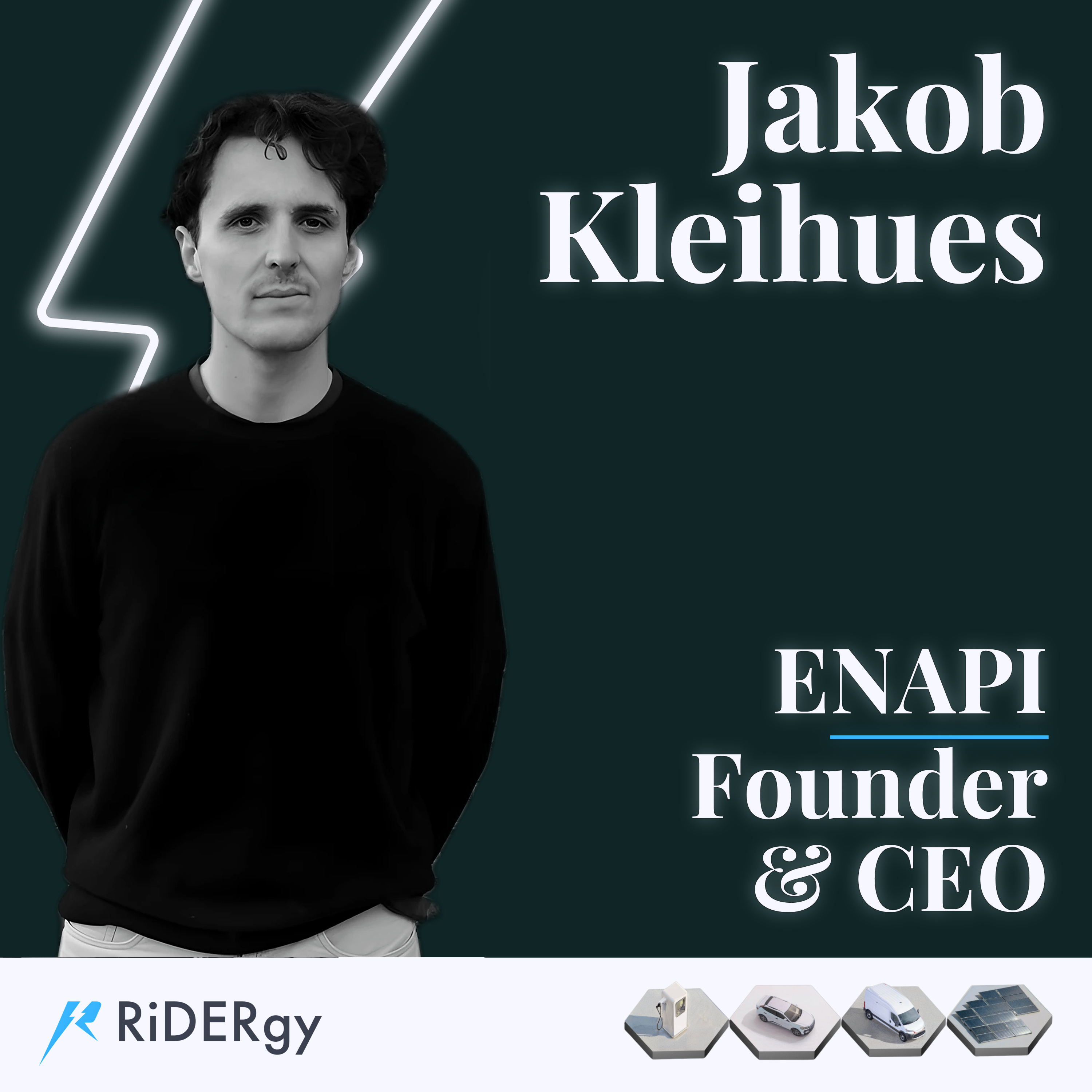
Jakob Kleihues, co‑founder of ENAPI
EV roaming, OCPI, financial clearing, uptime and AI native engineering
文字记录
由机器转录整理而成。译文为机器翻译,可能存在错误。
欢迎收听 Smart Charge by RiDERgy 播客。我是 Claudio Geyken,RiDERgy 的创始人兼首席执行官。这是你学习电动汽车和车队能源管理及智能充电创新的节目。连接 450 个合作伙伴,你就建立了 450 次握手,或者你建立一次握手。这就是 Inopi 背后的理念,而我今天的嘉宾是其联合创始人 Jacob Clayhus。在两年半的时间里,他的公司已连接超过 100 万个充电点,并且提出了一个听起来几乎带有挑衅性的主张。
充电点运营商和出行服务提供商之间的连接应该是免费的。他说,钱是在其他地方赚的。我们会谈到在哪里赚钱,财务清算到底涉及什么,以及一个非常小的团队如何让其基础设施保持 99.998% 的运行时间。让我们开始吧。好的,Jacob,很高兴你今天来到这里。你好吗?是的,非常感谢邀请。是的,我有点赶,你知道的,我迟到了。没关系,从机场赶来,但除此之外我很好。非常感谢。
你今天从荷兰赶过来,所以我想我还没有嘉宾在同一天从这么远赶过来。是的,没错,特别是因为我和你一样在柏林,所以有点奇怪。但无论如何,非常好,也非常感谢邀请。是的,也很高兴知道你是真正的柏林人,在这里出生、长大,你的父母也是。这是我不知道的,因为我也是在柏林长大的。是的,我在柏林长大。
我在欧洲各地的其他城市生活了很多年,在德国南部和哥本哈根学习,然后在伦敦短暂工作过一段时间,还有阿姆斯特丹。所以我也了解一些其他地方,但我已经回到柏林很多年了,现在也在柏林建立 Inopi。是的,也许你可以多分享一些你的背景。我也决定从柏林去德国南部学习,很有趣的是,但我想很多柏林人也喜欢留在柏林。
你去南部学习的动机是什么?我是说,这要追溯到我 18 岁的时候,对吧?我不知道我是否还能回忆起为什么。说实话,我想这是一种很自然的"让我们尽可能远离"的想法,也许我当时的视野有点局限于德国,说实话。但是,是的,所以我在康斯坦茨湖畔的腓特烈港的齐柏林大学学习,确切地说,
我在那里度过了一段美好的时光。说实话,我有时会想,我在大学或学校学到的东西在日常生活中实际应用了多少,接近零,但我最亲密的朋友确实是那个时候认识的,所以我非常愿意再来一次。你学的是什么?
第一年是社会学、政治学、文化和经济学之间的通识课程,然后你专注,我专注于企业管理和经济学。这基本上是我在康斯坦茨湖的学习,然后我去哥本哈根商学院读了一个相当标准的工商管理硕士。
显然在此期间,在不同的初创公司和不同的公司实习了很多次。我从未,我们在开始录制之前简短地谈到过这一点,为大公司工作过,所以我基本上没有与企业打交道以及在企业工作是什么样子的任何经验,这就是为什么我认为我一直在不断学习这些组织是如何运作的。但总的来说,是的,这基本上是我学习的内容。你在过去的工作中做了什么?
正如我说的,我在不同的公司做了很多实习。有一家公司对这个播客来说也许很有趣,那是 Climate-KIC。我在 Climate-KIC 实习过。
那是在 EUREF 校区,显然到现在很多知名的欧洲和德国公司都在那里设立了总部,但是,当时他们在那里有一个绿色车库,他们基本上在那里孵化了一些初创公司,这非常令人兴奋,我
只是团队的一员,试图帮助创始人完成事情。这也许是一个有趣的第一步,但我认为对我未来职业生涯真正相关的第一步是在 Project A Ventures,我在 2018 年在那里实习。那非常紧张,我喜欢的是
你每天都在和对自己所做的事情感到兴奋的人交谈,因为你在和创始人交谈,我认为这是我在之前担任的许多其他职位中所缺少的。这就是我决定的原因,因为我在 InnoEnergy,所以也是另一个触动点:Climate-KIC 关注更广泛的气候话题,而 InnoEnergy 非常专注于能源,我也能感受到我们支持的创始人的能量,所以我完全能理解这一点。
是的,没错。然后我决定,好的,快节奏的环境,我学到了很多,我一点也不无聊,我周围的人也不无聊,所以让我们在这里多待一些时间,基本上开始为风险投资基金工作。我做了 4 年半,所以实际上相当长的时间。总是在最早期阶段,所以基本上是什么都没有或接近什么都没有的初创公司,基本上是创始人本身和他们建立大事业的承诺,并试图弄清楚:他们是否有机会真正成功,对吧?
非常激动人心的时光。你学到了什么来区分这一点,也许这对你今天作为创始人也很相关?我的意思是,可能很难这样分解,但我认为我学到的一件事是,很多初创公司,投资初创公司本质上是投资一个潜在的异常值,即一家回报远超行业内任何其他公司的公司。
所以你想投资的是那种有潜力变得非常非常大的东西,对吧?我觉得你很快就会学到的是,每个人都有一种基于数据和其他公司历史表现来做到这一点的巨大动力,但很多这些异常值实际上并不遵循其他初创公司的常规路径,因为否则他们就不会做不同的事情,因此也就不会成为异常值,对吧?
也许这过于简化了,但我认为很多最令人兴奋的公司实际上是从第一性原理出发建立的,而不是试图模仿另一家公司。"我们是手机共享领域的Airbnb"之类的,对吧?多么无聊啊,对吧?我在努力不说脏话。所以这是我自己学到的一点:在某种程度上要独立思考,因为很可能如果你敢于独立思考,这会比你不这样做更成功,对吧?
我认为这是其中一件事。另一件事是:这在某种程度上肯定是关于努力工作和能够理解背景,但创业和扩大公司规模很大程度上也是运气和能量,对吧,我每天能够并愿意投入多少能量。
我认为这也是我们学到的东西。我在风险投资工作时还学到的,想法与执行,我看到你有一个观点;我不记得是在博客文章里还是在社交媒体帖子里。也许你能详细说明一下你在日常工作中是如何应用它的?然后我们会回到你是如何得到这个想法的,以及你是否从最初的概念转型过。是的,老实说,我总是对我们实际上转型得如此之少感到惊讶,但我们完全可以谈谈这个。
但是,我的意思是,你谈到了执行,我认为我们RiDERgy团队对此的看法是:我们是一个行业的挑战者,对吧?作为一家初创公司,你进入这个行业,你本质上没有标志,没有品牌,没有团队,一开始甚至没有资本。基本上整个世界都在与你作对,对吧?而你可能拥有的唯一东西就是执行力,对吧?
因为你总是会更快,你总是能够更快地做出反应,而且你总是会比那些迄今为止的在位者更关心,对吧?因此,我的意思是我们面临很多情况。
例如,那些从隐身模式中出来并推出自己的隐身初创公司,我从来不理解这一点,对吧,因为从我们的角度来看,这完全是关于执行,我很乐意与任何人分享我们在这里试图构建的东西以及我们拥有的所有秘密,对吧。因为归根结底,我们需要比其他人执行得更好,对吧?我看到这在这个行业中经常发生。例如,我们经常被要求
签署保密协议,这是我们愿意做的事情,我们确实有很多保密协议,我总是需要小心我在任何地方提到什么名字,但长话短说,我们从未要求任何公司签署保密协议,对吧,原因相同:归根结底,执行才是最重要的,而不是谁知道你有什么想法的秘密之类的。那么对你来说什么是好的执行?
比如,如果你必须,首先想到的事情,你会说,是的,这绝对是我们认为是良好执行的东西,我们每天在团队中培养的。是的,我的意思是,也许现在听起来有点太简单了,但那就是专注,对吧。知道你想在价值链中拥有什么,然后在拥有和构建它方面比其他人好10倍,对吧?
听起来很简单,但在这个行业,我的意思是,我们现在,我们可能稍后会谈到这一点,正在与、有合同、或者已经在生产中上线了,比如绝大多数行业,对吧?特别是在欧洲。每个人都有问题,我们喜欢听到它们,对吧,因为有时真的令人惊讶地难以获得关于我们可以为他们解决什么问题的高质量反馈,对吧?
与此同时,我们需要对这些请求和想法中的90%、95%说不,以便能够专注于我们实际上想要自己执行的东西,对吧?只有当我们真的能够做到这种专注,我们才能在下一步真正执行,因为那时我们知道我们的使命是什么,对吧?所以是的,我简单的答案就是专注。也许我要补充的是,我们有一个了不起的团队,对吧?所以这是一个工程团队远程优先的团队。
基本上我和我的联合创始人在我们开始时心中有大约5个人想要招募,就像在我们签署第一轮融资并知道可以雇佣一些人的第二天。我们基本上心中有5个档案,其中4个我们在此期间已经招募了。所以对我们来说,这在某种程度上就像是梦之队,我认为这也有助于执行,对吧,因为每个人都在朝同一个方向推进,每个人都
推动自己,但也有一种以目标为导向的合作方式,对吧?所以我们也可以互相说,好吧,这不好,对吧?到目前为止,是的,一起工作很开心。我认为这是第二件事。所以专注和与优秀的人一起工作并享受乐趣。有道理。不,我完全能理解。在我们马上深入探讨Inapi之前,你是怎么,我知道你为Bonnet工作过,你是如何进入Bonnet或进入电动出行行业的?路径是什么?是的。
我的意思是,Bonnet,也许对一些正在听这个节目的人来说他们知道这个品牌,Bonnet是一家公司,我真的不想现在撒谎,但它是一个EMSP,我想大约是在2020年左右开始的,来自伦敦帝国理工学院,由两位了不起的创始人Patrick和Elliott创立,他们真的是从一个大学项目开始创办了一个EMSP,因为他们说,好吧,外面没有一个拥有良好品牌的优秀MSP,对吧?
我相当早就认识了他们,我想可能是在他们创业旅程的4到5个月时,因为他们向我曾经工作的风险投资基金申请融资,然后我和他们通了个电话。基本上我们就达成了交易,是一笔相当小的投资,然后我开始和团队一起建设公司,对吧,在这段时间里我想我们在一起待了相当长的时间。
他们在筹集下一轮融资等方面确实遇到了困难,我们为完成这件事做了很多工作。然后突然之间就有点像追赶效应,对吧?基本上每个人都想投资,因为公司增长得相当快。他们从Lightspeed和Google Ventures筹集到了资金,这些都是相当知名和有声望的投资者,然后Patrick和Elliott邀请我全职加入,我就这么做了。我的意思是,我不想详细说Bonnet发生了什么。
公司在大约1年半之后被卖给了Over Energy,今天团队以Overdrive的名义运营,也是一个了不起的团队。但当收购发生时,我已经知道我不想为英国的一家大公司工作,而且我已经亲身体验过他们试图用Inapi解决的连接痛点,无论是从商业角度还是在一定程度上从技术角度。这就是为什么我离开并创立了Inapi。
是的,然后也许让我先设定一些背景,铺垫一下场景,这样我们就在同一起跑线上了。所以连接问题,据我理解,如果我遗漏了什么,请详细说明或纠正我,你所识别的问题是:行业中有很多参与者。我们有CPO(充电点运营商),我们有MSP(出行服务提供商),我会说这些是最重要的角色。在CPO下面有CPMS,也就是CPO使用的软件。
然后传统上创建了漫游枢纽来连接这些不同的参与者。我不知道过去和现在CPO和MSP的确切数量,但数量很可观。如果你脑海中有这些数据,也许可以更新一下我们。所以这个来自传统枢纽的连接层,这就是你所识别的,存在相当多的问题,或者说有很多可以做得更好的方式,而这本质上就是Inapi正在构建的,对吗?
也许你现在可以更详细地阐述一下。是的,所以也许首先,因为我认为作为一个行业我们做得还不够,也许从客户的角度来看,对吧,就像从电动车驾驶员的角度来看。电动车驾驶员想要关于充电桩可用性的准确数据,对吧,然后他们想要支付尽可能低的价格。而这与今天公共电动车充电的实际情况非常不符,对吧?现在我们可以深入探讨,好吧,为什么会这样,对吧?
我认为你很快就会得出结论:好吧,这个行业有很多不同的公司。正如你已经阐述的,有不同的角色,对吧,比如CPO、CPMS、EMSP,等等。还有碎片化的市场,所以有很多不同的CPO和很多不同的战略利益在市场中。但长话短说,这些公司需要以高效的方式合作,才能让这种客户体验真正大规模运作。
在Bonnet,我们很快了解到这在大规模上并不奏效。所以我们是一个非常经典的EMSP,基本上想要连接到欧洲所有相关的CPO。那时候是2022年夏天,基本上有两种连接方式。我称之为传统漫游枢纽,那些在14、15年前是先驱的平台,基本上试图标准化市场上CPO和EMSP之间的通信。
当我开始进入这个行业时,他们仍然完成了大约80%的集成,但已经只有20%的交易量,因为大量交易的集成,大型EMSP与大型CPO之间,已经开始走双边路线,建立双边OCPI集成。这基本上就是第二个选择:传统漫游枢纽和双边OCPI集成。在Bonnet,一开始我们想,好吧,为什么不和枢纽合作呢?
如我所说,另一个选择是双边OCPI集成,所以Bonnet开始建立大量的双边OCPI集成,我想超过50个。我能回忆起的是,平均来说这些集成中大约有10个总是处于故障状态,而这不是因为Bonnet。他们有出色的技术。原因甚至不是技术问题,而更多是运营问题。
比如,某些东西不工作,某些冲突不工作,某些令牌没有同步,OCPI协议实现的某些小的解释不工作。然后你需要另一边的人来调试那个问题。
让我们在这里停一下,因为我认为对于不是深度IT集成人员的每个人来说,这可能不是那么明显。这个集成有两个方面,需要集成的两个系统和需要集成的两个软件层。
有一个协议,OCPI,我想还有其他几个,但枢纽正在管理这些协议。如果我错了请纠正我,但OCPI可以说是自由独立的那个。而在其中,就像在许多其他协议中一样,我认为OCPP面临同样的问题,充电桩与充电点管理系统对话,但这不是本播客的核心焦点,存在协议的解释和实现的问题。
如果一个利益相关者把事情搞砸了,那就是事情出岔子的时候。我这样说对吗?有点,没错。所以让我也许给出一点历史分解,我肯定在某些方面会出错。我在这个行业已经五年了,我想我现在对它了解得相当好,但那时候我不知道之前发生了什么。
但长话短说,有这些平台,如我所说,那时候试图标准化通信,作为这个行业的先驱。他们开始
本质上是定义协议来实现标准化。所以Hubject提出了OICP,也许在此之前有其他协议,但这是我们所知道的。Gireve提出了eMIP,我想e-Clearing提出了OCHP,主要来自荷兰。我认为因为我的联合创始人Dennis Lauman是OCPI的原始作者之一,充电站运营商特别愿意独立出来,并推出一个独立于这些商业性、非中立参与者的协议。
这就是EV Roaming Foundation成立的原因,我们今天是EV Roaming Foundation的一部分,还有这个行业的许多其他相关参与者。EV Roaming Foundation所做的是把人们聚集在一起来定义OCPI标准。今天最相关的OCPI版本是OCPI 2.1.1和2.2.1。还有OCPI 2.3.0版本,已经发布,但只有极少数参与者实施了,很乐意详细讨论这个问题。但本质上OCPI是很多
充电站运营商想要摆脱专有协议的答案。所以这是核心的开源协议,显然我刚才提到的平台现在也采用了OCPI。从我们的角度来看,它正在成为标准,不仅在德国或欧洲,实际上在全世界范围内。我最近读到一个数据,中国以外超过95%的公共充电桩实际上传输OCPP数据,而这些充电桩中的绝大多数也可以使用OCPI协议。
这就是我对这些协议的高层次总结。而OCPI,回答你的问题,最初是为了建立双边集成而推出的。现在,我想在你的开场介绍中你已经说过,充电站运营商和电动汽车移动服务提供商的市场是分散的。双方都有数百个参与者,如果充电站运营商这边有3个参与者,电动汽车移动服务提供商那边有3个,那就很简单:每个人都相互连接,你就有9个集成。
现在,如果移动服务提供商这边有500个参与者,充电站运营商那边有500个参与者,那就是250,000个双边集成。我想你已经开始理解了:好吧,这些都是需要握手、需要设置、需要测试,然后需要维护的集成。而现在我们谈论的是OCPI的许多不同版本,这些版本显然彼此不兼容。所以情况很快就会变得非常非常混乱,让我这么说吧。
所以我认为当我进入这个行业时,行业面临的问题本质上是:我相信连接性应该是一种商品,应该是一种免费提供的资源,但实际上它是一个持续的痛点,诸如此类。
这是我们在Bonnet遇到困难的主要原因,我们很难提供真正好的客户体验,而且大部分成本都来自这个,甚至是间接成本。例如,客户成功成本的产生正是因为这些连接性问题,这就是为什么我说,好吧,一定有更好的方法来做这件事,然后开始研究其他行业。
是在2022年夏天,我联系了我的两位联合创始人,基本上开始思考一个什么样的模式能够将单一集成的巨大优势和良好的数据质量结合在一起,同时没有显著的交易成本。答案在于人工智能,但我想我们现在会讲到这个。是的,让我们深入探讨。
这是一个单独的话题,但正如你提到联合创始人,有一件事让我印象深刻,也因为就我个人而言,找到我的联合创始人花了相当长的时间,我发现特别是找技术类联合创始人,因为我们都是CEO,是非常困难的。而你成功了,如果我没记错的话,你心里有一个人。
你真的想和这个人一起创立公司,结果这个人说好,这是相当令人印象深刻的,或者说不可思议的。那个故事是怎样的?你能详细说说联合创始人的匹配吗,这对公司来说是如此重要的基础?是的,我的意思是我经历过这个问题。我谈判过很多漫游合同。我曾试图在商业层面上将很多连接性问题升级到一定程度。
但我知道我们不想构建什么;但我按照我设想的方式来构建它是否可行,这对我来说并不是很明显。所以我第一步做的本质上是整理了一份备忘录,可能有点老投资者的思维,但是一份关于这家公司将要做什么的备忘录,大约5页之类的。我需要再找找它;它在我电脑的某个地方。我基本上把这个发给了,我想,
四五个人。说实话,我只是冷外联。我真的在GitHub上查找谁编写了OCPI协议,然后你会发现,我希望我可以在这里说这些名字,本质上是Olga Vanier、Patrick Rademakers和Dennis Lauman。总是在这三个名字中,他们是教父级人物。
我喜欢这个说法,这可能来自我的一个演示文稿,OCPI的教父们,是的,没错。我实际上想和他们三个人都谈谈。我也和Olga谈过,但后来Dennis和我见了面,并且在亚琛的e-clearing活动上有一次有趣的、巧合的第二次见面。
我只记得我们俩当时都对这份备忘录感到相当兴奋,我们基本上利用在亚琛的那两天把自己锁在一个房间里,思考如何能够构建这个以及我们如何做到这一点。现在,Dennis当时仍然是Ihoma的管理合伙人,我想他们是这么称呼他的,我认为是行业内领先的技术咨询公司之一。他之前构建过很多CPMS系统,在那里也有一个非常有才华的团队,因此退出对他来说并不容易。
对我来说,创办这家公司是非常显而易见的决定。基本上我们在正职工作之余相当密集地工作了3到4个月,然后我们到了一个节点,我说,好吧,让我们试3到4个月。如果到2023年第一季度末我们还没有融到资,那你就回去上班。我们就是这样开始的。我认为很多投资人总是说,创始人彼此不是从日常工作中认识的,或者他们不是朋友的创始团队,本质上是有风险的。
我们甚至在第一轮融资中遇到过一个人拒绝了我们,当时有很多投资人想投资,但他因为这些氛围拒绝了,比如我们彼此不够了解,我们当时还考虑每年给他寄一张圣诞卡。我们现在一起工作,因为我们关系非常亲密。长话短说,Dennis很棒。他在荷兰,这就是为什么我一直百分之百清楚我们要把这个公司建成远程优先的。
我们试图在柏林招聘商务团队,但其他一切基本上都是远程优先的。但真的,从第一天起我们就互相信任、互相喜爱,是的,我们现在一起经历了很多,所以对此非常兴奋。非常酷的背景故事,我认为对创业者们很有启发。所以你说你们差不多在2022年底创建了公司。
对,是的,我们正式注册公司我想是在2023年1月,我们已经签了投资意向书,基本上在2022年12月就和投资人谈过了。所以是的,非常快。字面上就是我们开始融资两周后,我们就有了五六份投资意向书,必须做出决定。然后基本上就凭一份pitch deck融到了第一轮资金,投资方是Project A Ventures和伦敦的Seedcamp。
是的,那是一轮250万的融资,对吧?然后2025年1月是一轮750万的融资。是的,我想宣布的,我想那差不多是在11月、12月讨论的,抱歉,不,是2023年。是的,我现在说对了吗?不,是24年,当然,是2024年1月,抱歉。我们整个时间都差了一年。所以2024年1月我们启动了,2024年1月我们也宣布了255万的pre-seed轮融资。
然后在2025年1月宣布了我们750万的seed轮融资,这轮是在2024年12月完成的。所以基本上在我们完成第一轮融资10个月后,我们又融了一轮。是的,时间飞逝。然后我读到你们在2025年底连接了60万个充电点,但现在我想最近的帖子已经像85万了,差不多是这样。
说实话,没有不好的感觉,因为发展很快,但当这个节目播出时我可以说,我们现在正在宣布在生产环境中连接了100万个充电点。实际上我们已经达到了105万,所以是的,我们增长得超级快。自从我们开始以来,我们已经接入了超过450个合作伙伴。如果你计算一下,在我们开始接入以来的2.5年多一点的时间里,平均下来大约每周2个左右,稍微多一点。
这实际上只有一个团队成员主要在做这件事,当然其他人也可以帮忙,但基本上是一个人差不多全职在测试、接入和推动技术方面,其余的大部分是自动化的。我认为这是我们能够如此快速增长的原因之一。我们开始的时机非常完美:正是人们对传统漫游枢纽感到厌倦的时候。
他们在建立双边集成时遇到了问题,而他们有一个OCPI就绪的API,所以基本上我们可以立即连接他们,没有任何明显的摩擦。当然,建立450个握手连接,你会遇到很多,我不想评判,但是,可能有点奇怪的OCPI解释和实现。这是OCPI的大问题:它本质上可以用许多不同的方式实现,这么说吧。
我们已经建立了变通方法,所以到现在我们很少看到超过一到两周的实现时间。也许这是个愚蠢的问题,但因为我对此了解不深,所以更好地理解会很有趣。从根本上说,其中一个利益相关方的API质量可能会把事情搞砸。通过将自己定位在利益相关方之间并确保连接性良好,尽管如此,如果一个利益相关方搞砸了,你如何防止这些搞砸?
你能更快地识别它们吗,或者你的角色是怎样的,可以说,你如何确保这些搞砸不会发生?我认为显而易见的,也许是我们这里容易实现的价值主张是,你不再需要做450次握手了,你只需要做一次,与RiDERgy,然后你基本上可以从那里扩展,没有任何额外的技术开销。
你只需进入我们的门户,点击"我想给他们发送报价",发送报价,如果他们接受,你作为CPO的POI数据就会被推送到MSP,你可以从EMSP拉取令牌,非常直接,技术开销很小。但是回答你的问题,我认为这很重要:我们在协调合作伙伴的OCPI API方面发挥着巨大作用。OCPI设置在不同的模块中,并非每一个模块都是使连接工作所必需的。
所以当我们开始时,我们的许多合作伙伴,例如,还没有实现所谓的费率模块,所以他们在自动相互通信费率方面基本上遇到了困难。这会产生摩擦,因此我们总是激励每个人做的是真正实现整个OCPI协议。话虽如此,我认为我们在协调方面发挥着巨大作用,因为很多EMSP告诉我们,他们在NAP内的成功率明显高于他们在双边OCPI集成中的成功率。
我认为这有点反直觉,对吧?行业内很多人会说,啊,但我在链条中增加了一个额外的利益相关者,这会产生更多摩擦,多了一方,但现实中根本不是这样运作的。我们有一个非常成熟的预警系统,我们90%以上的客户成功互动都是主动发起而非被动响应。所以实际上是我们在清理数据,帮助合作伙伴把他们的事情搞定。
因此作为下一步,我们看到了很多非常成功的交易。在双边集成中你经常看到的另一个问题是,比如同步任务失败。某个令牌没有到达充电站运营商那里,因此当令牌试图在那里充电时无法授权会话,或者某个充电桩不知怎么的不在移动出行服务商的移动应用程序中,你就会纳闷为什么。
我们帮助合作伙伴做的是让他们能够看到同步任务的成功情况,并让他们灵活选择如何同步,他们想推送还是拉取数据,什么时候做,频率是多少,等等。所有这些都帮助整个行业简化连接。我认为我如此强调这一点的原因是:NAP从第一天起就不是为了取代传统枢纽而建立的。
我们的增长部分也来自于人们从传统枢纽迁移过来,但我们最直接的竞争对手不是这些传统枢纽。我们最直接的竞争对手是双边OCPI集成,因为那里才是大量业务所在,我们的目标是将某个特定充电站运营商或移动出行服务商100%的业务量迁移过来。显然我知道这需要时间和行业内的大量信任。但这就是我们存在的意义,这就是我们从第一天起构建NAP的方式。
所以对我们来说非常重要的是,比如NAP集成的成功率要高于双边设置,让人们理解这实际上是未来的新常态。对我们同样非常重要的是,我们看到第一批双边集成正在迁移到NAP,接入所有这些标志性客户是一回事,但让他们把所有集成都迁移到NAP是另一回事,而我们现在正在做到这一点。所以,是的。
还有一个我们没有谈到的利益相关者或连接类型,我认为在行业中相当常见,那就是平台,我认为主要是后端系统,充电站管理系统,它们也在促进集成。那么你如何看待这类利益相关者,也许你甚至能说出通过平台完成的集成占多少份额,通过双边漫游枢纽和现在通过NAP完成的又占多少?这是个好问题。不,如果这很难回答的话,我知道有时我只是有点超前了。
想到这个问题时我脑海中浮现的是我们在2024年1月种子轮前融资的演示文稿。那时我们做了一点客户细分,我们基本上说充电站运营商这一侧,如果你愿意的话,在我们的模型中就是供应侧,可以分为三类不同的公司。
第一类是战略性跨国企业:石油和天然气公司、公用事业公司、汽车制造商、原始设备制造商,基本上是对这个市场有战略利益的公司,它们资金非常雄厚,往往行动稍慢一些,尽管我们热爱所有与我们合作的这类公司。第二类基本上是当今行业中可能最有能力的参与者,那就是由基础设施基金支持的合资企业和这个行业的初创公司。
他们非常擅长利用数据,对优化流程非常感兴趣。很好的例子包括Charging League、Fastned、Atlante、Ionity、Electra、Power Dot,这类参与者浮现在脑海中。
这些参与者往往没有最大的网络,但他们有很多交易,因为他们的网络质量真的很高,而且他们扩张得非常快。然后最后一类我认为是通过充电站管理系统聚合的长尾市场。所以正是,这看起来是怎样的呢。
这些充电站管理系统作为与移动出行服务商的合同伙伴,所以对我们来说,如果你愿意这样理解的话,它们就是充电站运营商,因为它们与移动出行服务商有漫游合同,它们基本上也向移动出行服务商开具发票,然后将钱分配给充电站运营商。所以对我们来说,我们集成的利益相关者或参与者是充电站管理系统。如果它们是移动出行服务商的合同伙伴,它们也拥有NAP的账户。
所以我们总是看的是:我们真的不在乎你本质上是谁。你是漫游合同中的一方吗?如果是,你就是我们的客户。我们与很多充电站管理系统合作,到目前为止,我们已经宣布与它们中的或多或少所有公司建立了合作关系,我们与它们关系非常紧密。我不想撒谎,但我认为在欧洲没有我们没有任何集成的充电站管理系统。显然,充电站管理系统你又可以细分为稍老一些的、行动稍慢一些的初创公司等等。
我现在不想这样做,因为正如我说的,我们与所有这些公司合作,但我们正在与那里的许多了不起的技术、了不起的公司和人才合作。基本上,如果我理解正确的话,当你谈论在充电站运营商和移动出行服务商之间集成时,你是在集成充电站管理系统对OCPI的实现,对吗?没错。我的意思是,充电站运营商在复杂性方面有它们的终点。有些充电站运营商构建自己的充电站管理系统,也许两三年前有一点这样的趋势。
然后还有一些CPMS,它们只是充电桩管理系统,本质上是软件即服务公司,它们从不拥有漫游合同。从我们的角度来看,这通常符合CPO的利益,然后还有一些CPMS,它们在为其CPO客户进行整个财务清算和所有繁重工作方面有着悠久的历史。它们都有存在的权利。
所以这真的很复杂,但你说得对,毕竟,我们有技术集成,因此我们连接到充电桩管理系统。但正如我所说,有一些非常大的充电桩运营商拥有自己的充电桩管理系统,也有一些非常小的充电桩运营商也有自己的充电桩管理系统,所以这个市场有各种不同的形态。说到商业模式,我想你已经暗示了:连接应该是免费的。
所以我理解这也是EAI或其他试图做与EAI相同事情的利益相关者之间的根本区别,在那里连接不是免费的。我理解你们的商业模式完全基于财务清算。也许你可以详细说明这个清算方面,以及你们如何比其他专注于清算方面的利益相关者做得更好。
我想我简要地暗示过这一点:从第一天起,这也是为什么我总是很惊讶我们从第一天起就没有真正改变我们的身份和使命,从第一天起,我们的雄心就是取代双边直接集成,直接OCPI集成,因为它们在Bonnet对我们来说无法规模化。有些人告诉我们它们有效,有些人说它们根本不起作用。
但长话短说,如果你看成功率和所涉及的一切,连接应该是一种商品。而今天它不是商品,因为每个人都有一个技术团队坐在那里控制数据,每个人都在内部构建自己略显粗糙的验证,他们需要查看充电详细记录并本质上构建相关交易数据来分析,而所有这些都不起作用。
我们总是说我们想为CPO或EMSP的100%交易量构建产品,而不是为长尾。如果你这么说,你需要看看为什么他们通过双边集成来经纪80%的交易。对我们来说,原因很明显:显著的交易成本。如果你对连接收取交易成本,那么人们就有动力走双边。因为即使你每次会话只收取5美分,
,在每月100万次充电交易的情况下,走双边有相当明显的显著激励。因此,从我们的角度来看,在未来的大众市场中,不会有任何连接成本。没有任何对连接收费的公司能够在未来获胜。我想这在2.5年或3年前我们开始时对市场来说有点令人惊讶,但到现在绝大多数市场都同意我们的看法。
然后显而易见的问题是:我们如何进行连接,因为,如前所述,双边集成无法规模化?那么我们如何进行连接,下一个最大的问题是什么?我认为我们对此的答案是:让我们将连接商品化,使其成为免费可用的商品,确保任何人投入哪怕一个工程小时到他们不需要投入的内部连接上,本质上都是在浪费时间和金钱,因为他们应该投资于可以建立差异化的东西。
这是一种商品,是免费的,对吧?然后让我们看看下一个最大的问题,从我们的角度来看,下一个最大的问题是财务清算。CPO很难获得付款,而EMSP很难验证充电详细记录,打开相关交易数据,然后以可扩展的方式批准发票并支付,对吧?那里最大的EMSP,他们每个月收到大约450张发票,对吧?
实际上不是每个月,而是每2、4、6、8、12周,有时有CDR,有时没有CDR,不同的货币,不同的增值税率。这很混乱,这就是我们在这里要解决的问题。现在,为什么我们有解决这个问题的不公平优势?只有当我们实际经纪交易时,我们才有解决这个问题的不公平优势,对吧?因为我们能做的是,我们可以在不同的层面上验证交易,而不是在许多不同行业中做这件事的横向参与者,对吧?因为我们可以查看开具发票的充电详细记录并说:
嘿,上面有一些CDR,我们没有授权会话,这没有发生,或者我们可以说,嘿,有一些缺失的CDR,或者有一些重复的CDR具有不同的CDR ID,但我们知道这一点是因为我们授权了会话,对吧?我们可以验证数百万个细节,但长话短说,只有因为我们经纪交易,我们才能真正构建最好的财务清算产品。我们坚信绝大多数市场
未来不会自己进行财务清算。现在它是粗糙的,基于CSV文件等的内部流程,这是我们用财务清算产品与之竞争的对象。但在未来这将变得更加复杂,因为我们将有可变定价,我们将有折扣,有很多事情会增加复杂性。
欧洲450家公司在内部构建自己的解决方案是没有意义的,对吧,这就是我们介入的地方。所以清算主要是在内部完成的,或者有第三方用,比如说,传统技术来做,这就是
我不想对遗留技术那么挑剔,但我可以说的是,一如既往,我认为这是贯穿我们到目前为止整个对话的一个稳定主题,显然这个行业里什么情况都有:有自己做的人,有和外部一些随机公司合作做的人,也有完全不做、基本上就是收到发票就付款、什么都不验证的人,对吧?
所以真的是什么情况都有,我们遇到过各种情况。但这绝对是每个人都面临的一个明显问题,你可以和外面任何一个CPO和EMSP交谈,他们都会同意,账单相关交易数据的验证、然后是支付的审批、再然后是支付本身,都是超级手动的流程。
是的,我也可以从我的交谈中确认这一点。你提到了一个令人印象深刻的KPI:2025年99.998%的正常运行时间和低于20毫秒的延迟,这确实非常令人印象深刻。你们是如何能够实现如此出色的KPI的?我理解这就是你们与遗留技术竞争的优势,有力的论据来说服人们采用你们的技术。是的,我认为非常真实且容易说明的一个理由就是一个非常有才华的团队,对吧?
我们仍然是一个非常小的团队,而且我们对此非常清楚,对吧?我们相信,如果我们是一个中介,而且我们不想收取连接成本,我们可以用一个非常精简的团队来构建这个。同时,我们团队拥有令人难以置信的人才。另一个诚实的答案是,与我刚才提到的那些遗留枢纽相比,对吧,
我们不是14年前开始的,我们是在2024年开始的。我们的云基础设施可能是我们产品的核心;它是最先进的技术,这就是我们如何能够实现这一点的。此外,我想分享的一件事是,与外面大多数参与者相比,我们实际上随时发布我们的正常运行时间,所以每个人都可以去status.api.com查看我们在美国和欧洲的基础设施的正常运行时间。
我们通过公开这些信息来让自己负责,到目前为止这一直运作得非常好。对团队超级满意,我认为有很多原因,老实说,这涉及很多工作。还有很多AI。因为这是游戏的名字,它每天都在我脑海中。你如何看待AI,作为一家可能是AI原生的公司?
所以,首先,是的,对吧。我想,我不需要再查一遍,但我相信大约从2026年1月15日或16日开始,当Claude的一个新模型发布时,Sonnet,是吗?是的,类似的东西。总之,我认为超过94%的我们的生产代码是AI编写的。显然它让我们的速度大大加快了,这肯定有帮助,对吧?
但我也要说的是:我们不是你们下一个那种AI火箭飞船公司,只是把遇到的任何东西扔进拉取请求然后放手,对吧?这是有充分理由的。如果你基本上想要作为一家公司、一家初创公司与大型企业建立信任,他们会寻找的一件事就是:这个产品是否有效,对吧?
如果你对CPO和ESP来说是基础设施相关的,而且这与直接ROI相关,你就不能承受像遗留枢纽有时那样停机20分钟或一个小时。作为一家初创公司,这只是我们无法承受的事情。因此,我们产品的某些部分,我们的工程师非常清楚这一点,我们只会极其小心地触碰,在那里AI很有帮助,但显然不能取代人类真正重要的第二、第三和第四次审查,对吧?
所以这是一个评论,但是的,AI对我们来说绝对是一个巨大的话题,显然让我们能够做到这些。然后,也许最后但并非最不重要的,在商业方面,这很疯狂,对吧?我的意思是,今天我的一位联合创始人在产品上花费了大量时间,但他也与客户有相当多的接触。但除此之外,就是我和我们新聘请的增长总监Dennis Daniel Brown,他来自前ChargePoint。
他正在处理我们的商业扩展。所以现在我们与行业的绝大多数人合作,但我们没有开展疯狂的外展活动来接触他们,因为这根本不起作用。我或多或少是商业方面的独行侠,AI帮助很大。所以这是另一个维度。但话虽如此,过去从未与我交谈过的任何人,请联系我们,特别是CPO和MSP。
我们有时会对一些参与者感到惊讶,特别是在西班牙地区、法国,还有北欧国家,他们从未听说过我们,有点像,"啊,好吧,这听起来很有趣",我们就像,是的,好吧,让我们谈谈。所以是的,我很乐意交谈。你过去说过行业里存在合作问题,你觉得我们应该更多合作。你是什么意思?
老实说,我不知道我是在什么背景下说的。我有时会对人们对合作的开放程度感到惊讶,但我认为我们几乎没有什么替代方案。大多数公司都不像特斯拉,它基本上有一个从硬件到充电站运营商到CPMS到EMSP,再到基本上汽车、插头和充电器等等的全栈解决方案。基本上只有特斯拉。除此之外,人们必须协作和合作,所以我认为不这样做真的不是一个选项。
所以是的,不确定我什么时候说的,但我同意,尽可能多的合作对行业是有帮助的,我认为。然后你发了一个帖子,也许你可以用你自己的话再详细说明一下:是"蛋糕的大小而非蛋糕的份额",如果你记得你的博客文章的话。是的,从我们的角度来看,老实说,我在绝大多数对话中都能感受到这一点,如果行业赢了,每个人都赢了。这就是我们的心态。我们不是试图杀死竞争对手。柴油才是敌人。
是的,没错。柴油是敌人。在德国,油卡(Tankerkarte)是敌人。归根结底,我们想在推动绿色出行革命中发挥作用,但我们还没有做到。我的意思是,17%的增长对于一个传统行业来说听起来不错,但说实话,我们需要让这个转型成功。
如果整个行业都专注于此,我们会更快地实现目标,每个人都会从中受益。这就是我的意思。我们不是为了优化去干掉另一家公司或占领某个特定的市场份额,我们只是想确保我们真正解决行业的互联互通问题,帮助它扩大规模。
我认为到目前为止,这种思维方式帮助我们做了很多正确的事情。这通常是有道理的。然后让我们谈谈定价,这也是我在智能充电和灵活性领域特别感兴趣的一个话题,这将作为最后一部分。你也写过这个,充电站运营商可以使用不同的杠杆:批量激励、车队费率,以及针对聚合商的流量路线的其他类型的附加费。
也许你可以详细说明一下你对定价未来的看法,目前,大家可能都知道,仍然相当静态。它主要取决于充电速度;如果是直流充电桩通常会更高,但动态费率并不多。你认为行业会走向何方?也许作为通往灵活性话题的过渡,理想的定价应该是什么样的,如果你有任何想法的话?
我最近听到一个静态,还有一次演讲,或者交通部博物馆的演讲,或者叫什么,谈论灵活性。我想这会很令人兴奋,对吧?我有点想起安格拉·默克尔说"互联网"的那种感觉。我不知道你是否明白我的意思,但本质上,对我们来说这是相当明显的,对吧?我读到一个数据,我需要再查一下,但大概是到2030年,75%的电池容量都在电动汽车上到处跑,对吧?
我们如何真正挖掘这个潜力,对吧?挖掘这个宝藏。我认为很多非常聪明的人,包括你在内,实际上在这个问题上花了很多时间,对吧?我们正在开始,我想我会回到这个重点上,对吧?我们现在可以思考很多关于如何实施、如何协调等等的问题,对吧。但这不是我现在花时间的地方。我们花时间的地方是:我们如何帮助
与我们合作的公司运营他们想要运营的商业模式,因为否则如果他们不能做他们想做的事情,他们又会有动力去做双边交易,对吧?他们中的很多人想要测试很多东西。我认为这从可变价格开始,对吧?我的意思是,一个非常简单的开始是一天两个不同的价格,夜间定价等等,这可以通过费率模块传达,正如我说的,第一个挑战,对吧,我们需要帮助
但显然,我们也看到的是,例如,对于重型车辆,有相当多的折扣,因为这对充电站运营商来说相当有吸引力,对吧?那么你如何实施这些折扣呢?因为它变得非常混乱,我们在行业中经常看到的是充电运营商只是对发票应用10%的折扣。但一旦CDR受到质疑,整个事情显然就会崩溃,对吧?
所以你想把这个放到OCPI层级和充电详细记录层级,才能真正拥有控制权,对吧?这就是我们为很多公司实现的。所以我们今天拥有的是我们称之为折扣的东西,我理论上也可以添加附加费,但本质上我们做的是让充电站运营商为特定合作伙伴定义折扣,对吧?
然后我们的系统重新评估费率模块,为费率模块添加一个路由标头,针对他们想要给予折扣的特定合作伙伴,然后还重新评估CDR,这样电动出行服务提供商就能从他们那里收到正确评估的CDR。这是我们今天原生支持的产品,这是一个相当令人兴奋的产品。但我认为,转到你的下一个问题,这是更高级一点的思考。
我的意思是,我总是觉得听起来不错的本质上是:我们如何通过价格机制,从能源供应商,通过整个链条到电动汽车司机,实施一个激励方案,对吧?显然目标是让电动汽车司机对价格信号做出反应。
我认为这是未来的音乐,我们很乐意发挥作用,但现在我们的明确重点是赋能我们的合作伙伴。可以说你通过更好地实现充电站运营商的互联互通以及以更好的方式实施某些模块(如定价模块)来实现这一点,归根结底,这也是为更高级的东西打下基础,如果你愿意的话。100%同意,对吧?这有点像如果你去美国,例如,这是一个超级令人兴奋的市场,我们现在正在与那里的很多超级有趣的人合作,对吧?
就像,当每个人都在谈论自动驾驶时,我们显然同意,对吧,但我们的重点思维总是:好的,但让今天的充电交易正常工作怎么样,对吧?我认为通过这样思考,我们实际上能够实现这一点,所以我完全同意。顺便说一下,我看到你最近去美国的行程,你也提到自动驾驶也是这次行程的重要部分。
所以你现在已经在美国作为一个解决方案活跃了。有没有,你也说有相当多的差异,但对你作为一个产品来说,你认为现在在美国运营与在欧洲相比有很大区别吗?是的,我们的产品理论上是可扩展的
对吧。OCPP是一个标准,然后OCPI在一定程度上也是一个标准,我们已经启动了北美基础设施,现在正在积极引入合作伙伴。虽然还处于早期阶段,但我们已经签署了,我不想说错,大概13份合同,并且引入了大约8个合作伙伴之类的。
我们招募了一位我一直想合作的人,Daniel Brown,ChargePoint前全球漫游负责人,他在领导我们的美国业务以及英国业务。他最近去了那边。我也经常去那边,因为我们还从一家美国风险投资基金那里完成了种子轮融资,确切地说是Voyager Ventures,可能是领先的
他们总是不想让我说跨大西洋,但就是领先的气候风投,我想现在他们不想再叫气候了,现在叫韧性之类的,但无论如何,我觉得我是这个社群的一部分。他们是了不起的人,对电力和电子的理解比我见过的任何人都深,而且跟投资我们的另外两家风投一样,他们关注的是财务回报。
我想说的是,我们没有任何战略投资者,对吧。所以不会有人告诉我,"嘿Jacob,你能不能做这个那个,因为某大公司想要那个。"这对我们保持中立、专注于财务回报非常重要。他们很棒,所以我在美国花了很多时间。我们很喜欢美国。那里不一样,但我觉得我们的产品可以立即规模化。
我认为主要区别,这很有意思,是我们不想强迫任何人,在欧洲也不会。AP的核心理念就是你拥有自己的合同和商务条款,因此你拥有控制权。在美国这个论点更加重要,因为没人想被强制进入漫游或类似的事情。
我们相信,要优化你的利用率和单位经济效益,与其他合作伙伴合作是个好主意,但我们给你基础设施,如果你想要的话,而且你保留控制权。这在美国非常重要,这是我们学到的。我觉得进展得非常好。所以你们现在对全世界开放业务了?你问了个好问题,因为我经常谈论专注,诚实的答案可能是的。
在某些情况下,我们会对真正超出我们当前范围的事情说不。但也许退一步想想我们的增长模式:很多初创公司有城市到城市、国家到国家、地区到地区、货币到货币的增长模式。我们不是这样增长的。我们是网络到网络地增长,如果Ionity在24个国家有充电点,告诉我,"嘿Jacob,你能不能在我正在进入的新国家引入这五个EMSP?"
显然我会去做。这就是它的本质,这也是促使我们在美国引入合作伙伴,以及在澳大利亚、新西兰和其他地区引入合作伙伴的原因。
所以这是一个谨慎的,是的,并且保持专注。昨天我参加了一个会议,其中一个主要话题是电动卡车,在国家Leitstelle,与政府挂钩的电动出行协会,所以电动卡车现在是个相当热门的话题。
这对你们的业务有什么影响吗,比如预订或MCS?是的,比如我们有一个功能叫OCPI版本互操作性,我们让不同合作伙伴能够通过OCPI 2.2.1连接到我们,然后与使用2.1.1的合作伙伴进行漫游。这对一些仍然停留在2.1.1的合作伙伴很有帮助。现在有了新版本的OCPI,我不是OCPI专家,在我们大约20个团队成员中,可能
有11个人比我更了解,甚至可能15个。但我能说的是,根据我们目前的经验,OCPI 2.3.0基本上有两个推动采用的主要功能。一方面,在位置模块中,你有更多能力传达更复杂的数据,比如充电场地有多大之类的。其次是预订模块。预订模块本质上是一个附加功能,让你可以预订未来的时段。
我们认为这对物流公司高度相关,尤其对围墙内充电场景特别相关。但在公共充电方面,至少很多我讨论过的人告诉我,他们不太相信大规模应用,因为会出现潜在的运营问题,比如,现在有另一辆车停在那里,我们该怎么办?
这类事情使得围绕预订提供真正良好的客户体验有时变得相当复杂。我们是EVRoaming Foundation的成员,我们是新协议的支持者,别误会我的意思,但我想说的是,我们在预订上没有花很多时间,对于今天我们关注的公共充电来说,我们觉得这不是当前的重点。不过,重型车辆绝对是重点,我们已经引入了该领域的核心参与者。
我现在不想点名,但无论是EMSP还是CPO方面,我想我们已经连接了所有参与者,我们很高兴他们通过我们进行漫游。为什么有意思?因为有惊人的交易量,而且卡车总是在行驶,因此也需要频繁充电。
所以最后评论一下:当我5年前进入这个行业时,这个行业还有很多人到处说,"是啊,氢能,对乘用车来说也许电动会成为新常态,但对卡车来说我很确定是氢能。"巴伐利亚州当时用2亿或多少钱在资助一些关于出行的氢能想法,对吧?
有时候退一步再看这个行业真的挺有意思的,现在很明显整个行业也在走电动化这条路。也许,我的意思是,对我们来说,这就是为什么有时候讨论某些事情会让人沮丧,比如,我不知道,我们在德国政治中有这些流行词,像"Technologieoffenheit"(技术开放性),你就会觉得……
好吧,我们可以保持这种开放态度,然后丧失更多我们已经失去的优势,因为从基本原理来看,电动出行必然会胜出,这是如此明显。再说一遍,这是我想传达的一个重要信息:关注蛋糕的大小而不是蛋糕的一块。拜托,让我们都明白没有其他选择,而且这也不会改变。我们行动吧。在德国和欧洲有很多人还没有理解这一点。
是的,展望未来,在我们以个人话题结束之前的最后一个问题,双向充电:你认为它会出现在公共充电中还是只会在私人充电中?现在你明确专注于公共充电,你认为Enapi在私人充电领域也会扮演重要角色吗?
是的,专注,没错。我不会想太多,嗯,我显然会想。我只能告诉你我从与几乎所有相关充电桩运营商的高层交流中听到的内容,我认为他们也在积极考虑公共充电桩的双向充电。这对我来说很有意思,因为显然他们的身份是销售电力,对吧?
现在突然间他们要进入"好的,我们不是在优化利用率,我们实际上是在交易灵活性",就像,好的,这里有一些悬而未决的问题,对吧?这将如何实施,我们不知道,但我们确实相信这至少是公共充电桩运营商花时间研究的事情。至于你的问题……
我认为对于很多这些连接性话题,我们是他们首选的合作伙伴,我们非常乐意与他们讨论如何实施某些想法。至于私人充电,是的,当然。我们已经连接了很多私人充电桩。我们知道漫游显然也是私人充电的一个话题,我们相信我们显然是当今连接性方面最好的解决方案,这对公共和私人充电都适用,对吧?
为什么我不怎么谈论这个,为什么我现在不去接触那些专注于私人充电桩和围墙内充电桩的充电桩管理系统?专注,对吧。我不能什么都做,我认为我们想要利用网络效应。我们现在在公共电动汽车充电领域非常清楚地看到这些网络效应,我们想要利用它们。好的。
我不知道你是否真的开电动汽车,但如果你要分享一个有趣的,或者也可以是一个糟糕的公共充电故事,也许再加一个非常愉快的?好的,这是个好问题。首先,我目前没有车,但实际上我在柏林有两辆电动车可以使用。我爸爸开一辆本田,我哥哥开一辆特斯拉,我显然经常用这两辆车进行充电交易。我认为最令人愉快的一次是……
是的,叫什么来着,本质上是我们在柏林的一次现场活动中的一次旅行,我们大部分团队成员都来到柏林。我们的新团队成员Daniel Brown基本上带我们在柏林从一个充电桩到另一个充电桩游览,显然我们的工程师带着他们的电脑,追踪了一切,那很有趣。那非常棒,两辆车,八个人,大家玩得很开心。那么,我有糟糕的故事吗?说实话,我显然到处都听到糟糕的故事,对吧?
我的意思是,我告诉我的家人,或者我家人的朋友,或者我的父母,或者投资者,我告诉他们连接性确实不好用,而且可以说,我告诉的人中90%都会说,"是的,没错。我有一次在某个地方度假,开了一辆电动车,真的很糟糕。"在过去两周里,我又听到了大约20个这样的故事。所以,是的,我期待着解决这个问题,但我不想再添加更多故事了。
那么,就这样,我们以一个积极的基调结束,我相信你在尽最大努力快速解决这个问题。非常感谢你,Jago,感谢你的辛勤工作和今天来到这里。非常感谢。谢谢邀请。这次对话让我印象深刻的有三件事。第一,连接性的价格。即使每次交易收费5美分,在每月100万次交易的情况下也会累积起来,这让合作伙伴有充分的理由建立自己的直接连接。Jacob的结论是:从长远来看,任何对连接性收费的人都不会成功。第二,清算。
因为Enapi自己代理交易,它可以将开具发票的充电详细记录与它实际授权的会话进行比较,找出重复或缺失的记录。第三,人工智能。现在Enapi超过94%的生产代码是用人工智能编写的,但那些不能宕机的部分只会极其谨慎地处理,而且正常运行时间是公开的,任何人都可以查看。Jacob用一个词来概括这一切:专注。感谢您收听RiDERgy的Smart Charge节目。如果这一集对您有用,请与从事充电基础设施工作的人分享,或给我们5星好评。下次见。
Welcome to the Smart Charge by RiDERgy podcast. This is Claudio Geyken, founder and CEO of RiDERgy. This is your show to learn about all things energy management and smart charging innovation for electric vehicles and fleets. Connect to 450 partners and you build 450 handshakes, or you build one. That is the idea behind Inopi, and my guest today is its co-founder, Jacob Clayhus. In 2.5 years, his company has connected more than 1 million charge points, and it did so with a claim that sounds almost provocative.
Connectivity between charge point operators and mobility service providers should be free. The money, he says, is made somewhere else. We talk about where, about what financial clearing really involves, and about how a very small team keeps its infrastructure running at 99.998% of the time. Let's get into it. Right, Jacob, nice that you are here today. How are you? Yeah, thank you so much for the invite. Yeah, I'm a little bit stressed, as you know, I was late. No worries, rushing from the airport, but other than that I'm fine. Thank you so much.
You made it in from the Netherlands today, so I think I didn't have a guest that made it so far in the same day. Yeah, exactly, especially because I'm home in Berlin as you are, so it's strange. But anyways, very good and thank you so much for the invite. Yeah, and great to also know that you are a true Berliner, born here, born and raised, and your parents as well. It's something I didn't know, as I also was raised here in Berlin. Yeah, I grew up in Berlin.
I lived for quite a lot of years in other cities all across Europe - studied in the south of Germany and in Copenhagen, then worked in London for a short time and in Amsterdam. So I kind of know some other places as well, but I'm back in Berlin for quite a lot of years already now and building Inopi from Berlin as well. Yeah, and maybe you can share a little bit more about your background. I also decided to go from Berlin to the south of Germany, funny enough, to study, but I think a lot of Berliners like to stay in Berlin as well.
What was your motivation to go to the south and to study? I mean, this is going back to when I was 18, right? I wonder if I can even recollect why that was. To be honest, I think a very natural "let's go as far away as possible" - and maybe my horizon back then was a little bit Germany-focused, to be honest. But yeah, so I studied at Zeppelin University in Friedrichshafen, on the Lake of Constance exactly, and
I had a great time there. To be honest, I sometimes wonder how much I'm actually applying from what I learned at university or school in general in my normal life, and it's close to zero, but I definitely have my closest friends from that time still, so I very much would do it again. What did you study?
It's like a general studies program between sociology, politics, culture and economics for the first year, and then you focus - and I focused on corporate management and economics. That was essentially my study at the Lake of Constance, and then I went for a pretty standard Master in Business Administration at Copenhagen Business School for my master's.
And obviously in between, a lot of internships at different startups and different companies. I never worked - and we briefly spoke about that just before we started taping here - for a big company, so I essentially don't have any experience with corporates and how it is working for corporates, and that's why I think I'm on an ongoing basis learning a lot about how these organizations work. But in general, yeah, that is essentially what I studied. And what did you do in your past jobs?
As I said, I did a lot of internships in different companies. There was one company that was maybe interesting for this podcast as well - there was a Climate-KIC. I did an internship at Climate-KIC.
That was at the EUREF Campus, where obviously a lot of well-known European and German companies are headquartered by now, but yeah, back then they had a green garage there and they essentially incorporated some startups there, which was very exciting and I was
just part of the team there trying to help founders get things done essentially. That was maybe an interesting first step, but I think the first step that was really relevant for my future career was at Project A Ventures, where I did an internship in 2018. It was very intense, and what I loved about it is
you're talking to people who are excited about what they're doing every day, because you're talking to founders, and I think that was what I had missed in a lot of other positions I held before. That's why I decided - as I was at InnoEnergy, so also the other kick: Climate-KIC was on broader climate topics and InnoEnergy very much on energy - I could also feel the energy of the founders we were supporting, so I can totally relate to the point.
Yeah, exactly. And then I decided, OK, fast-paced environment, I learned a lot, I'm not bored at all and the people around me are not bored, so let's spend some more time here and essentially start working for venture capital funds. And I did that for 4.5 years, so actually quite some time. Always in the earliest stages, so essentially startups that had nothing, or close to nothing - essentially the founders themselves and their commitment to build something big - and trying to figure out: do they have chances to actually make it, right?
Super exciting time. What did you learn, to be able to distinguish that - and maybe that is also relevant today for your being a founder? I mean, it's hard to break it down like that probably, but I think one thing I believe I learned is that a lot of startups - investing into startups is essentially investing into a potential outlier, as in a company that returns significantly more money than any other company in the industry.
So what you want to invest into is something that has the potential to become really, really big, right? And I think what you learn quite quickly is that everyone has a kind of huge incentive to do that based on data and historic performances of other companies, but a lot of these outliers are actually not following the normal path of other startups - because otherwise they wouldn't do something different and therefore wouldn't be an outlier, right?
Maybe that's oversimplifying, but a lot of the most exciting companies I think are built from first principles, without trying to mimic another company. "We are the Airbnb for phone sharing" or something like that, right? How crazy boring, right? I'm trying not to swear. So that was a little bit of what I learned for myself: think for yourself to a certain extent, because most likely if you dare to think for yourself, this can be more successful than if you don't, right?
And I think that was one of the things. The other thing was: it's definitely to some extent about working hard and being able to understand the context, but a lot of starting and scaling a company is also luck and energy, right - how much energy am I able and willing to invest every single day.
And I think that's something we also learned. What I also learned working in venture capital - idea versus execution, which I saw you had a point on; I don't remember if it was in a blog post or in a social media post. Maybe can you elaborate on how you apply it in your day-to-day as well? And then we will come back to how you got the idea, and whether you pivoted from the initial concept at all. Yeah, I'm always surprised how little we actually pivoted, to be honest, but we can totally speak about that.
But yeah, I mean, you spoke about execution, and I think what our view on this as a RiDERgy team would be is: we are the challengers in an industry, right? As a startup you get into this industry, you essentially have no logo, you have no brand, you have no team, and you don't even have capital in the beginning. Essentially the entire world is against you, right? And the one thing that you potentially have is execution, right?
Because you will always be faster, you will always be able to react quicker, and you will always care more than the companies that are so far the incumbents, right? And therefore I mean we face a lot of situations.
For example, these stealth startups that come out of stealth and launch themselves - I never understood this, right, because from our perspective it's all about execution, and I'm happy to share with anyone essentially what we are trying to build here and all of the secrets that we have, right. Because what it comes down to is we need to execute better than everyone else, right? And I see that happening a lot in this industry. For example, we are asked a lot
to sign non-disclosure agreements, which is something we are open to do, and we do have a lot of NDAs - I always need to be careful what names I drop anywhere - but long story short, we never asked any company for an NDA, right, for the same reason: at the end of the day, execution is going to matter, and not who knows what about secrets that you have an idea about or something like that. And what is good execution for you?
Like, if you had to - the first things that come to mind where you say, yeah, this is definitely what we believe is good execution that we foster every day in the team. Yeah, I mean, maybe that sounds a little bit too easy now, but what that is, is focus, right. Knowing what you want to own in the value chain and then being 10x better than everyone else in owning that and building that, right?
And it sounds easy, but in this industry - I mean, we are by now, and we'll probably speak about that later - working with, have contracts with, slash have onboarded in production, like the vast majority of the industry, right? Especially in Europe. And everyone has problems, and we love to hear about them, right, because it's really sometimes surprisingly hard to get good quality feedback on what it is that we could solve for them, right?
And at the same time, we need to say no to 90, 95% of these requests and ideas that we have, to be able to focus on what we actually want to execute on our own, right? And only if we can actually get this focus in can we actually execute in the next step, because then we know what our mission is, right? And so yeah, my easy answer would be focus. And maybe what I would add to that is we have an insane team, right? So this is a team that is remote-first for the engineering team.
And essentially my co-founders and I had like 5 people in mind who we wanted to bring on board when we started, like the day after we signed our first funding round and knew, OK, we can hire some people. We essentially had 5 profiles in mind and 4 of them we onboarded in the meantime. So for us it's like the dream team to a certain extent, and I think that also helps to execute, right, because everyone is pushing in the same direction, and everyone.
Pushes themselves, but also has a goal-oriented way of working together, right? So we can also tell each other, OK, this was not good, right? And so far, yeah, just have a lot of fun working together. I think that's the second thing. So focus and having fun working with great people. Makes sense. No, I can totally relate. And before we deep-dive into Inapi in a sec, how did - I know you worked for Bonnet - how did you get into Bonnet or into the e-mobility industry? What was the path? Yeah.
I mean, Bonnet - maybe for some people who are listening to this they know the brand - Bonnet is a company, I really don't want to lie now, but it's an EMSP that was started, I would think around 2020 or something like that, out of Imperial College London, by two amazing founders, Patrick and Elliott, who literally out of a university project started an EMSP because they said, OK, out there there's no fancy MSPs with a good brand, right?
And I got to know them quite early - I think maybe 4–5 months into their journey - because they applied for funding from the venture capital fund I used to work for, and I hopped on a call with them. Essentially we did the deal, like quite a small investment, and I started working with the team to build the company, right, and in this time I think we spent quite some time together.
They definitely struggled to raise the next round and so on, and we worked a lot to kind of get that done. And then suddenly it's always like a little bit of a catch-up effect, right? Essentially everyone wanted to invest because the company grew quite quickly. They raised money from Lightspeed and Google Ventures, quite well-known and renowned investors, and then Patrick and Elliott asked me to come on board full-time, and that's what I did. I mean, I don't want to get into the details of what happened at Bonnet.
The company was, a little bit later - like 1.5 years later - sold to Over Energy, and today the team works as Overdrive, amazing team as well. But when the acquisition happened, I already knew I wouldn't want to work for a big corporation in the UK, and also I had experienced this connectivity pain they were trying to solve with Inapi firsthand, both from a commercial but also to a certain extent from a technical point of view. And that's why I left and started Inapi.
Yeah, and then maybe let me just set some context, set the scene, so that we're on the same ground. So the connectivity problem, as far as I understand - and please elaborate or correct me if I'm missing something - that you identify is: there are plenty of players around in the industry. We have CPOs, we have MSPs, those are the most important roles I would say. And underneath the CPOs there are CPMSs, so that's the software that CPOs use.
And then there were traditionally roaming hubs that were created to connect those different players. I don't know the exact number of CPOs and MSPs there was and that there is right now, but it's significant. Maybe you can update us if you have them on top of your mind. And so this connectivity layer from traditional hubs - that's what you identify - there are quite a lot of issues with it, or a lot of ways that it can be done better, and that's what Inapi is essentially building, right?
And maybe you can elaborate now with a bit more detail. Yeah, so maybe first of all - because I think as an industry we're not doing this often enough - maybe look at it from a customer point of view, right, like an EV driver point of view. The EV driver wants accurate data about the availability of charge points, right, and then they want to pay the lowest possible price. And that's very much not how public EV charging works today, right? And now we can get into, OK, why is that, right?
And I think you quite quickly arrive at: OK, there's a lot of different companies in this industry. As you already elaborated, there's different roles, right, like CPO, CPMS, EMSP, whatever. There's also fragmented markets, so there's a lot of different CPOs and a lot of different strategic interests in the market. But long story short, these companies need to work together in an efficient way to make this customer experience actually work at scale.
At Bonnet, what we learned quite quickly is this is not working at scale. So we were a very classic EMSP and essentially wanted to connect to all relevant CPOs in Europe. Back then, it was summer 2022, and there were essentially two ways to connect. What I would call legacy roaming hubs - platforms that were pioneers 14, 15 years ago - essentially trying to standardize the communication between CPOs and EMSPs in the market.
When I started in this industry, they still did something like 80% of the integrations, but already only 20% of the transactions, because the big volume integrations - the big EMSP with the big CPO - had already started to go bilateral, build bilateral OCPI integrations. And that's essentially the second option: legacy roaming hubs and bilateral OCPI integrations. At Bonnet, in the beginning, we thought, OK, why not work with the hubs?
The alternative, as I said, was bilateral OCPI integration, so Bonnet started building a lot of bilateral OCPI integrations - I think over 50. What I can recall is that on average around 10 of those were always down, and that was not because of Bonnet. They had amazing tech. The reason was not even technical issues but more operational issues.
Like, something doesn't work, some conflict doesn't work, some tokens weren't synced, some small interpretation of the OCPI protocol implementation didn't work. And then you need the other person on the other side to debug that.
Let's stop there for a second, because I think it might not be so obvious for everyone who isn't a deep IT integrations person. There are two sides to this integration - two systems that need to integrate and two software layers that need to integrate.
There's a protocol - OCPI - and I think there are a couple more, but the hubs are managing those protocols. Correct me if I'm wrong, but OCPI is, let's say, the free independent one. And in it, like in many other protocols - and I think OCPP faces the same issue, where the charger talks to the charge point management system, but that's not really the core focus of this podcast - there is the question of the interpretation and the implementation of the protocol.
If one stakeholder messes things up, that's when things go sideways. Am I correct in putting it this way? Kind of, exactly. So let me give maybe a little bit of a historic breakdown - and I'm definitely going to be wrong in some ways. I've been in this industry for five years, and I think I understand it quite well by now, but back then I had no idea what happened before that.
But long story short, there are these platforms that back then tried to standardize communication, as I said, as pioneers in this industry. And they started
essentially defining protocols to standardize it. So Hubject came up with OICP - maybe there was something before it, but that's what we know. Gireve came up with eMIP, I think e-Clearing came up with OCHP, mainly out of the Netherlands. And I think because my co-founder Dennis Lauman was one of the original authors of OCPI, there was this willingness, especially among charge point operators, to become independent and essentially launch a protocol that is independent of these commercial, non-neutral players.
That's why the EV Roaming Foundation was launched - we are part of the EV Roaming Foundation today, as are a lot of other relevant players in this industry. What the EV Roaming Foundation does is bring people together to define the OCPI standard. The most relevant OCPI versions today are OCPI 2.1.1 and 2.2.1. There is OCPI version 2.3.0, already launched and implemented by very few players - happy to speak about that in detail. But essentially OCPI is the answer of a lot of
CPOs wanting to become independent of proprietary protocols. So that's the core open-source protocol, and obviously the platforms I just mentioned have adopted OCPI by now. From our perspective it very much becomes the standard - not only in Germany or Europe but actually across the world. I read a stat recently that more than 95% of public charge points outside of China actually communicate OCPP data, and the vast majority of those charge points could also use the OCPI protocol.
So that is, I think, the high-level summary of these protocols. And OCPI - to just answer your question - was launched initially with the idea of building bilateral integrations. Now, I think in your initial introduction you already said the markets for charge point operators and EMSPs are fragmented. There are hundreds of players on both of these market sides, and if you would have 3 players on the CPO side and 3 on the EMSP side, it's quite easy: everyone connects with each other and you have 9 integrations.
Now, if you have 500 players on the MSP side and 500 players on the CPO side, then it's 250,000 bilateral integrations. And I think there you already start understanding: OK, these are all integrations that need a handshake, they need to be set up, they need to be tested, and then they need to be maintained. And now we are talking about a lot of different versions of OCPI that are obviously not interoperable with each other. So it gets very, very messy, very, very quickly - let me put it like that.
So I think what the industry faced - to go back to when I entered the industry - was essentially: I believe connectivity should be a commodity, should be a freely available good, but actually it's a constant pain, and so on.
And that's the main reason for us at Bonnet where we had a hard time delivering a really good customer experience, and most of the costs came from that - even indirect costs. For example, customer success costs were created because of exactly these connectivity issues, and that's why I said, OK, there needs to be a better way to do that, and started looking into other industries.
Yeah, it was summer '22 when I reached out to my two co-founders and essentially started thinking about what a model would look like that would bring together the huge advantages of one single integration and, at the same time, good data quality without significant transaction costs. The answer to that is in AI, but I guess we'll get there now. Yeah, let's get into it.
This is a separate segment, but as you mentioned the co-founders - one thing that struck me, also because personally speaking it took me quite some time to find my co-founder - I find that especially finding technical co-founders, as we are both CEOs, is very difficult. And you managed, if I remember correctly, you had like one person in mind.
That you really wanted to co-found the company with, and it turns out that this person said yes, which is quite impressive - or incredible. How did that story go? Can you elaborate on the co-founder matching, which is so important as a foundation for the company? Yeah, so I mean I had experienced the problem. I had negotiated a lot of roaming contracts. I had tried to escalate a lot of problems with connectivity on the commercial side to a certain extent.
But I knew what we wouldn't want to build; it wasn't super obvious to me whether we could even build it the way I had envisioned. So what I did as a very first step was essentially put together a memo - maybe a little old investor mindset, but a memo on what this company would do, like 5 pages or something. I need to search for it again; it's somewhere on my computer. And I essentially sent this to, I think,
four or 5 people. To be honest, I just did cold outreach. I literally looked up on GitHub who wrote the OCPI protocol, and what you find then - I hope I can say these names here - is essentially Olga Vanier, Patrick Rademakers, and Dennis Lauman. Always among the three names that are the godfathers.
I love that - that's probably from one of my pitch decks - the godfathers of OCPI, yeah, exactly. And I actually wanted to speak to all three of them. I spoke to Olga as well, but then Dennis and I met and had a funny, coincidental second meetup in Aachen at an e-clearing event.
And I can just remember we were already both quite excited about the memo, and we essentially used those two days in Aachen to lock ourselves in a room and think about how this could be built and how we could do that. Now, Dennis back then was still a managing partner, I think they called him, at Ihoma - I think one of the leading tech consultancies in the industry. He had built a lot of CPMSs before and had a really talented team there as well, and therefore it wasn't easy for him to drop out.
For me it was quite obvious that I wanted to start this company. So essentially I think we worked for 3–4 months quite intensively next to our day jobs, and then we came to a point where I said, OK, let's try this for 3–4 months. If we haven't raised until end of Q1 '23, then you go back to your job. And that's how we started. I think what a lot of investors always say is that a founding team where the founders don't know each other from daily work, or where they're not friends, is essentially risky.
And we even had this one guy who said no in our first round, where we had a lot of investors who wanted to invest but said no because of exactly those vibes - like that we didn't know each other well enough - and we were considering sending him a Christmas card every year. We work together now because we are so close. So long story short, Dennis is amazing. He's based out of the Netherlands, and that's why I was always 100% clear that we would build this remote first.
We are trying to hire the commercial team in Berlin, but everything else is kind of remote first. But no, it's really like on the first days we trust each other, love each other, and yeah, we've experienced a lot together now, so quite excited about it. Very cool background story as well - I think inspiring for founders out there. And so you said you created the company more or less at the end of 2022.
Right, yeah, so we officially incorporated the company I think January 23, and we had already signed the term sheet - essentially had talked to investors in December 22. So yeah, it was super quick. It was literally two weeks after we started fundraising; we had like five, six term sheets and had to decide. And then raised the very first funding round literally based on a pitch deck, with Project A Ventures and Seedcamp from London.
Yeah, and that was a 2.5 million round, right? And then January 25 was a 7.5 million round. Yes, so I think announced - I think that was more or less discussed in November, December - sorry, no, 2023. Yeah, am I getting this right now? No, 24, of course - this was January 24, sorry. We were one year off the entire time. So January 24 we launched, and in January 24 we also announced our 2.55 million pre-seed round.
And then announced in January 25 our seed round of 7.5 million that we had closed in December 24. So essentially 10 months after we raised our first round, we raised an additional round. Yeah, time flies. And then I read that you had 600,000 charge points connected by the end of 2025, but now I think the most recent post was like 850 already, something like that.
To be honest, no hard feelings because it's moving fast, but when this is coming out I can say that already - we're now announcing a million charge points connected in production. And actually we are already at 1,050,000, so yeah, we're just growing super fast. We've onboarded more than 450 partners since we started. That's, on average if you calculate that across 2.5 years, a little bit more since we started onboarding, roughly 2 per week or something like that, a little bit more.
And that is literally with one team member who's mainly doing that - of course others can help as well, but essentially one person who's more or less full time testing, onboarding and pushing on the technical side, and the rest is widely automated. I think that's one of the reasons why we were able to grow so fast. The timing was perfect when we started: it was literally exactly the time where people were fed up with the legacy roaming hubs.
They ran into issues with building bilateral integrations, and they had an OCPI-ready API, so essentially we could connect them right away without any significant friction. And of course, building 450 handshakes, you come across a lot of - I don't want to judge, but - maybe a little bit weird interpretations and implementations of OCPI. That's the big problem with OCPI: it's essentially implementable in many different ways, let's say like that.
And we've built workarounds, so by now we rarely see implementation times of more than one to two weeks. Maybe that's a stupid question, but as I'm not so deep into that it will be interesting to understand better. So fundamentally the API quality of one of the stakeholders can mess things up. By positioning yourself somehow in between the stakeholders and ensuring that connectivity works well - still, if one stakeholder messes it up, how do you prevent those mess-ups?
Are you able to identify them quicker, or how is your role - so to say - how are you enabling that the mess-ups don't occur? I think the obvious, maybe low-hanging-fruit value proposition we have here is you're not doing 450 handshakes anymore, you're doing one - with RiDERgy - and then you can scale from there essentially without any additional technical overhead.
You just go into our portal, click "I want to send them an offer," send them an offer, and if they accept, your POI data as a CPO gets pushed to the MSP and you can pull the tokens from the EMSP - super straightforward, very little technical overhead. But to answer your question, I think that's important: we play a huge role in harmonizing the OCPI APIs of our partners. OCPI is set up in different modules, and not every single one of those modules is necessary to make a connection work.
So when we started, a lot of our partners, for example, had not implemented the so-called tariffs module yet, so they essentially had a hard time automatically communicating the tariffs with each other. This creates friction, and therefore what we always kind of motivate everyone to do is to actually implement the entire OCPI protocol. Having said that, I think we play a huge role in harmonizing in that sense that a lot of EMSPs tell us that they have significantly better success rates within NAP than they have in bilateral OCPI integrations.
And I think that's counterintuitive, right? A lot of people in the industry are like, ah, but I'm adding an additional stakeholder in the chain, like it's going to create more friction, there's another party - but this is just not how it works in reality. We have a very sophisticated alerting system, more than 90% of our customer success interactions are outbound and not inbound. So we actually are the ones cleaning up the data and helping partners to get on top of their shit.
And as a next step, we therefore see a lot of very successful transactions. Another issue that you see a lot in bilateral integrations is, for example, sync jobs failing. Some token doesn't arrive at the CPO and therefore it cannot authorize the session when the token tries to charge there, or some EVSE somehow isn't in the mobile application of an EMSP, and you wonder why.
What we help partners to do is to get visibility into the success of their sync jobs, and to get flexibility into how they want to sync - do they want to push or pull the data, when do they want to do this, what is the cadence, and so on. All of these things help the entire industry to streamline connectivity. And I think why I'm putting so much emphasis on this is: NAP from day one wasn't built to replace the legacy hubs.
We are growing also in part because people are migrating from them, but our most direct competition is not these legacy hubs. Our most direct competition is bilateral OCPI integrations, because that's where the big volumes are, and our ambition is that 100% of the volumes of one specific CPO or EMSP are migrated over. Now obviously I know this is going to take time and a lot of trust in the industry. But this is what we're here for, and that's how we have built NAP from day one.
So it's super important for us that, for example, success rates for NAP integrations are higher than in a bilateral setup, and that people understand that this is actually the new normal going forward. And what is also super important for us is that we see the first bilateral integrations being migrated to NAP - it's one thing to onboard all of the logos, but it's another thing to make them migrate all of the integrations to NAP, and we're getting there right now. So yeah.
And one stakeholder or connection type that we haven't talked about, that I think is quite common in the industry, is the platforms - which I think are mostly the backends, the CPMSs - that are also facilitating integrations. So how do you look at that stakeholder type, and maybe you're even able to say which share of the integrations is done via platforms and which one is done via bilateral roaming hubs and now in NAP? That's a good question. No, if it's difficult, I know sometimes I'm just getting ahead of myself.
What comes into my head when thinking about that is our pitch deck for the pre-seed round in January '24. That was essentially where we did a little bit of a customer segmentation, and we essentially said the charge point operator side - the supply side, if you want, in our model - can be separated into three different groups of companies.
The first one is strategic multinational players: oil and gas companies, utilities, car manufacturers, OEMs - essentially companies that have a strategic interest in this market, that have very deep pockets and tend to be slightly slow-moving, although we love all of them who are working with us. The second bucket is essentially the most capable players probably in the industry today, and that is the infrastructure fund-backed joint ventures and startups in this industry.
They are really good at leveraging their data, they are really interested in optimizing their processes. Good examples of that are the Charging League, Fastned, Atlante, Ionity, Electra, Power Dot - those kind of players come to mind.
These players tend to not have the biggest networks, but they have a lot of transactions because they are really high-quality networks, and because they are scaling really fast. And then the last bucket I think is the long tail being aggregated through charge point management systems. So exactly - and how that looks like is.
These charge point management systems act as the contractual partner with EMSPs, so for us they are the CPO, if you want to think of it like that, because they have the roaming contracts with the EMSP and they essentially invoice the MSPs as well and distribute the money between the CPOs afterwards. So for us, the stakeholder or the player we are integrated with is the charge point management system. They also have the account with NRP if they are the contractual partner for the MSP.
So what we always look for is: we really don't care who you are essentially. Are you the party in the roaming contract? And if you are, you are our customer. We work with a lot of CPMSs - we have partnerships announced with more or less all of them by now, we're very close with them. I don't want to lie, but I think there's no CPMS that we don't have any integration with in Europe. Obviously, the CPMSs you can again segment into a little bit older, a little bit slower-moving startups and so on.
I don't want to do that now because, as I said, we work with all of them, but there's a lot of amazing technology and a lot of amazing companies and people that we're working with there. And essentially, if I understand correctly, when you talk about integrating between CPOs and MSPs, you're integrating the CPMS implementation of OCPI, right? Exactly. I mean, the CPOs have their end in complexity. There are CPOs who build their own CPMS - there was a little bit of a trend maybe two or three years ago.
Then there are CPMSs who are just charge point management systems, so essentially software-as-a-service companies, and they don't own the roaming contracts, never. From our perspective, oftentimes in the interests of the CPO, then there are some CPMSs who essentially have a long history in doing the entire financial clearing and the entire heavy lifting for their CPO customers. And all of them have a right to exist.
So it's really complex, but you're right - after all, we have technical integrations and therefore we connect to charge point management systems. But as I said, there are very big charge point operators who have their own charge point management system, and there are very small charge point operators who also have their own charge point management system, so this market has all different flavors. And talking about the business model, I think you already hinted at it: connectivity should be free.
So I understand this is also a fundamental difference between EAI or other stakeholders trying to do the same thing that EAI does, where connectivity is not free. And I understand your business model is entirely based on the financial clearing. Maybe you can elaborate on this clearing aspect and how you do it better than other stakeholders that are focusing on the clearing aspects.
I think I hinted briefly towards this: from day one - and that's also where I'm always surprised that we haven't really changed our identity and mission since day one - from day one, our ambition was to replace bilateral direct integrations, direct OCPI integrations, because they didn't work at scale for us at Bonnet. Some people tell us they work, some people say they don't work at all.
But long story short, if you look at success rates and everything involved, connectivity should be a commodity. And it's not a commodity today, because everyone has a tech team sitting there controlling data, everyone builds their own slightly scrappy validations in-house, they need to look at charge detail records and essentially build relevant transaction data to analyse - and all of this doesn't work.
And we always said we want to build product for 100% of the volumes of a CPO or EMSP, not for the long tail. And if you say that, you need to look at why they broker 80% of their transactions through bilateral integrations. For us, the reason is quite obvious: significant transaction costs. If you charge transaction costs for connectivity, then people have an incentive to go bilateral. Because even if you only charge 5 cents a session -
- at 1 million charging transactions a month, there's quite an obvious significant incentive to go bilateral. And therefore, from our perspective, in a mass market in the future, there won't be any connectivity costs. No one who charges for connectivity will be able to win in the future. I think this was a little bit surprising to the market 2.5 or 3 years ago when we started, but by now the vast majority of the market agrees with us on that.
And then the obvious question is: how do we do connectivity, because, as already stated, bilateral integrations don't scale? So how do we do connectivity, and what is the next biggest problem? I think our answer to that is: let us commoditize connectivity, make it a freely available good, make sure that everyone who invests even one engineering hour into internal connectivity that they wouldn't need to invest is essentially wasting time and money - because they should be investing into something where they can build differentiation.
It's a commodity, it's free of charge, right? And then let's look at the next biggest problem, and from our perspective, the next biggest problem is financial clearing. CPOs have a very hard time essentially getting paid, and EMSPs have a very hard time validating charge detail records, opening relevant transaction data, then approving invoices and paying them in a scalable way, right? The biggest EMSPs out there, they receive like 450 invoices every month, right?
And actually not every month, but every 2, 4, 6, 8, 12 weeks, sometimes with CDRs, without CDRs, different currencies, different VAT rates. It's messy, and this is what we are tackling here. Now, why do we have an unfair advantage to solve that? We only have an unfair advantage to solve that if we actually broker the transaction, right? Because what we can do is we can validate the transaction at a different level than horizontal players who are doing this in many different industries could, right? Because we can look at the charge detail records that are invoiced and can say:
hey, there are some CDRs on there where we didn't authorize the session, this didn't happen - or we can say, hey, there are some missing CDRs, or there are some duplicate CDRs with different CDR IDs, but we know that because we authorized the session, right? And there are millions of details we can validate, but long story short, only because we broker the transaction can we actually build the best financial clearing product out there. Our strong belief is that the vast majority of the market
won't be doing their financial clearing themselves in the future. Right now it's scrappy, in-house processes based on CSV files and so on that we are competing against with our financial clearing product. But in the future this is going to get more complex because we'll have variable pricing, we'll have discounts - there are a lot of things that add complexity to this.
And it doesn't make sense that 450 companies in Europe build their own solution in-house, right, and this is where we come in. So the clearing is mostly done in-house, or there are third parties doing it with, let's say, legacy tech - that would be the
- I don't want to be so judgy about legacy tech, but what I can say is, as always, and I think that's a steady theme throughout our talk so far, obviously there's everything in this industry: people who do it themselves, people who do it with some random companies from outside, people who just don't do it at all and essentially pay invoices however they come and don't validate anything, right?
So there's really everything - we've come across everything. But it's definitely an obvious problem that everyone faces, and you can talk to every CPO and EMSP out there, they'll agree that the validation of billing-relevant transaction data, then the approval of payments, and then the payments themselves are super manual processes.
Yeah, I can confirm as well from conversations I've had. And you mentioned an impressive KPI: 99.998% uptime and under 20 milliseconds latency in 2025, which is quite impressive. How are you able to achieve such great KPIs? I understand that's what you are competing against legacy tech with - strong arguments to be made to adopt your technology. Yeah, so I think what is very much true and an easy argument is an insanely talented team, right?
We are still a very small team, and we are very conscious about that, right? We believe that if we're an intermediary and we don't want to charge connectivity costs, we can build this with a very lightweight team. At the same time, we have incredible talent on the team. The other honest answer is, in contrast to the legacy hubs I just spoke about, right,
we didn't start 14 years ago - we started in 2024. Our cloud infrastructure is probably the heart of our product; it's state-of-the-art technology, and that's how we can achieve that. Also, one thing I want to share is that, in contrast to most of the players out there, we actually publish our uptime at all times, so everyone can go to status.api.com and see the uptime of our infrastructure both in the US and in Europe.
We hold ourselves accountable by making this public, and so far this has been working really well. Super happy with the team, and I think there are many reasons for that - there is a lot of work involved, to be honest. And also a lot of AI. As it's the name of the game, it's on my mind every day. How are you looking at AI as, probably, an AI-native company?
So, first of all, yes, right. I think - I wouldn't need to look it up again - but I believe since around January 15th or 16th, 2026, when a new model of Claude was launched - Sonnet, was it? Yeah, something like that. Anyway, I think more than 94% of our production code was AI-written. Obviously it sped us up like crazy, and definitely this helps, right?
What I will also say though is: we are not your next kind of AI rocket ship company that just throws whatever comes their way into a pull request and lets go, right? And there's a very good reason for that. If you essentially want to build trust with big corporations as a company, as a startup, the one thing that they will look for is: is this product working, right?
And you just cannot afford, if you are infrastructure-relevant for CPOs and ESPs and that is direct ROI-relevant, to be down for 20 minutes or an hour like the legacy hubs sometimes are. This is just something we cannot afford as a startup. And therefore there are parts of our product - and our engineers are very aware of that - that we only touch with utmost care, and where AI is helpful but obviously not kind of replacing the really important second, third and fourth look from humans, right?
So that's the one comment, but yeah, AI is definitely a huge topic for us, obviously enabling us. And then, maybe last but not least, on the commercial side - it's crazy, right? I mean, today one of my co-founders spends a lot of time in product, but he's also quite involved with customers. But other than that, it's me and our newly hired Director of Growth, Dennis Daniel Brown, from former ChargePoint.
He is handling our commercial scaling. So by now we work with the vast majority of the industry, but we haven't run crazy outbound campaigns to reach them, because it just doesn't work. I was more or less alone on the commercial side, and AI helps a lot. So that's another dimension. But with that - whoever has never talked to me in the past, please reach out, especially CPOs and MSPs.
We are sometimes surprised by some of the players, especially in the Spanish region, France, but also in the Nordics, who have never heard of us and are a little like, "ah, OK, this sounds interesting" - and we're like, yeah, alright, let's talk. So yeah, I'd love to talk. And you said in the past that there's a problem with collaboration in the industry, that you feel like we should collaborate more. What did you mean by that?
To be honest, I don't know in what context I said that. I'm sometimes surprised by how open people are for collaboration, but I think there are very few alternatives for us. Most companies are not like Tesla, which essentially has a full-stack solution from hardware to charge point operator to CPMS to EMSP to essentially a car, plug and charger, and so on. There's only Tesla, essentially. And other than that, people have to collaborate and cooperate, so I don't think it's really an option not to.
So yeah, not sure when I said that, but I agree - as much collaboration as possible is helpful for the industry, I think. And then there was a post you made, and maybe you can elaborate in your own words again: it's "size of the pie over slice of the pie," if you remember your blog post. Yeah, so from our perspective - and to be honest, I can feel this in the vast majority of the conversations I have - if the industry wins, everyone wins. And that is our mindset. We're not trying to kill a competitor. Diesel is the enemy.
Yeah, exactly. Diesel is the enemy. The Tankerkarte is the enemy in Germany. At the end of the day we want to play a role in enabling the green mobility revolution, and we're just not there yet. I mean, 17% growth sounds good for an old-school industry, but what the hell - we need to make this transformation work.
And if the entire industry is focused on that, we'll make it work much quicker and everyone will benefit from that. That is what I mean by that. We are not optimizing to, I don't know, kill another company or capture some specific percentage - we just want to make sure that we actually solve connectivity for the industry to help it scale.
And I think so far this mindset has helped us quite a lot to do the right things. That often makes sense. And then let's talk pricing, which is a topic I'm also particularly interested in in the smart charging and flexibility space, which will come as a last bit. You also wrote about it - that there are different levers that CPOs could play: volume incentives, fleet rates, and other types of surcharges on traffic routes to aggregators.
Maybe you can elaborate what your view is on the future of pricing, which right now - everybody probably knows - is still quite static. It's mostly dependent on charging speed; if it's a DC charger it's usually higher, but not too many dynamic rates. Where do you see the industry going? And maybe also, as a segue to flexibility, what would the ideal pricing look like, if you have any thoughts on that?
I recently heard a static - and a talk, or the Museum talk about the transportation ministry, or whatever it's called - talk about flexibility. This would be exciting, I imagine, right? And I had a little bit of this kind of Angela Merkel "internet" kind of remembrance. I don't know if you know what I mean, but essentially, for us it's quite obvious, right? I read a stat - I need to look this up again - but something like 75% of the battery capacity until 2030 is electric cars driving around, right?
How can we actually lift this potential, right? Lift this treasure. And I think a lot of very smart people, you included, essentially spend a lot of time on this question, right? We are starting, and I think I'm coming back a little bit to this focus point, right? We could now be thinking a lot about how do we implement that, how can we orchestrate that, whatever, right. This is not where I'm spending my time right now. Where we are spending our time is: how can we help
companies that we are working with to run the business model that they want to run, because otherwise they again will have an incentive to go bilateral if they cannot do what they want to do, right? And a lot of them want to test out a lot of things. I think this starts with variable prices, right? I mean, a very easy start would be two different prices a day, nighttime pricing, da da da - this can be communicated through the tariff module, as I said, the first challenge, right, that we need to help
But then, obviously, what we also see is, for example, for heavy-duty vehicles, quite a lot of discounts, because it's quite attractive for CPOs, right? So how do you implement these discounts? Because it gets really messy - what we see in the industry a lot is charging operators just applying a 10% discount to the invoice. But then once the CDR is kind of challenged, suddenly the whole thing kind of breaks, obviously, right?
So you want to get this to the OCPI level, and to the charge detail record level, to be able to really have control, right? And that's what we're enabling for a lot of companies. So what we have in place today is what we call discounts - I can also theoretically add a surplus - but essentially what we do there is we enable CPOs to define a discount for a given partner, right?
Our system then re-rates the tariff module, adds a routing header to the tariff module for the specific partner that they want to give a discount to, and then also re-rates the CDRs, so that the EMSP receives the correctly rated CDRs from them. This is a product we natively support today, and it's quite an exciting product potentially. But I think, to go over to your next question, this is a little bit more fancy thinking.
I mean, I always feel like what sounds good is essentially: how do we implement an incentive scheme via a price mechanism from the energy provider, throughout the chain to the EV driver, right? With obviously the goal that the EV driver reacts to the price signal.
And I think this is future music where we are happy to play a role, but right now our clear focus is on enabling our partners. One could say you enable it through better implementation of connectivity of CPOs and implementation of certain modules like the pricing module in a better way - this also is the foundation, at the end of the day, for fancier stuff if you want. 100% agreed, right? It's a little bit like if you go to the US, for example - it's a super exciting market, there are a lot of super interesting people who we are working with there right now, right?
Like, when everyone is talking about autonomous driving - and we agree, obviously, right - but our focus mindset is always: OK, but what about making the charging transaction today work, right? And I think by thinking like that we actually get to enable that, so I couldn't agree more. Yeah, by the way, I saw your trip to the US, which was quite recent as well, and you also mentioned autonomous driving being a big part of the trip as well.
So you are active already in the US as a solution right now. Is there - you also said that there are quite a lot of differences - but for you as a product, would you say there is a big difference now to operate in the US compared to Europe? Yeah, our product is theoretically scalable
across the world today, right. OCPP is a standard, and then OCPI is to a certain extent a standard as well, and we have launched a North American infrastructure and we are actively onboarding partners right now. It's still early, but we already have signed - I don't want to lie about it - I think it's something like 13 contracts now and onboarded like 8 partners or something like that.
We have brought on board a person I always wanted to work with, Daniel Brown, former global head of roaming at ChargePoint, and he's leading our US efforts as well as the UK efforts. He was recently there. I was there quite a lot because we also raised our seed round from a US venture capital fund - Voyager Ventures exactly, probably the leading
They always don't want me to say transatlantic, but the leading climate VC - I think now they don't want to call it climate anymore, now it's resilience or something like that - but anyway, I think I'm part of the community. They're amazing people who understand electricity and electrons better than anyone else I've met, and who are exactly as the other two VCs that are invested in us interested in financial return.
What I want to say about that is we don't have any strategic investors, right? So there's no one who will tell me, "Hey Jacob, can you please build this and that because this big company would want that." And that's so important for us to be neutral and to be solely focused on financial return. They're amazing, and that's why I spend a lot of time in the US. We like it a lot in the US. It's different, but I think our product is kind of scalable right away.
I think the main difference - and this is an interesting one - is we don't want to force anyone, also not in Europe. The very idea of an AP is you own your own contracts and commercials and therefore you have control. In the US that argument is even more important because no one wants to be forced into roaming or anything like that.
We believe that to optimize your utilization and your unit economics, it's a good idea to work with other partners - but we give you the infrastructure if you want it, and you keep control. That's very important in the US, and that's something we learned. And I think it's going really well. So you're open for business everywhere in the world right now? You're taking me at a good one, because I speak a lot about focus and the honest answer is probably yes.
There's a world where we say no to some things that are really out of our scope right now. But maybe to take a step back and think about our growth patterns: a lot of startups have a city-to-city, country-to-country, region-to-region, currency-to-currency growth pattern. That's not how we grow. We grow network to network, and if Ionity, with charge points in 24 countries, tells me, "Hey Jacob, can you please onboard these five EMSPs in the new country that I'm entering?"
Obviously I'm doing it. So that's the nature of it, and that's also what brought us to onboarding partners in the US, but also to onboarding partners in Australia, New Zealand, and other regions.
So it's a careful - it's a yes - and let's keep the focus. Yesterday I was at a conference where one leading topic was electric trucks, at the national Leitstelle - the electric mobility association linked to the government - so electric trucks are quite a hot topic right now.
Does it affect your business in some way, like booking or MCS? Yeah, so we have a feature for example that we call OCPI version interoperability, where we enable different partners to be connected to us via OCPI 2.2.1 and then roam with partners who are on 2.1.1. That is quite helpful for some partners who are still stuck with 2.1.1. Now there's a new version of OCPI, and I'm not the OCPI expert - out of our roughly 20 team members, probably
11 know it better than me, maybe even 15. But what I can say is OCPI 2.3.0 essentially has two main features driving adoption from our experience so far. On the one hand, in the locations module you have more ability to communicate more sophisticated data - for example, how big is the charging lot and things like that. And secondly, the booking module. The booking module is essentially an add-on that lets you book a slot in the future.
We believe that is highly relevant for logistics companies and especially relevant for behind-the-fence charging situations. But in public charging, at least a lot of the people I've discussed it with tell me they don't really believe in it at scale, because there are potential operational issues that arise - for example, there's another car parked there right now, so what do we do?
Those kinds of things make it quite complex to deliver a really good customer experience around booking sometimes. We're part of the EVRoaming Foundation, we're fans of the new protocol - don't get me wrong - but what I'm saying is we don't spend a lot of time on booking, and for public charging, where today our focus is, we don't feel like it's top of mind right now. Heavy duty vehicles, though, are totally top of mind, and we have onboarded the core players in the field.
I don't want to name names now, but both on the EMSP and CPO sides I think we have all of the players connected, and we're happy for them to roam through us. Why is it interesting? Because of crazy volumes, and because trucks are always driving and therefore also need to charge a lot.
So maybe last comment on that: when I entered the industry 5 years ago, there was still a lot of players in this industry running around saying, "Yeah, hydrogen - for passenger cars maybe electric is now going to be the new normal, but hydrogen for trucks I'm pretty sure." And Bavaria was kind of funding some hydrogen ideas around mobility with 200 million or whatever, right?
And it's just quite funny sometimes to take a step back and look at this again and see how this industry is now so obviously going for electrification as well. And maybe, I mean, for us that is the reason why it's sometimes frustrating to discuss things like - I don't know - we have these buzzwords in German politics like "Technologieoffenheit," openness for technology, and you're just like...
Yeah, alright, we can keep this open and kind of lose even more ground than we already have, because it's so obvious from first principles that electric mobility is going to win. And again, that's one of the big messages I want to put out there: size of the pie rather than slice of the pie. Please, let's all understand there's no alternative and it's also not going to change. Let's go. And there are a lot of people in Germany and Europe who haven't understood this.
Yeah, and just looking at the future - the last question before we end on a personal note - bidirectional charging: do you see it in public charging or only in private charging? And now that you focus clearly on public charging, do you see a big role for iapi also in private charging?
Yes, focus, right. I don't think about it too much - well, I do obviously. I can just tell you what I hear from our talks with C-levels at more or less all relevant CPOs out there, and I think they're thinking about it quite actively, also for public charge points. And that's interesting for me to hear, because obviously their identity is selling electrons, right?
And now suddenly they're going into, "OK, we're not optimizing utilization, we're actually kind of trading flexibility" - and it's like, OK, there are some open questions there, right? How this is going to be implemented, we don't know, but we do believe it's at least something that public CPOs spend time with. And for your question...
I think for a lot of these connectivity topics, we are their preferred partner to talk to, and we are very happy to discuss with them how to implement certain ideas. And for private charging - yeah, of course. We already have a lot of private charge points connected. We know that roaming is obviously a topic for private as well, and we believe that we are quite obviously the best solution out there for connectivity today, and that's both for public and private, right?
Why am I not talking about it a lot, and why am I not reaching out to CPMSs who are focused on private charge points and behind-the-fence charge points right now? Focus, right. I can't do everything, and I think we want to leverage network effects. We very clearly see these network effects in public EV charging right now, and we want to leverage on that. Alright.
And I don't know if you actually drive an electric vehicle, but if you had to share a funny, or also a bad, public charging story - and maybe one very pleasant one? OK, that's a good question. So first of all, I currently don't have a car, but actually I have two electric cars in Berlin available to me. My dad drives a Honda, my brother drives a Tesla, and I've obviously used both of these cars a lot for charging transactions. I think the most delightful one to break it down is...
Yeah, what is it called - essentially a trip that we did at one of our on-sites in Berlin, where most of our team members came to Berlin. Our new team member Daniel Brown essentially did a tour with us through Berlin from ChargePoint to ChargePoint, and obviously our engineers took their computers with them and tracked everything a little bit, and that was fun. That was very nice - two cars, eight people, just enjoying themselves. And then, do I have a bad story? To be honest, I obviously hear about bad stories everywhere, right?
I mean, I tell my family, or friends of my family, or my parents, or investors - I tell them connectivity doesn't really work, and more or less, I would say 90% of the people I tell this to say, "Yeah, that's true. I was on holiday once somewhere, I had an electric car, and it was really awful." And I heard like 20 of these stories more or less in the last two weeks again. So yeah, I'm looking forward to fixing it, but I don't want to add more stories.
Well then, with that, we end on a good positive note - you're doing your best to fix it very quickly, I'm sure. Thanks a lot, Jago, for your hard work and for being here today. Thank you so much. Thanks for the invite. Three things stay with me from this conversation. First, the price of connectivity. Even a fee of 5 cents per session adds up at 1 million sessions a month, and that gives partners every reason to build their own direct connections instead. Jacob's conclusion: no one who charges for connectivity will win in the long run. Second, clearing.
Because Enapi brokers the transaction itself, it can compare invoiced charge detail records with the sessions it actually authorized and find duplicates or missing records. Third, AI. More than 94% of Enapi's production code is now written with AI, yet the parts that cannot go down are touched only with utmost care, and the uptime is public for anyone to check. Jacob's word for all of it is focus. Thank you for listening to Smart Charge by RiDERgy. If this episode was useful, share it with someone who works on charging infrastructure, or give us a 5-star review. See you next time.
节目笔记
With 500 players on each side of the market, connecting everyone to everyone takes 250,000 bilateral integrations, and every one of them needs a handshake, testing and maintenance. Jakob Kleihues, co-founder of ENAPI, argues that connectivity between charge point operators and mobility service providers should be a free commodity, and that the real money is in financial clearing. Jakob explains why connecting to hundreds of partners one by one does not scale: with 500 players on each side of the market, that is 250,000 bilateral integrations, and every one of them needs a handshake, testing and maintenance. ENAPI replaces them with a single connection. Since it started onboarding, it has connected more than 450 partners and over one million charge points, with implementation times that rarely exceed one or two weeks. He also shows why even a fee of five cents per session pushes volume towards direct connections, and how brokering the transaction lets ENAPI check invoiced charge detail records against the sessions it authorized. The conversation also covers the practical side of pricing, from discounts applied at charge detail record level instead of a flat reduction on the invoice to the new booking module in OCPI 2.3, and what it takes to keep a published 99.998 percent uptime with a very small team where more than 94 percent of production code is written by AI. Jakob explains why the US, Australia and New Zealand followed network by network rather than country by country, and why he wants the industry to think about the size of the pie rather than the slice. An episode about turning connectivity into a commodity, and about what it takes to make public charging simply work. Topics covered: - OCPI and why bilateral integrations do not scale - Free connectivity and the business case for financial clearing - Validating charge detail records - Discounts, variable prices and the booking module - Uptime and AI native engineering - Growing network by network into the US