

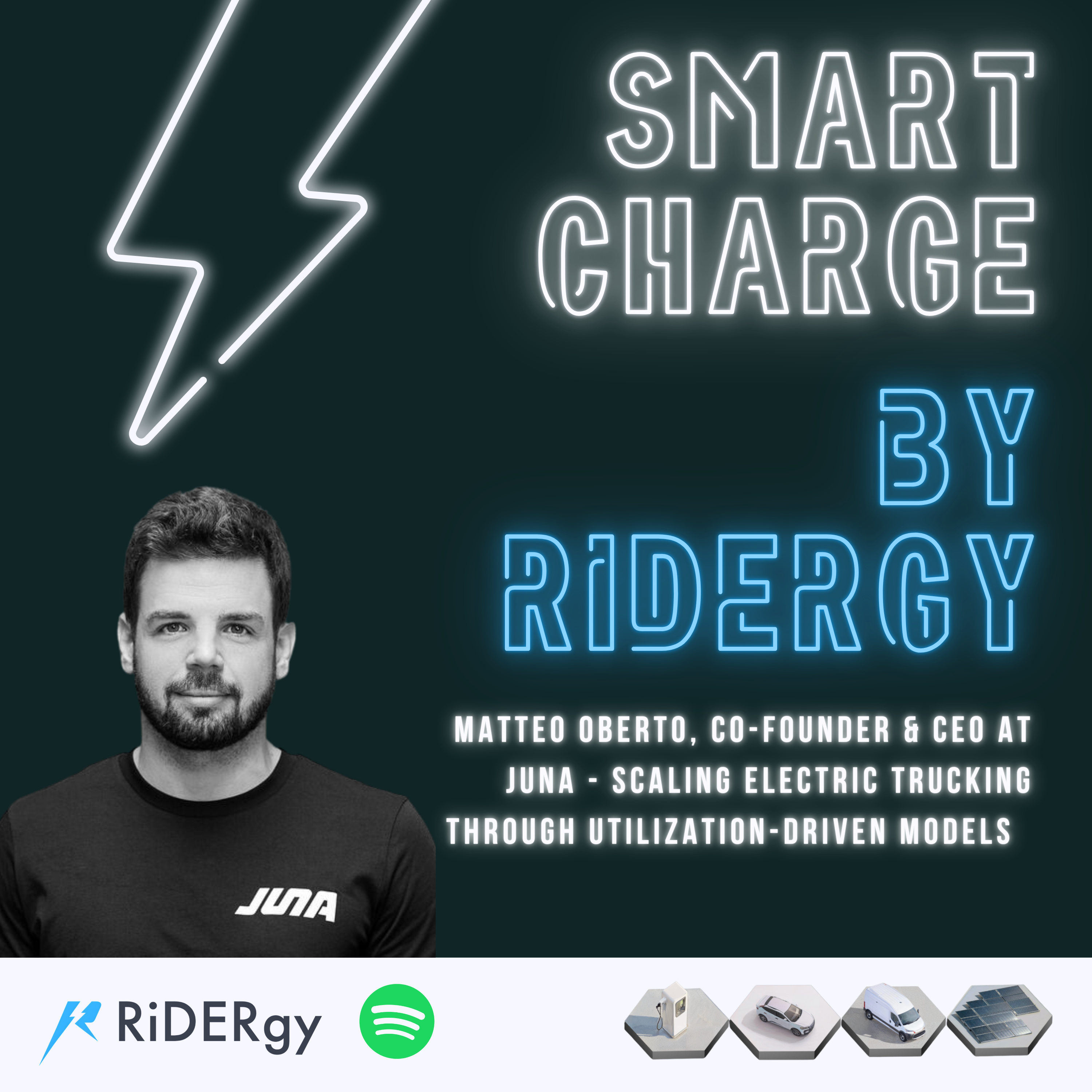
Matteo Oberto - Co‑Founder & CEO at JUNA
Scaling Electric Trucking Through Utilization-Driven Models
Transcripción
Depurada a partir de una transcripción automática. Las traducciones son automáticas y pueden contener errores.
Bienvenido al podcast Smart Charge by RiDERgy. Soy Claudio Geyken, fundador y CEO de RiDERgy. Este es tu programa para aprender todo sobre gestión de energía e innovación en smart charging para vehículos eléctricos y flotas.
El episodio de hoy trata sobre la dura realidad de electrificar el transporte de carga por carretera. No es un simple cambio de tecnología, es un cambio completo del sistema operativo - vehículos, acceso a carga, rutas, utilización y financiamiento - donde el eslabón más débil determina si el caso de negocio funciona. Mi invitado es Matteo, CEO de Juna. Comparte su trayectoria desde sus primeros roles en BCG en Londres hasta trabajar en empresas en crecimiento en logística, especialmente en Senda, y cómo esa experiencia moldeó una visión muy pragmática: si quieres que los camiones eléctricos escalen, la solución tiene que funcionar para los
transportistas que realmente mueven la mayor parte de la carga en Europa, y muchas dimensiones juegan un papel. Luego desglosamos qué está construyendo Juna y por qué - reduciendo riesgos para flotas, estructurando modelos comerciales viables y haciendo que la carga sea una realidad práctica a través de carga en depósito, carga pública y el mundo emergente intermedio de infraestructura compartida semi-pública. Si te importan los e-trucks más allá de pilotos, esta conversación es un modelo de lo que necesita funcionar. Vamos allá. Hola Matteo, un placer tenerte aquí. ¿Cómo estás hoy? Hola, y gracias por recibirme.
Estoy muy emocionado de estar aquí y tener esta conversación contigo. Genial. Entonces primero, antes de pasar a temas más detallados sobre Juna, ¿puedes presentarte? ¿Cuál es tu trayectoria, para que la gente se haga una idea de quién es Matteo? Sí, encantado de hacerlo. Mi nombre es Matteo, soy italiano originalmente. Crecí en una ciudad llamada Torino, cerca de los Alpes. Mi formación desde el punto de vista educativo es gestión empresarial. Estudié economía en mi
licenciatura en Turín, y luego pasé a estudiar gestión empresarial en Copenhague, Dinamarca. Después de eso me moví al mundo profesional. Comencé en consultoría, luego terminé en startups y finalmente en Juna. Encantado de profundizar un poco más en eso, pero gestión empresarial y ahora emprendimiento es mi trayectoria. OK, ¿y cuáles fueron las primeras startups en las que estuviste involucrado, o cuál fue la primera trayectoria profesional que tomaste después de tus estudios? Sí, entonces en realidad comencé
en Londres. Empecé en Vodafone, una empresa de telecomunicaciones. En aquel entonces, después de mi maestría, realmente no sabía qué quería hacer, así que comencé un programa de graduados - el típico programa multifuncional donde cada seis meses básicamente haces algo diferente. Mientras estaba en Vodafone lo descubrí: quería estar un poco más involucrado en las áreas de estrategia de las empresas. Y por eso me moví para empezar en consultoría. Me uní a una firma de consultoría estratégica
llamada Boston Consulting Group, donde terminé pasando 4.5 años. Lo que hice en BCG fue principalmente trabajar en la práctica de private equity - básicamente pasando tiempo con fondos de inversión privada, ayudándoles en dos cosas: o bien decidir si una empresa es un buen activo para comprar o vender, las llamadas due diligences comerciales, o ayudándoles, una vez que realmente habían comprado una empresa, a entender qué hacer con esa empresa - los típicos planes de transformación o estratégicos donde intentan
acelerar el crecimiento de sus empresas. En algún momento estaba, si quieres, cansado del entorno de consultoría, principalmente porque tenía la sensación - como muchas personas que hacen consultoría en algún momento tienen - de que mis responsabilidades terminaban cuando el trabajo del fondo comenzaba, que es básicamente la implementación. Y por eso me preguntaba qué más podía hacer en mi carrera para estar un poco más cerca de la implementación, para ver el resultado real de mi
pensamiento y mi trabajo. Fue entonces cuando empecé a pensar que el ecosistema de startups podría ser muy interesante para mí - principalmente porque trabajar en un entorno pequeño a mediano, pero muy dinámico, me habría dado la oportunidad de realmente ver el resultado de mi trabajo, de construir un impacto, pero también de permanecer en un entorno muy dinámico, energético y de ritmo rápido. En ese momento básicamente me encontré con Senda. En aquel entonces ya estaba en su fase de scale-up,
no realmente una startup en etapa temprana. ¿Estamos hablando de qué año? Estamos hablando de 2021, básicamente hace unos 4.5 años. En aquel entonces tuve la primera conversación con el equipo fundador de Senda. Estaban buscando a alguien que básicamente se hiciera cargo de liderar su equipo de estrategia. Quedé muy impresionado por la historia de Senda, por la gente que trabajaba en Senda, y decidí casi de la noche a la mañana dejar la consultoría, mudarme a Berlín y comenzar mi trayectoria
en Senda. Desde ahí todo fue bastante rápido. Pasé un par de años en Senda ayudando en diferentes temas estratégicos, y uno de esos temas era en realidad la electrificación - qué tipo de papel podría jugar Senda en este cambio tecnológico. Desde ahí, básicamente, comenzó el trabajo en Juna - las discusiones con el equipo, y luego tomé la responsabilidad de lanzar la empresa y establecer las operaciones. Hoy lidero la
empresa como CEO y uno de los directores gerentes. Muy interesante. Tal vez antes de proceder con Juna, un paso atrás nuevamente sobre el rol de private equity. ¿Qué tipo de empresas analizaste en aquel entonces - en términos de tamaño - o hay algún tema en particular en el que tuvieras que trabajar, y qué conclusiones clave sacas de ese tiempo? Sí, pregunta interesante. Realmente hice una mezcla de muchas cosas, principalmente empresas de tamaño mediano a grande,
en una variedad de industrias, así que realmente miré cosas que eran - recuerdo energía. Recuerdo haber analizado esta empresa de hidrógeno, muy interesante porque fue para mí una introducción a qué es el hidrógeno. Me metí en automotriz, hice medios, así que fue realmente una mezcla de muchas cosas. Así que diría que no desarrollé realmente un conocimiento vertical específico de la industria. Principalmente lo que aprendí fue un método
realmente abordar un problema o una gran pregunta que no necesariamente tiene una respuesta directa, e intentar descomponer el problema, intentar descomponer la pregunta en piezas pequeñas y trabajar en ellas para luego llegar a una respuesta final. Lo cual creo que también es lo que hago hoy en mi vida diaria cuando se trata de mi actividad profesional, porque el emprendimiento, o de cualquier manera hacer crecer una empresa, es muy parecido a lidiar con incógnitas e intentar
enfrentar esas incógnitas y encontrar un camino, un camino exitoso a través de esas incógnitas. Así que diría que considero mucho la consultoría como un gimnasio donde construyes tus músculos, donde construyes tu técnica, y luego necesitas ir - suelo decir - al mundo real, y entonces usar esos músculos, esas técnicas para enfrentar desafíos de verdad, y poder, como decía, también mirar el resultado y la implementación de tu trabajo. Tiene sentido. Y
para Sennder, entonces comenzaste a trabajar directamente en e-movilidad, toda esa estrategia alrededor de e-movilidad. ¿Y cómo llegaste a la conclusión de que construir Juna junto con Scania era una buena idea? ¿Cuál fue la historia del origen de Juna? Básicamente, al principio yo estaba abordando para Sennder una variedad de temas estratégicos, pero había un punto específico que estaba en la mente de David, el CEO y uno de los cofundadores, que era cómo Sennder debía posicionarse cuando se trata de
cambios tecnológicos. Y si miramos la industria del transporte, en el transporte por carretera, podemos ver que ha habido un par de grandes cambios y vienen más en el futuro. Entonces, por supuesto, Sennder se construyó sobre la digitalización, que es un cambio muy transformador de la industria del transporte. Y el siguiente cambio que Sennder estaba observando era, en ese momento, la electrificación, y luego si miráramos hacia el
futuro, por supuesto, tendríamos la autonomía en algún momento. Y entonces en ese momento se estaba pensando en qué tipo de obstáculos había para que sucediera la electrificación y qué tipo de papel podría jugar Sennder para permitir que la electrificación se acelerara, porque por supuesto hay una parte importante del ADN de Sennder que es lo que llaman la parte verde - que es cómo básicamente descarbonizar las operaciones. Y entonces estábamos discutiendo - recuerdo que junto con David y Nico, quien
en ese momento era el Director de Estrategia, y Graham, que es el Director Senior del departamento Verde en Sennder - estábamos discutiendo qué tipo de papel podría jugar Sennder. Y en ese momento la idea que tuvimos, que sigue siendo uno de los conceptos principales de Juna, fue: bueno, Sennder tiene muchos volúmenes, tiene muchas conexiones con los grandes cargadores que realmente están demandando transporte eléctrico. ¿Qué tal si combináramos esa demanda con la oferta de camiones? Entonces básicamente le
daríamos a la empresa de transporte promedio - que es una empresa pequeña a mediana que no quiere asumir mucho riesgo - no solo la tecnología, es decir el camión eléctrico, sino también utilización lista. ¿No resolveríamos lo que hoy está impidiendo, o incluso en ese momento estaba impidiendo, la adopción de camiones eléctricos, que es el riesgo de invertir en una nueva tecnología que es muy cara, muy nueva, sin la certeza de tener un retorno de esa inversión? Entonces ese fue el
punto de partida. Y luego hay una relación de larga data entre Sennder y Scania, porque Scania es uno de los inversores en Sennder. Y por lo tanto, básicamente, nos acercamos a Scania, contándoles un poco sobre nuestra narrativa y nuestro pensamiento. En ese momento, Scania también estaba lanzando sus primeros camiones eléctricos de batería, y estaban pasando por un razonamiento un poco similar: ¿cómo podemos, desde una perspectiva de fabricante, acelerar la adopción de camiones eléctricos, sabiendo que nuevamente, tecnología nueva, costosa, no tan fácil de operar? Y ahí básicamente
les gustó la idea. Comenzamos con un grupo de trabajo, comenzamos a refinar la idea, construyendo el típico modelo de negocio, plan de negocios, etc., y eventualmente nos movimos hacia la discusión más concreta de cómo establecer una empresa - la negociación legal alrededor de construir una empresa conjunta, que nunca es trivial. Y desde ahí, básicamente, nos movimos hacia la incorporación de la empresa, que sucedió a finales de 2023. Y desde entonces, tenemos a Juna. Entonces ahora
ya pasamos el segundo año de operación, lo cual creo que es un logro muy bonito y muy gratificante, porque estamos haciendo un gran progreso desde mi perspectiva. Bien. Y profundicemos en los usuarios que ya mencionaste, que estás ayudando - así que los conductores o las empresas de logística que usualmente son muy pequeñas, entiendo. Tal vez también puedas dar algunas estadísticas sobre cuál es la empresa objetivo típica que ayudas. Y si entiendo correctamente, el problema que estaban identificando es
que tienen dificultades con tener el capex por un lado - financiar estos camiones, ese es el gran problema - y luego estar inseguros de que generen suficientes ingresos y por lo tanto puedan hacer frente a los costos de operar. Y entonces estaban resolviendo esos dos problemas con la utilización a través de la red de Sennder y el financiamiento de capex que ustedes proveerían, ¿correcto? Así es. Y tienes razón, entonces si miramos la industria del transporte de carga por carretera, el 80% de las empresas de transporte son pequeñas a
medianas empresas. Tienen en promedio 7 camiones y van desde, digamos, 5 hasta 50 camiones. Esas empresas por supuesto no tienen los recursos, ni tampoco tienen las competencias para mirar hacia la electrificación, y son adversas al riesgo. Ahora, el modelo típico en la industria del transporte de camiones sería vender camiones a las empresas de transporte o arrendarlos. Estos modelos realmente no se ajustan a la adopción de una nueva tecnología porque ponen todos los riesgos de la nueva
tecnología en esas pequeñas empresas de transporte que, digamos, tradicionalmente tendrían que comprar o arrendar el activo, aprender cómo optimizar la utilización de esos activos y luego encontrar utilización para pagar su CAPEX u OPEX dependiendo de cómo obtengan acceso a esos activos. Ahora, lo que Juna - o la forma en que Juna, en cierto modo, resuelve el problema de adopción - es mirando quién realmente demanda electrificación o descarbonización. Esos suelen ser los compradores de flete, y pueden ser embarcadores - Coca-Cola,
Pepsi, los Pepsis de este mundo - o incluso proveedores de servicios logísticos más grandes. Piensa en DHL, piensa en Kuehne+Nagel, los grandes proveedores de servicios logísticos. Esas empresas operan mayormente a través de subcontratistas. Básicamente el 80 a 90% de su flete es movido por esas pequeñas empresas de transporte de las que estábamos hablando. Ahora, necesitan una forma de incentivar a esas empresas de transporte para que adopten camiones eléctricos, de lo contrario no pueden descarbonizar sus operaciones. Entonces la lógica que adopta Juna es asociarse con los proveedores de servicios logísticos y embarcadores - los compradores de flete - e identificar dónde
puede ocurrir la electrificación, diseñar una hoja de ruta para que suceda la electrificación y luego acercarse a las empresas de transporte, los subcontratistas, y habilitarlas para adoptar camiones eléctricos con un modelo que no es un típico alquiler o arrendamiento, sino lo que llamamos una suscripción. Entonces es un modelo como servicio mediante el cual las empresas de transporte obtienen el camión, todos los servicios relacionados con el camión, y también pagan según la utilización, o sea por kilómetro. Eso, como decías correctamente, resuelve dos problemas. Por un lado, el llamado financiamiento del
nuevo activo, considerando que esos activos son 2 a 3 veces más caros que los típicos camiones diésel, pero también resuelve el problema de utilización - dónde se utilizarán esos camiones - y ayuda a las empresas de transporte a tener seguridad de ingresos para cubrir sus costos. Y Sennder juega un papel central porque Sennder es un gran transportista de carga y tiene conexión con un gran número de embarcadores que demandan transporte verde. Entonces Sennder, especialmente al principio y todavía hoy, jugó un papel importante proporcionando acceso
a esa utilización que combinamos con nuestra suscripción, que permite que la electrificación ocurra hoy a un ritmo más rápido que si las empresas fueran dejadas solas para invertir en camiones eléctricos. Entendido. Entonces una tesis fundamental, o también un problema subyacente de la nueva tecnología que estás resolviendo - si entiendo correctamente, ese sería el más grande, el elefante en la habitación si quieres - es el rango, ¿verdad? Eso es cómo lidiar con el rango más limitado de los camiones eléctricos. Porque al final del día, y si
puedes recargar o cargar y simplemente hacer tus rutas como si estuvieras poniendo un camión eléctrico como pondrías un camión diésel, y eso es todo, no tienes mucho cambio en tu - pero necesitas entender qué rutas son factibles con qué rango, y luego cuáles son las implicaciones de carga, ¿verdad? Esa es la complejidad, la mayor complejidad que estás resolviendo con ese enfoque, ¿correcto? Esa es definitivamente una gran complejidad, yo diría.
Desde una perspectiva operativa, es probablemente la más grande. Cuando pienso en las complejidades, suelo tender a mirar en diferentes categorías. Entonces definitivamente hay una categoría operativa, que básicamente significa que los camiones eléctricos tienen un rango limitado y también la infraestructura para cargar los camiones no es tan densa como el típico sistema de combustible para gasolina y diésel. Entonces eso es definitivamente, en el lado operativo, una gran barrera a superar. Luego por supuesto no tenemos que
olvidar la barrera financiera - el hecho de que esos camiones son más caros en cuanto al CapEx, el costo, pero también cuando se trata de operarlos. Cuando se trata de los gastos operativos, necesitan ser usados de cierta manera inteligente para poder realizar costos operativos competitivos. Entonces con nuestro modelo, si quieres, abordamos ambos, porque encontramos en nombre de las empresas de transporte las rutas que sabemos pueden ser electrificadas desde un punto de vista operativo. Entonces sabemos que el
rango no es demasiado largo, o hay una estación de recarga en el medio. Hacemos el llamado análisis técnico y decimos que lo hemos verificado - puede ser electrificado desde una perspectiva técnica. La segunda capa, que es extremadamente importante, es también resolver la pregunta: ¿es también rentable operar la ruta? ¿Podemos operar la ruta a un costo que esté cerca - el término usual siendo el TCO, el costo total de propiedad - de operar un camión en
esa ruta cerca del costo total de propiedad de operar la ruta con diésel? Entonces, ¿podemos operar cerca del costo diésel con un camión eléctrico? Y esa es la segunda capa de complejidad que necesitamos resolver. ¿Cómo resolvemos eso? Bueno, necesitamos tomar una perspectiva un poco más amplia. Resolvemos eso a través de la forma en que financiamos los camiones eléctricos - reducimos el costo de los camiones eléctricos a través de nuestro modelo de financiamiento. Ese es un elemento. Resolvemos eso mirando
la carga. La carga y la energía son un componente importante en el costo de operar camiones eléctricos. Es aproximadamente un tercio del costo total de operar camiones eléctricos. Entonces tenemos, digamos, una forma de mirar la carga inteligente. Tenemos un modelo de asociación con actores de carga para reducir el costo de la carga. Y luego la tercera capa es cómo construimos el enrutamiento, que creo que también es a lo que te referías al principio, lo que básicamente significa que debido a que los activos son más caros,
necesitan ser operados de una manera muy efectiva, entonces reduciendo tanto como sea posible los kilómetros vacíos. Tenemos un equipo tecnológico que ha desarrollado, o está desarrollando mientras hablamos, una solución tecnológica, y tenemos un equipo de los llamados diseñadores de soluciones. Lo que hacen es básicamente construir, dentro de redes logísticas, enrutamientos efectivos para camiones eléctricos, asegurando que esos camiones eléctricos estén tanto como sea posible completamente utilizados y mirando la forma en que los camiones eléctricos son usados, para que esa utilización ayude
el caso de negocio y ayuda a reducir el coste de operación. Sí, me encanta este desglose. Creo que hemos hecho una muy buena visión general ahora mismo. Podemos profundizar un poco más en la tercera categoría. Creo que también requeriría un poco de contexto para las personas que no están tan familiarizadas con la industria logística. Será muy interesante entender cómo sucede hoy. ¿Cuál es el status quo hoy? ¿Es tan simple como decir que un camión tiene un pedido y
necesita hacer ese pedido de A a B y luego simplemente vuelve a su punto A vacío? ¿Y eso es el 90% de los casos? ¿O eso es una caricatura, y a dónde intentas llegar eventualmente - que hagan más rutas tipo A, B, C, D antes de volver al depósito? Tal vez puedas dar un poco más de contexto ahí.
Claro, y la realidad es que no hay una respuesta única para todos, porque depende de las características del mercado. Te doy un ejemplo claro: en Alemania, y a partir del próximo año también en los Países Bajos, los camiones eléctricos no pagan peajes en las autopistas. Eso básicamente significa - y también los camiones diésel pagan una tarifa muy elevada por kilómetro, aproximadamente 34 céntimos en autopista - que para encontrar los mejores casos de negocio, uno de los mejores casos de negocio es en realidad hacer que los camiones eléctricos circulen tanto como sea posible, completamente
en autopistas. Lo que básicamente significa maximizar el tiempo que un conductor pasa conduciendo en autopista con un camión eléctrico. Esto básicamente significa que priorizas - o nosotros priorizamos - rutas de larga distancia que van hasta 400 o 500 kilómetros en una dirección, principalmente en autopistas. Esto también significa, sin embargo, que el camión tiene que volver, y si vuelve vacío, tienes mucha ineficiencia, porque el camión diésel no volverá vacío. El camión diésel continuaría quizás haciendo otra
carga, tal vez ni siquiera volviendo, tal vez iría a otro lugar porque es lo suficientemente flexible como para recoger otra carga e ir a otro sitio. Con un camión eléctrico, necesitas saber a dónde va el camión porque necesitas saber dónde va a cargar el camión en algún momento, ya sea durante el día o por la noche. Lo que básicamente significa que construyes esos circuitos que están 100% completados, o lo más posible, lo más cerca posible del 100%, e intentas construir esos circuitos
en autopistas para que maximices el ahorro en costes que los camiones eléctricos pueden darte. En otros países, este no es el caso. En otros países, si circulamos en autopista extensamente, no tenemos una ventaja. Te doy el ejemplo de Italia, y en esas circunstancias, por ejemplo, lo que estamos viendo es que es más rentable reducir el número de kilómetros pero aumentar el número de envíos, para que prioricemos operaciones donde hacemos un trabajo frecuente de A a B.
Así que los camiones se mueven frecuentemente de A a B. Va en una dirección lleno, vuelve vacío, y al volver vacío, ahorra tiempo para hacer otro circuito, otro envío. Entonces en ese caso, lo que hacemos es optimizar el número de envíos y dividimos el coste del camión - el alto coste del camión - entre un número alto de envíos. Así que dependiendo de las condiciones del mercado, y dependiendo no solo de las autopistas sino también del coste de la energía, dependiendo del coste
de los camiones también en diferentes mercados, hemos desarrollado una estrategia diferente que nos permitiría construir esas rutas inteligentes que son adecuadas para camiones eléctricos, con la intención, el propósito y el objetivo de cerrar o reducir la brecha tanto como sea posible entre el coste de operar un camión eléctrico y el coste de operar un camión diésel. Tiene sentido. Y luego en la segunda categoría, la carga - y tal vez antes de eso, dijiste que un tercio del coste es la carga, y
un tercio sería CapEx, y luego el otro tercio es típicamente lo que llamamos el coste del transportista o la empresa de transporte, así que piensa en el conductor, el remolque y sus costes fijos - pero principalmente sería el conductor. Y entonces en este tercio del coste, la carga, ¿cuáles son las formas en que ayudas a estas empresas? Dijiste que tienes socios para la instalación de infraestructura de carga en depósito, imagino. Y luego la segunda sería en carga pública, tienes partnerships con operadores de puntos de carga, CPOs, o MSPs, así que la tarjeta o app. ¿Cuál es el enfoque para los dos escenarios de carga?
Sí, eso es correcto. Así que básicamente trabajamos con socios en ambos verticales. El vertical uno, que es el segundo que mencionaste, es la carga pública. Tal vez algunos de los oyentes se sorprendan al saber que hay, en ciertos mercados, en realidad un número bastante alto de estaciones de carga para camiones. Ahora, no estoy diciendo que ese número
sea suficiente para electrificar el transporte de mercancías por carretera. Apenas estamos al principio, estamos arañando la superficie. ¿Te refieres exclusivamente a las del tipo Milence del mundo, o te refieres a las que podrían ser utilizadas por camiones en general? También para - es un buen punto, así que hay dos categorías. Están las llamadas - las llamamos truck-built - así que esas han sido construidas para camiones. Mencionaste Milence, que es definitivamente uno de los jugadores líderes en este segmento. También BP Aral ha desarrollado estaciones para
camiones eléctricos. También hemos visto a Shell jugando en este vertical. Así que hay tanto jugadores tradicionales incumbentes que vienen del mundo del diésel como, digamos, recién llegados en cierto modo, construyendo estaciones para camiones. Esas son las estaciones típicas que pueden acomodar tanto el remolque como el tractor juntos, y ofrecen la mejor experiencia para cargar porque están exclusivamente pensadas y construidas para camiones. Luego hay otra categoría que llamamos las estaciones truck-friendly. Esas serían estaciones donde, digamos,
la intención cuando se construyeron no era alojar camiones eléctricos, sino solo coches de pasajeros, pero debido a la potencia de la infraestructura y al espacio físico, también pueden acomodar no el tractor más el remolque, sino solo el tractor. Por supuesto, en esos casos, necesitamos ser un poco más cuidadosos. Necesitamos tener siempre un cierto acuerdo con el CPO para poder usar esas estaciones, porque no queremos - por una razón de seguridad, pero
también por una razón operativa - no queremos interrumpir las operaciones normales de esas estaciones. Pero hoy hay varios casos en los que los CPOs permiten que las unidades tractoras carguen en estaciones que fueron construidas para coches de pasajeros. Entonces, en este gran grupo de, digamos, estaciones públicamente disponibles para camiones, trabajamos con un modelo tipo asociación, que básicamente significa que tenemos contacto con todos los llamados CPOs, los operadores de puntos de carga. Trabajamos con ellos para identificar qué estaciones están disponibles y dónde. Tenemos
nuestra propia base de datos de estaciones que mantenemos junto con los CPOs, y usamos esa base de datos para básicamente apoyar nuestro trabajo en el enrutamiento eficiente. La otra cosa que hacemos con esa base de datos es tener una comprensión de cuánta utilización podemos aportar a cada CPO, y discutir con ellos cómo podemos reducir el costo de recarga en sus estaciones. La idea para nosotros nunca es usar descuentos para ganar más dinero de nuestra parte. No revendemos
electricidad, pero lo que hacemos es pasar cualquier descuento directamente a nuestros clientes finales, que son las empresas de transporte. Porque nuestra misión es reducir el costo de operar camiones eléctricos, para aumentar el volumen, el número de camiones eléctricos que desplegamos juntos. Bien. El segundo grupo es la carga en depósito, carga en el sitio. Aquí también tenemos varios socios en nuestro ecosistema, y lo que hacemos es trabajar con ellos para - digamos, primero evaluar: ¿tiene sentido construir una infraestructura de carga en depósito,
dependiendo del caso de utilización que tenemos, y si es así, básicamente construimos juntos el caso de negocio y luego los dejamos construir y/o gestionar la estación de carga, porque no tenemos - o no es una competencia que tengamos internamente en Juna. También hay un modelo híbrido intermedio, que creo que es muy interesante, especialmente en esta fase inicial de electrificación, que es el modelo de las estaciones semi-públicas. Entonces, esas serían estaciones que tienen cargadores - exacto. Entonces,
estaciones que habrían sido construidas por una empresa de logística pero no están completamente utilizadas. Eso básicamente significa que esas empresas pueden dar acceso a la capacidad sobrante a otras empresas de logística. Y hay varios actores que están construyendo mercados que agregan esas estaciones, y creo que esa es una oportunidad fantástica porque permite una utilización más eficiente de la infraestructura, lo que debería traer eficiencia a toda la transformación de la industria. ¿Qué tipo de actores están construyendo estos proyectos de infraestructura compartida?
Entonces, hay diferentes actores. Esas estaciones compartidas usualmente están realmente diseñadas y construidas para una empresa específica en mente, pero esa empresa específica podría necesitarlas solo durante la noche o durante el día. Entonces, tendrían capacidad sobrante y pueden hacer que esa capacidad sobrante esté disponible. También hay actores que están construyendo - digamos, más compartidos, si quieres - hubs, donde básicamente identificarían en cierta ubicación una necesidad de carga porque es una ubicación de alta frecuencia
para logística, y luego básicamente construirían la estación sabiendo - o teniendo cierto compromiso ya - de una empresa específica o múltiples empresas operando ese corredor logístico. Entonces, esa es también otra, tal vez si quieres, especie de esa infraestructura semi-pública. Y para asegurarme de que entendí correctamente: para las asociaciones con CPOs, no trabajas con un MSP, trabajas solo con los CPOs directamente. Eso es correcto - ese es el caso en el 90% de los casos. Tenemos ciertos acuerdos con MSPs; específicamente hay una empresa de
Scania llamada Scania Charging Access, que es un MSP, y sí nos asociamos con ellos en ciertas estaciones específicas donde tienen buenos acuerdos. Pero digamos que nuestra estrategia estándar sería ir directamente, y la razón es: en esta fase tratamos de obtener tanto como sea posible una relación directa con los CPOs para apoyarlos en identificar dónde se pueden construir nuevas estaciones, para obtener también un intercambio frecuente sobre dónde están planeando construir las estaciones, y luego para obtener tanto como sea posible
digamos una tarifa baja, sin intermediarios, para luego poder pasar eso a nuestros clientes. Y el enfoque - creo que ahora ya están en múltiples países, ¿no? No solo en Alemania o Italia. Y entonces el enfoque para construir infraestructura de carga en depósitos - también hay, supongo, no un solo socio en Europa, sino varios en cada geografía. ¿Es correcto? Entonces, dependiendo de la geografía y dependiendo de la disponibilidad de socios, trabajamos con múltiples actores. Y la idea siempre es
traer al actor mejor posicionado al juego, para asegurar que podamos construir juntos el caso de negocio que funcione para la empresa de transporte y para el embarcador. OK. Y hablemos de - entonces dijiste que creaste una empresa en 2023. ¿Cuál ha sido la recepción del mercado? ¿Cómo están reaccionando las empresas de transporte hasta ahora? ¿Cuáles son los obstáculos, objeciones y desafíos que enfrentan, y cómo los están abordando? Cuando estabas formulando la pregunta, me vino a la
mente - el primer camión eléctrico que llevamos a la carretera, que ocurrió poco después de que incorporamos la empresa. Todavía recuerdo la experiencia de entregar eso a una empresa de transporte, porque yo mismo y el equipo de gestión de Juna, básicamente viajamos junto con el camión en realidad. El CEO, el COO Johann, y el CFO Andred, condujeron el camión porque vienen del ecosistema Scania, así que tienen licencia para conducir un camión. Entonces,
yo mismo y Thomas - y Thomas es el CTO - íbamos detrás en un coche, y juntos condujimos desde Berlín hasta Stuttgart para entregar el camión a esta empresa de transporte llamada Ava, que es uno de nuestros socios más fuertes hoy en día. Recuerdo la energía y la emoción del dueño al recibir su primer camión eléctrico. Así que lo que estoy tratando de transmitir
aquí es que aún hoy, lo que vemos es que hay una aceptación muy abierta de esta tecnología por parte de la mayoría de las empresas con las que trabajamos. Esto no significa que las empresas no sean escépticas al principio, que no hagan preguntas, que no teman también, hasta cierto punto, la tecnología, el costo, los eventos imprevistos que pueden ocurrir - pero una vez que se ponen en las condiciones adecuadas, están realmente muy dispuestas a pasar por este cambio. Y hay dos
razones. No soy ingenuo - definitivamente hay un razonamiento de tipo sostenibilidad. Realmente creo que hay muchas empresas en el transporte que piensan y quieren traer la descarbonización a la mesa, porque entienden que lo que hacen, su servicio, es fundamental para la sociedad, pero sí tiene un impacto en el mundo. Así que sí, la sostenibilidad es un
gran motor. Y el segundo motor es: entienden que para volverse y mantenerse competitivos en un mercado que está muy impulsado por los costos, necesitan distinguirse de sus competidores. Especialmente las pequeñas y medianas empresas de transporte - tienen un cierto límite en cuanto a cuánto pueden optimizar su base de costos, y por lo tanto apostar por la capacidad de ofrecer un servicio diferente se convierte en una forma de mantenerse competitivos en el mercado. Así que diría que la aceptación de
la nueva tecnología es muy positiva, y específicamente diría que nuestro modelo parece estar respondiendo muy bien a las necesidades y preguntas de las empresas de transporte. Porque hasta ahora, cada vez que hemos tenido un compromiso de demanda de un comprador de carga y luego hablamos con sus empresas de transporte o trajimos una empresa de transporte para hacer el trabajo, nunca recibimos una negativa. En el momento en que las empresas de transporte reciben apoyo - se les da
el activo, se les da la demanda - están muy abiertas, dispuestas y proactivas para operar. Y luego cuando entran en operaciones, asumen todas las responsabilidades. Si hay problemas, saben cómo comportarse. Obviamente, el transporte y las operaciones de transporte son su campo, y se vuelven extremadamente atentos para asegurar que el proyecto se desarrolle de manera positiva para que pueda prolongarse, confirmarse, y también puedan hacer crecer su flota de camiones eléctricos. Bien. Los casos de uso para estos
camiones - quiero decir, hay muchos: pueden ser larga distancia, o más bien la milla intermedia, o la distribución, en diferentes tipos de casos de uso o sectores. ¿Cuáles son los más comunes ahora mismo desde que empezaron? ¿Cuáles son los casos de uso típicos, si quieres decirlo así? Sí, entonces hoy, cuando se trata de dónde hemos desplegado camiones, diría que principalmente hacemos lo que yo llamaría distribución regional o transporte regional. Lo que básicamente significa que la
distribución regional es típicamente una operación de tipo hub-and-spokes, así que el camión cada mañana sale del mismo centro y luego, dependiendo de la disponibilidad de cargas, se mueve a diferentes destinos. O transporte regional, es decir, el camión haría en realidad A a B y luego B a A dentro del mismo día, todos los días. La distancia puede oscilar desde - digamos cuando lo veo - 50 kilómetros hasta 600 kilómetros diarios. Así que si obviamente solo hacemos 50 kilómetros punto a punto, hacemos
múltiples punto a punto, entonces diariamente, nunca hacemos menos de 300, 350 kilómetros, porque menos de eso hemos visto que no es económicamente competitivo. Así que necesitamos maximizar la utilización de los camiones eléctricos. Y digamos que trabajamos en una variedad de industrias. Hay algunas industrias que son un poco más adecuadas para la electrificación, especialmente las industrias donde vemos volúmenes estables y también viajes de retorno. Pongo un ejemplo: la industria de bebidas es una industria típica donde
llevas botellas llenas en una pierna, y luego regresas con botellas vacías. Esos son obviamente circuitos ya eficientes por sí mismos. Otras industrias, por ejemplo los productos de consumo masivo, usualmente van solo en una dirección, y por lo tanto somos nosotros quienes tenemos que encontrar una optimización en la pierna de retorno. Pero digamos que hacemos tanto industrias orientadas al consumidor, donde la capacidad de también usar el transporte y el transporte verde como marketing, como una comunicación
palanca es explotada - así que trabajamos con industrias orientadas al consumidor, pero también con industrias industriales donde a veces la contribución del costo del transporte sobre el costo del bien final es menor que en las industrias orientadas al consumidor, y por lo tanto hay una aceptación ligeramente mayor de un costo más alto del transporte eléctrico. Entendido. En el TCO que han medido hasta ahora y que lograron obtener
equivalente o incluso más bajo que el diésel. Yo diría que también aquí es una respuesta caso por caso. Trabajamos en ciertas configuraciones donde trajimos al transportista una optimización junto con el despliegue de camiones eléctricos. Tengo uno en mente que estamos ejecutando en Hamburgo, donde básicamente combinamos cargas que tradicionalmente se hacían con múltiples camiones, las pusimos en un camión, y por lo tanto hemos reducido el número de vehículos pero
también cambiado a vehículos eléctricos, y lo hicimos TCO-neutral simplemente construyendo eficiencia en su red. Hay casos donde hemos podido cambiar una operación que funciona extensivamente en la autopista y por lo tanto hemos podido alcanzar paridad de TCO. Hay otros casos donde los transportistas necesitan hacer una inversión. Así que depende mucho de cómo podamos diseñar las operaciones y cómo las operaciones tienen que funcionar, pero nuestro objetivo
siempre es cerrar la brecha, y la razón es que entendemos que la electrificación, para que ocurra a escala, tiene que suceder de manera competitiva en costos. No podemos pretender y no podemos prever una alta adopción de la electrificación si mover mercancías con camiones eléctricos cuesta 3 o 4 veces más que mover mercancías con un camión diésel, así que necesitamos llegar a la paridad de TCO. Obviamente es un esfuerzo conjunto. Nosotros en Juna hemos construido un modelo en el que creo mucho y que puede ayudar a impulsar la electrificación en esa
dirección. Definitivamente necesitamos el apoyo de los OEMs. Necesitamos que el costo de sus camiones baje. Necesitamos que asuman y sean más valientes con el llamado valor residual. Necesitamos apoyo de los actores de la carga. Necesitamos que también asuman un riesgo - que no reduzcan el costo de la electricidad solo cuando sus estaciones estén llenas, sino que también acepten que para que las estaciones se llenen, necesitan apoyar en el costo de la electricidad. Y luego también necesitamos que los transportistas estén
dispuestos a flexibilizar a veces sus operaciones - para permitir que ciertas eficiencias ocurran. A veces necesitamos hacer ciertos cambios. Necesitamos incluir los llamados remolques de acrobacia, que básicamente nos permiten hacer más cargas, más envíos, en el mismo día. Así que también necesitamos ese tipo de flexibilidad. En esencia es un poco un juego de ecosistema. Todavía veo que hoy todos están trabajando en la dirección correcta, pero para aumentar la velocidad de adopción, probablemente
también necesitamos aumentar la velocidad del trabajo en la dirección de la paridad de TCO. Sí, no lo tengo presente en términos de cuánto han disminuido los costos de los camiones eléctricos hasta ahora, pero las baterías han estado disminuyendo en costo tremendamente, y la tendencia sigue a la baja. Así que no estoy seguro si tú también lo tienes presente - cuál era el costo de un camión eléctrico hace un par de años - y ahora estamos hablando de 2 a 3 veces
cuándo. Y probablemente terminará siendo menos de 2 veces, lo cual sería un cambio radical en esa perspectiva, por ejemplo. Es un punto muy válido. Así que sí, para responder directamente a tu pregunta, hemos visto una disminución en el costo de los camiones eléctricos desde que empezamos, que también fue el primer año en que todos los OEMs introdujeron sus primeros modelos eléctricos. Hasta ahora, diría que probablemente hemos visto, en general, una disminución del 10% al 15% en dos años. ¿Continuará ese ritmo tan
rápido? Diría que hay diferentes perspectivas. Asumiría que probablemente bajará en los próximos 2 a 3 años otro probablemente 10% por año - creo que eso es posible - y luego probablemente se estabilizará. Hay diferentes tendencias, por supuesto, que podrían potencialmente acelerar esa disminución. Una grande es la entrada de actores chinos en el mercado, y ya los vemos empezando
desde 2026 - hay un par de actores chinos que básicamente deberían empezar operaciones con su oferta en Europa, y sabemos que el punto de precio es muy competitivo. Hay muchas preguntas abiertas sobre en qué medida su producto es competitivo, su servicio - es decir, su reparación y mantenimiento - es competitivo, pero definitivamente pondrán algo de presión sobre los fabricantes europeos para bajar los precios de los camiones. Así que sí, la
disminución de costos es visible y continuará. También creo que si tomamos la experiencia de los autos de pasajeros, la curva continuará bajando, ¿verdad? Porque hay economías de escala, economías de aprendizaje. También es cierto que estamos hablando de una tecnología diferente, así que lo que necesitamos hacer es ganar escala en las baterías para camiones eléctricos.
Básicamente, necesitamos que se empujen más camiones al mercado si queremos que esas economías de escala entren en juego. Y en el aspecto de la carga, también veo muchos vientos a favor para reducir costos. Tendría curiosidad, por un lado, cuánto es la distribución ahora mismo entre carga pública y carga privada, es decir, carga en depósito, y cómo esperas que esto se desarrolle para estos casos de uso. Y segundo - y eso es algo por lo que aquí en RiDERgy también estamos muy
apasionados - es cómo hacer de la flexibilidad en el uso de energía un activo para reducir costos: cargar cuando los mercados spot tienen muy bajo costo, tanto en cargadores públicos como privados, pero también, si tienes un depósito, la oportunidad de instalar solar, tratando de maximizar esa energía y apoyando a la red. Todos estos aspectos - carga bidireccional, vender energía de estas baterías cuando están estacionadas - creo que también pueden disminuir mucho el costo. ¿Cómo ves
eso? Sí, así que cuando se trata de la división, si miro la experiencia de Juna, hoy estamos dependiendo en gran medida de la carga pública. Diría que aproximadamente el 60 al 70% de nuestros camiones cargan en estaciones públicas. La razón es que por supuesto hay un costo de electricidad que es más alto cuando cargas públicamente, pero la velocidad a la que puedes desplegar camiones eléctricos es diferente porque no tienes que esperar a que la infraestructura esté
lista. A veces la potencia de la red no está ahí, así que exacto. Cuando vas con carga pública, puedes actuar más rápido, y especialmente cuando inicialmente despliegas un número limitado de camiones eléctricos no hay ninguna limitación real en usar carga pública. Hoy - mencionaba al principio - tenemos un caso muy interesante que funciona en Hamburgo donde tenemos 5 camiones eléctricos desplegados con 1 transportista y 1 operador, todos cargando en la estación de infraestructura de carga pública sin ningún
problema, porque en la configuración correcta yo todavía diría que cuando encuentras la estación de carga correcta para el proyecto correcto, generalmente la capacidad está disponible. Ahora, ¿cambiará esto en el futuro? Sí, por supuesto, porque espero que más camiones eléctricos entren al mercado, y la velocidad a la que los camiones eléctricos pueden entrar al mercado es más rápida que la velocidad a la que podemos desplegar infraestructura. Así que sí, también necesitamos depender de la carga en depósito, porque
la carga en depósito también ayudaría a la eficiencia - ayudaría a encontrar el equilibrio adecuado entre, por ejemplo, la carga lenta nocturna y la carga rápida durante el día o durante las operaciones, y la carga lenta cuando hay un descanso. Mirando hacia adelante, he escuchado y leído diferentes cifras. Creo que la carga en depósito jugará un papel importante dependiendo del tipo de operaciones. Dependiendo de si hablamos de transporte regional o de larga distancia, puede representar entre el 40
y el 60%, porque por supuesto depende mucho de la disponibilidad de un depósito al final de la operación - los camiones necesitan circular cerca del depósito y regresar a él. ¿Y todos tienen un depósito? Esa también es una pregunta interesante: ¿la mayoría de las empresas de transporte tienen suficiente capacidad para instalar cargadores en sus depósitos? Ese es un punto. ¿Tienen los depósitos? ¿Están los depósitos ubicados donde operan los
camiones? A veces las empresas de transporte operan camiones a kilómetros de distancia de su depósito, y por lo tanto los camiones no regresan al depósito. Tiene sentido. También es cierto que dentro de la categoría de carga en depósito, también puedes considerar los cargadores que los expedidores ahora están construyendo en sus almacenes. Definitivamente, la carga en depósito jugará un papel importante. Hoy también está jugando un papel importante. Trabajamos con varias empresas de transporte que están haciendo la inversión, y definitivamente vemos que
esta inversión es rentable si la infraestructura está bien diseñada, tiene el tamaño adecuado y también se usa de manera eficiente. Volviendo a tu punto sobre, por ejemplo, la carga dinámica y la carga bidireccional - esos son definitivamente conceptos que son extremadamente importantes en la industria. Yo diría que ahí es donde construyes el valor como actor de carga: la parte de software, la capacidad de construir una infraestructura que no sea solo el cargador conectado a la red, sino también colocar una batería, agregar
energía solar, y luego gestionar todos los diferentes activos a través de los sistemas de gestión de carga. Hoy lo que veo es que la industria se está poniendo al día en ese punto. Por ejemplo, en la carga pública, el precio dinámico aún no es algo común, y por lo tanto los CPOs están diseñando estrategias de precios para cubrir el costo más alto, porque no pueden prever la demanda y aún no pueden hacer precios dinámicos de la manera que quisieran - pero sé que
todos están trabajando en esa dirección. Así que confío en que no solo la infraestructura será más disponible, sino también que la forma en que se use y optimice la infraestructura reducirá el costo de la energía. Eso tiene todo el sentido. Y un punto que mencionaste también, que al menos en mis conversaciones escucho a menudo, es: "No podemos usar cargadores públicos porque no son confiables". Pero pareces sugerir que por experiencia no ves ningún problema de disponibilidad si tienes que depender de cargadores públicos
- normalmente son utilizables, ¿verdad? No necesitas reservarlos. La capacidad de reservarlos también se menciona a menudo. ¿Cómo lo ves? Sí, es un buen punto. La reserva es definitivamente un tema candente en la industria. Yo diría que hoy, por experiencia, es más un punto psicológico y no un punto real, es decir, a menudo escuchamos a expedidores o compradores de flete, pero incluso empresas de transporte, preguntar: "¿Qué pasa si la estación está ocupada? ¿Qué pasa si no está disponible?" En la mayoría de
los casos, esto no va a suceder. Y de todos modos, cuando diseñamos un proyecto, siempre verificamos con el operador de puntos de carga en qué medida esa estación suele estar ocupada según datos históricos en ciertas franjas horarias. Así que sí, es algo que tomamos en consideración - la disponibilidad - pero hoy diría que la reserva probablemente no es necesaria dado el número de camiones en la carretera. En el futuro será necesaria, especialmente en ciertas operaciones donde llegar a tiempo es extremadamente importante. Piensa en e-commerce. Piensa en
automotriz. Así que definitivamente también estamos colaborando con los CPOs para asegurar que reciban nuestra opinión cuando se trata de construir sistemas de reserva de franjas horarias. Pero como concepto general hoy, probablemente no es el cuello de botella en la carga. Cuando se trata de la confiabilidad de los cargadores públicos, diría que nuestra experiencia es que los CPOs - especialmente, solo puedo hablar principalmente de las estaciones para camiones - son en promedio extremadamente reactivos y extremadamente rápidos si señalamos que una de sus estaciones no está
funcionando. Obviamente hay un gran juego de reputación aquí, porque en el momento en que tu estación no funciona - con un auto de pasajeros tal vez puedes moverte unos kilómetros o cambiar el enchufe porque tienes múltiples opciones disponibles - con camiones este no es el caso. Y si tienes una mala experiencia, probablemente no volverás a esa estación. Por lo tanto, diría que puedo ver que hay un fuerte esfuerzo de
los CPOs, y hasta ahora no hemos estado experimentando problemas con la calidad de los puntos de carga. Bueno, eso es muy bueno. ¿Y qué hay del valor residual? Lo mencionaste como nota al margen. ¿Cuál es el riesgo ahí? ¿Lo asumes tú, la empresa de transporte, el OEM? Y la vida útil de la batería también es siempre un tema. Sí, entonces en nuestro modelo, y también cómo veo que se mueve la industria, el valor residual es algo que queda en
manos del OEM - así que típicamente esto sucedería si tenemos un acuerdo de leasing, o en nuestro caso con nuestro modelo de e-truck-as-a-service, recuperamos el camión al final de la asignación, así que asumimos el riesgo del valor residual, pero luego tenemos acuerdos con los OEMs - o la otra forma sería que las empresas compren camiones eléctricos y luego tengan el valor residual en sus libros. Creo que la industria se moverá en
una dirección donde el valor residual quedará con los OEMs. Así que básicamente el modelo de e-truck-as-a-service se convertirá en el modelo principal, donde la propiedad del activo permanece en manos del OEM - o en este caso de Juna, y Juna tiene un acuerdo con el OEM. Porque hay un valor en el activo una vez que regresa, que es mayor que el valor residual que solía existir para los camiones diésel. Los camiones diésel al final son hierro, si quieres simplificar
extremadamente, así que una vez que regresan el valor real es bastante bajo, bastante limitado. Cuando una batería regresa - es decir, al final de la vida útil de un camión - la batería todavía tiene el 80% de su capacidad. Por debajo del 80% lamentablemente ya no es adecuada para el transporte; se vuelve poco confiable. Pero puede usarse para otras aplicaciones - piensa en almacenamiento - lo que básicamente significa que hay un cierto
valor para los OEMs en mantener y retener la propiedad de las baterías, porque pueden monetizarlas en otras aplicaciones, mientras que las empresas de transporte no podrían hacerlo porque juegan un juego diferente y sería difícil para ellas especializarse también en este juego de circularidad. Así que mi opinión es que los OEMs querrían mantener el valor de sus activos al final de sus vidas - básicamente quieren
retener este riesgo de valor residual. Ahora, donde sí veo potencial de mejora es en la capacidad de fijar el precio del valor residual correctamente y de manera más agresiva. Hoy en día, debido a la experiencia limitada y al número limitado de camiones, todos estos acuerdos de recompra tienden a tener un valor residual bastante bajo porque es muy conservador. Esto significa que el costo de lo que se paga en términos del camión cubre la mayor parte, así que
el delta con el diésel se vuelve aún mayor. Y lo que estamos haciendo, por ejemplo con Scania - que es muy interesante - estamos cooperando con uno de sus equipos que básicamente son responsables de entender cómo el valor residual cambia dependiendo de las operaciones de los camiones. Así que tienen no solo capacidades para entender las tendencias en los mercados de baterías, sino también capacidades para entender cómo se agota la batería durante las operaciones dependiendo del tipo de operaciones. Entonces estamos
trabajando con ellos para asegurar que básicamente podamos hacer dos cosas. Una es que podemos tomar más riesgos sobre el valor residual, pero también - y esto es específicamente interesante para Juna - podemos construir un poco más de flexibilidad de pago por uso, aún más flexible, porque si usas los camiones de cierta manera y estás ahorrando un valor residual, entonces también puedes devolver o reducir el precio al cliente porque tienes más batería que puedes usar en
otras aplicaciones más adelante, en el futuro. Otra cosa genial en la que estamos pensando en RiDERgy también es combinar la carga con la optimización de energía y la optimización de la vida útil de la batería, así que puedes hacer muchas cosas si trabajas con la química de la batería. Considerando las químicas de batería - si observas las tasas C o las temperaturas de las celdas y consideras cuál es la temperatura actual, cuál es la tasa C o el SOC - también tienes estrategias operacionales de carga que puedes ejecutar y luego puedes
demostrar que afectó la batería de manera positiva y por lo tanto también mejoró el valor residual. Eso es súper genial. Sí, es súper genial, y creo que hay muchas cosas que están sucediendo en esa vertical, si quieres. Por supuesto estamos ayudando - es decir, tratamos de poner camiones en diferentes tipos de operaciones, aprender de esas operaciones, y luego entender qué operaciones son las más eficientes, también cuando se trata de extraer
valor de las baterías. Creo que todavía estamos en el principio, el verdadero principio aquí, pero veo tanto progreso y es un campo tan interesante que tengo muchas ganas de ver qué más se puede hacer en el espacio. Y he visto en LinkedIn y en las redes sociales que estás generalmente uno de los proyectos clave de los que hablabas con Gruber Logistics. Quizás puedas compartir algunos detalles más sobre ese. Es interesante, es decir, Gruber
no es el cliente típico que servimos porque es una empresa de transporte bastante grande. Usualmente compran camiones y hacen inversiones, y también lo han hecho en el espacio eléctrico. Donde fue una discusión interesante con Gruber es que cuando entramos en contacto, necesitaban cierta capacidad adicional para algunas asignaciones que eran bastante a corto plazo. Así que no querían tomar el riesgo de comprar activos, solo sabiendo que esos activos
habrían tenido una asignación limitada. Además, una de las discusiones que recuerdo haber tenido con Gruber fue que, sí, son una empresa grande y ahora también tienen mucha experiencia en transporte eléctrico, pero en ese entonces dijeron que cuando miran hacia la electrificación, también son de cierta manera una empresa pequeña - también tienen solo unas pocas unidades - así que también necesitan el tipo de apoyo, pero también el tipo de socios de discusión que les ayuden a crecer
más rápido. Por lo tanto, decidimos desplegar algunas unidades juntos, para básicamente darles la capacidad de responder a esa demanda a corto plazo que tenían de un cliente. Fue una discusión muy fructífera e interesante. Tuvimos camiones en operación durante algún tiempo. Ahora estamos discutiendo cómo potencialmente aumentar la cooperación aún más, y en general, hablar con esas empresas que son empresas de logística tradicionales pero están tanto en la
primera fila cuando se trata de electrificación es siempre refrescante, porque nos ayuda a entender cómo dar forma aún más precisamente a nuestra propuesta de valor para ayudar a que la transición suceda. Sí, y sobre esa nota, está Electro Trucker y la empresa Nano Jansen. ¿Cuál es tu opinión sobre ese tipo de empresas y su historia? De manera similar, diría que son historias muy positivas. Como dije, me siento refrescado
cuando veo empresas tradicionales abrazando el cambio y también tomando riesgos. Obviamente tienen una estrategia que es diferente de utilizar Juna - ellos compran activos y toman sus propios riesgos - pero creo que son historias tan grandiosas porque realmente muestran cómo la industria está tratando proactivamente de abrazar este cambio. Y para ser justo, esos son casos de uso buenos y exitosos, y cuanto más podamos difundir los casos de uso buenos y exitosos, más creo que podemos cambiar la narrativa
que la electrificación no está sucediendo, que es demasiado cara, que es demasiado compleja. Podemos captar la atención positiva de los actores en logística pero también de los reguladores, y creo que eso eventualmente simplemente aceleraría el proceso. Sí. Eres italiano, ahora vives aquí en Alemania, y Juna sirve a empresas alemanas. ¿Cómo evalúas los países a los que entrar y las geografías a las que servir, y cuáles tienen mejores incentivos políticos y regulatorios? ¿Cuáles son los factores donde decides, OK, ahora entramos a ese? Creo que China es el número uno - ¿es siquiera un mercado, o cómo lo consideras?
Me encantaría abrir una oficina en Italia, quizás en algún lugar del sur de Italia - estoy bromeando, creo que no va a suceder en el corto plazo. En serio, nos vemos como un actor europeo, así que por el momento
no prevemos nada fuera de Europa, y creemos que Europa es un mercado lo suficientemente grande, con un desafío lo suficientemente grande, que tendríamos más que suficiente aquí para hacer. ¿Cómo evaluamos los diferentes mercados? Hoy es una combinación de elementos. Nuestra estrella polar es siempre la llamada paridad de TCO. Lo que solemos hacer es dos cosas. Por un lado, tomamos lo que vemos como las tarifas de flete - así que qué tan costoso
es operar diésel en un país determinado. Usualmente utilizamos el costo por kilómetro cuando se trata de distancia media-larga, o las tarifas diarias para la distancia muy corta, y luego hacemos nuestro propio caso de negocio sobre lo que sería el equivalente si operáramos camiones eléctricos. Y entonces sí, tomamos todos los elementos en consideración: básicamente el costo de los camiones, el servicio, costo de la electricidad, costo de los peajes
así que tomamos todos los insumos de costos. Y eso nos ayuda con el caso de negocio, y luego miramos la infraestructura. Qué tan desarrollada está la infraestructura, cuáles son los planes de los CPOs para construir infraestructura. Y por último pero no menos importante, miramos si ya tenemos socios potenciales o clientes con los que podamos, digamos, trabajar juntos para encontrar los primeros casos de negocio, para luego lanzar las operaciones comenzando con negocios concretos y no solo con, digamos, el costo de una nueva entidad legal.
Así que sí, el costo, la infraestructura, y las oportunidades de desarrollo de negocio. Para los camiones eléctricos es similar a los vehículos de pasajeros en términos de tasa de electrificación en Europa, donde los países nórdicos y Noruega son los más avanzados, luego los Países Bajos, y luego el Reino Unido, y luego cuanto más al sur vayas, menos lo son. Diría que generalmente ese es el caso, lo cual también es un poco desafortunado porque nuevamente, soy italiano. Me encantaría ver, digamos, muchos camiones eléctricos en Italia. Pero ese es
el caso. Creo que obviamente las dos cosas están conectadas, ¿verdad? Cuanto más familiarizada esté la gente con la tecnología, con la tecnología eléctrica a nivel personal, menos miedo tienen cuando se trata de adoptarla también para negocios. Así que totalmente, sí, vemos a los países nórdicos impulsando el cambio, luego tenemos, digamos, Europa Central, donde diría que Alemania hizo un gran trabajo, aunque últimamente ha estado quedando un poco rezagada porque Alemania solía
tener un muy
- era un esquema de incentivos muy grande. Quiero decir, es debatible si la forma en que se construyó fue la más efectiva y eficiente, pero definitivamente fue un esquema de incentivación muy interesante. Francia ahora está surgiendo bastante fuerte porque el costo de la energía es muy bajo, principalmente impulsado por la energía nuclear, y luego desafortunadamente tenemos al sur de Europa quedando un poco atrás. Diría que los países nórdicos probablemente están atravesando su tercera ola de electrificación cuando se trata de negocios. Europa Central
probablemente la segunda, el sur de Europa la primera. Tiene sentido. Y entonces tienes un modelo bastante único. Sin embargo, en cada mercado atractivo hay competidores. Uno que creo conocer es Einride. ¿Cuál dirías que es tu USP comparado con los competidores? Sí, es un punto muy interesante. Entonces Einride también es una historia muy interesante, un negocio súper exitoso. Ellos son más una empresa de transporte, lo que significa que también hacen operaciones de transporte y también poseen una flota. Así que hasta cierto
punto, sí, estamos compitiendo con ellos en varias discusiones con clientes. Ellos podrían también ser un competidor, podrían también ser un cliente nuestro, podrían también, ya sabes, tomar camiones de nosotros. Pero digamos que en general, los competidores más tradicionales serían empresas de alquiler u OEMs que básicamente solo pueden proporcionar activos. Ahora lo que hacemos, que es diferente - y perdón, por cierto, también hay más, digamos, empresas de camión-eléctrico-como-servicio
que también tienen una oferta tipo pago-por-kilómetro que están emergiendo en diferentes mercados. En Alemania tenemos un par de ejemplos grandes y luego hay otros ejemplos más pequeños en toda Europa. En general, lo que es nuestro punto verdaderamente único es este elemento de utilización. No hay actores en el mercado que, digamos, tengan un Sennder detrás de ellos. Sennder fue, si quieres, el socio para lanzar tal modelo. Hoy no solo reunimos
utilización de Sennder. Trabajamos directamente con otros cargadores, compradores de flete, y proveedores de servicios logísticos que dan acceso a su utilización. Así que Sennder sigue siendo un socio súper importante para nosotros, pero ahora estamos en nuestro camino a ser básicamente completamente independientes, y por supuesto todavía serviremos a transportistas con utilización de Sennder, pero la idea es que básicamente tenemos múltiples Sennders en nuestro portafolio. Y este elemento es algo que nadie más tiene en el mercado, porque
modelos como Einride, ellos también serían la empresa de transporte. Entonces, o ganan el contrato de transporte o básicamente no electrificarán un proyecto específico. Nosotros no tenemos que ganar el contrato de transporte. Para nosotros, somos agnósticos respecto a quién es la empresa de transporte que opera. Podemos vender con nuestro modelo a cualquier tipo de empresa de transporte. Les ayudaríamos a encontrar utilización - hablaríamos con los compradores de carga para identificar la utilización, y luego el comprador de carga puede decidir a qué empresa de transporte
quiere darle el contrato de transporte. Trabajaremos con ellos para habilitar la electrificación. Entendido. Y mirando hacia el futuro, ¿cuáles son las cosas que más te emocionan en, digamos, el corto plazo para Juna, y más a mediano y largo plazo en términos de tecnología, como por ejemplo la conducción autónoma u otras cosas que puedan afectarla? Sí, yo diría que a corto plazo, para mí el elemento más emocionante es - quiero decir, va sin decir - básicamente escalar Juna y escalar el
equipo y la empresa a un tamaño del cual pueda estar orgulloso. Estoy muy orgulloso del tamaño en el que estamos ahora, pero por supuesto es una gota en el océano y me gustaría que esta gota básicamente se vuelva cada vez más grande. Así que estoy muy enfocado en entender cómo puedo yo y el equipo conmigo mejorar el modelo de negocio. Cómo también podemos asegurar que nuestro modelo de negocio y lo que ofrecemos siga siendo
muy relevante, considerando que la industria es muy dinámica. Pasará por diferentes iteraciones. El costo de los camiones bajará, se construirá infraestructura. Entonces, ¿cuál será el desafío más difícil, y cómo podemos nosotros, en este escenario dinámico y en constante evolución, seguir siendo relevantes y mantener nuestra ventaja competitiva? Ese es mi enfoque, y yo diría que para el corto y mediano plazo, es suficiente, porque las cosas se están moviendo tan rápido que realmente es la capacidad de hablar
con los clientes, obtener su retroalimentación, iterar con el equipo sobre qué se puede desarrollar desde un modelo comercial y desde un modelo tecnológico, y luego llevar eso a la implementación. A largo plazo, todavía pienso que la electrificación es en cierta medida un viaje a largo plazo, porque si miramos los números y las estimaciones, para 2030 se estima que un tercio de los camiones recién vendidos serán camiones eléctricos. Entonces
todavía es un tercio para 2030. Llegar al 50% y luego al 60%, y así sucesivamente, tomará mucho tiempo. Así que yo diría que a largo plazo todavía hay electrificación como un gran tema, pero por supuesto la siguiente ola será autónoma. Es algo que creo que tomará otros 5, si no 10 años para volverse muy relevante, pero siempre es difícil predecir un cambio tecnológico así. Pueden
ocurrir mucho antes, dependiendo de cómo evolucione no solo la tecnología sino especialmente el marco regulatorio. Así que creo que la logística en general, el transporte en general, es una industria tan dinámica que es una buena industria en la cual estar. Es una buena industria para no aburrirse, y para siempre estar pensando en cuál es la próxima transformación, cuál es la próxima cosa que perturbará las dinámicas, y cómo puede, en este caso, Juna seguir siendo relevante y tal vez incluso repensar
su modelo de negocio para potencialmente incluso abordar lo autónomo en algún momento. Sí, fascinante. Y como último mensaje para los oyentes, ¿tienes algo especial que te gustaría dejarles, y cómo puede la gente contactarte en general? Bueno, lo que me gustaría dejarle a los oyentes es una forma de ponerse en contacto con nosotros - tanto si están interesados en primera persona en adoptar camiones eléctricos, si son empresas de transporte,
o socios trabajando en electrificación que puedan ver una conexión con Juna, con el modelo de Juna. En general, yo diría que es un espacio sistémico, así que siempre estamos buscando no solo clientes sino también socios. Definitivamente visiten Juna.com o incluso contáctenme directamente a mi dirección de correo profesional, que es matteo.oberto@juna.com. Estaré muy feliz de iniciar una conversación - pero incluso entusiastas en la
industria que podrían estar un poco menos involucrados desde una perspectiva personal, pero tendrían curiosidad de discutir estos temas más a fondo - tal vez tengan buenas ideas. Personalmente estoy muy abierto a la discusión, porque es un tema que me fascina más allá del horario de oficina. Así que definitivamente contáctennos - no solo a mí, sino a
todo el equipo. Creo que somos un gran grupo de personas apasionadas y estamos felices de discutir sobre electrificación. Sí, pude sentir la pasión. Muchas gracias, Matteo, y sigue adelante con los camiones. Muchas gracias. Lo que más aprecio de esta conversación es lo concreta que se mantuvo. Matteo no presenta la electrificación como un ciclo de hype. La presenta como una ecuación logística. Si no puedes asegurar una utilización confiable, carga predecible, y un modelo económico en el que los transportistas puedan confiar, no tienes
un despliegue de camiones eléctricos - tienes una demo. Cubrimos la mecánica detrás de esa ecuación: por qué la carga en depósito suele ser el ancla, cuándo puede funcionar la carga pública, y cómo las estaciones compartidas semipúblicas pueden desbloquear escala al servir a múltiples actores logísticos. También tocamos la capa comercial oculta - suscripciones, pensamiento de pago por kilómetro, y el tema incómodo pero esencial del valor residual y cómo el rendimiento de la batería con el tiempo moldea el financiamiento y el riesgo. Antes de irte, tres líneas de este episodio que vale la pena tener en mente: la electrificación necesita señales de demanda, no solo vehículos;
la infraestructura no es solo un problema de construcción, es un problema de operaciones y acceso; y los ganadores serán aquellos que empaqueten camiones, carga y estructuras comerciales en algo que un transportista pueda operar con confianza. Gracias por escuchar y sigue adelante con los camiones.
Welcome to the Smart Charge by RiDERgy podcast. This is Claudio Geyken, founder and CEO of RiDERgy. This is your show to learn about all things energy management and smart charging innovation for electric vehicles and fleets.
Today's episode is about the hard reality of electrifying road freight. It's not a single technology switch, it's a full operating system change - vehicles, charging access, routes, utilization and financing - where the weakest link determines whether the business case holds. My guest is Matteo, CEO of Juna. He shares his journey from early roles with BCG in London into scale-up work in logistics, most notably at Senda, and how that experience shaped a very pragmatic view: if you want electric trucks to scale, the solution has to work for the
carriers who actually move most of Europe's freight, and many dimensions play a role. We then unpack what Juna is building and why - reducing risks for fleets, structuring viable commercial models and making charging a workable reality across depot charging, public charging, and the emerging in-between world of semi-public shared infrastructure. If you care about e-trucks beyond pilots, this conversation is a blueprint for what needs to click. Let's go. Hello Matteo, nice to have you here. How are you today? Hi, and thank you for having me.
I'm very excited to be here and to have this discussion together. Great. So first, before we move into more detailed topics about Juna, can you introduce yourself? What's your background, so that people get a feel of who Matteo is? Yeah, very happy to do so. My name is Matteo, I'm originally Italian. I grew up in a city called Torino, near the Alps. My background from an educational standpoint is business management. I studied economics in my
bachelor's in Turin, and then I moved on to study business management in Copenhagen, Denmark. After that I moved into the professional world. I started from consulting, then ended up in startups and finally at Juna. Happy to dive a bit more into that, but business management and now entrepreneurship is my background. OK, and which were the first startups you were involved with, or what was the first career path you took after your studies? Yeah, so I actually started
in London. I started at Vodafone, a telecommunications company. Back then, after my master's degree, I didn't really know what I wanted to do, so I started a graduate program - the typical cross-functional program where every six months you basically do something different. While at Vodafone I figured it out: I wanted to be a bit more involved in the strategy areas of companies. And hence I moved on to start in consulting. I joined a strategic consulting
firm called the Boston Consulting Group, where I ended up spending 4.5 years. What I did at BCG was mostly working in the private equity practice - basically spending time with private equity funds, helping them on two things: either deciding whether a company is a good asset to buy or to sell, the so-called commercial due diligences, or helping them, once they had actually bought a company, understand what to do with that company - the typical transformation or strategic blueprints where they try
to accelerate the growth of their companies. At some point I was, if you want, tired of the consulting environment, mostly because I had the feeling - as many people who do consulting at some point have - that my responsibilities were ending when the fund's work was starting, which is basically the implementation. And hence I was wondering what else I could do in my career to be a bit more close to implementation, to see the actual result of my
thinking and my work. That is when I started thinking the startup ecosystem could be a very interesting one for me - mostly because working in a small to medium, yet very dynamic environment would have given me the chance to really see the result of my work, to build an impact, but also to remain in a very dynamic, energetic, fast-paced environment. At that point I basically came across Senda. Back then it was already in its scale-up
phase, not really an early-stage startup. We're talking which year? So now we're talking 2021, basically about 4.5 years ago. Back then I had the first conversation with the founding team at Senda. They were looking for someone to take over basically the leading of their strategy team. I was very much impressed by the story of Senda, by the people working at Senda, and I decided almost overnight to leave consulting, to move to Berlin, and to start my journey
at Senda. From there it went all quite quickly. I did a couple of years at Senda helping on different strategic topics, and one of those topics was actually electrification - what kind of role could Senda play in this technology shift. From there, basically, it started the work on Juna - the discussions with the team, and then I took ownership of launching the company and setting up the operations. Today I lead the
company as CEO and one of the managing directors. Very interesting. Maybe before we proceed with Juna, one step back again on the private equity role. Which type of companies did you analyze back then - size-wise - or are there any topics in particular that you had to work on, and what key takeaways do you take from that time? Yeah, interesting question. I really did a mix of a lot of things, mostly companies in the medium to large size.
across a variety of industries, so I really looked into stuff that was - I remember energy. I remember looking into this hydrogen company, very interesting because it was for me an introduction to what hydrogen is. I went into automotive, I did media, so it was very much a mix and match of a lot of things. So I would say I didn't really develop a vertical, industry-specific type of knowledge. Mostly what I learned was a method
to really approach a problem or a big question which does not necessarily have a straightforward answer, and try to break down the problem, try to break down the question into small pieces and work on them to then get to a final answer. Which I believe is also what I do today in my daily life when it comes to my professional activity, because entrepreneurship, or anyway growing a company, is very much like dealing with unknowns and trying to
face those unknowns and find a way, a successful way through those unknowns. So I would say I very much consider consulting like a gym where you build your muscles, where you build your technique, and then you need to go - I tend to say - into the real world, and then use those muscles, those techniques to tackle challenges for real, and being able to, as I was saying, also look into the result and the implementation of your work. Makes sense. And
for Sennder, so you started working directly on e-mobility, that whole strategy around e-mobility. And how did you get to the conclusion that building Juna together with Scania was a good idea? What was the origin story of Juna? Basically, at the beginning I was tackling for Sennder a variety of strategic topics, but there was one specific point which was in the mind of David, the CEO and one of the co-founders, which was how Sennder should position itself when it comes
to technological shifts. And if we look into the transportation industry, in road transportation, we can see that there have been a couple of big shifts and a couple more are coming up in the future. So of course Sennder was built on digitalisation, which is a very transformative shift of the transportation industry. And the next shift that Sennder was looking into was, back then, electrification, and then if we were to look into the
future, of course, we would have autonomy at some point. And so back then there was thinking around what kind of hurdles there were for electrification to happen and what kind of role Sennder could play in order to allow electrification to accelerate, because of course there is an important part of the Sennder DNA which is what they call the green part - which is how to basically decarbonise operations. And so we were discussing - I remember together with David and Nico, who
back then was the Chief Strategy Officer, and Graham, who is the Senior Director of the Green department at Sennder - we were discussing what kind of role Sennder could play. And back then the idea that we had, which is still one of the main concepts of Juna, was: well, Sennder has a lot of volumes, has a lot of connections with the big shippers who are actually demanding electric transport. What if we were to combine that demand with the supply of trucks? So basically we
would give to the average transportation company - which is a small to medium company that doesn't want to take a lot of risk - not only the technology, so the electric truck, but also ready utilisation. Wouldn't we solve what today is preventing, or even back then was preventing, the adoption of electric trucks, which is the risk of investing into a new technology that is very expensive, very new, without the certainty of having a return on that investment? So that was the
starting point. And then there is a long-lasting relationship between Sennder and Scania, because Scania is one of the investors in Sennder. And hence, basically, we approached Scania, telling them a bit about our narrative and our thinking. Back then, Scania was also launching their first battery-electric trucks, and they were going through a bit of the same reasoning: how can we, from an OEM perspective, accelerate the adoption of electric trucks, knowing that again, new technology, expensive, not that easy to operate? And that's where basically
they liked the idea. We started with a working group, we started refining the idea, building the typical business model, business plan, etc., and eventually we moved into the more concrete discussion of how to set up a company - the legal negotiation around building a joint venture, which is never trivial. And from there, basically, we moved into the incorporation of the company, which happened at the end of 2023. And since then, we have Juna. So now
we are past the second year of operation, which I think is a very nice and very rewarding achievement, because we're making great progress from my perspective. Nice. And let's dive into the users that you already addressed, that you're helping - so the drivers or the logistics companies that are usually very small, I understand. Maybe you can also give some stats on what the typical target company is that you help. And if I understand correctly, the problem you were identifying is
that they struggle with having the capex on the one hand - financing these trucks, that's the one big issue - and then being unsure that they make enough revenue and therefore are able to cope with the costs of running operations. And thus you were solving those two problems with the utilisation through the Sennder network and the capex financing that you would provide, right? That's correct. And you're right, so if we look at the road freight industry, 80% of transportation companies are small to
Medium companies. They have on average 7 trucks and they range between, let's say, 5 to 50 trucks. Those companies of course do not have the resources, neither do they have the competencies to look into electrification, and they are risk-averse. Now, the typical model in the trucking industry would be to either sell trucks to transportation companies or to lease them. These models do not really fit the adoption of a new technology because they put all the risks of the new
technology into those small transportation companies who, let's say, traditionally would have to buy or lease the asset, learn how to optimize the utilization of those assets, and then find utilization to pay for their CAPEX or OPEX depending on how they get access to those assets. Now what Juna - or the way Juna, in a way, solves the adoption problem - is by looking at who really demands electrification or decarbonization. Those are typically the freight buyers, and they can be shippers - Coca-Cola,
Pepsi, the Pepsis of this world - or even larger logistics service providers. Think about DHL, think about Kuehne+Nagel, the big logistics service providers. Those companies mostly operate via subcontractors. Basically 80 to 90% of their freight is moved by those small transportation companies we were talking about. Now, they need a way to incentivize those transportation companies to adopt electric trucks, otherwise they can't decarbonize their operations. So the logic Juna adopts is partnering with the logistics service providers and shippers - the freight buyers - and identifying where
electrification can happen, devising a roadmap for electrification to happen, and then approaching the transportation companies, the subcontractors, and enabling them to adopt electric trucks with a model which is not a typical rental or lease, but is what we call a subscription. So it's an as-a-service model whereby transportation companies get the truck, all the services related to the truck, and they also pay based on utilization, so per kilometer. That, as you were correctly saying, solves two problems. On the one hand, the so-called financing of
the new asset, considering that those assets are 2 to 3 times more expensive than typical diesel trucks, but it also solves the utilization problem - where those trucks will be utilized - and helps transportation companies have security of revenue to cover their costs. And Sennder plays a central role because Sennder is a large freight forwarder and has a connection with a large number of shippers who demand green transport. So Sennder, especially at the beginning and still today, played an important role in providing access
to that utilization that we combine with our subscription, that allows electrification to happen today at a faster pace than if companies were left alone to invest into electric trucks. Got it. So one fundamental thesis, or also underlying issue of the new technology that you're solving - if I understand correctly, that will be the biggest one, elephant in the room if you want - is range, right? That's how to deal with the more limited range of electric trucks. Because at the end of the day, and if
you are able to refuel or charge and just run your routes as you're just putting an electric truck as you would put a diesel truck, and that's it, you don't have much change in your - but you need to understand what routes are feasible with what range, and then what the charging implications are, right? That's the complexity, the largest complexity that you're solving with that approach, right? That's definitely one big complexity, I would say.
From an operational perspective, it's probably the largest. When I think about the complexities, I usually tend to look into different buckets. So there is definitely an operational bucket, which basically means electric trucks have a limited range and also the infrastructure to charge the trucks is not as dense as the typical fueling system for gas and diesel. So that is definitely, on the operational side, a big barrier to overcome. Then of course we don't have to
forget the financial barrier - the fact that those trucks are more expensive when it comes to the CapEx, the cost, but also when it comes to operating them. When it comes to the operational expenditures, they need to be used in a certain smart way in order to realize competitive operational costs. So with our model, if you want, we tackle both, because we find on behalf of the transportation companies the lanes that we know can be electrified from an operational standpoint. So we know the
range is not too long, or there is a recharging station in between. We do the so-called technical analysis and we say we've checked it - it can be electrified from a technical perspective. The second layer, which is extremely important, is also solving the question: is it also cost-effective to run the lane? Can we run the lane at a cost which is near - the usual term being the TCO, the total cost of ownership - of running a truck on
that lane near the total cost of ownership of running the lane with diesel? So can we run close to the diesel cost with an electric truck? And that is the second layer of complexity that we need to solve. How do we solve that? Well, we need to take a bit of a broader perspective. We solve that through the way we finance electric trucks - we bring down the cost of electric trucks through our financing model. That's one element. We solve that by looking
into charging. Charging and energy is an important component in the cost of running electric trucks. It's roughly one third of the total cost of running electric trucks. So we have, let's say, a way of looking into smart charging. We have a partnership model with charging players to bring down the cost of charging. And then the third layer is how we build the routing, which I think is also what you were referring to at the beginning, which basically means that because the assets are more expensive,
they need to be run in a very effective way, so reducing as much as possible the empty kilometers. We have a tech team that has developed, or is developing as we speak, a tech solution, and we have a team of so-called solution designers. What they do is basically build, within logistic networks, effective routings for electric trucks, ensuring those electric trucks are as much as possible fully utilized and looking at the way electric trucks are used, so that utilization helps
the business case and helps the cost of operation to go down. Yeah, I love this breakdown. I think we did a great overview right now. We can deep dive a bit more into the third category. I think it would also require a little bit of context setting for people who are not so familiar with the logistics industry. It will be very interesting to understand how it happens today. What's the status quo today? Is it as simple as saying a truck has an order, you
They need to run that order from A to B and then they just go back to their point A empty. And that's 90% of the cases. Or is that a caricature, and where are you trying to get at eventually - that they do more A, B, C, D type of routes before getting back to the depot? Maybe you can give some more context there.
Sure, and the reality is that there is no one-size-fits-all type of answer, because it depends on the characteristics of the market. I'll give you a clear example: in Germany, and from next year also in the Netherlands, electric trucks don't pay tolls on highways. That basically means - and also diesel trucks pay a very hefty tariff per kilometer, roughly 34 cents on highway - that to find the best business cases, one of the best business cases is actually to make electric trucks run as much as possible, fully
on highways. Which basically means maximizing the time a driver spends driving on a highway with an electric truck. This basically means that you prioritize - or we prioritize - longer-distance lanes that run up to 400 or 500 kilometers one way, mostly on highways. This also means, though, that the truck has to come back, and if it comes back empty, you have a lot of inefficiency, because the diesel truck will not come back empty. The diesel truck would continue maybe doing another
load, maybe not even coming back, maybe it would go somewhere else because it's flexible enough they can pick another load and move somewhere else. With an electric truck, you need to know where the truck is going because you need to know where the truck will charge at some point, either during the day or at night. Which basically means you build those loops which are 100% completed, or as much as possible, as close as possible to 100%, and you try to build those loops
on highways so that you maximize the saving in cost that electric trucks can give you. In other countries, this is not the case. In other countries, if we run on a highway extensively, we don't have an advantage. I'll give you the example of Italy, and in those circumstances, for example, what we're seeing is that it's more cost competitive to reduce the number of kilometers but to increase the number of shipments, so that we prioritize operations where we do a frequent A to B job.
So the trucks move frequently A to B. It goes one way full, it comes back empty, and by coming back empty, it saves time to do another loop, another shipment. So in that case, what we do is we optimize the number of shipments and we split the cost of the truck - the high cost of the truck - on a high number of shipments. So depending on the market conditions, and depending on not just highways but also cost of energy, depending on the cost
of the trucks as well in different markets, we have developed a different strategy that would allow us to build those smart routings which are suitable for electric trucks, with the intent, the scope and the goal of bridging or closing the gap as much as possible between the cost of operating an electric truck and the cost of operating a diesel truck. Makes sense. And then on the second category, the charging - and maybe before that, you said a third of the cost is charging, and
a third would be CapEx, and then the other third is typically what we call the carrier or the transportation company cost, so think about the driver, the trailer and their fixed costs - but mostly it would be the driver. And so on this third of the cost, the charging, what are the ways you help these companies? You said you have partners for the depot charging infrastructure setup, I imagine. And then the second would be on public charging, you have partnerships with charge point operators, CPOs, or MSPs, so the card or app. What's the approach for the two scenarios of charging?
Yeah, that's correct. So basically we work with partners in both verticals. Vertical one, which is the second you mentioned, is public charging. Maybe some of the listeners would be surprised to know that there are, in certain markets, actually a rather high number of charging stations for trucks. Now, I'm not saying that number
is enough to electrify road freight. We are barely at the beginning, we are scratching the surface. You mean exclusively like the of this world, or you mean that could be used by trucks in general? Also for - it's a good point, so there are two categories. There are the so-called - we call them truck-built - so those have been built for trucks. You mentioned Minas, which is definitely one of the leading players in this segment. Also BP Aral has developed stations for
electric trucks. We've seen also Shell playing into this vertical. So there are both traditional incumbent players coming from the diesel world and, let's say, newcomers in a way, building stations for trucks. Those are the typical stations that can fit both the trailer and the tractor together, and they offer the best experience for charging because they are exclusively thought and built for trucks. Then there is another category which we call the so-called truck-friendly stations. Those would be stations where, let's say,
the intention when they were built was not to host electric trucks, but only passenger cars, but because of the power of the infrastructure and because of the physical space, they can also fit not the tractor plus the trailer, but the tractor only. Of course, in those instances, we need to be a bit more careful. We need to always have a certain agreement with the CPO that we can use those stations, because we don't want - from a safety reason, but
also from an operational reason - we don't want to disrupt the normal operations of those stations. But today there are a number of instances where CPOs would allow tractor units to charge at stations which were built for passenger cars. So in this big bucket of, let's say, publicly available stations for trucks, we play with a partnership type of model, which basically means we have contact with all the so-called CPOs, the charging point operators. We work with them to identify which stations are available and where. We
have our own database of stations which we maintain together with the CPOs, and we use that database to basically support our work on efficient routing. The other thing that we do with that database is having an understanding of how much utilization we can bring to each and every CPO, and discuss with them how we can bring down the cost of recharging at their stations. The idea for us is never to use discounts to earn more money on our end. We don't resell
electricity, but what we do is we pass any discount directly to our end customers, being the transportation companies. Because our mission is to reduce the cost of operating electric trucks, to increase the volume, the number of electric trucks that we deploy together. Nice. Second bucket is depot charging, on-site charging. Here also we have a number of partners in our ecosystem, and what we do is we work with them to - let's say, first assess: does it make sense building a depot charging
charging infrastructure, depending on the utilization case that we have, and if so, we basically build together the business case and then we let them build and/or manage the charging station, because we don't have - or it's not a competence that we have internally at Juna. There is also a hybrid model in between, which I think is very interesting, especially in this initial phase of electrification, which is the model of the semi-public stations. So those would be stations that have chargers - exactly. So
stations that would have been built by a logistics company but are not fully utilized. That basically means that those companies can give access to the spare capacity to other logistics companies. And there are a number of players who are building marketplaces aggregating those stations, and I think that is a fantastic opportunity because it allows a more efficient utilization of infrastructure, which should bring efficiency to the whole transformation of the industry. What type of players are building these shared infrastructure projects?
So there are different players. Those shared stations usually are actually designed and built for a specific company in mind, but that specific company might only need them overnight or over the day. So they would have spare capacity and they can make that spare capacity available. There are also players who are building - let's say, more shared, if you want - hubs, where they would basically identify in a certain location a need for charging because it's a high-frequency location
for logistics, and then they would basically build the station knowing - or having a certain commitment already - from a specific company or multiple companies operating that logistics corridor. So that is also another, maybe if you want, species of those semi-public infrastructure. And to make sure I understood correctly: for the CPO partnerships, you don't work with an MSP, you work only with the CPOs directly. That's correct - that's the case in 90% of cases. We do have certain agreements with MSPs; specifically there is a Scania
company called Scania Charging Access, which is an MSP, and we do partner with them on certain specific stations where they have good agreements. But let's say our standard strategy would be to go directly, and the reason being: in this phase we try to get as much as possible a direct relationship with the CPOs to support them in identifying where new stations can be built, to get also a frequent exchange on where they are planning to build the stations, and then to get as much as possible
Let's say a low rate, so without intermediaries, to then being able to pass that on to our customers. And the approach - I think you're now already in multiple countries, no? You're not only in Germany or Italy. And then the approach for building charging infrastructure depots - there are also, I guess, not one partner in Europe, but several in each geography. Is that correct? So depending on geography and depending on availability of partners, we work with multiple players. And the idea is always
to bring the best-positioned player into the game, to ensure that we can build together the business case that works for the transportation company and for the shipper. OK. And let's talk about - so you said you created a company in 2023. What's been the reception of the market? How are transportation companies reacting so far? What are the hurdles, objections, and challenges you're facing, and how are you addressing them? When you were phrasing the question, it came to my
mind - the very first electric truck we brought to the road, onto the road, which happened soon after we incorporated the company. I still remember the experience of handing that over to a transportation company, because myself and the management team of Juna, we basically traveled together with the truck actually. The CEO, the COO Johann, and the CFO Andred, they drove the truck because they come from the Scania ecosystem, so they have a license for driving a truck. So
myself and Thomas - and Thomas is the CTO - we were driving behind in a car, and together we drove from Berlin to Stuttgart to deliver the truck to this transportation company called Ava, which is one of our strongest partners today. I do remember the energy and the emotion of the owner receiving their first electric truck. So what I'm trying to convey
here is that still today, what we see is that there is a very open acceptance of this technology from most of the companies we work with. This doesn't mean that companies are not skeptical at the beginning, that they don't ask questions, that they don't also fear, to an extent, the technology, the cost, the unforeseeable events that can happen - but once they are put in the right conditions, they are actually very much willing to go through this shift. And there are two
reasons. I'm not naive - there is definitely a sustainability type of reasoning. I really think there are a lot of companies in transportation that think and want to bring decarbonization to the table, because they do understand that what they do, their service, is fundamental for society, but it does have an impact on the world. So yes, sustainability is a
big driver. And the second driver is: they understand that to become and to remain competitive in a market that is very much cost-driven, they need to distinguish themselves from their competitors. Especially small and medium transportation companies - they have a certain floor to how much they can optimize their cost base, and hence betting on the ability to offer a different service becomes a way to remain competitive in the market. So I would say the acceptance of
the new technology is very positive, and specifically I would say our model seems to be very much answering the needs and questions of transportation companies. Because until now, whenever we had a demand commitment from a freight buyer and then we talked to either their transportation companies or brought in a transportation company to do the job, we never received a decline. In the moment transportation companies are supported - they are given
the asset, they are given the demand - they are very much open, willing, and proactive to operate. And then when they go into operations, they take all the responsibilities. If there are problems, they know how to behave. Obviously, transportation and transport operations is their field, and they become extremely attentive to ensure that the project develops in a positive way so that it can be prolonged, confirmed, and they can also grow their fleet of electric trucks. Nice. Use cases for these
trucks - I mean, there are many: can be long haul, or more the middle mile, or the distribution, in different types of use cases or sectors. What are the most common right now since you started? Which are the typical use cases, if you want to put it that way? Yes, so today, when it comes to where we have deployed trucks, I would say mostly we do what I would call regional distribution or regional haulage. Which basically means the
regional distribution is typically a hub-and-spokes type of operation, so the truck every morning starts from the same hub and then, depending on availability of loads, it would move to different destinations. Or regional haulage, meaning the truck would actually do A to B and then B to A within the same day, every day. The distance can range from - let's say when I look at it - 50 kilometers to 600 kilometers on a daily basis. So if we do obviously only 50 kilometers point to point, we
do multiple point to point, then on a daily basis, we never do less than 300, 350 kilometers, because less than that we've seen is not economically competitive. So we need to maximize the utilization of the electric trucks. And let's say we work across a variety of industries. There are some industries which are a bit more suitable for electrification, especially the industries where we see stable volumes and also return trips. I make an example: the beverage industry is a typical industry where you
bring full bottles on the one leg, and then you return with empty bottles. Those are obviously already efficient loops by themselves. Other industries, FMCGs for example, usually go only one way, and hence we are the ones who have to find an optimization on the return leg. But let's say we do both consumer-facing industries, where the ability of also using the transportation and the green transport as a marketing, as a communication
lever is exploited - so we work with consumer-facing industries, but also with industrial industries where sometimes the contribution of the cost of transport on the cost of the final good is lower than in consumer-facing industries, and hence there is a slightly higher acceptance of a higher cost of electric transport. Got it. In the TCO that you have measured so far and you managed to get
it equivalent or even lower than diesel. I would say it is also here a case-by-case type of answer. We do work in certain setups where we brought to the shipper an optimization together with the deployment of electric trucks. I have one in mind that we are running in Hamburg, where basically we combined loads that were traditionally done by multiple trucks, we put them on one truck, and hence we have reduced the number of vehicles but
also switched to electric vehicles, and we made it TCO-neutral just by basically building efficiency into their network. There are cases where we've been able to switch an operation which is running extensively on the highway and hence we've been able to reach TCO parity. There are other cases where the shippers need to make an investment. So it is very much dependent on how we can design the operations and how the operations have to run, but our objective
is always to close the gap, and the reason is that we do understand that electrification, to happen at scale, has to happen in a cost-competitive manner. We cannot pretend and we cannot foresee high adoption of electrification if moving goods with electric trucks costs 3 to 4 times moving goods with a diesel truck, so we need to come to TCO parity. It is obviously a joint effort. We as Juna have built a model which I very much believe can help steer electrification in that
direction. We definitely need the support of OEMs. We need the cost of their trucks to go down. We need them to take and be more brave on the so-called residual value. We need support from charging players. We need them also to take a risk - not lowering the cost of electricity only when their stations will be full, but also accepting that in order to have the stations full, they need to support on the cost of electricity. And then also we need the shippers to be
willing to sometimes flex their operations - to allow certain efficiencies to happen. Sometimes we need to make certain changes. We need to include the so-called stunt trailers, which basically allows us to do more loads, more shipments, in the same day. So we also need that type of flexibility. It is in essence a bit of an ecosystem play. I do still see that today everyone is working in the right direction, but to increase the speed of adoption, we
probably need also to increase the speed of the work in the direction of TCO parity. Yeah, I don't have it on top of my mind in terms of how much electric truck costs have decreased so far, but batteries have been decreasing in cost tremendously, and the trend is still going downwards. So I'm not sure if you have it on top of your mind as well - what the cost of an electric truck was a couple of years back - and now we're talking 2 to 3 times
when. And it will probably end up less than 2 times, which would be a game changer in that perspective, for example. It's a very fair point. So yes, to answer directly to your question, we've seen a decline in the cost of electric trucks since we started, which was also the first year all OEMs introduced their first electric models. Up until now, I would say we've probably seen, across the board, a 10% to 15% decrease over two years. Is that rate going
to be so quick? I would say there are different perspectives. I would assume it will probably go down in the next 2 to 3 years another probably 10% per year - I think that's possible - and then it will probably plateau. There are different trends, of course, that could potentially accelerate that decrease. One big one is the entrance of Chinese players in the market, and we already see them starting
from 2026 - there are a couple of Chinese players who should basically start operations with their offering in Europe, and we do know that the price point is very competitive. There are a lot of open questions as to what extent their product is competitive, their servicing - so their repair and maintenance - is competitive, but definitely they will put some pressure on European manufacturers to bring truck prices down. So yes, the
The cost decrease is visible and it will continue. I also believe that if we take the experience from the passenger cars, the curve will continue to decrease, right? Because there are economies of scale, economies of learning. It is also true that we're talking about a different technology, so what we need to do is gain scale in the batteries for electric trucks.
Basically, we need more trucks to be pushed into the market if we want those economies of scale to kick in. And in the charging aspect, I also see a lot of tailwinds to reduce costs. I'd be curious, on the one hand, how much the distribution is right now from public to private charging, so depot charging, and how do you expect this to develop for these use cases? And second - and that's something that we are here at RiDERgy also
very passionate about - is how to make the flexibility in energy usage an asset to reduce costs: charging when spot markets are very low cost, both in public chargers and private chargers, but also, if you have a depot, the opportunity to install solar, trying to maximize that energy and supporting the grid. All these aspects - bidirectional charging, selling energy from these batteries when they are parked - I think can also decrease the cost a lot. How do you see
that? Yeah, so when it comes to the split, if I look at the June experience, today we are relying to a great extent on public charging. I would say roughly 60 to 70% of our trucks charge on public stations. The reason is that of course there is a cost of electricity which is higher when you charge publicly, but the speed at which you can deploy electric trucks is different because you don't have to wait for the infrastructure to
be ready. Sometimes the grid power is not there, so exactly. When you go with public charging, you can act faster, and especially when you initially deploy a limited number of electric trucks there is no real limitation in using public charging. Today - I was mentioning at the beginning - we have a very interesting case which runs in Hamburg where we have 5 electric trucks deployed with 1 shipper and 1 carrier, all charging at the public charging infrastructure station without any
problems, because in the right setup I would still say that when you find the right charging station for the right project, usually the capacity is available. Now, will this change going forward? Yes, of course, because I do expect that more electric trucks will enter the market, and the speed at which electric trucks can enter the market is faster than the speed at which we can deploy infrastructure. So yes, we need to also rely on depot charging, because
depot charging would also help efficiency - it would help to take the right trade-off between, for example, slow overnight charging and fast charging during the day or during operations, and slow charging when there is a break. Moving forward, I've heard and read different numbers. I do believe depot charging will play an important role depending on the type of operations. Depending on whether we're talking about regional or long haulage, it can account for anything between 40
and 60%, because of course it is highly reliant on availability of a depot at the end of the operation - the trucks need to run close to the depot and need to return back to it. And do they all have a depot? That's an interesting question as well: do most transportation companies have enough capacity to install chargers at their depots? That's one point. Do they have the depots? Are the depots located where they run the
trucks? Sometimes transportation companies run trucks kilometers away from their depot, and hence the trucks do not go back to the depot. Makes sense. It is also true that within the bucket of depot charging, you can also consider the chargers that shippers are now building at their warehouses. Definitely, depot charging will play an important role. Today it is also playing an important role. We work with a number of transportation companies who are making the investment, and we definitely see that
this investment pays off if the infrastructure is well designed, is the right size, and is also used efficiently. Going back to your point on, for example, dynamic charging and bidirectional charging - those are definitely concepts which are extremely important in the industry. I would think that's where you build the value as a charging player: the software part, the ability to build an infrastructure which is not only the charger connected to the grid, but also placing a battery, adding
PV, and then managing all the different assets through the charging management systems. Today what I see is that the industry is catching up on that point. For example, in public charging, dynamic pricing is not yet a thing, and hence CPOs are designing pricing strategies to cover the highest cost, because they cannot foresee the demand and cannot yet do dynamic pricing the way they would like to - but I know that
They are all working in that direction. So I'm confident that not only infrastructure will become more available, but also that the way infrastructure will be used and optimized will bring down the cost of energy. That makes total sense. And one point you raised as well, that I at least in my conversations get often, is: "We cannot use public chargers because it's not reliable." But you seem to suggest that from experience you don't see any uptime jeopardization if you have to rely on public
chargers - they're usually usable, right? You don't need to reserve them. The ability to reserve them is often also mentioned. How do you look at that? Yeah, it's a good point. Reservation is definitely a hot topic in the industry. I would say today, from experience, it's more of a psychological point and not an actual point, meaning we often hear shippers or freight buyers, but even transportation companies, asking: "What if the station is occupied? What if it's not available?" In most of
the cases, this is not going to happen. And anyway, when we design a project, we always check with the charging point operator to what extent that station is usually occupied given historical data in certain windows. So yes, it is something that we take into consideration - availability - but today I would say booking is probably not needed given the number of trucks on the road. In the future it will be needed, especially on certain operations where being on time is extremely important. Think about e-commerce. Think about
automotive. So we are definitely also collaborating with CPOs to ensure that they get our input when it comes to building slot booking systems. But as a general concept today, it's probably not the bottleneck in charging. When it comes to reliability of public chargers, I would say our experience is that CPOs - especially, I can only speak mostly for the truck stations - are on average extremely reactive and extremely fast if we signal that one of their stations is
not working. There is obviously a big reputation game here, because the moment your station is not working - with a passenger car you can maybe move a few kilometres or change the socket because you have multiple options available - with trucks this is not the case. And if you have a bad experience, you probably won't go back to that station. Hence I would say I can see that there is a strong effort from
CPOs, and so far we haven't been experiencing problems with the quality of charging points. Well, that's very good. And what about residual value? You mentioned it as a side note. What's the risk there? Do you bear the risk, the transportation company, the OEM? And battery lifetime is also always a topic. Yeah, so in our model, and also how I see the industry moving, residual value is something that either stays in
the hands of the OEM - so typically this would happen if we have a leasing arrangement, or in our case with our e-truck-as-a-service model, we take back the truck at the end of the assignment, so we bear the residual value risk, but then we have agreements with the OEMs - or the other way would be companies buying electric trucks and then having the residual value on their books. I think the industry will move in
a direction where residual value will stay with the OEMs. So basically the e-truck-as-a-service model will become the main model, where the ownership of the asset stays in the hands of the OEM - or in this case of Juna, and Juna has an agreement with the OEM. Because there is a value in the asset once it goes back, which is higher than the residual value that used to exist for diesel trucks. Diesel trucks in the end are iron, if you want to simplify
extremely, so once they go back the actual value is quite low, quite limited. When a battery goes back - meaning at the end of the life of a truck - the battery still has 80% of its capacity. Below 80% it is unfortunately no longer suitable for transportation; it becomes unreliable. But it can be used for other applications - think about storage - which basically means there is a certain
value for OEMs to keep and retain ownership of the batteries, because they can monetize them in other applications, while transportation companies would not be able to do so because they play a different game and it would be difficult for them to specialize in this circularity game as well. So my view is that OEMs would want to keep the value of their assets at the end of their lives - they basically want to
retain this residual value risk. Now, where I do see potential to improve is the ability to price the residual value correctly and in a more aggressive way. Today, due to limited experience and the limited number of trucks, all these buyback agreements tend to have a rather low residual value because it's a very conservative one. This means that the cost of what is paid in terms of the truck covers most of it, so
the delta with diesel then becomes even larger. And what we are doing, for example with Scania - which is very interesting - we are cooperating with one of their teams who are basically responsible for understanding how residual value changes depending on the operations of the trucks. So they have not only capabilities in understanding trends in the battery markets, but also capabilities in understanding how the battery is depleted during operations depending on the type of operations. So we're
Working with them to ensure that basically we can do two things. One is we can take more risks on the residual value, but also - and this is specifically interesting for Juna - we can build a bit of a more flexible pay-per-use, even more flexible, because if you use the trucks in a certain way and you are saving a residual value, then you can also give back or reduce the price to the customer because you have more battery that you can use in
other applications later on, further down the line. Another cool thing that we are thinking about at RiDERgy as well is to combine charging with energy optimization and battery lifetime optimization, so you can do a lot of things if you work with the battery chemistry. Considering battery chemistries - if you look at the C-rates or the temperatures of the cells and consider what's the current temperature, what's the C-rate or the SOC - you also have operational charging strategies that you can run and you can then
prove that it affected the battery in a positive way and therefore also improved the residual value. That's super cool. Yeah, it's super cool, and I think there are a lot of things which are going on in that vertical, if you want. Of course we are helping - meaning we try to put trucks on different types of operations, learn from those operations, and then understand which operations are the most efficient, also when it comes to extracting
value from the batteries. I think we're still at the very, very beginning here, but I see so much progress and it's such an interesting field that I'm very much looking forward to seeing what else can be done in the space. And I've seen on LinkedIn and on social media that you're generally one of the key projects you were talking about with Gruber Logistics. Maybe you can share a few more details on that one. It's an interesting one, meaning Gruber is
not the typical customer that we serve because it's a rather large transportation company. They usually buy trucks and make investments, and they've also done that in the space of electric. Where it was an interesting discussion with Gruber is that when we got in contact, they needed some additional capacity for some assignments which were rather short-term. So they did not want to take the risk of buying assets, only knowing that those assets
would have had a limited assignment. Also, one of the discussions I remember having with Gruber was that, yes, they are a large company and by now they also have a lot of experience in electric transport, but back then they said that when they look into electrification, they are also in a way a small company - they also have only a few units - so they also need the type of support, but also the type of sparring partners to help them grow
faster. Hence, we decided to deploy a few units together, to basically give them the ability of answering that short-term demand they had from a customer. It was a very fruitful and interesting discussion. We had trucks in operation for some time. Now we are discussing how to potentially increase the cooperation further, and in general, talking to those companies who are traditional logistics companies but are so much on the
front row when it comes to electrification is always refreshing, because it helps us to understand how to even more precisely shape our value proposition to help the transition happen. Yeah, and on that note, there is Electro Trucker and the Nano Jansen company. What's your view on those types of companies and their story? Similarly, I would say those are very positive stories. As I said, I feel refreshed
when I see traditional companies embracing the change and also taking risks. Obviously they have a strategy which is different from utilizing Juna - they buy assets and take their own risks - but I think those are such great stories because they really show how the industry is proactively trying to embrace this change. And to be fair, those are good and successful use cases, and the more we can spread the good and successful use cases, the more I think we can turn the narrative
that electrification is not happening, that it is too expensive, that it is too complex. We can gather the positive attention from the players in logistics but also from the regulators, and I think that would eventually just speed up the process. Yeah. You are Italian, now living here in Germany, and Juna serves German companies. How do you look at countries to enter and geographies to serve, and which ones have better policy and regulatory incentives? What are the factors where you decide, OK, now we enter that one? I think China is number one - is that even a market, or how do you consider it?
I would love to open an office in Italy, maybe somewhere in the south of Italy - I'm just joking, I think it's not going to happen in the short term. On a serious note, we see ourselves as a European player, so for the time
being we don't foresee anything outside Europe, and we believe Europe is a big enough market, with a big enough challenge, that we would have more than enough here to do. How do we look at different markets? Today it's a combination of elements. Our North Star is always the so-called TCO parity. What we usually do is two things. On one hand, we take what we see as the freight rates - so how costly
is to run diesel in a given country. Usually we use either the cost per kilometer when it comes to the more medium-long distance, or the daily rates for the very short distance, and then we make our own business case when it comes to what would be the equivalent if we were to run electric trucks. And so yes, we take all the elements into consideration: basically the cost of the trucks, the service, cost of electricity, cost of tolls
so we take all the cost inputs. And that helps us with the business case, and then we look into infrastructure. How well developed is infrastructure, what are the plans from the CPOs to build infrastructure. And then last but not least, we look into whether we already have potential partners or customers that we can, let's say, work together with to find the first business cases, to then launch the operations starting with concrete businesses and not only with, let's say, the cost of a new legal entity.
So yeah, the cost, the infrastructure, and the business development opportunities. For electric trucks it's similar to passenger vehicles in terms of electrification rate in Europe, where the Nordics and Norway are the most advanced, then the Netherlands, and then the UK, and then the more southern you go, the less they are. I would say generally that's the case, which is also a bit unfortunate because again, I'm Italian. I would love to see, let's say, a lot of electric trucks in Italy. But that's
the case. I think obviously the two things are connected, right? The more people are acquainted with the technology, with electric technology on a personal level, the less scared they are when it comes to adopting it also for business. So totally, yes, we see the Nordic countries driving the shift, then we have, say, Central Europe, where I would say Germany did a great job, although lately has been lagging a little bit because Germany used
to have a very
- it was a very big incentive scheme. I mean, it's debatable if the way it was built was the most effective and efficient one, but it was definitely a very interesting incentivization scheme. France now is coming up quite strong because the cost of energy is very low, mostly driven by nuclear, and then unfortunately we have Southern Europe lagging a bit behind. I would say the Nordics are probably going through their 3rd wave of electrification when it comes to business. Central
Europe is probably the 2nd, Southern Europe the 1st. Makes sense. And so you have a quite unique model. Nevertheless, in every attractive market there are competitors. One that I think I know is Einride. What would you say is your USP compared to competitors? Yeah, it's a very interesting point. So Einride is also a very interesting story, super successful business. They are more of a transportation company, meaning they also do transport operations and they also own a fleet. So to an
extent, yes, we are competing with them on several customer discussions. They could also be a competitor, they could also be a customer of ours, they could also, you know, take trucks from us. But let's say in general, the more traditional competitors would be rental companies or OEMs that basically can only provide assets. Now what we do, which is different - and sorry, by the way, there are also more, let's say, e-truck-as-a-service companies
that also have a pay-per-kilometer type of offering that are emerging in different markets. In Germany we have a couple of big examples and then there are other smaller examples across Europe. In general, what is our truly unique point is this utilization element. There are no players in the market who, let's say, have a Sennder behind them. Sennder was, if you want, the partner to kick off such a model. Today we don't only gather
utilization from Sennder. We work directly with other shippers, freight buyers, and logistics service providers who give access to their utilization. So Sennder is still a super important partner to us, but now we are on our journey to be basically fully independent, and of course we will still serve carriers with utilization from Sennder, but the idea is that basically we have multiple Sennders in our portfolio. And this element is something that no one else has in the market, because
models such as Einride, they would also be the transportation company. So either they win the transportation contract or they will basically not electrify a specific project. We don't have to win the transportation contract. For us, we are agnostic as to who the transportation company operating is. We can sell with our model to any type of transportation company. We would help them to find utilization - we would talk to the freight buyers to identify the utilization, and then the freight buyer can decide what transportation
company they want to give the transportation contract to. We will work with them to enable electrification. Understood. And looking at the future, what are the things that excite you most in, let's say, the near term for Juna, and more medium-to-long term in terms of technology, like for example autonomous driving or other things that might affect it? Yeah, I would say in the short term, to me the most exciting element is - I mean, it goes without saying - basically scaling Juna and scaling the
team and the company to a size which I can be proud of. I'm very much proud of the size we are at now, but of course it's a drop in the ocean and I would like this drop to basically become bigger and bigger. So I'm very much focused on understanding how can I and the team with me improve the business model. How can we also ensure that our business model and what we offer remains
very much relevant, considering that the industry is a very dynamic one. It will go through different iterations. Cost of the trucks will go down, infrastructure will be built. So what will be the hardest challenge, and how can we, in this dynamic and ever-evolving scenario, remain relevant and keep our competitive advantage? So that is my focus, and I would say for the short to medium term, it's enough, because things are moving so quickly that it's really the ability of talking
to customers, getting their feedback, iterating with the team on what can be developed from a commercial model and from a technology model, and then bringing that to implementation. Long term, I do still think that electrification is to an extent a long-term journey, because if we look at the numbers and the estimations, by 2030 the estimation is that one third of newly sold trucks will be electric trucks. So
it's still one third by 2030. To arrive at 50% and then 60%, and so on and so forth, will take a lot of time. So I would say long term there is still electrification as a big topic, but of course the next wave will be autonomous. It is something that I think will take another 5, if not 10 years to become very much relevant, but it's always hard to predict such a technology shift. They can
happen much earlier, depending on how not only technology but especially the regulatory setup will evolve. So I think logistics in general, transportation in general, is such a dynamic industry that it's a good industry to be in. It's a good industry not to get bored in, and to always be thinking about what is the next transformation, what is the next thing that will disrupt the dynamics, and how can, in this case, Juna remain relevant and maybe even rethink
their business model to potentially even address autonomous at some point. Yeah, fascinating. And as a last message for listeners, do you have anything special you would like to leave them with, and how can people reach out to you in general? Well, what I would like to leave with the listeners is a way to get in touch with us - both if they are interested in the first person in adopting electric trucks, if they're transportation
companies, or partners working in electrification who might see a connection with Juna, with the Juna model. In general, I'd say it is a systemic space, so we are always not only looking for customers but also partners. Definitely visit Juna.com or even reach out directly to me on my professional email address, which is matteo.oberto@juna.com. I would be very happy to pick up a conversation - but even enthusiasts in the
industry who might be a bit less involved from a personal perspective, but would be curious to discuss these topics more - maybe they have good ideas. I personally am very much open to discussion, because it's a topic that fascinates me beyond office hours. So definitely reach out to us - not only to me, but to
the full team. I think we are a great group of passionate people and we are happy to discuss electrification. Yeah, I could feel the passion. Thanks a lot, Matteo, and keep on trucking. Thank you very much. What I appreciate most about this conversation is how concrete it stayed. Matteo doesn't frame electrification as a hype cycle. He frames it as a logistics equation. If you cannot secure reliable utilization, predictable charging, and an economic model that carriers can trust, you do not have
an electric trucking rollout - you have a demo. We covered the mechanics behind that equation: why depot charging is often the anchor, when public charging can work, and how semi-public shared stations can unlock scale by serving multiple logistics players. We also touched on the hidden commercial layer - subscriptions, pay-per-kilometer thinking, and the uncomfortable but essential topic of residual value and how battery performance over time shapes financing and risk. Before you go, three lines from this episode worth keeping in mind: electrification needs demand signals, not just vehicles;
infrastructure is not only a build-out problem, it's an operations and access problem; and the winners will be the ones who package trucks, charging, and commercial structures into something a carrier can run with confidence. Thanks for listening and keep on trucking.
Notas del episodio
Episode Overview In this episode, we sit down with Matteo Oberto, CEO & Managing Director at JUNA, to unpack how electric trucking can scale today - not in theory, but in real operations. From Matteo’s journey through consulting at Boston Consulting Group and strategy leadership at Sennder, to co-founding JUNA with OEM partner Scania, this conversation dives deep into the mechanics of making e-trucks commercially viable. Key Topics We Cover - Why utilization - not just technology - is the real unlock for electric trucking - How JUNA’s subscription & pay-per-kilometer model reduces CAPEX risk for small and mid-sized carriers - Designing routes, charging strategies, and operations that close the TCO gap with diesel - Public vs. depot charging, and why early scaling relies heavily on public infrastructure - Residual value, battery second life, and why OEM partnerships matter - Where Europe is leading (Nordics, Germany, France) and where adoption is just starting (Southern Europe) Why This Conversation Matters Matteo explains why electrifying freight isn’t mainly a battery problem - it’s an ecosystem problem. Electric trucks only work when demand, routing, charging, financing, and operations are designed together. JUNA’s model flips the traditional approach by starting from shipper demand and guaranteed utilization, then wrapping technology and financing around it. The result? Small transport companies - often with fewer than 10 trucks - can adopt electric vehicles without betting their balance sheets. It’s a pragmatic, scalable path toward decarbonizing road freight across Europe.