

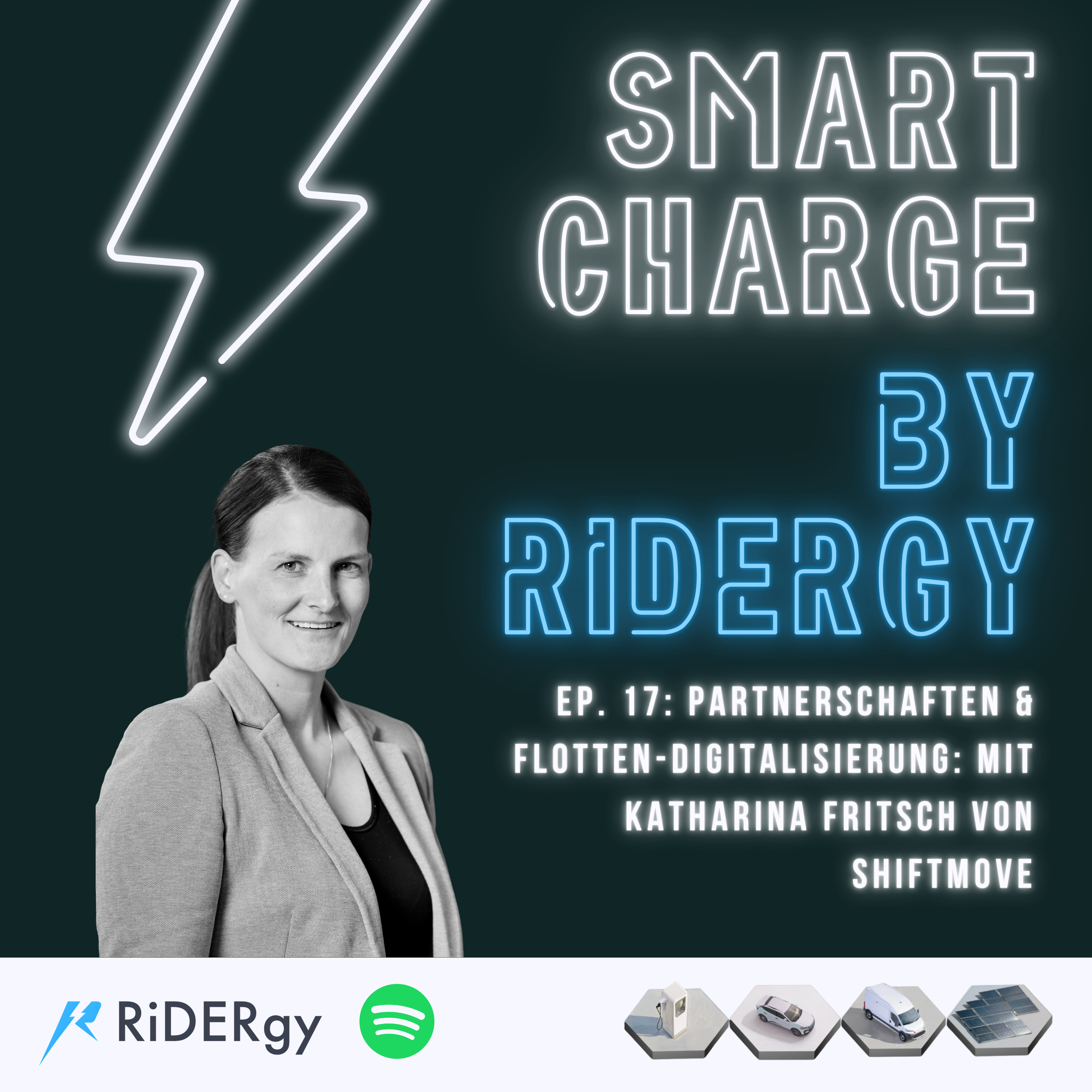
Ep. 17: Partnerschaften & Flotten‑Digitalisierung: Mit Katharina Fritsch von Shiftmove
Transcript
Cleaned up from a machine transcript. Translations are machine-generated and may contain errors.
Welcome to the Smart Charge by RiDERgy Podcast. This is Claudio Geyken, Founder and CEO of RiDERgy. This is your show to learn about all things energy management and smart charging innovation for electric vehicles and fleets.
In this episode, I'm speaking with Katharina Fritsch, Head of Partnerships and Account Management at Shiftmove. Before joining Shiftmove, Katharina gained valuable experience at Enterprise, the well-known car rental company, and at Clever Shuttle, one of Germany's first electric vehicle-based ridepooling providers. Shiftmove combines real-time tracking, compliance tools, automated workflows and data analytics and is already used by over 18,000 companies to operate more than 550,000 vehicles daily. In our conversation, Katharina shares her experiences and the specific problems she solves with Shiftmove, what types of fleets she targets, how the
collaboration and cooperation within Shiftmove is progressing after the merger of Avos, Wimka and Optimum, how she views ESG and e-mobility as well as AI, and what's still being planned. So, let's get started with Katharina.
Hello, Katharina. Great to have you here today. How are you? Hello. Thanks for the invitation. I'm doing well, arrived here in good shape. Perfect. Wonderful, I'm glad. Before we really dive into detailed topics around Shiftmove and so on, can you perhaps bring the listeners up to speed and say: What's your background? How did you get to where you are now, in this role? Exactly. So, my name is known, I believe. Katharina Fritsch, I've been with the company Shiftmove for a good four years now.
After university I started in fleet management, I was at a large car rental company for about six, seven years, and made my first contacts in fleet management. Then I went to a large ridepooling provider for another three years, here in Berlin, and got to experience what it's like to almost completely build up and scale a fleet – from 30, 40, 50 vehicles up to 500 to 600 vehicles in the fleet. All purely electric, actually. It was a very exciting time. What years was that? That
was 2018 until the COVID period in 2021. Pretty early for there to be that much electric already. It was actually very challenging, but I think we managed it very well. And then I joined Shiftmove – so from the user side, from the software user side, I switched to the software side. One step back: How did you get into this fleet world at all? What fascinated or motivated you about it? Or did you just stumble into it? Well, I have to say, I've
had a bit of contact with cars and mobility since childhood.
Due to family reasons, there was always an affinity for vehicles somewhere in the family, and then after university I actually got into it by chance, because a friend of mine worked at the car rental company and said: "Hey, it's so much fun. Why don't you try it too?" I was there for about seven years. And what did you like so much about that car rental company and then at the ridesharing that you've now
been in this industry for so long? Well, at the car rental company it was actually the case that I started quite classically as a management trainee. I had a very generalist approach there, you could get a taste of all company areas – whether vehicle dispatch, customer service or sales. You somehow picked up all abilities and skills. I thought that was very good to first get a broad foundation. And of course you still had the vehicle topic parallel to that. It was also nice, of course, to see and drive different vehicles every day
and get a feel for the cars. And how did the step to the next career phase come about? If you also want to say the names of the companies. Yes, of course. I can gladly say the car rental company, that was the company Enterprise, and the ridepooling provider was the company Clever Shuttle – I think also known here in Berlin, the green cars that drove around here. How did you then get from Enterprise to Clever Shuttle?
Also by chance, through friendship, acquaintance – as it happens, you talk in your circle of friends about what you're doing. And they were actually looking for someone at the time to take over the whole fleet management topic, because they had founded this tech start-up here in Berlin for the ridepooling service. In the end it was a fortunate coincidence. After seven years I also said, time for something new – it was super exciting to be able to accompany the project. And then I switched.
And that was your first contact point with e-mobility then, actually? Yes, at Enterprise there wasn't much yet. And then it was basically already 100 percent electric vehicles from the start. Exactly, that was also the business model: you base everything on electromobility, sustainable mobility, the ridepooling concept, that several people share one vehicle. And that's why they did it with electric vehicles and also with hydrogen vehicles. And how do you look back on these two experiences? What are topics that for you
that stuck with you, right? Insights when you look back. Actually, I look back very, very positively. The time at CleverShuttle was, I think, very formative, also regarding the topic of fleet management, how you scale processes, make them scalable in the fleet, and design that sustainably so it can be scaled up quickly. And electric mobility that early, I can imagine that wasn't easy. Do you still remember challenges that you had to overcome? Yes, there were actually many challenges. For one thing
when you scale the fleet like that. We started in Berlin back then – I'd have to lie now – with 20 to 30 vehicles and then brought that to somewhere around 100 vehicles. Then you naturally run into one challenge or another with charging and load management, especially at that time, because many parking garages simply weren't designed to handle such loads in the end. So you had to find people and locations yourselves where there was enough power available for
charging, in other words. Well, we were very lucky that we had a parking garage and a landlord who cooperated very well. That allowed us to electrify relatively quickly and also provide the capacity accordingly, and then through intelligent smart load management – after all, not all cars need to charge at the same time. That way it always distributed itself quite well. Cool. And did the vehicles always suffice in terms of the range you needed for the
entire ridepooling needs of the users or customers? That's actually a very good, very valid question. We all know the first electric vehicles didn't have great range yet. But I have to say, for Berlin city traffic it actually sufficed, so we always managed quite well with it. Of course in summer and winter there were one or two challenges regarding air conditioning or heating. But we got that under control quite well too, I think. I don't know if you were still
there, but to my knowledge CleverShuttle was acquired by Deutsche Bahn. And then they made a big pivot in terms of the business model, and then didn't just offer ridepooling directly to end users, but did that with the public transport players in the various cities. And then I believe last year or two years ago the company had to file for insolvency. Yes, maybe you can say: Where were you then? At which point did you switch to Avrios? And how do you look back
on that development? Exactly. So I switched to Avrios in November 2021. By then we had actually already downsized a large part of the fleet due to Corona. GHT Mobility, which was or is behind CleverShuttle, then changed the business model in that they went more towards this last mile. That was always the approach to say: We cover the last mile, basically from the train station to home. But now they're more into offering mobility for the public
sector in the context of tenders and are also more active in rural areas. Exactly. And then I switched to Avrios in November 2021. And Avrios – can you give us a brief introduction? What was it about? What's the company like? How did it establish itself? And what problems do you solve? Exactly. I'd maybe start with why I switched to Avrios. Namely, at CleverShuttle we had actually always used Avrios as fleet management software. That means
when I started there, I basically built up and expanded all the processes and structures with the software and was always a fan of the software. And then at some point it came about to say: Okay, you're actually switching sides – from the pure user and operational side into software sales, by now. And what was this software about? What are the problems that the software solves? So basically we try to solve as many everyday problems of fleet managers as possible
starting with collecting the data pool in the fleet, then to operational processes like damage management, invoice processing, fine processing, driver's license checks, workplace safety inspections. So we also cover the whole compliance topic. So a digitisation of all the processes that a fleet unfortunately needs around the vehicle. Exactly. Then there was a certain history in the company. Maybe you can also add what the company's milestones were up to now. Exactly. So we now operate under the name Shift Move.
That means the companies Avrios and Vimcar merged about two years ago under the name Shift Move. Vimcar, certainly known to some, founded in 2013 here in Berlin, known for digital logbooks and geotracking. Avrios then as a great complement to that with the fleet management software. And at the end of last year we actually also brought the company Optimum Automotive in France into the Shift Move family. And Optimum – how does that fit together? You explained Vimcar quite well I think, and Optimum Automotive is
Especially relevant for the French market, as it also covers fleet management and geotracking. Now I've understood correctly: all those brands, those companies that have joined together, are now called Shiftmove. Exactly. Okay. Yes, it's sometimes not so easy to understand from the outside, but that was quite clear, I think. And what are your roles within Shiftmove then? What are your responsibilities, or what's currently occupying you as a team? Right. So I'm now responsible for the areas of Customer Success, Account Management and Partnerships.
And what's occupying me at the moment? We actually have many topics, especially on the fleet side the topic of AI in fleet management, artificial intelligence. How can we make our product even smarter to ultimately deliver even greater value to the user? Then clearly the topic of cost pressure. I think everyone's feeling that right now. Many fleets are currently under enormous cost pressure. How can we also help make costs visible? And then personally I'd like to grow the team a bit more,
so have a bit more man- or woman-power behind it. And what are the ideas you see for AI use cases? How can you imagine that? We're actually already using AI in the software. In ARos, several areas are already covered with AI, whether it's automatic invoice reading or fine management that runs completely AI-supported. But we actually have many more ideas to make it even smarter, for example with a mail room, so to speak, in the
inbox, where I simply throw in all my documents and the software assigns them – whether it's a fine notice, whether it's an invoice, whether it's a damage case – and automatically sorts them to the individual vehicles. Yes, cool. And regarding team growth: what are the challenges you're facing? Yes, I'm actually looking for support in all teams, because we're actually growing as a company as well. Correspondingly, we naturally also need more support in the individual teams, and yes, I would just like
to get one or two more people with subject matter expertise into the team as well, to be able to deliver even greater value to our customers. Okay. Yes, then those listening and perhaps looking around – that's an opportunity. And on the topic of cost pressure: can you explain which three main cost factors are perhaps particularly concerning the fleet managers you speak with? Generally, you notice that fleet management is a very underestimated area in most companies. As we see it, it's actually the second highest
cost factor. After personnel costs comes cars and fleet management quite quickly, but it receives relatively little attention. We also see that in the area of digitalisation. Currently, only a third, a quarter of fleets are actually fully digitalised. The rest work completely manually – Excel, paper and pen. And because of that, costs are actually super non-transparent. Then the question is always: where can I save costs in my fleet? And as a fleet manager, I actually don't see it at all. What we actually see as
the biggest cost drivers at the moment: firstly leasing costs, but then also damages, damage management and insurance costs, which can very quickly drive up the costs of a fleet. And with leasing costs – can you give an example of how you would then have a solution to prevent these costs from being so high? Sure, gladly. What we see is that many fleets aren't aware of how user behaviour is. So: my company car user – how many kilometres does he really drive per year? Often a rough estimate is made
both by the driver and by the fleet manager. And then you simply conclude a leasing contract for the next three years with x kilometres. Sometimes the driving behaviour then changes, and many fleet managers don't know it or simply miss adjusting or optimising the leasing contract accordingly, so that you don't end up with too many or too few kilometres and incur costs from that. And are we talking about the very large fleets that would have something like that, or also smaller ones? How can you imagine
how large the companies would need to be approximately, or the fleet size? So actually with ARos as fleet management software, we address fleets from around 20 vehicles onwards. We say that there's already a certain return on investment there, so that the investment in software simply pays off. And then open end – we actually also have very large fleets in our portfolio. And Vimcar actually as a digital logbook from one vehicle onwards – there I already have a cost saving. Exactly. And just for understanding, because there are
software systems that you would also use from one person and then scale up to very large. I'm thinking of a folder system, a Dropbox or similar – there are various software systems. Why is it with you that you don't target a fleet with one vehicle? What are the hurdles, why aren't you realistic for very small fleets? Generally, smaller fleets can of course also obtain the software from us.
I wouldn't rule that out at this point. But of course it's also important that we can demonstrate: where is the added value of the software at the end of the day? And of course we also have a subscription model. That means I pay a fee per vehicle per month. And I think anyone who has maybe 12 vehicles in their fleet still has a relatively good overview – either with an Excel spreadsheet or with a folder system. When is my next service? When is my next MOT? What's the damage situation? Which insurance do I have?
But when I get into more vehicles, it actually does become more confusing. Exactly, that you easily lose overview beyond a certain number of vehicles. That's the big problem, so to speak. With smaller fleets you could perhaps still do it manually. Exactly, I understand. Now it's the case that as a woman you're unfortunately actually in a male-dominated industry. And I wonder: what experiences have you had there? What has particularly shaped you, or what do you think – how should
one change that? Could one change it so that there are more women in the fleet industry? Well, I can honestly say for myself that I actually don't perceive it that way at all. Honestly, because throughout my entire career I've actually always been surrounded by women or worked in mixed teams and not exclusively only worked with men. And even now in the team I actually also have two female team leads and one male team lead. So it's actually very
mixed with us as well. Therefore I personally don't perceive it that way at all and rather think that one shows: if you approach something with competence and passion, then you shouldn't distinguish between man or woman. Exactly. Well, that's good. And regarding – now you've joined together, all these companies. How does such a cooperation work? How can one imagine it when three companies with perhaps different cultures come together? That's not always easy. Can you
give insights there, also how that works in practice? Yes, well I have to say that the products themselves complement each other brilliantly. With Avrios as a fleet management software we naturally cover a completely different area than with Vimcar – digital logbook – and Optimum actually then for the French market. And purely in terms of how the teams also complement each other, I believe that both we at Vimcar and Avrios are very similar in terms of corporate culture. We've actually only had Optimum since last year and also for the –
you also mentioned that not that many fleets are digitised yet. In your view, what is a challenge, or what are arguments that one could give fleets to get them to digitise – as the first question – and then as the second question: how can one also reach these fleets so that they adopt a digitalised solution? It's a very good question. I think currently we're seeing a generational change in fleet management. That means, on the one hand we're reaching
many fleets precisely because this generational change is taking place – rather younger fleet managers taking over who have an affinity for digitalisation and also understand that with software you can make many processes simpler. How do we reach the fleets? That is actually a good and also difficult question. We try to create a lot of content and engage fleets through webinars by explaining many topics around fleet management and thereby simply also offering added value. But we're
naturally also present at trade fairs and events and try to do a lot of networking. There are – yes, there are – that's where we also met last time, at the Flotte event. There are good events where many fleet managers gather. Indeed, yes. And we've talked a bit about the past and already teased AI a little. But where do you see Shift Move in the next five years? Where is the journey heading? Yes, ultimately our vision is – we
always call it building a one-stop-shop solution for anyone who has a fleet of any kind, and that everyone finds the right product with us. So really from the small fleet – as I said – maybe 20 vehicles, who perhaps doesn't need the comprehensive software with all solutions, right up to the large fleet that has many different processes and many different structures, that everyone can basically put together their own product and Shift Move ultimately becomes the point of contact for the fleet manager where they can also solve all their everyday challenges
as well. One thing we perhaps haven't clarified yet: when you talk about fleets, are those mainly company cars, passenger cars, or also trucks or buses? Do you have a certain target group that you exclude, or are all vehicle types relevant? Well, we definitely don't want to exclude anyone. Generally the core business, as it has grown, is actually the classic company car fleets. But what we're seeing is that we also have many functional fleets. So, I'd say
classic delivery service. But we also have customers – this is always my favourite example – who manage street sweepers, who manage boats. So everything that somehow relates to the topic of mobility. Company bicycles, job bikes can actually be recorded in our software. Interesting. Aircraft not, I assume. You could actually record a special vehicle as well, but it's then very niche and I don't think the right use case with an aircraft. And the topic of ESG was also prominent in recent years, with the supply chain act also in the news. How do you look at
on the ESG topic? Actually very relaxed, because basically all our fleets can report in ESG-compliant fashion. This is primarily about electric mobility, vehicle consumption, CO2 reporting. And in fact we have ready-made reports for our fleet managers that they can pull for any time period they want to analyse. So our fleets are ESG-compliant in that regard. Oh yes, cool. So basically the emission values per vehicle are then simply extracted once from the software. Interesting. Yes, e-mobility – you already mentioned it – that's also a focus
of this podcast. We also have the topic of charging. Electric mobility is about the vehicles, but of course also about charging and energy. How do you look at the topic? And what's on your mind there? What do you also see with fleets, do you already offer solutions there? Yes, of course fleet managers can also manage electric vehicles in our system. They can also report on them, as we just talked about, do ESG reporting there, see what my actual consumption per electric vehicle is, whether employees are charging
relatively much or little. Exactly. Otherwise we actually see that fleet electrification is progressing quite well. Currently 11% of fleets are electrified with us. What's actually missing is electrification in the truck segment too. We see relatively few fleets leading by example there right now. Do you mean 11% of all fleets have at least one electric vehicle? Or is it 11% of the total number of vehicles being managed that are electric? 11% of the total number are electric. Exactly. Interesting. And
is there also a difference between fleet size? Can you generally say that the larger the fleet, the higher the electric mobility share? I think it depends very much on the company and the business model they have. We see that many company car fleets are now moving more and more towards purely electric vehicles. Of course there are targets there too. Especially when we talk to large fleets, they say they want to try by 2030 to provide every employee with an electric vehicle as comprehensively as
possible. Exactly. The targets are getting closer. 2030 isn't that far away anymore. And are there also geographical differences? You don't just have Germany as a market, I believe. Do you already see differences between countries? Actually we see that in France for example the sustainability topic is being pushed a bit more, currently in Germany rather less at the moment. But we're just watching what the next funding programmes bring and whether we'll then get
more momentum on electric mobility in Germany again. It's also the case, if I'm not mistaken, that in some countries company cars aren't really that much of a thing – I believe even less so in the USA than in Europe or Germany. Company cars are much more widespread in Germany especially. Would that then also be an exclusion criterion or difficult for you to enter markets where there are fewer company cars? Generally we can say that we now also have customers, especially international companies,
who use it in an international context, actually have operations in America and South America where they manage vehicles. But yes, it's not our core business now. The software actually works there too though. Okay. Yes, and then the software topic again asked a bit more specifically. There's data, there are integrations, interfaces perhaps with partners, analytics. What role does that play for you? What kind of challenges are those? Maybe you can also give examples. Well we naturally try to connect a lot of data as
well. The newest product we now have meanwhile is that we get direct vehicle data into the software too. Currently the first data point is mileage – from our perspective the most important KPI in fleet management, because against mileage I can measure all costs, make cost per kilometre visible. And from newer vehicles we now meanwhile get the data once a day directly from the vehicle into the software. So that's the beginning now, and then you want to collect even more data points
over time. Well the data points themselves are already there. The manufacturers deliver that. Now it's actually up to us to make the data points visible to the fleet manager. Do you see any specific challenges with electric mobility for fleets to go electric? Are those also topics you support, namely the charging topic? Or there are certainly also use cases that you – also from your history with the ridepooling approach – where you see there's more, with
company cars there's more electric share because it's simpler than now a carsharer. Or are those topics you also look at? What we see is that many fleets are naturally keen to electrify, but then keep running into the challenge: where does my employee charge at home? Especially in major cities. Or how is billing regulated? So if the employee charges at home, perhaps at a private wallbox – how can I make visible which vehicle was charged there? Is it the
Company car? Is it a private vehicle? How do I get the data transferred back into a system? These are actually topics that concern us as well. We can already make it visible, sometimes a bit bumpy, but at least in a way that customers can then evaluate it. And last but not least, because this podcast is called Smart Charge: How do you see the topic of smart charging or even bidirectional charging like V2G, what potential you would have if you manage a large fleet and perhaps not only optimise those costs that
you mentioned, but actually also generate revenue with these vehicles, where batteries are lying dormant and then in future you can earn money with them. Well, currently, I have to be honest, we haven't really dealt with that in depth yet. That will certainly come. Yes, certainly, there are still challenges there. You can also listen to some other episodes we've recorded to dive deeper into the challenge. And I'm also
personally of the opinion that it will come soon, of course. And before we say goodbye, do you want to point the listeners to something special? How they can reach you and perhaps stay in touch if they're interested in learning more. Exactly. So anyone who's interested in Shiftmove is of course warmly invited to attend one of our webinars. We actually have live webinars every two weeks on a wide variety of topics – just take a look. And otherwise you can actually find me on LinkedIn, write to me
anytime. And then I'd be happy to get in touch with one or another and continue the exchange. Then thank you so much, Katharina, it was a great pleasure. And I wish you a wonderful weekend. Thanks for the invitation. My pleasure.
And that was the episode with Katharina Fritsch. I found her background particularly fascinating, that she's been in the fleet industry for so long and especially that she shaped e-mobility so early – already in 2018 with Clever Shuttle – and also had challenges with electrical installation and how they solved that back then with smart energy management when scaling the electric fleet. And then how she switched from being a user of Fleetops and Shiftmove to working there, and especially how many fleets they already serve
and what expansion plans they still have, and how sensible all these digitalisation approaches actually are when you consider that a lot is still done with Excel and paper in the age of AI. There's still a lot of potential for cost savings, and of course in e-mobility there are many levers too. There's definitely still a lot planned. You can tell that Shiftmove is very active when it comes to new services and new plans and new geographies they want to tackle. I hope you enjoyed the episode.
And if so, feel free to check out what Katharina recommended regarding the webinars, or connect with her and give us five stars. Until the next conversation.
Welcome to the Smart Charge by RiDERgy Podcast. This is Claudio Geyken, Founder and CEO of RiDERgy. This is your show to learn about all things energy management and smart charging innovation for electric vehicles and fleets.
In dieser Folge spreche ich mit Katharina Fritsch, Head of Partnerships and Account Management bei Shiftmove. Bevor sie zu Shiftmove kam, sammelte Katharina wertvolle Erfahrungen bei Enterprise, dem bekannten Autovermieter, und bei Clever Shuttle, einem der ersten E-Fahrzeug-basierten Ridepooling-Anbieter Deutschlands. Shiftmove vereint Echtzeit-Tracking, Compliance-Tools, automatisierte Workflows und Datenanalysen und wird bereits von über 18.000 Unternehmen genutzt, um mehr als 550.000 Fahrzeuge täglich zu betreiben. In unserem Gespräch teilt Katharina ihre Erfahrungen und die genauen Probleme, die sie mit Shiftmove löst, welche Art von Fuhrparks sie angeht, wie die
Zusammenarbeit und Kooperation innerhalb von Shiftmove nach dem Zusammenschluss von Avos, Wimka und Optimum vorangeht, wie sie auf das Thema ESG und E-Mobilität sowie KI schaut und was da alles noch geplant wird. Also, los geht's mit Katharina.
Hallo, Katharina. Schön, dass du heute dabei bist. Wie geht's dir? Hallo. Vielen Dank für die Einladung. Mir geht's gut, gut hier angekommen. Passt. Super, das freut mich. Bevor wir wirklich in detaillierte Themen einsteigen rund um Shiftmove et cetera, kannst du vielleicht die Hörer abholen und sagen: Was ist dein Hintergrund? Wie kamst du dahin, wo du jetzt bist, in diese Rolle? Genau. Also, mein Name ist bekannt, glaube ich. Katharina Fritsch, ich bin jetzt seit gut vier Jahren bei der Firma Shiftmove tätig.
Nach dem Studium habe ich angefangen im Bereich Flottenmanagement, war bei einer großen Autovermietung, knappe sechs, sieben Jahre da, und habe die ersten Kontakte im Bereich Flottenmanagement gemacht. Bin dann noch mal weitere drei Jahre zu einem großen Ridepooling-Anbieter gegangen, hier in Berlin, und durfte da die Erfahrung machen, wie es ist, eine Flotte fast komplett aufzubauen und hochzuskalieren – von 30, 40, 50 Fahrzeugen hoch auf 500 bis 600 Fahrzeuge im Fuhrpark. Alles rein elektrisch, tatsächlich auch noch. War eine sehr spannende Zeit. In welchen Jahren war das? Das
war 2018 bis dann Coronazeit 2021. Schon ganz schön früh, dass das so viel elektrisch war. Das war tatsächlich sehr herausfordernd, aber wir haben es, denke ich, doch sehr gut gemanagt. Und dann bin ich zu Shiftmove gekommen – quasi von der Anwenderseite, von der Softwareanwenderseite, dann auf die Softwareseite gewechselt. Noch mal einen Schritt zurück: Wie kamst du überhaupt in diese Fuhrparkwelt? Was hat dich daran fasziniert oder motiviert? Oder bist du einfach reingestolpert? Also, ich muss sagen, ich habe
schon von Kindheitstagen an immer so ein bisschen Kontakt zum Thema Auto und Automobilität gehabt.
Familiär bedingt war immer eine Affinität zu Fahrzeugen irgendwo in der Familie dagewesen, und bin dann tatsächlich nach dem Studium über einen Zufall in das Thema reingekommen, weil eine Freundin von mir bei der Autovermietung gearbeitet hat und gesagt hat: „Hey, das macht so viel Spaß. Warum willst du es nicht auch mal ausprobieren?" Da war ich knappe sieben Jahre. Und was hat dich an dieser Autovermietung und dann beim Ridesharing so gut gefallen, dass du jetzt
schon so lange in dieser Branche bist? Also bei der Autovermietung war es tatsächlich so, dass ich ganz klassisch als Management Trainee angefangen habe. Ich hatte einen sehr generalistischen Ansatz dort, man konnte irgendwie in alle Firmenbereiche reinschnuppern – sei es Fahrzeugdisposition, Kundenservice oder Sales. Man hat irgendwie alle Fähigkeiten und Skills mitbekommen. Das fand ich sehr gut, um sich erstmal auch breit aufzustellen. Und klar hat man dann das Thema Fahrzeuge immer noch parallel dazu gehabt. War natürlich auch schön, jeden Tag verschiedene Fahrzeuge auch mal zu
sehen, zu fahren und ein Feeling für die Autos zu kriegen. Und wie kam dann der Schritt zur nächsten Karrierephase? Wenn du auch Namen von den Firmen sagen willst. Ja, also klar. Die Autovermietung kann ich gerne sagen, das war die Firma Enterprise, und der Ridepooling-Anbieter war die Firma Clever Shuttle – denke ich, hier in Berlin auch bekannt, die grünen Autos, die hier gefahren sind. Wie kamst du dann von Enterprise zu Clever Shuttle?
Auch durch einen Zufall, durch Freundschaft, Bekanntschaft – wie es dann so ist, unterhält man sich im Freundeskreis, was man so macht. Und die hatten zu dem Zeitpunkt tatsächlich jemanden gesucht, der das ganze Thema Flottenmanagement übernimmt, weil sie hier in Berlin dieses Tech-Start-up gegründet hatten für den Ridepooling-Service. Am Ende war es ein günstiger Zufall. Nach sieben Jahren habe ich dann auch gesagt, mal Zeit für was Neues – war super spannend, auch das Projekt damit begleiten zu dürfen. Und dann bin ich gewechselt.
Und das war dein erster Berührungspunkt mit der E-Mobilität dann, tatsächlich? Ja, bei Enterprise war noch nicht so viel. Und dann waren es quasi schon 100 % Elektrofahrzeuge von Anfang an. Genau, das war ja auch das Geschäftsmodell: Man setzt das alles auf Elektromobilität, nachhaltige Mobilität, den Ridepooling-Gedanken, dass mehrere Leute sich ein Fahrzeug teilen. Und deswegen hat man das dann auch mit Elektrofahrzeugen und auch mit Wasserstofffahrzeugen gemacht. Und wie blickst du auf diese zwei Erfahrungen zurück? Was sind so Themen, die bei dir
so hängengeblieben sind, oder? Erkenntnisse, wenn du zurückblickst. Also tatsächlich blicke ich sehr, sehr positiv zurück. Die Zeit bei Clever Shuttle war, glaube ich, sehr prägend, auch was das Thema Fuhrpark angeht, wie man Prozesse auch skaliert, skalierbar gestaltet im Fuhrpark, und das auch nachhaltig gestaltet, sodass das schnell hochskaliert werden kann. Und so früh schon E-Mobilität, das kann ich mir vorstellen, war nicht einfach. Hast du da auch Herausforderungen, die dir noch im Sinn bleiben, die ihr meistern musstet? Ja, da gab es tatsächlich viele Herausforderungen. Zum einen
wenn man die Flotte so steigert. Wir haben in Berlin damals – müsste jetzt lügen – mit 20 bis 30 Fahrzeugen angefangen und das dann auf 100 Fahrzeuge irgendwo gebracht. Da kommt man dann natürlich schnell auch beim Thema Laden und Lastmanagement in die eine oder andere Herausforderung, gerade auch zur damaligen Zeit, weil viele Parkgaragen ja auch gar nicht darauf ausgelegt waren, solche Lasten am Ende zu tragen. Das heißt, da habt ihr dann eigens Leute und Orte finden müssen, wo es genügend Leistung gab zur
Verfügung zum Laden, in anderen Worten. Also wir hatten das große Glück, dass wir eine Parkgarage hatten und einen Vermieter, der da sehr gut mitgemacht hat. Dadurch konnten wir halt relativ schnell elektrifizieren und auch entsprechend die Kapazität zur Verfügung stellen, und dann durch ein intelligentes, smartes Lademanagement – es müssen sich ja nicht immer alle Autos auch gleichzeitig laden. Dadurch hat sich das dann immer ganz gut verteilt. Cool. Und die Fahrzeuge haben dann auch immer ausgereicht, was die Reichweite anging, die ihr benötigt habt für die
ganzen Ridepooling-Bedarfe der Nutzer oder der Kunden? Das ist tatsächlich eine sehr gute, sehr valide Frage. Wir wissen ja alle, die ersten Elektrofahrzeuge hatten jetzt noch nicht die große Reichweite. Aber ich muss sagen, für den Berliner Stadtverkehr hat es tatsächlich ausgereicht, sodass wir damit immer ganz gut hingekommen sind. Natürlich im Sommer und im Winter gab es da die eine oder andere Herausforderung, was das Thema Klimaanlage oder Heizung angeht. Aber auch das haben wir, glaube ich, ganz gut in den Griff bekommen. Ich weiß nicht, ob du noch
da warst, aber meines Wissens wurde ja Clever Shuttle von der DB aufgekauft. Und dann haben sie einen großen Pivot gemacht, was das Geschäftsmodell anging, und dann nicht nur Ridepooling direkt an die Endnutzer angeboten, sondern das mit den ÖPNV-Playern jeweils in den verschiedenen Städten. Und dann glaube ich, letztes Jahr oder vor zwei Jahren musste die Firma Insolvenz anmelden. Ja, vielleicht kannst du sagen: Wo warst du dann? In welchem Schritt bist du dann zu ARus gewechselt? Und wie blickst du
dann auf diese Entwicklung zurück? Genau. Also ich bin im November 2021 zu Avos gewechselt. Da hatten wir tatsächlich mit Corona schon einen Großteil der Flotte abgebaut. Die GHT Mobility, die hinter Clever Shuttle stand oder steht, hat dann das Geschäftsmodell dahingehend gewechselt, dass sie mehr auf diese letzte Meile gegangen sind. Das war schon immer der Ansatz zu sagen: Wir decken die letzte Meile ab, quasi vom Bahnhof bis nach Hause. Aber die sind jetzt mehr dabei, Mobilität für die öffentliche
Hand anzubieten im Rahmen von Ausschreibungen und sind da auch mehr im ländlichen Raum unterwegs. Genau. Und ich bin dann im November 2021 zu ARus gewechselt. Und Avrius – kannst du uns eine kurze Einführung geben? Worum ging es? Wie ist die Firma? Wie hat sie sich etabliert? Und was für Probleme löst ihr? Genau. Ich würde vielleicht erst mal anfangen, warum ich zu Avos gewechselt bin. Und zwar haben wir bei Clever Shuttle tatsächlich Aureus schon immer als Flottenmanagementsoftware im Einsatz gehabt. Das heißt,
ich habe, als ich dort angefangen habe, im Prinzip die ganzen Prozesse und Strukturen mit der Software mit auf- und ausgebaut und war immer Fan der Software. Und dann hat sich's irgendwann ergeben zu sagen: Okay, man wechselt halt tatsächlich die Seite – von der reinen Anwender- und operativen Seite dann in den Softwarevertrieb, mittlerweile. Und worum ging es bei dieser Software? Was sind so die Probleme, die die Software löst? Also im Prinzip versuchen wir, so viele Alltagsprobleme der Fuhrparkleiter wie möglich
zu lösen, angefangen vom Sammeln des Datenschatzes im Fuhrpark, dann bis hin zu operativen Prozessen wie Schadensmanagement, Rechnungsverarbeitung, Bußgeldverarbeitung, Führerscheinkontrolle, UVV. Also das ganze Thema Compliance decken wir auch mit ab. Also eine Digitalisierung von all den Prozessen, die ein Fuhrpark leider so rund um das Fahrzeug braucht. Genau. Dann gab es ja eine gewisse Historie in dem Unternehmen. Vielleicht kannst du da auch ergänzen, was so die Meilensteine waren des Unternehmens bis jetzt. Genau. Also wir firmieren jetzt mittlerweile unter dem Namen Shift Move.
Das heißt, die Firmen Avus und Wimka haben sich vor gut zwei Jahren zusammengeschlossen unter dem Namen Shift Move. Wimka, sicherlich dem einen oder anderen auch bekannt, 2013 gegründet hier in Berlin, bekannt fürs digitale Fahrtenbuch und Geotracking. Avrius dann als super Ergänzung dazu mit der Flottenmanagementsoftware. Und Ende letzten Jahres haben wir dann tatsächlich auch noch die Firma Optimum Automotive in Frankreich mit zur Shiftmove-Familie dazu genommen. Und Optimum – wie passt das zusammen? Du hast, glaube ich, ganz gut erklärt jetzt die Wimka, und Optimum Automotive ist
Vor allem für den französischen Markt relevant, da auch im Bereich Flottenmanagement und Geotracking. Jetzt richtig verstanden: Die ganzen Marken, diese Unternehmen, die sich zusammengeschlossen haben, heißen jetzt Shiftmove. Genau. Okay. Ja, das ist von außen manchmal nicht so einfach zu verstehen, aber das war ganz klar, glaube ich. Und was sind dann deine Rollen innerhalb von Shiftmove? Was sind deine Verantwortlichkeiten, oder was treibt dich gerade so um als Team? Genau. Also ich verantworte jetzt mittlerweile den Bereich Customer Success, Account Management und Partnerships.
Und was treibt mich gerade um? Wir haben tatsächlich viele Themen, gerade vor allem auf der Fuhrparkseite das Thema KI im Fuhrpark, künstliche Intelligenz. Wie können wir unser Produkt noch smarter machen, um auch noch einen größeren Mehrwert am Ende an den Nutzer zu bringen? Dann ganz klar das Thema Kostendruck. Ich glaube, jeder spürt das gerade. Viele Fuhrparks sind gerade einem enormen Kostendruck ausgesetzt. Wie können wir da auch anteilig unterstützen, Kosten sichtbar zu machen? Und dann ganz persönlich würde ich gerne noch ein bisschen das Team
wachsen lassen, also gerne noch ein bisschen mehr Man- oder Woman-Power mit dahinter stecken. Und was sind da Ideen, die ihr bei den KI-Anwendungsfällen so seht? Wie kann man sich das vorstellen? Wir nutzen tatsächlich schon KI in der Software. In ARos sind schon einige Bereiche mit KI abgedeckt, sei es die automatische Rechnungsauslesung oder ein Bußgeldmanagement, was komplett KI-gestützt läuft. Wir haben aber da tatsächlich auch noch sehr viele Ideen, das noch smarter zu machen, beispielsweise mit einer Poststelle sozusagen im
Posteingang, wo ich einfach alle meine Dokumente reinwerfe und die Software ordnet das zu – ob es ein Bußgeldbescheid ist, ob es eine Rechnung ist, ob es ein Schadensfall ist – und sortiert das automatisch den einzelnen Fahrzeugen zu. Ja, cool. Und beim Teamwachstum: Was sind da Herausforderungen, die vor euch liegen? Ja, ich suche tatsächlich in allen Teams noch Unterstützung, weil wir tatsächlich auch als Unternehmen wachsen. Entsprechend brauchen wir natürlich auch mehr Unterstützung in den einzelnen Teams, und ja, würde mir halt wünschen,
den einen oder anderen mit Fach-Background auch noch ins Team zu bekommen, um da noch einen größeren Mehrwert an unsere Kunden liefern zu können. Okay. Ja, dann die, die zuhören und sich vielleicht umschauen – das ist ja mal eine Chance. Und zu dem Thema Kostendruck: Kannst du erläutern, welche drei Hauptkostenfaktoren vielleicht besonders die Fuhrparkleiter gerade umtreiben, mit denen du sprichst? Generell merkt man, dass Fuhrpark ein sehr unterschätzter Bereich in den meisten Unternehmen ist. Das ist, wie wir es sehen, eigentlich der zweithöchste
Kostenfaktor. Nach dem Thema Personal kommt dann auch ganz schnell schon Autos und Fuhrpark, aber er wird relativ wenig wahrgenommen. Das sehen wir halt auch im Bereich der Digitalisierung. Aktuell sind tatsächlich nur ein Drittel, ein Viertel der Flotten wirklich komplett digitalisiert. Der Rest arbeitet halt komplett händisch – Excel, Zettel und Stift. Und dadurch sind die Kosten halt tatsächlich super intransparent. Dann ist immer die Frage: Wo kann ich Kosten sparen in meinem Fuhrpark? Und als Fuhrparkleiter sehe ich es eigentlich gar nicht. Was wir tatsächlich sehen, was
die größten Kostentreiber aktuell sind: zum einen die Leasingkosten, aber dann auch Schäden, Schadenmanagement und Versicherungskosten, die einen Fuhrpark kostenmäßig sehr schnell in die Höhe treiben können. Und bei den Leasingkosten – kannst du mal ein Beispiel geben, wie ihr dann eine Lösung hättet, um zu vermeiden, dass diese Kosten so hoch sind? Klar, gerne. Was wir halt sehen, ist, dass vielen Fuhrparks nicht bewusst ist, wie das Nutzerverhalten ist. Also: Mein Dienstwagennutzer – wie viel Kilometer fährt der wirklich im Jahr? Oft wird da eine grobe Schätzung
abgegeben, sowohl vom Fahrer als auch vom Fuhrparkmanager. Und dann schließt man einfach einen Leasingvertrag auf die nächsten drei Jahre mit x Kilometern ab. Teilweise ändert sich dann das Fahrverhalten, und viele Fuhrparkmanager wissen es nicht oder verpassen es einfach, den Leasingvertrag entsprechend auch anzupassen oder zu optimieren, sodass man nicht in zu viele oder zu wenige Kilometer reinläuft und daraus Kosten entstehen. Und reden wir von den ganz großen Fuhrparks, die sowas hätten, oder auch von kleineren? Wie kann man sich das vorstellen,
wie groß die Unternehmen da ungefähr sein müssen oder die Fuhrparkgröße? Also tatsächlich mit ARos als Fuhrparkmanagement-Software sprechen wir eigentlich Fuhrparks so ab 20 Fahrzeugen an. Da sagen wir, da ist ein gewisser Return on Invest schon gegeben, sodass sich die Investition in eine Software einfach lohnt. Und dann open end – wir haben tatsächlich auch sehr große Fuhrparks bei uns im Portfolio. Und Vimcar tatsächlich als digitales Fahrtenbuch schon ab einem Fahrzeug – da habe ich schon eine Kostenersparnis. Genau. Und nur zum Verständnis, weil es gibt
ja Softwaresysteme, die würde man auch ab einer Person nutzen und skaliert dann bis ganz groß. Ich denke da an ein Ordnersystem, einen Dropbox oder ähnliches – es gibt ja verschiedenste Softwaresysteme. Wieso ist es bei euch so, dass ihr nicht auf einen Fuhrpark mit einem Fahrzeug? Was sind da die Hürden, weshalb ihr für ganz kleine Fuhrparks nicht realistisch seid? Generell kann man natürlich auch als kleinerer Fuhrpark bei uns die Software beziehen.
Das möchte ich auch gar nicht ausschließen an der Stelle. Aber es ist natürlich auch wichtig, dass wir aufzeigen können: Wo ist am Ende der Mehrwert der Software? Und natürlich haben wir auch ein Subscription-Modell. Das heißt, ich zahle eine Gebühr pro Fahrzeug pro Monat. Und ich denke, jeder, der irgendwie 12 Fahrzeuge im Fuhrpark hat, der hat das auch noch relativ gut im Blick – entweder mit einer Excel-Tabelle oder mit einem Ordnersystem. Wann ist mein nächster Service? Wann ist mein nächster TÜV? Wie ist die Schadenlage? Welche Versicherung habe ich?
Aber wenn ich da in mehr Fahrzeuge komme, dann wird es tatsächlich schon unübersichtlicher. Genau, dass man die Übersicht halt leicht verliert ab einer bestimmten Anzahl von Fahrzeugen. Das ist sozusagen das große Problem. Bei kleineren könnte man das vielleicht noch händisch machen. Genau, verstehe. Nun ist es ja so, dass du auch als Frau leider eigentlich in einer männerdominierten Branche bist. Und ich frage mich: Was hast du da für Erfahrungen gemacht? Was hat dich besonders geprägt, oder was denkst du – wie sollte
man das ändern? Könnte man das ändern, dass es mehr Frauen gibt in der Fuhrpark-Branche? Also, ich kann persönlich für mich tatsächlich nur sagen, dass ich das so gar nicht wahrnehme. Ehrlicherweise, weil ich meine ganze Karriere eigentlich auch schon immer von Frauen umgeben war oder auch in gemischten Teams unterwegs war und nicht ausschließlich nur Männer mit mir gearbeitet haben. Und auch jetzt im Team habe ich tatsächlich auch zwei weibliche Teamleads und einen männlichen Teamlead. Also, das ist auch bei uns tatsächlich sehr
gemischt. Von daher nehme ich das persönlich gar nicht so wahr und denke eher, dass man zeigt: Wenn man irgendwo mit Kompetenz und einer Leidenschaft an eine Sache rangeht, dann sollte man da nicht unterscheiden zwischen Mann oder Frau. Genau. Na ja, das ist ja gut. Und in Sachen – jetzt habt ihr euch zusammengeschlossen, diese ganzen Unternehmen. Wie funktioniert da so eine Kooperation? Wie kann man sich das vorstellen, wenn so drei Unternehmen mit vielleicht verschiedenen Kulturen aufeinander stoßen? Das ist ja nicht immer einfach. Kannst du
da Einblicke geben, auch wie das in der Praxis funktioniert? Ja, also ich muss sagen, dass sich die Produkte an sich super ergänzen. Mit Aos als Flottenmanagement-Software haben wir natürlich einen ganz anderen Bereich abgedeckt als mit Wimka – digitales Fahrtenbuch – und Optimum tatsächlich dann für den französischen Markt. Und rein davon, wie sich die Teams auch ergänzen, glaube ich, sind wir sowohl Wimka als auch Avreos von der Unternehmenskultur her sehr ähnlich. Optimum haben wir jetzt tatsächlich erst seit letztem Jahr und auch für den –
hattest du auch erwähnt, dass noch nicht so viele Fuhrparks digitalisiert sind. Was ist in deinen Augen eine Herausforderung, oder was sind Argumente, die man Fuhrparks geben könnte, um sie zu digitalisieren – als erste Frage – und dann als zweite Frage: Wie kann man diese Fuhrparks auch erreichen, damit sie auf eine digitalisierte Lösung setzen? Es ist eine sehr gute Frage. Ich glaube, aktuell sehen wir so einen Generationenwechsel im Fuhrpark. Das heißt, zum einen erreichen wir halt
viele Fuhrparks gerade dadurch, dass dieser Generationenwechsel stattfindet – eher jüngere Fuhrparkleiter und Leiterinnen übernehmen, die eine Affinität zur Digitalisierung haben und auch verstehen, dass man mit einer Software viele Prozesse einfacher gestalten kann. Wie erreichen wir die Fuhrparks? Das ist tatsächlich eine gute und auch schwierige Frage. Wir versuchen, sehr viel Content zu kreieren und Fuhrparks über Webinare abzuholen, indem wir viele Themen rund um das Fuhrparkmanagement erklären und dabei einfach auch einen Mehrwert bieten. Aber wir sind
natürlich auch auf Messen und Veranstaltungen unterwegs und versuchen, sehr viel Networking zu betreiben. Da gibt es – ja, da gibt es ja – da haben wir uns ja auch das letzte Mal getroffen, auf der Flotte. Da gibt es gute Veranstaltungen, wo sich viele Fuhrparkleiter tummeln. Tatsächlich, ja. Und wir haben ein bisschen über die Vergangenheit gesprochen und schon ein bisschen KI angeteasert. Aber wo siehst du Shift Move in den nächsten fünf Jahren? Wo geht die Reise hin? Ja, am Ende ist unsere Vision eine – wir
nennen es immer eine One-stop-shop-Solution zu bauen für jeden, der irgendwie einen Fuhrpark hat, und dass jeder bei uns das passende Produkt findet. Also wirklich vom kleinen Fuhrpark – wie ich es gesagt habe – irgendwie 20 Fahrzeuge, der vielleicht nicht die vollumfängliche Software mit allen Lösungen braucht, bis hin zum großen Fuhrpark, der viele verschiedene Prozesse und viele verschiedene Strukturen hat, dass jeder sich im Prinzip sein Produkt zusammenstellen kann und Shift Move am Ende die Anlaufstelle für den Fuhrparkleiter ist, wo er alle seine Herausforderungen des Alltags auch
lösen kann. Eine Sache, die wir vielleicht noch nicht klargestellt haben: Wenn man vom Fuhrpark spricht, sind das dann vor allem Dienstwagen, PKWs, oder auch LKWs oder Busse? Habt ihr eine gewisse Zielgruppe, die ihr ausschließt, oder sind alle Fahrzeugarten relevant? Also ausschließen wollen wir schon mal gar keinen. Generell ist das Kerngeschäft, so wie es gewachsen ist, tatsächlich die klassischen Dienstwagenflotten. Aber was wir sehen, ist, dass wir auch viele funktionale Flotten haben. Also, ich sage
Mal klassischer Lieferdienst. Wir haben aber auch Kunden – das ist immer so mein Lieblingsbeispiel – die Kehrmaschinen verwalten, die Boote verwalten. Also alles, was irgendwie das Thema Mobilität betrifft. Dienstfahrräder, Jobräder kann man bei uns tatsächlich in der Software erfassen. Interessant. Flugzeuge nicht, nehme ich an. Du könntest tatsächlich ein Spezialfahrzeug auch erfassen, aber es ist dann doch sehr nischig und ich glaube nicht der richtige Use-Case mit dem Flugzeug. Und das Thema ESG war auch viel in den letzten Jahren, mit dem Lieferkettengesetz auch in den Nachrichten. Wie schaut ihr
auf das Thema ESG? Tatsächlich sehr entspannt, weil eigentlich alle unsere Fuhrparks ESG-konform reporten können. Es geht ja hier vor allem um das Thema Elektromobilität, Verbräuche von Fahrzeugen, CO2-Reporting. Und da haben wir tatsächlich für unsere Fuhrparkleiter vorgefertigte Reports, die sie sich in jedem beliebigen Zeitraum, den sie auswerten wollen, ziehen können. Von daher sind unsere Fuhrparks da ESG-konform. Ah ja, cool. Also quasi die Emissionswerte pro Fahrzeug werden dann einfach einmal extrahiert von der Software. Spannend. Ja, E-Mobilität – du hast es schon genannt – das ist auch ein Fokus
dieses Podcasts. Wir haben auch das Thema Laden. Elektromobilität geht um die Fahrzeuge, geht aber natürlich auch um das Thema Laden und Energie. Wie schaut ihr auf das Thema? Und was treibt euch da um? Was seht ihr auch bei Fuhrparks, bietet ihr auch da schon Lösungen an? Ja, natürlich können die Fuhrparkverantwortlichen auch Elektrofahrzeuge bei uns im System verwalten. Auch reporten natürlich, wie wir gerade gesprochen haben, das Thema ESG-Reporting dort machen, schauen, wie tatsächlich mein Verbrauch pro Elektrofahrzeug ist, laden die
Mitarbeiter relativ viel oder wenig. Genau. Ansonsten sehen wir halt tatsächlich, dass die Elektrifizierung der Flotten ganz gut vorangeht. Aktuell bei uns sind 11 % der Flotten elektrifiziert. Was tatsächlich fehlt, ist das Thema Elektrifizierung auch im Bereich Lkw. Da sehen wir gerade relativ wenig Flotten, die da schon mit gutem Beispiel vorangehen. Meinst du, 11 % der gesamten Flotten haben mindestens ein E-Fahrzeug? Oder ist es 11 % der Gesamtmenge an Fahrzeugen, die verwaltet werden, sind elektrisch? 11 % der Gesamtmenge sind elektrisch. Genau. Interessant. Und
gibt es da auch einen Unterschied zwischen der Größe der Flotten? Kann man tendenziell sagen, dass je größer die Flotte ist, desto größer der Elektromobilitätsanteil? Ich glaube, das hängt ganz stark von der Firma ab und von dem Geschäftsmodell, was sie haben. Wir sehen, dass sehr viele Dienstwagenflotten jetzt immer mehr und mehr auf rein elektrische Fahrzeuge gehen. Natürlich gibt es da auch Ziele. Also gerade wenn wir mit großen Flotten sprechen, sagen sie, sie wollen irgendwie bis 2030 probieren, möglichst vollumfänglich jedem Mitarbeiter ein E-Fahrzeug zur Verfügung zu
stellen. Genau. Die Ziele werden immer näher. 2030 ist nicht mehr so weit weg. Und gibt es auch geografische Unterschiede? Ihr habt ja nicht nur Deutschland als Markt, glaube ich. Seht ihr da auch schon Unterschiede, was die Länder angeht? Also tatsächlich sehen wir, dass in Frankreich beispielsweise das Thema Nachhaltigkeit ein bisschen mehr getrieben wird, aktuell in Deutschland momentan eher weniger. Aber wir schauen halt einfach, was die nächsten Förderprogramme bringen und ob wir dann
auch in Deutschland wieder mehr Zug auf das Thema Elektromobilität bekommen. Ist ja auch so, wenn ich mich nicht täusche, dass in manchen Ländern Dienstwagen gar nicht so richtig ein Thema sind – in den USA glaube ich weniger noch als in Europa oder in Deutschland. Vor allem ist das Thema Dienstwagen in Deutschland viel weiter verbreitet. Wäre das für euch dann auch ein Ausschlusskriterium oder schwierig, in Märkte reinzugehen, wo es weniger Dienstwagen gibt? Also generell können wir sagen, dass wir mittlerweile auch schon Kunden haben, gerade internationale Firmen,
die das auch im internationalen Kontext nutzen, auch tatsächlich in Amerika und Südamerika Dependancen haben, wo sie Fahrzeuge verwalten. Aber ja, ist jetzt nicht unser Kerngeschäft. Die Software funktioniert da aber tatsächlich auch. Okay. Ja, und dann das Thema Software noch mal ein bisschen spezifischer gefragt. Da gibt es Daten, da gibt es Integrationen, Schnittstellen vielleicht mit Partnern, Analytik. Was spielt das für eine Rolle für euch? Was sind das für Herausforderungen? Vielleicht kannst du auch Beispiele nennen. Also wir probieren natürlich sehr viele Daten auch mit
anzubinden. Das neueste Produkt, was wir jetzt mittlerweile haben, ist, dass wir direkte Fahrzeugdaten auch in die Software kriegen. Aktuell erster Datenpunkt ist der Kilometerstand – aus unserer Sicht die wichtigste KPI auch im Fuhrpark, weil gegen den Kilometerstand kann ich irgendwie alle Kosten messen, Kosten pro Kilometer sichtbar machen. Und von den neueren Fahrzeugen kriegen wir die Daten jetzt mittlerweile auch schon direkt einmal am Tag aus dem Fahrzeug in die Software. Das heißt, das ist jetzt der Anfang, und dann wollt ihr noch mehr Datenpunkte erheben
mit der Zeit. Also die Datenpunkte an sich sind ja da. Die Hersteller liefern das. Jetzt ist es tatsächlich an uns, die Datenpunkte für den Fuhrparkleiter sichtbar zu machen. Seht ihr bei der Elektromobilität noch spezifische Herausforderungen, damit der Fuhrpark elektrisch wird? Sind das auch Themen, die ihr begleitet, eben das Thema Laden? Oder gibt es bestimmt auch Use-Cases, die du – auch von deiner Geschichte mit dem Rightpooling-Ansatz – wo du siehst, da gibt es mehr, beim
Dienstwagen gibt's mehr Elektroteil, weil es einfacher ist als jetzt ein Carsharer. Oder sind das so Themen, die ihr auch anschaut? Was wir halt sehen, ist, dass viele Flotten natürlich bemüht sind zu elektrifizieren, aber dann halt immer wieder auf die Herausforderung stoßen: Wo lädt mein Mitarbeiter zu Hause? Gerade in Großstädten. Oder wie ist das Thema Abrechnung geregelt? Also, wenn der Mitarbeiter bei sich zu Hause lädt, vielleicht an einer privaten Wallbox – wie kann ich sichtbar machen, welches Fahrzeug da jetzt geladen hat? Ist es der
Dienstwagen? Ist es der Privatwagen? Wie kriege ich die Daten dann wieder in ein System zurücktransferiert? Das sind tatsächlich auch Themen, die uns umtreiben. Wir können es schon sichtbar machen, teilweise ein bisschen holperig, aber zumindest so, dass die Kunden das dann auch auswerten können. Und zu guter Letzt auch, weil dieser Podcast hier Smart Charge heißt: Wie seht ihr das Thema intelligentes Laden oder sogar bidirektionales Laden wie V2G, was man dann an Potenzialen hätte, wenn man einen großen Fuhrpark managt und vielleicht diese Kosten, die
du ja auch erwähnt hast, nicht nur optimieren, sondern tatsächlich auch noch Umsätze vielleicht generieren will mit diesen Fahrzeugen, wo ja Batterien schlummern und dann perspektivisch damit Geld verdient werden kann. Also aktuell, muss ich ehrlicherweise sagen, haben wir uns damit noch nicht so in der Tiefe beschäftigt. Das wird sicherlich kommen. Ja, sicherlich, da gibt es noch Herausforderungen. Da kann man sich auch einige andere Folgen, die wir aufgenommen haben, anhören, um da noch mal tiefer einzusteigen in die Herausforderung. Und ich bin auch
persönlich natürlich der Meinung, dass es demnächst kommen wird. Und bevor wir uns quasi verabschieden, willst du noch die Hörer auf etwas Besonderes hinweisen? Wie man dich dann auch erreichen kann und vielleicht im Austausch bleiben kann, wenn man Interesse hat, mehr zu erfahren. Genau. Also jeder, der Interesse an Shiftmove hat, ist natürlich herzlich eingeladen, eines unserer Webinare zu besuchen. Wir haben tatsächlich alle zwei Wochen Live-Webinare zu verschiedensten Themen – einfach mal reinschauen. Und ansonsten findet man mich tatsächlich auch auf LinkedIn, schreibt mich
gerne an. Und dann würde ich mich freuen, mit dem einen oder anderen auch in Kontakt zu treten und weiter auszutauschen. Dann vielen lieben Dank, Katharina, hat mich sehr gefreut. Und ich wünsche dir noch ein super schönes Wochenende. Danke für die Einladung. Gerne.
Und das war die Folge mit Katharina Fritsch. Besonders spannend fand ich ihren Hintergrund, dass sie so lange schon in der Fuhrparkbranche war und vor allem, dass sie die E-Mobilität so früh – schon 2018 mit Clever Shuttle – mitgeprägt hat und Herausforderungen mit der Elektroinstallation dann auch hatte und wie sie das mit smartem Energiemanagement schon damals gelöst haben bei der Skalierung der Elektroflotte. Und dann, wie sie von der Anwenderin von Fleetops und Shiftmove dorthin gewechselt ist und vor allem, wie viele Fuhrparks sie schon bedienen
und was sie alles noch an Expansionsplänen haben und wie sinnvoll eigentlich diese ganzen Digitalisierungsansätze sind, wenn man bedenkt, dass noch vieles mit Excel und per Papier im Zeitalter der KI gemacht wird. Da ist noch viel Potenzial für Kosteneinsparung, und auch natürlich in der E-Mobilität gibt es viele Hebel. Da ist auf jeden Fall noch viel geplant. Man merkt, dass Shiftmove da sehr umtriebig ist, was neue Dienstleistungen und neue Pläne angeht und neue Geografien, die sie angehen wollen. Ich hoffe, die Folge hat euch gefallen.
Und wenn ja, checkt gerne nochmal, was Katharina so empfohlen hatte, was die Webinare angeht, oder connected mal mit ihr und gebt uns fünf Sterne. Bis zum nächsten Gespräch.
Episode notes
In dieser Episode spreche ich mit Katharina Fritsch, Head of Partnerships & Account Management bei Shiftmove, über ihren Werdegang und die Zukunft der Fuhrparkbranche. Katharina blickt zurück auf ihre Erfahrungen bei Enterprise und CleverShuttle – einem der ersten E-Pooling-Anbieter in Deutschland – und erklärt, wie sie bei Shiftmove komplexe Herausforderungen löst. Wir sprechen darüber, - welche Fuhrparks besonders von Echtzeit-Tracking, Compliance-Tools und automatisierten Workflows profitieren, - wie sich die Zusammenarbeit nach dem Zusammenschluss von Avrios, Vimcar und Optimum entwickelt, - welche Rolle ESG, E-Mobilität und KI in der modernen Flottensteuerung spielen, - und welche Expansions- und Digitalisierungspläne Shiftmove als Plattform-Allrounder verfolgt. Ob Excel- und Papier-Tickets endlich der Vergangenheit angehören und wo die größten Kostensenkungs- und Effizienzhebel liegen – Katharina gibt praxisnahe Einblicke und Inspiration für alle, die ihre Flotte digital und nachhaltig optimieren wollen.