

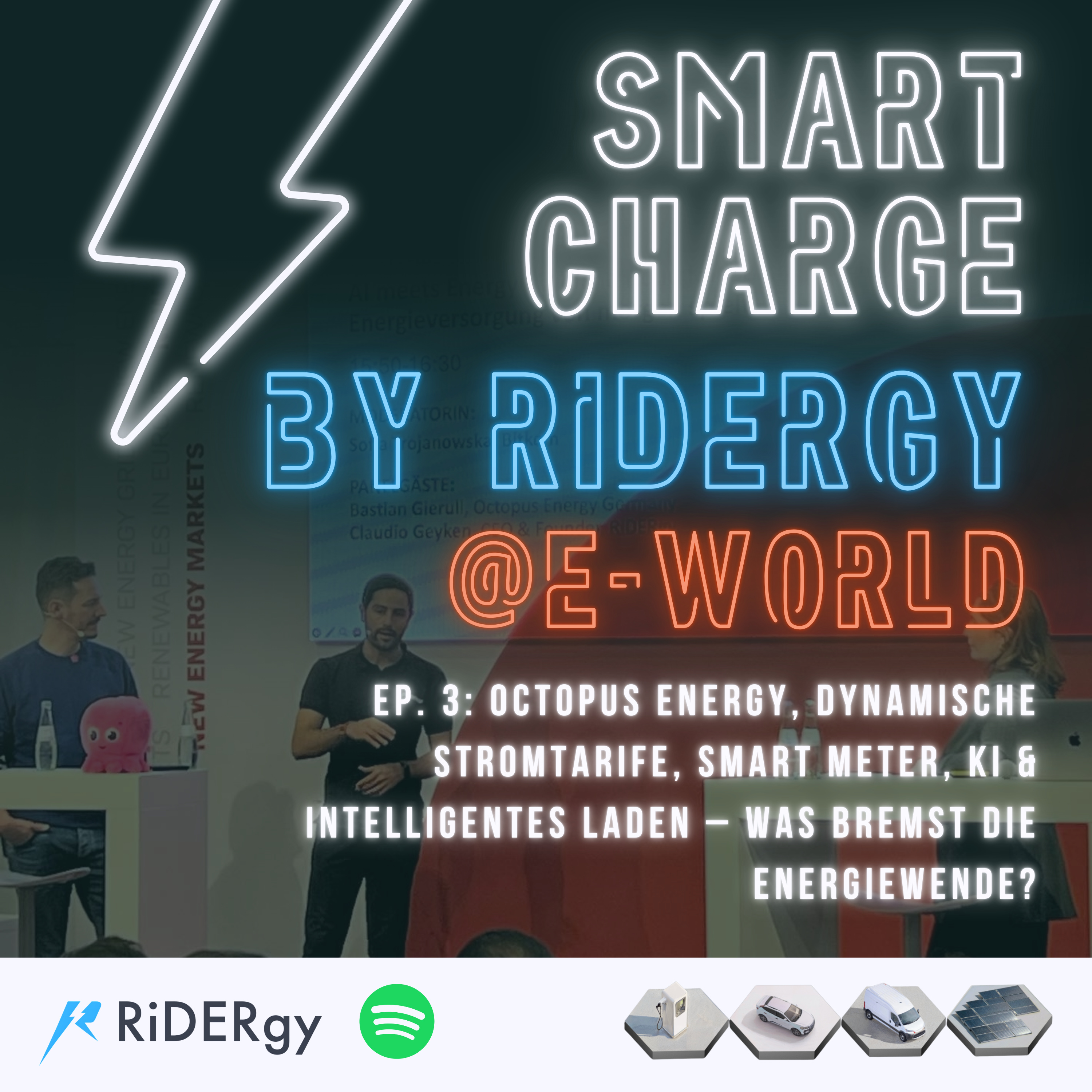
Ep. 3: Octopus Energy, Dynamische Stromtarife, Smart Meter, KI & intelligentes Laden – Was bremst die Energiewende?
Transcript
Cleaned up from a machine transcript. Translations are machine-generated and may contain errors.
Welcome to the Smart Charge by RiDERgy Podcast. This is Claudio Geyken, founder and CEO of RiDERgy. This is your show to learn about all things energy management and smart charging innovation for electric vehicles and fleets.
A warm welcome to our panel "AI Meets Energy – What Role Does AI Play in Tomorrow's Energy Supply?" As Emily already announced: My name is Sofia Trojanowska and I work with energy and utility companies in Germany, but also across Europe, on their decarbonisation and digitalisation. Because my goal is to minimise global warming and save our society from global warming. With this grand global objective, we're also approaching this wonderful panel, because AI as a driver of the energy transition is indispensable. AI-based systems are crucial for the
energy sector to master the current transformation of energy supply and make it future-proof. We need more efficient grid management for the increasingly volatile energy grid, predictive maintenance for the increasingly complex energy grid, and also enhanced cybersecurity for digitalisation in our energy grid. Last but not least, individualised customer communication is also important to answer recurring questions efficiently. Because currently we still have limited use of AI in pilot projects, and that's what we want to discuss today. The goal of our panel is to talk in our expert round about long-term solutions, but also current challenges
and perhaps also formulate an appeal to regulators and policymakers to make AI deployment in the energy sector comprehensive. We already had the introduction of wonderful start-ups with Christoph Bingener. And when I'm here at E-world for the first time, I also see incredibly many young, dynamic people. That means there are not only the old players in the energy sector, but also young people who are increasingly innovating and also getting a stage, which is wonderful. This panel – I want to say this again – is being
recorded as part of a podcast, through which we can then also engage in more exchange afterwards. I ask you all for a warm round of applause for our two speakers: Claudio Geyken, CEO and founder of RiDERgy,
and Bastian Gerold, CEO of Octopus Energy Germany.
Thank you very much. It's wonderful that you're here on our stage today.
RiDERgy is a provider of B2B energy management software for cost optimisation of electric fleets. A wonderful new venture, a great technology that we want to discuss now. Thank you for being here. Thank you. And also thanks to Bitkom for the invitation. Octopus Energy is a globally active energy tech company, a pioneer of renewable energy solutions and provider of the zero energy cost home, also one of the largest investors in renewable energy in Europe, which we urgently need. The portfolio amounts to 8.4 billion euros, as I've researched. Welcome. Thanks, thank you very much. Very pleased to be here.
Good, then let's dive right into our discussion – nice and relaxed. I wanted to know from you how you're currently using AI in your companies. Does it already have a key role? Is it moving in that direction? How does it look? Let's start with RiDERgy. Just to clarify – the question is: Can you repeat how you're currently using AI in your company? Okay. Yes, so perhaps a bit of context for background. It's about us optimising energy both at the depot and at the company site of businesses, but then
also prospectively at various locations – as the previous speaker also teased a bit. A major problem we now have with regard to the energy and mobility transition is that we need to understand how each individual vehicle is used – whether by an employee, by a logistics operator, whether it's a bus, etc. For this, we didn't have to do much in the past, it wasn't necessary when refuelling. But in the energy world, as we've already seen a lot today and tomorrow, it's essential that this data is processed and the
prediction is precise and can be assessed with risks – mainly so that you can make predictions for each individual vehicle, both in a fleet and in the home setting. For this, it's essential that AI is used. It can also work differently – it can also work without AI, let that be said. You can also operate initially with rules of thumb and simpler rules. But if we want to do optimisation well, that's an essential building block of RiDERgy as well. Secondly: because we operate as a module, if you will,
in this new software world of the energy world, it's essential that we're able to cooperate with other assets as well. This data and these AI algorithms for predicting mobility must work in conjunction with battery storage, with the prediction of a solar installation and with the energy markets and grids in harmony. Reinforcement learning is also essential there. So we're talking – just for understanding perhaps for those who aren't so deep into AI – not about LLMs and language models, but really about the
that happened even before OpenAI. Deep learning and reinforcement learning as the essential models that are relevant to us. Understood. That's incredibly interesting. And I can also imagine that data integration naturally plays a very significant role as well. We'll come back to that again later. And to you as well, Bastian: How are you already integrating AI into your business model? Well, we have several approaches there. I think you can roughly cluster it into two areas. One is really the interaction with the customer. We
focus very strongly on building close customer relationships and really delivering top service. Also because we say: The customer that I'm supporting excellently today on a standard load profile with a normal electricity contract is also someone we can take with us into the future of the energy transition, when it comes to much more complex products. Where do we use AI now? For example: When we have customer inquiries, we have language models that help us pre-evaluate a customer's history. Everyone knows this: You call your energy supplier and
you have a problem. And every time you have to describe the entire problem again, because the contact person you had, you're now speaking to for the first time. Then you explain again from A to Z what happened. There were emails exchanged, there were different phone calls in between. With us it works so that our system that we work with aggregates that. When you call, the agent, our customer service representative, suddenly has an overview: What has happened so far? What is the problem? And at
which step are we? That means the entire conversation is much shorter, more precise and dealt with more quickly for the customer. We can offer higher service and answer more customer inquiries. This applies to phone calls, but also to emails, where AI can help us find the right measures more quickly and tailor the responses more precisely to the customer. That was the customer side. On the other side we see the development that we have. And we see this here
effectively at every point: renewable energies, flexibility, much more complex systems. How do we plan all of this? How do we deal with the fact that electricity simply no longer always comes from the socket the same way and is consumed the same way, that we have EVs that should be charged at certain times and shouldn't be charged at certain times? There are considerable amounts of data from the grid operator, weather data that you bring in, consumption data that you should bring in. Managing this amount of data and purchasing electricity in an optimized way based on it, respectively
stabilizing the grid, is extremely difficult for humans – it's actually too complex. What such a thing is a particularly good task for are AI models. They can do that particularly well. And we already use them today for that. Yes, super interesting. I also did a bit of research. Magic Inc. as a tool is also something that you use and developed. And indeed, response times are shortened and service quality is elevated. And I mean, for all of us it's like this: When we pick up the phone
and call somewhere, we want to be processed, handled and advised quickly and not waste time unnecessarily with waiting times. Wonderful. Then let's go into the main part of the discussion: the current challenges. To you, Claudio: When we think about operating costs for electric vehicles, they're not insignificant. Can you explain to us how the AI solution now reduces operating costs and potentially also generates revenue in the future? So, is it more about the solutions first? Okay.
Well, I've already hinted at the challenges a bit. Just briefly in more depth so you understand the challenge: Making this prediction – as Bastian also mentioned, this still happens partly manually. A fleet manager sometimes had to tell his drivers: plug in, plug out – actually manually. That can of course still work with a few vehicles. However, this then has to be controlled automatically. That's a big challenge. The grid connection capacities that are available are usually around 80 kW –
a typical value. With a certain small number of charge points that still works without energy management, otherwise the fuses threaten to blow. And that's a huge problem, which is why the pain is simply very great, especially for fleets with more than a few vehicles. Operating costs, especially for logistics companies where margins are very low, present a major problem: they want to minimize TCO. That comes through peak shaving, better energy procurement as well as solar and battery storage combinations – those are the challenges that
we as a company still face. Which fleets have enough electric vehicles that it's worthwhile to minimize costs? That's a big challenge. However, we also see that there are more and more fleets in Germany – especially the large corporates sometimes have hundreds to thousands of charge points at their sites. These are the preferred customers where we're optimistic we can achieve up to 50% energy savings – realistically and very conservatively calculated more like 10 to 20%. And when bidirectional charging comes, that will also
which will become a huge driver in terms of energy savings. Another problem we're addressing: conventional legacy systems worked with local controllers and had to operate heavily with local hardware and Modbus – for those who are very deep into the technical side – protocols. Newer, more cloud-based systems and real-time control of systems is also one of the core solutions we're bringing to market, where we're not as tightly bound to always operating only with local hardware.
Yes, very exciting. So especially Vehicle-to-Grid, to drill down into that a bit more now: What do you think, when is the moment? When will we see Vehicle-to-Grid in Germany? Should I go into a roadmap and the challenges now or later? Now. Okay. So bidirectional charging, let's say as an umbrella term, and V2G as one of the ways to implement it. There are, as I see it, three dimensions. First, there are the tax levies, which fortunately were at least abolished in Germany recently by Habeck. However, the grid fees remain, and that
kills the business case. In other words: regulation still needs work at the grid fee and tax level. Then secondly, we're talking about interoperability. Those are protocols – without going too deeply into detail – but ISO 15118-20, OCPP, etc. There are several protocols that haven't yet been fully implemented by all stakeholders to achieve this. And then there's the electrical engineering level, where we need certain charging stations with AC/DC and vehicles with AC/DC that can do this, but not yet across the board. That means to enable bidirectionality in general,
you have to work on these levers. Certain use cases are already possible now. Vehicle-to-Load, I think almost every electric vehicle has that by now. That's pretty cool, so where you can discharge the vehicle for needs like camping or other applications. And the other use cases: Vehicle-to-Building will come next, and V2G will come last, where you then also have to make certain changes in market communication. Yes, market communication – a huge challenge. Now one final question for
you, so for this package: What hurdles do you see in implementing your technologies at customers? Are those large investments? Is it the process, is it data? What do you say? The practical implementation hurdles. Yes, so data is definitely a topic. In the mobility world there are various systems that are used or not used: telematics, ERP, TMS – so Enterprise Resource Planning, keyword SAP, and TMS. Fleet management systems – logistics companies in particular use those a lot. And there are many, many systems, so
having a tool that abstracts that and makes it available in an API – that's a topic that keeps us very busy: how to harmonise and bundle this mobility data. And then know-how is also a topic that my predecessor also mentioned – I would completely agree with that. We're a bit the geeks in the energy scene here, as soon as you then actually try to speak with the fleet manager in the mobility world. There's still a lot of education needed, which isn't meant in a bad way. But that is
in terms of timing for solutions like ours very difficult at times. You really have to find the right person who is also able and willing to put it on the agenda. But I believe we're staying on the ball and are convinced that the more electric vehicles there are in every fleet on the market, the greater the pain – and then we're ready. Understood. Yes, very interesting. Thank you very much. Now to you, Bastian. Your zero-energy-cost house is indeed an exciting approach for sustainable
living. How does AI support the optimisation of energy consumption and storage here? You've already mentioned quite a bit, like energy management systems and so on. But I'd now like to understand again how that happens in this zero-energy-cost house – or in our homes. Can you describe that a bit? Yes, certainly. The topic is – for those who don't know it: our Zero Bills House, our zero-energy-cost house. That's a concept – and not just a concept, it really exists – where a PV system, storage and heat pump are installed in the house. We have a smart meter
and we then have the technology platform – we use Kraken – which essentially optimises the generation, consumption, purchase and sale of electricity to the market in such a way that the people who live in this house pay €0 for their electricity bill and consequently also for their heating bill, because they have a heat pump. That's designed for the next six to ten years perspectively. That's naturally a very complex setup. It's about optimising precisely, because of course we don't want any loss of comfort in the
houses. It's not about somehow reducing or controlling, which we in Germany really like to do – this path via the control box that we want to take, §14a, reducing and taking things away from people when we see a problem in the system – but rather to go and say: How can I see this building as a virtual power plant? How can I implement the optimisations within it, which alone can already mean that you optimise all these components against each other? And that doesn't just have to do with current moments in
the energy market, but also with forecasting. How is the weather developing right now? How do we see – now again in February – the weather has an extreme influence on the electricity market price. The weather has an influence on how strongly renewables are generated or not. And you have to factor all these points into such optimisations. And for that you need an intelligent system that takes care of it.
Yes, absolutely exciting. Especially when you imagine that you could live in a zero-energy-cost home in the future. Five years ago, ten years ago, you wouldn't have been able to really grasp either of these solutions yet. And now it's actually almost reality already, right? Also to you, Bastian: when you scale your business model – you started on the UK side, in England, in 2015, and you're already huge there. You have a considerable market share, you're the number-one energy market player in England. How will this develop in Germany? What is your vision for the German market?
Actually, in Great Britain we've grown from an energy startup to the largest energy supplier in the country within eight, or rather now nine years. And that's really across customers – so standard electricity customers and energy customers. But we also do EV leasing, we do heat pump installation, we do smart meter installation, we do solar. We have innovative concepts like Zero Bills Home or like Intelligent Octopus, which goes a bit in your direction – just for individual households: the optimisation, the charge optimisation of individual EVs. We want to do that here in Germany too. That's our approach, to say globally: we want to bring everything that
we've tested in Great Britain or also in other markets into the respective markets. We want to become one of the largest energy suppliers here too, as far as energy customers are concerned. But we're already bringing innovative solutions to market here for a year now – precisely that innovative charging, the Zero Bills Home. We install heat pumps nationwide. We install smart meters, announced here at the trade fair that we're offering smart metering services to drive the whole smart metering topic forward in Germany. We have quite large
scaling targets. Very ambitious. And smart meters are important – we'll come back to that in a moment. When I now hear about the challenges – data interoperability, different industries that actually need to work together – I see automotive as one industry, very important for Germany of course, manufacturing, then the energy industry and then IT somewhere in this triangle as well, as a connecting link. And when I hear the challenges from you: we still don't have the smart meter rollout yet in some cases, so that we can use the data to
work even faster and more intelligently. But also with you: data for fleet management. Which stakeholder would you most like to talk to in order to bring about changes? Funny question, Claudio. Yes, probably the one who's most powerful in Germany – maybe Friedrich Merz then, to steer him a bit in the right direction, to let him set the right priorities, not fusion energy – and then maybe the Federal Network Agency, so that we do more in that direction there too. And then maybe also the most influential at the municipal utility level, because
I may not have mentioned this: dynamic electricity tariffs have actually been mandatory since January of this year. The Clean Energy Package 2019, passed by the EU Parliament, obligated every member state to actually implement this by 2021, to implement dynamic electricity tariffs. Now we're in 2025. Now actually every energy supplier should be doing it, and de facto most of them still haven't done it. So actually something illegal, which in my view is just not acceptable, especially in the country where if we cross the road on red, we already get told off
about it. And well, there are innovative energy suppliers here. But they're sometimes also loyal to their other energy supplier first. We're not an energy supplier, we're a software provider. We're naturally then dependent on the municipal utility or the respective energy supplier, who then has to give such incentives to the fleet. Otherwise the fleet gets nothing out of it – as an example. That's a major challenge. And there are more examples. But very, very exciting. Very good. So that's what a forum is about too: to critically question
and to see who you need to speak with to bring about changes that are also constructive. Also to you: who would you most like to exchange ideas with to drive further changes forward? That's an exciting question, because that's the problem we have in Germany: this extreme fragmentation that we have in the market. We always have extremely many of everything – many grid operators, many energy providers, many basic suppliers, many municipal utilities. Everyone has some kind of topic in it. Everyone has a stake. Everyone has interests that are also sometimes in conflict
with each other. I see that as the main challenge, because for us to be successful with the energy transition, we need to bring about a real system change. We can't carry on as we are. We can't pretend that the energy transition or the new energy system is something we could dock onto our old systems. That will actually cost us several hundred billion more. Or we'll have to expand the grid so much more that it becomes possible. If we really want to say we want to go in the direction of renewables and renewable electricity from renewable sources is the cheapest that
we've ever had, and it's getting cheaper every year. But how we use it becomes difficult in our systems. And if, for example, we have a 2% rollout with smart meters in Germany, we have a problem, because that's the core of such a renewable energy system, an energy system that's based on flexibility. So who would I want to talk to? Of course, you end up ultimately with politics and regulation, with whom you need to discuss this. What do we need to change to really set the course? And we need bold decisions, and
it's more about synergies, but also about the potential of AI. If we remember back when ChatGPT suddenly appeared, we were all like, "Okay, oh no, AI. We're afraid of it. What's going to happen with it?" But ultimately many people use ChatGPT and communicate with the tool. And that evil spirit of AI has kind of disappeared, I feel. It's a theoretical question, but do you feel that because we're now using AI more and more on a personal
level through ChatGPT, that communication with and through AI can be improved, which in turn could improve the interoperability problem with many of the systems? Can we trust AI now?
I'm happy to say something about that. So yes, I think we should actually be quite a bit further along. It's coming slowly now, more and more people are using it. But I think if you look around at your surroundings: Who is really actively using AI? Who really manages to get some benefit out of it? It's still far too few people. And I think you framed it quite nicely at the beginning. That's also a bit of the German psyche:
Something new comes along, it's first unsettling. Let's look at it very, very, very carefully. Maybe we need to put up a little fence around it and observe it first, instead of embracing it and saying, "Cool, there's something new. This is a technology solution with which we can move something forward. Now let's try it out first." And that's on one hand for AI. But if we stay with the energy business: We've talked about it. All these flexibility topics – in many heads and in many
conversations it's still about: How do we manage that? How do we control it? How do we steer and regulate it, instead of saying, "Hey, what are the benefits we can leverage?" People will live in houses in the future and pay nothing for their electricity and heating. Those are the benefits we're moving towards. So at that point: I think we all still need to become more interactive with these media, with AI, and
apply them to really get out of this buzzword thing – everything now has an AI, everything has an AI solution, whether it makes sense or not, we just slap it on because it's definitely good to write it on the front – but rather: Where are the use cases where it actually brings something? And that's really through trying things out. We have to do it, you have to do it in trial cases, not just in theoretical concepts. And that's another topic, I think, where we Germans are relatively
good at: talking about what we could do if something else had happened. These conversations also towards politics saying, "Yes, if this and that legislation were to change, then we all could." But we don't do it, because we're not allowed to. Rather, going ahead – especially us as companies in this forward-looking industry we're operating in – and saying, "We also invest something in lighthouse projects that perhaps aren't yet based on a hundred percent product-market fit, that aren't yet one hundred
percent covered by the government and by regulation, but where we say: Okay, but we can already prove this is going in the right direction. This is something people out there want, and this is something that advances the energy transition for us." V2G is such a case. We've been talking about it for years now. I still haven't seen any large-scale trials where an economic benefit is actually worked out. If we have that once in a region, then we'll relatively quickly
see that we can switch from these theoretical conversations of "What are the problems we have?" to "Amazing, what worked well?" What also comes to mind, broken down briefly: AI as an umbrella term – the history of AI actually goes back to the 1950s. Machine learning came at some point, I think in the nineties, and especially Amazon or Netflix – the recommendation algorithms are based on machine learning. And then at some point came what we've basically been using for years, perhaps without
really being conscious of it. And then now we're using ChatGPT and LLMs much more actively, since they've existed. And I think these touchpoints create fewer fears. And that's good. And in the energy world I would say we'll have certain touchpoints, similar to OpenAI, that are much more active. And certain things will happen in the background. And then, as already seen with autonomous driving with Waymo in San Francisco or elsewhere, people get used to it extremely quickly and then don't really think about it anymore. That's how
where I believe the vision also looks at how AI is developing, that it becomes a kind of internet. And suddenly we've got used to it. We've got used to the smartphone. And then it would be hard to imagine anything else. And these dangers, I wouldn't completely dismiss them either, that AI – there are leading AI researchers and Elon Musk etc. who are thinking about this and also see it as a risk. So I wouldn't deny the risks completely. We really would have to, and in
that sense, good again for the EU. I think the EU is always criticised, but it's right that we try to create a certain regulatory framework and foresee certain risks. And especially in the critical infrastructure of energy we also have to cushion certain risks. Nevertheless I'm back with Bastian, that you say: Let's just tackle and try things out. At certain scales it's also good and you mustn't over-regulate. Understood. You always see that in the United States the
big exponential digital business models come to market and there they're also tried out very boldly and then a few years later they're present in a similar way in Europe. But I think it would be very good if we just flipped the coin a bit and also became very actively innovative ourselves with our excellent talents in Europe. We'll stay with you now as well, Claudio. When I think about your technology – and I also mentioned it very briefly – can your technology also be connected to other stakeholders in the framework of a VPP
in the market? Because I'm also hearing a lot at the fair: Everyone is building their own. But rather like Android or Linux, open standards are essential, otherwise we have chaos and not a symphony that really has to interact with each other. And simply put: I think many people have good standards on their radar. And I also think innovative players have to think openly and not isolate themselves and think they'll do everything alone. Yes, I'm completely with you on that
in the wake of.
Let's move on to the next question. Back to your zero-cost energy house.
I see these energy communities, which we've also had anchored in the Renewable Energy Act since 2023, as a very sensible synergy partner for, for example, zero-energy house concepts. How do you observe these renewable energy communities in Germany? We have between 800 and 1,700 citizen energy communities in Germany. Is that a group that inspires you, and do you inspire them back? So now in the big context of synergies. I would even zoom out a bit more in the context of synergies, because of course it's positive. And it's also good. These energy communities have already
shown on a small scale where the future is heading. Namely, that through networking and using the resource of energy and a sharing and the optimisation thereby for an overall group, you leverage something that you don't have if you do it individually. But we have to think bigger. It doesn't help us if we have many of these energy communities that then don't communicate with each other again. And that also goes back a bit to your first question before. It's a bit like:
Where do we need to go? If everyone here builds their own solutions now, is that a problem? Do we have to impose some standards on it? We have to, I think. And the insidious thing is: You think you have a complex problem, now we have to start developing more complex regulations, install even more difficult stages and ensure that we can control it all. The reality is different. We won't be able to – unless we move towards state directives – slow down the innovation power that we
see at every stand. And that's also good. We need every single one. But what we do need is a system where you can, a bit like you said, dock on, where you can use all these different solutions collectively. And it has a lot to do with the system itself not being allowed to be fragmented. Communication across the system has to work. For example, smart meters have to be installed everywhere. And the data has to be available to everyone, so that everyone who
has such a product can connect to it. The signals with which this system works have to be relatively simple – not very complex and very multi-layered in the control, because then it becomes difficult again – but for example the price alone. By going ahead and saying, we have the electricity price on one hand, which tells us how much renewable or cheap electricity production we currently have, so dynamic tariffs on one hand, but on the other hand we also need an indication of what's
happening with the grid right now. Yes, and for example dynamic grid fees would be very useful there. With just these two elements alone you can already give very strong signals into the market, where then everyone who has their own VPP or charging network or something can work with it. Because I know right now: How much is the electricity? How much does the electricity cost? How much does the grid give me for now providing flexibility, by prospectively giving energy back with vehicle-to-grid and other solutions or currently taking less. And when I do take it,
it's simply more expensive. Then I have to be aware: Is it worth it to me? For someone else, the interest grows to say: Oh, we have an innovative set-up where we have electricity that we can make available. And in this mix we create an energy system, not with isolated solutions. I think we have two approaches in Germany. One is always a bit: Oh, we have to think centrally, and the grid operators dictate what happens. And on the other side, every single homeowner starts
to make themselves virtually energy-independent with PV and a battery. And I think that's exactly where the problem lies. A house with storage and a solar system is a great flexibility option. The storage, the car that's parked there – you can also use that to stabilise the grid. But if the person tries to isolate themselves as much as possible from the grid, then they're all individual houses trying to optimise themselves. And if it doesn't work out, they have a huge problem and then suddenly have to fall back on the grid.
The grid isn't prepared for that. And we need to somehow figure out how to solve the problem – to get everything together into a connectivity solution. That's the way forward, understood. But if I think about it now: Would you say that these energy communities will increase in Germany? Or will they stay at the same level? What's your feeling? I think they'll probably increase if there are incentives for them. We'll see now, when we have the new government, how
things will continue in the long term in such directions – whether these incentives will remain, whether there will be other incentives that go in a different direction. But I think per se it's a good thing. But I don't think the goal should be to say: Okay, we'll make sure we have as many individual energy communities as possible, and the rest will then have to figure out how to manage. Understood. Wonderful.
We're now looking together into the future, at how the vision of the energy transition and energy supply will shape up in Germany. And when I listen to you, there are various hurdles and various levers. But now quite concretely: What would you say needs to happen so that AI isn't just applied in these isolated solutions and pilot projects, but across the board in the energy sector? Do we now need specific regulations in Germany for the energy industry regarding AI? Or are there certain projects that you've seen or heard about
that can now also be implemented and initiated? At the cost of this data privacy, we can achieve significant savings, as Bastian mentioned earlier. We can only realise these potentials if we also have this data comprehensively. And secondly, all these data systems also need to provide more harmonised API interfaces that make it possible to easily obtain these transport management systems etc., which I mentioned earlier, load profiles and so on. Those would be the two things that come to mind most.
Thank you. I think the task of politics and regulation is to prepare infrastructure for us.
Whether that's the roads and bridges on one side – on the other side it's the grids or, and this is the smart meter point again. We simply have a point here in Germany where we've been talking about the same topic for ten years. We should finally start with the smart meter rollout. We're still at 2%. The other countries around us are at 90, 95%. They're finished. Britain is at 60%. But they started later than
everyone else and have now switched on the turbo. That's where we need to get to now as well. And we need a very clear solution for that, because we have so many conflicts of interest around it – who owns these metering devices, who should install them, who then applies the tariff and the electricity. We need a very clear nationwide solution from regulation on how we advance this rollout, where it's clearly regulated how you install simple, intelligent devices cost-effectively in people's
basements. So that's already the core. Regarding AI – which was also part of your question – it's like this: I always think when politics interferes in the technology landscape, especially software, things get messy. There too, to create foundations, to create infrastructure, to say: How should the data flow? Do we have centralised data storage where all data from all smart meters flows in and everyone else has access to it, as we have in other countries? Or are they all small isolated solutions
where everyone tries to do their own thing? That's where influence exists. How then the individual providers and players in the energy market use AI with which software solutions – there you can certainly put a broader bracket around the larger AI question, which you mentioned. What about ethical concerns? But in the actual implementation it's like with all technological things: whoever has the better solution faster will also be more likely to win in the market. And we have to be careful that we don't try through unnatural hurdles to
to distort it, because we simply have players in the market who say: "We don't want to go along with that" or "We can't go along with that." But just because we can't go along or because we don't want to invest, does that mean nobody else is allowed to do it? Then we're just moving backwards again. And then we'll stay stuck at 2% smart meter rollout and with an energy system that isn't fit for the future. One more thing occurred to me: as quickly as possible, dynamise the dynamic grid fees that were mentioned earlier – as far as possible – so that when
we have this data available from the various branches – the thousands of grid branches that we have in Germany – then the prices are dynamic and dynamic electricity tariffs are offered by all energy suppliers. Then AI can also reach its full potential, and of course vehicle-to-grid as well. Plus remove the necessary barriers that I mentioned earlier as quickly as possible. Yes, you've actually pre-empted my last question. I wanted to ask very specifically: What do you wish for from politics and regulation? But you've
actually already articulated perfectly what needs to be done. And that's why we're definitely taking your points on board and also appealing here to the future. So now I can already thank you and briefly summarise this panel. AI is a driver for cost-efficient and sustainable energy supply. We have dynamic electricity tariffs that now need to be rolled out further and also need to be adopted in order to create transparency for customers and really create a new energy vision for Germany and Europe. A lot is going into
self-supply and autonomous self-sufficiency concepts, but it should also be about connecting and about harmonising and orchestrating these individual systems, which will then allow us to further optimise our consumption. I'm noting: synergies are important between the individual players. We've also talked about smart meters and vehicle-to-grid concepts in the future. But the lack of interoperability is essential – that must
be resolved, and also the compatibility of the individual systems, whether in the passenger car sector or in the smart meter sector. In some cases there are of course very complicated requirements, and these simply need to be broken down systematically. All in all, in short: data communication between the individual stakeholders needs to be improved so that we can make faster progress with the energy transition and also advance great, futuristic, innovative business models in Europe and Germany. We can really be proud that we have such great thinkers and such great innovators, and now they just need
to be pushed even further. That was this episode, recorded live from E-world, with Octopus Germany CEO Bastian Girodt. I hope the discussion about smart meter rollout, the challenges posed by AI regarding data access and data protection, and the regulatory hurdles for bidirectional charging has given you new insights. It's not easy with less than 2% smart meter rollout. And we absolutely need an agnostic view of the issue when it comes to control, particularly that you can also approach it via the charging stations without a smart meter gateway
and less excessive data protection, so that AI can be approached more efficiently and the cost efficiencies can then also be achieved. Especially now, when energy costs are so top of mind for everyone and Germany is suffering under these costs, we need a bit more pragmatism in that sense. And we also need companies that increasingly take on risks and are able to innovate faster, and regulations that change more quickly and for the better. Stay tuned for more
exciting insights into the future of energy – until next time.
Welcome to the Smart Charge by RiDERgy Podcast. This is Claudio Geyken, founder and CEO of RiDERgy. This is your show to learn about all things energy management and smart charging innovation for electric vehicles and fleets.
Herzlich willkommen zu unserem Panel „AI Meets Energy – Welche Rolle spielt KI in der Energieversorgung von morgen?" Wie von Emily schon angekündigt: Mein Name ist Sofia Trojanowska und ich arbeite mit Energie- und Versorgungsunternehmen in Deutschland, aber auch in Europa zusammen zur Dekarbonisierung und Digitalisierung jener. Denn mein Ziel ist es, die Erderwärmung zu minimieren und unsere Gesellschaft vor der Erderwärmung zu retten. Mit diesem großen Weltziel gehen wir auch in dieses wunderbare Panel ran, denn KI als Treiber der Energiewende ist unabdingbar. KI-basierte Systeme sind entscheidend für die
Energiebranche, um die aktuelle Transformation der Energieversorgung zu meistern und sie zukunftsfest aufzustellen. Wir brauchen ein effizienteres Netzmanagement für das zunehmend volatile Energienetz, vorausschauende Wartung für das zunehmend komplexe Energienetz, auch erhöhte Cybersicherheit für die Digitalisierung in unserem Energienetz. Last but not least ist auch eine individualisierte Kundenkommunikation wichtig, um wiederkehrende Fragen effizient zu beantworten. Denn aktuell haben wir noch einen begrenzten Einsatz von KI in Pilotprojekten, und das wollen wir heute thematisieren. Das Ziel unseres Panels ist es, in unserer Expertenrunde über langfristige Lösungen, aber auch aktuelle Herausforderungen
zu sprechen und vielleicht auch einen Appell an die Regulierung und die Politik zu formulieren, um den KI-Einsatz in der Energiebranche flächendeckend zu gestalten. Wir hatten schon mit Christoph Bingener die Vorstellung von wunderbaren Start-ups. Und wenn ich hier das erste Mal auf der E-world bin, sehe ich auch unheimlich viele junge, dynamische Leute. Das heißt, es gibt nicht nur die alten Player im Energiebereich, sondern auch die jungen Menschen, die zunehmend innovieren und auch eine Bühne bekommen, was wunderbar ist. Dieses Panel – das will ich auch noch mal sagen – wird
aufgenommen im Rahmen eines Podcasts, wodurch wir dann auch noch mal mehr in den Austausch im Nachhinein gehen können. Ich bitte Sie alle um einen herzlichen Applaus für unsere zwei Speaker: Claudio Geyken, CEO und Gründer von RiDERgy,
und Bastian Gerold, CEO von Octopus Energy Germany.
Vielen Dank. Es ist wunderbar, dass ihr heute hier auf unserer Bühne seid.
RiDERgy ist ein Anbieter von B2B-Energiemanagementsoftware für die Kostenoptimierung von Elektroflotten. Ein wunderbares neues Engagement, eine tolle Technologie, die wir jetzt besprechen wollen. Danke schön, dass du da bist. Danke dir. Und danke auch dem Bitkom für die Einladung. Octopus Energy ist ein weltweit aktives Energietech-Unternehmen, ein Pionier erneuerbarer Energielösungen und Anbieter des Nullenergiekostenhauses, zudem einer der größten Investoren in erneuerbare Energien in Europa, was wir dringend brauchen. Das Portfolio beträgt 8,4 Milliarden €, so wie ich recherchiert habe. Willkommen. Danke, vielen Dank. Freut mich sehr, hier zu sein.
Gut, dann steigen wir gleich in unsere Diskussion ein – locker flockig. Ich wollte von euch gerne wissen, wie ihr momentan KI in euren Unternehmen einsetzt. Hat es schon eine Schlüsselrolle? Bewegt es sich da rein? Wie verhält es sich? Fangen wir mal mit RiDERgy an. Nochmal zum Verständnis – die Frage ist: Kannst du es wiederholen, wie du momentan KI in deinem Unternehmen einsetzt? Okay. Ja, also vielleicht zum Hintergrund ein bisschen Kontext. Es geht darum, dass wir sowohl am Depot und am Unternehmensstandort von Unternehmen Energie optimieren, aber dann
auch perspektivisch an verschiedenen Standorten – wie auch vom Vorredner ein bisschen angeteasert. Ein großes Problem, das wir jetzt im Hinblick auf die Energie- und Mobilitätswende haben, ist, dass wir verstehen müssen, wie jedes einzelne Fahrzeug verwendet wird – sei es von einem Arbeitnehmer, sei es von einem Logistiker, sei es ein Bus etc. Dafür mussten wir in der Vergangenheit nicht viel machen, es war beim Tanken nicht nötig. Aber in der Energiewelt, wie wir heute und morgen schon viel gesehen haben, ist es essenziell, dass diese Daten verwertet werden und die
Vorhersage präzise ist und mit Risiken eingeschätzt werden kann – hauptsächlich dafür, dass man die Vorhersage eines jeden einzelnen Fahrzeugs, sowohl in einer Flotte als auch im Heimbereich, treffen kann. Dafür ist es essenziell, dass KI benutzt wird. Es geht auch anders – es geht auch ohne KI, sei auch mal gesagt. Man kann auch mit Faustregeln und einfacheren Regeln erst mal agieren. Aber wenn wir die Optimierung gut machen wollen, ist das ein wesentlicher Baustein auch von RiDERgy. Zweitens: dadurch, dass wir als Modul, wenn man so will,
in dieser neuen Softwarewelt der Energiewelt agieren, ist es essenziell, dass wir in der Lage sind zu kooperieren, auch mit anderen Assets. Diese Daten und diese KI-Algorithmen der Vorhersage der Mobilität müssen im Zusammenspiel mit Batteriespeichern, mit der Vorhersage einer Solaranlage und mit den Energiemärkten und den Netzen im Zusammenklang agieren. Reinforcement Learning ist auch dort essenziell. Also wir sprechen – auch nur zum Verständnis vielleicht für diejenigen, die in der KI nicht so drinstecken – nicht von LLMs und Sprachmodellen, sondern wirklich von dem
was schon vor OpenAI stattgefunden hat. Deep Learning und Reinforcement Learning als die essenziellen Modelle, die für uns relevant sind. Verstanden. Das ist unheimlich interessant. Und ich kann mir auch vorstellen, dass die Datenintegration natürlich auch eine sehr wesentliche Rolle spielt. Wir werden darauf jetzt noch mal später zurückkommen. Und auch an dich, Bastian: Wie integriert ihr jetzt schon KI in eurem Geschäftsmodell? Also, wir haben da schon mehrere Ansätze. Ich glaube, man kann das grob clustern in zwei Bereiche. Das eine ist wirklich die Interaktion mit dem Kunden. Wir
fokussieren sehr stark darauf, enge Kundenbindungen aufzubauen und wirklich Top-Service zu liefern. Auch weil wir sagen: Den Kunden, den ich heute auf einem Standard-Lastprofil auf einem normalen Stromvertrag hervorragend begleite, das ist auch jemand, den wir mitnehmen können in die Zukunft der Energiewende, wenn es um viel komplexere Produkte geht. Wo benutzen wir da jetzt KI? Zum Beispiel: Wenn wir Kundenanfragen haben, haben wir Sprachmodelle, die uns helfen, eine Historie eines Kunden vorauszuwerten. Man kennt das alles: Man ruft an bei seinem Energieanbieter und
hat ein Problem. Und man muss jedes Mal das gesamte Problem wieder schildern, weil man den Ansprechpartner, den man hatte, jetzt zum ersten Mal hat. Dann erklärt man wieder von Adam bis Eva, was da alles passiert ist. Da sind E-Mails geflossen, da gab es unterschiedliche Telefonate zwischendurch. Bei uns läuft es so, dass unser System, mit dem wir arbeiten, das aggregiert. Wenn man anruft, hat der Agent, unser Customer-Service-Mitarbeiter, auf einmal die Übersicht: Was ist bisher passiert? Was ist die Problematik? Und an
welchem Schritt befinden wir uns? Das heißt, das gesamte Gespräch ist viel kürzer, präziser und schneller abgehandelt für den Kunden. Wir können einen höheren Service bieten und mehr Kundenanfragen beantworten. Das gilt beim Anruf, aber auch bei der E-Mail, wo KI uns unterstützen kann, schneller die richtigen Maßnahmen zu finden und die Antworten präziser auf den Kunden zuzuschneiden. Das war jetzt mal die Kundenseite. Auf der anderen Seite sehen wir die Entwicklung, die wir haben. Und wir sehen das ja hier
im Endeffekt an jeder Stelle: Erneuerbare Energien, Flexibilisierung, viel komplexere Systeme. Wie planen wir das alles? Wie gehen wir damit um, dass Strom einfach nicht mehr immer gleich aus der Steckdose kommt und gleich verbraucht wird, dass wir EVs haben, die zu gewissen Zeiten geladen werden sollten und zu gewissen Zeiten nicht geladen werden sollten? Es gibt erhebliche Datenmengen vom Netzbetreiber, Wetterdaten, die man mit reinnimmt, Verbrauchsdaten, die man mit reinnehmen soll. Diese Menge an Daten zu managen und darauf optimiert Strom einzukaufen beziehungsweise
das Netz zu stabilisieren, ist extrem schwierig für Menschen – es ist eigentlich zu komplex. Wofür so etwas besonders eine gute Aufgabe ist, sind KI- bzw. AI-Modelle. Die können das besonders gut. Und da nutzen wir sie heute auch schon. Ja, superinteressant. Ich habe auch ein bisschen recherchiert. Magic Inc. als Tool ist ja auch etwas, was ihr anwendet und entwickelt habt. Und in der Tat werden Antwortzeiten verkürzt und die Servicequalität gehoben. Und ich meine, bei uns allen ist es so: Wenn wir den Hörer in die Hand nehmen
und irgendwo anrufen, wollen wir schnell bearbeitet, verarbeitet und beraten werden und nicht unnötig Zeit vertrödeln mit Wartezeiten. Wunderbar. Dann gehen wir einmal in den Hauptteil der Diskussion rein: die aktuellen Herausforderungen. An dich, Claudio: Wenn wir über Betriebskosten für Elektrofahrzeuge nachdenken, sind die ja nicht unerheblich. Kannst du uns erklären, wie die KI-Lösung jetzt die Betriebskosten senkt und potenziell auch zukünftig Erträge generiert? Also, geht es mehr um die Lösungen zunächst? Okay.
Also, die Herausforderungen habe ich ja schon ein bisschen angedeutet. Noch mal kurz vertieft, damit man die Herausforderung versteht: Diese Vorhersage zu machen – das passiert, wie Bastian auch schon meinte, zum Teil noch manuell. Ein Fuhrparkleiter musste zum Teil seinen Fahrern sagen: Stecker rein, Stecker raus – tatsächlich manuell. Das kann natürlich bei ein paar Fahrzeugen noch funktionieren. Allerdings muss das dann automatisch gesteuert werden. Das ist eine große Herausforderung. Die Netzanschlussleistungen, die vorhanden sind, liegen meistens bei 80 kW –
ein üblicher Wert. Bei einer gewissen geringen Anzahl von Ladepunkten geht das noch ohne Energiemanagement, sonst drohen die Sicherungen zu fliegen. Und das ist ein Riesenproblem, weshalb der Pain einfach sehr groß ist, gerade bei Flotten mit mehr als wenigen Fahrzeugen. Die Betriebskosten, insbesondere bei Logistikern, wo die Margen sehr niedrig sind, stellen ein großes Problem dar: Sie wollen die TCO minimieren. Das geht über Lastspitzenkappung, bessere Energiebeschaffung sowie Solar- und Batteriespeicher-Kombination – so die Herausforderungen, die
uns als Unternehmen noch vorliegen. Welche Flotten haben denn genügend Elektrofahrzeuge, dass es sich lohnt, Kosten zu minimieren? Das ist eine große Herausforderung. Allerdings sehen wir auch, dass es immer mehr Flotten in Deutschland gibt – insbesondere die großen Corporates haben zum Teil Hunderte bis Tausende von Ladepunkten an ihren Standorten. Das sind die präferierten Kunden, bei denen wir optimistisch bis zu 50 % Energieeinsparungen erzielen können – realistisch und sehr konservativ gerechnet eher 10 bis 20 %. Und wenn bidirektionales Laden kommt, wird das auch
zu einem Riesentreiber noch werden, was Energieeinsparungen bedeutet. Was noch ein Problem ist, was wir so adressieren: Konventionelle Legacy-Systeme waren mit lokalen Controllern und mussten viel mit lokaler Hardware und Modbus – für diejenigen, die in der Technik sehr drinstecken – Protokolle agieren. Neuere, Cloud-basiertere Systeme und Echtzeit-Steuerung der Systeme ist auch eine der Kernlösungen, die wir am Markt bringen, wo wir nicht so stark gebunden sind, immer nur mit lokaler Hardware zu agieren.
Ja, sehr spannend. Also insbesondere Vehicle-to-Grid, um da jetzt nochmal ein bisschen reinzuklicken: Was denkst du, wann ist der Zeitpunkt? Wann werden wir Vehicle-to-Grid in Deutschland sehen? Eine Roadmap und die Herausforderungen – soll ich jetzt oder später darauf eingehen? Jetzt. Okay. Ja, bidirektionales Laden, sagen wir mal als Oberbegriff, und V2G als eines der Wege, das umzusetzen. Da gibt es, wie ich darüber denke, drei Dimensionen. Zum einen sind es die steuerlichen Abgaben, die glücklicherweise von Habeck zuletzt in Deutschland zumindest abgeschafft worden sind. Allerdings bleiben die Netzentgelte, und das
killt den Business-Case. Also sprich: die Regulatorik hat auf Netzentgelt- und steuerlicher Ebene noch Bedarf. Dann zweitens sprechen wir von Interoperabilität. Das sind Protokolle – ohne zu stark ins Detail reinzugehen – aber ISO 15118-20, OCPP etc. Da gibt es einige Protokolle, die noch nicht vollständig von allen Stakeholdern implementiert worden sind, um das zu erreichen. Und dann gibt es die elektrotechnische Ebene, wo wir bestimmte Ladesäulen mit AC/DC und Fahrzeuge mit AC/DC brauchen, die das können, allerdings noch nicht flächendeckend. Das heißt, um Bidirektionalität generell zu
ermöglichen, muss man an diesen Hebeln arbeiten. Gewisse Use-Cases sind jetzt schon möglich. Vehicle-to-Load hat, glaube ich, fast jedes Elektrofahrzeug mittlerweile. Das ist ganz cool, also wo man das Fahrzeug entladen kann für Bedarfe wie Camping oder andere Anwendungen. Und die anderen Use-Cases: Vehicle-to-Building wird als nächstes kommen, und V2G wird zu guter Letzt kommen, wo man dann auch in der Marktkommunikation gewisse Änderungen vornehmen muss. Ja, Marktkommunikation – eine Riesenchallenge. Jetzt auch nochmal eine Abschlussfrage für
dich, also jetzt für dieses Paket: Welche Hürden siehst du bei der Implementierung deiner Technologien bei Kunden? Sind das große Investitionen? Ist es der Prozess, sind es Daten? Was sagst du? Die Praxisimplementierungshürden. Ja, also Daten sind auf jeden Fall ein Thema. In der Mobilitätswelt gibt es verschiedene Systeme, die angewendet werden oder nicht angewendet werden: Telematik, ERP, TMS – also Enterprise Resource Planning, Stichwort SAP, und TMS. Flottenmanagement-Systeme – insbesondere Logistiker haben das viel. Und da gibt es viele, viele Systeme, also
dass man ein Tool hat, das das abstrahiert und in einer API zur Verfügung stellt – das ist ein Thema, was uns viel beschäftigt: wie man diese Mobilitätsdaten harmonisiert und bündelt. Und dann ist Know-how auch ein Thema, das mein Vorredner auch angesprochen hat – dem würde ich komplett zustimmen. Wir sind hier ein bisschen die Geeks in der Energieszene, sobald man dann wirklich in der Mobilitätswelt versucht, mit dem Fuhrparkleiter zu sprechen. Da ist noch viel Education nötig, was nicht böse gemeint ist. Aber das ist
vom Timing für solche Lösungen wie unsere zum Teil sehr schwierig. Da muss man wirklich den Richtigen finden, der auch in der Lage ist und auch will, das auf die Agenda zu setzen. Ich glaube aber, wir bleiben am Ball und sind überzeugt, dass je mehr E-Fahrzeuge in jeder Flotte am Markt sind, desto größer der Pain ist – und dann sind wir bereit. Verstanden. Ja, sehr interessant. Vielen Dank. Nun an dich, Bastian. Dein Null-Energiekostenhaus ist ja ein spannender Ansatz für nachhaltiges
Wohnen. Wie unterstützt KI hier die Optimierung von Energieverbrauch und Speicherung? Du hast ja schon einiges angesprochen, so Energiemanagementsysteme und so. Aber ich würde jetzt gerne nochmal verstehen, wie das in diesem Null-Energiekostenhaus passiert – oder bei uns zu Hause. Kannst du das ein bisschen beschreiben? Ja, durchaus. Das Thema ist – wer das nicht kennt: unser Zero-Bills-Haus, unser Null-Energiekostenhaus. Das ist ein Konzept – und nicht nur ein Konzept, das gibt es wirklich –, wo PV-Anlage, Speicher und Wärmepumpe verbaut sind in dem Haus. Wir haben einen Smartmeter
und wir haben dann die Technologieplattform – wir benutzen Kraken –, die im Endeffekt die Erzeugung, den Verbrauch, den Einkauf und den Verkauf von Strom an den Markt so optimiert, dass die Menschen, die in diesem Haus wohnen, 0 € für ihre Stromrechnung zahlen und demnach auch für ihre Heizrechnung, weil sie eine Wärmepumpe haben. Das ist perspektivisch auf die nächsten sechs bis zehn Jahre ausgelegt. Das ist natürlich ein sehr komplexes Setup. Da geht es darum, genau zu optimieren, weil wir natürlich keinen Komfortverlust haben wollen in den
Häusern. Es geht nicht darum, irgendwie runterzuregeln oder zu steuern, was wir ja hier in Deutschland ganz gerne machen – diesen Weg über die Steuerbox, den wir einschlagen wollen, §14a, den Leuten Sachen zu reduzieren und wegzunehmen, wenn wir ein Problem im System sehen –, sondern vielmehr hinzugehen und zu sagen: Wie kann ich dieses Gebäude als virtuelles Kraftwerk sehen? Wie kann ich die Optimierungen darin umsetzen, die allein schon bedeuten können, dass man diese ganzen Komponenten gegeneinander optimiert? Und das hat ja nicht nur etwas mit Ist-Momenten zu tun
im Energiemarkt, sondern eben auch mit Prognose. Wie entwickelt sich das Wetter gerade? Wie sehen wir – jetzt wieder im Februar – das Wetter hat einen extremen Einfluss auf den Strommarktpreis. Das Wetter hat einen Einfluss darauf, wie stark die Erneuerbaren generiert werden oder nicht. Und diese Punkte muss man alle mit einrechnen in solche Optimierungen. Und dazu braucht man ein intelligentes System, das das übernimmt.
Ja, absolut spannend. Insbesondere wenn man sich vorstellt, dass man in einem Null-Energiekosten-Haus in der Zukunft leben kann. Vor fünf Jahren, vor zehn Jahren hätte man beide Lösungen noch gar nicht so wirklich greifen können. Und jetzt ist es eigentlich schon fast Realität. Richtig? Auch an dich, Bastian: Wenn ihr euer Geschäftsmodell skaliert – ihr habt ja angefangen, UK-seitig, in England, 2015, und dort seid ihr ja auch schon riesig. Ihr habt einen beträchtlichen Marktanteil, seid der Number-One-Energie-Market-Player in England. Wie wird sich das in Deutschland entwickeln? Was ist deine Vision für den deutschen Markt?
Tatsächlich, in Großbritannien sind wir innerhalb von acht, beziehungsweise inzwischen seit neun Jahren von einem Energie-Startup zum größten Energieanbieter des Landes gewachsen. Und das ist wirklich über Kunden hinweg – also Standard-Stromkunden und Energiekunden. Aber wir machen auch E-Leasing, wir machen Wärmepumpenverbau, wir machen Smartmeter-Verbau, wir machen Solar. Wir haben eben so innovative Konzepte wie Zero Bills Home oder wie Intelligent Octopus, was ein bisschen in deine Richtung geht – nur für den Einzelhaushalt: die Optimierung, die Ladeoptimierung von einzelnen EVs. Das wollen wir hier in Deutschland auch machen. Das ist unser Ansatz, weltweit zu sagen: Wir wollen alles das, was
wir in Großbritannien oder auch in anderen Märkten erprobt haben, in die jeweiligen Märkte bringen. Wir wollen auch hier einer der größten Energieanbieter werden, was Energiekunden angeht. Aber wir sind jetzt auch schon dabei, innovative Lösungen seit einem Jahr hier an den Markt zu bringen – eben das innovative Laden, das Zero Bills Home. Wir installieren Wärmepumpen deutschlandweit. Wir installieren Smart Meter, haben hier auf der Messe announced, dass wir Smartmetering-Services anbieten, um das ganze Thema Smartmetering in Deutschland nach vorne zu treiben. Wir haben recht große
Skalierungsziele. Sehr ambitioniert. Und Smart Meter sind wichtig – wir kommen gleich noch mal darauf zurück. Wenn ich mir jetzt die Herausforderungen teilweise anhöre – Dateninteroperabilität, verschiedene Industrien, die eigentlich zusammen miteinander arbeiten müssten – sehe ich einmal Automotive als Industrie, sehr wichtig natürlich für Deutschland, Manufacturing, dann die Energieindustrie und dann IT irgendwo auch so in diesem Triangle, in diesem Dreieck, als Bindeglied. Und wenn ich die Herausforderungen von euch höre: Teilweise haben wir noch nicht den Smartmeter-Rollout, damit wir die Daten nutzen können, um da
noch schneller und intelligenter arbeiten zu können. Aber auch bei dir: Daten für das Flottenmanagement. Mit welchem Stakeholder würdet ihr euch am liebsten unterhalten, um Veränderungen herbeizuführen? Lustige Frage, Claudio. Ja, wahrscheinlich der, der am mächtigsten ist in Deutschland – vielleicht dann Friedrich Merz, um ihn ein bisschen in die richtige Richtung zu lenken, die richtigen Prioritäten setzen zu lassen, nicht Fusionsenergie – und dann vielleicht die BNetzA, dass man da auch in die Richtung noch mal mehr macht. Und dann vielleicht auch die Einflussreichsten auf der Stadtwerke-Ebene, weil
das habe ich vielleicht nicht angesprochen: Die dynamischen Stromtarife sind ja eigentlich seit Januar dieses Jahres verpflichtend. Das Clean Energy Package 2019, durch das EU-Parlament gegangen, verpflichtete jeden Mitgliedstaat, bis 2021 eigentlich diese Implementierung zu machen, also dynamische Stromtarife zu implementieren. Jetzt sind wir in 2025. Jetzt müsste es eigentlich jeder Energieversorger machen, und de facto haben das die meisten immer noch nicht gemacht. Also eigentlich etwas Illegales, was meines Erachtens gar nicht geht, insbesondere in dem Land, wo wir, wenn wir bei Rot über die Ampel gehen, schon irgendwie gemeckert
wird. Und gut, es gibt innovative Energieversorger hier. Aber die sind halt manchmal erst mal auch loyal gegenüber ihrem anderen Energieversorger. Wir sind kein Energieversorger, wir sind Softwareanbieter. Wir sind natürlich dann abhängig von dem Stadtwerk oder dem jeweiligen Energieversorger, der dann solche Incentives der Flotte geben muss. Sonst hat die Flotte nichts davon – als Beispiel. Das ist eine große Herausforderung. Und da gibt es noch weitere Beispiele. Aber sehr, sehr spannend. Sehr gut. Also, darum geht es auch in einem Forum: hier kritisch zu
hinterfragen und zu schauen, mit wem man sprechen muss, um Veränderungen herbeizuführen, die auch konstruktiv sind. Auch an dich: Mit wem würdest du dich am liebsten austauschen, um weitere Veränderungen voranzutreiben? Das ist eine spannende Frage, weil das ist ja das Problem, das wir in Deutschland haben: diese extreme Fragmentierung, die wir am Markt haben. Wir haben von allem immer extrem viel – viele Netzbetreiber, viele Energieanbieter, viele Grundversorger, viele Stadtwerke. Jeder hat da irgendwie ein Thema drin. Jeder hat einen Stake. Jeder hat Interessen, die auch manchmal im Konflikt
miteinander liegen. Da sehe ich die Hauptherausforderung, weil wir müssen, damit wir erfolgreich werden, mit der Energiewende einen echten Systemwandel herbeiführen. Wir können nicht so weitermachen. Wir können nicht so tun, als wäre die Energiewende oder das neue Energiesystem etwas, was wir an unsere alten Systeme andocken könnten. Das wird uns tatsächlich mehrere 100 Milliarden mehr kosten. Oder wir müssen das Netz so viel mehr ausbauen, dass es möglich ist. Wenn wir wirklich sagen wollen, wir wollen Richtung Erneuerbare gehen und erneuerbarer Strom aus erneuerbaren Quellen ist der günstigste, den
wir je hatten, und er wird jedes Jahr günstiger. Nur wie wir den benutzen, wird halt schwierig in unseren Systemen. Und wenn wir zum Beispiel in Deutschland 2% Rollout mit Smartmetern haben, haben wir ein Problem, weil das ist der Kern eines solchen erneuerbaren Energiesystems, eines Energiesystems, das auf Flexibilität aufbaut. Also, mit wem würde ich reden wollen? Natürlich endet man am Ende bei Politik und Regulatorik, mit denen man darüber sprechen muss. Was müssen wir denn verändern, um wirklich Weichen zu stellen? Und wir brauchen mutige Entscheidungen und
da geht es mehr um Synergien, aber auch um das Potenzial von KI. Wenn wir uns daran zurückerinnern, als ChatGPT auf einmal auftauchte, waren wir alle so: „Okay, oh nein, KI. Wir haben Angst davor. Was passiert damit?" Aber letztendlich nutzen viele Leute ChatGPT und kommunizieren mit dem Tool. Und dieser böse Geist der KI ist so ein bisschen verschwunden, habe ich das Gefühl. Es ist eine theoretische Frage, aber habt ihr das Gefühl, dadurch, dass wir jetzt mehr und mehr auch auf persönlichem
Level KI nutzen durch ChatGPT, dass die Kommunikation mit und durch KI verbessert werden kann, was dann wiederum das Interoperabilitätsproblem bei vielen der Systeme verbessern könnte? Können wir KI jetzt schon vertrauen?
Ich kann gern was dazu sagen. Also ja, ich glaube, wir sollten eigentlich noch eine ganze Ecke weiter sein. Es kommt jetzt langsam, immer mehr Leute nutzen das. Aber ich glaube, wenn man sich umschaut in seinem Umfeld: Wer ist denn wirklich aktiv dabei und nutzt KI? Wer schafft es wirklich, da einen Nutzen für sich rauszuholen? Es sind immer noch viel zu wenig Leute. Und du hast es, glaube ich, ganz schön am Anfang geframt. Das ist auch so ein bisschen die deutsche Seele:
Kommt was Neues, ist das erstmal unheimlich. Gucken wir mal sehr, sehr, sehr vorsichtig. Vielleicht müssen wir einen kleinen Zaun drum machen und das erstmal beobachten, anstatt dass wir das embracen und sagen: „Cool, da ist was Neues. Das ist eine Technologielösung, mit der wir irgendwas bewegen können. Jetzt probieren wir das erstmal aus." Und das ist jetzt für KI auf der einen Seite. Aber wenn wir beim Energie-Business bleiben: Wir haben darüber gesprochen. Diese ganzen Themen Flexibilisierung – in vielerlei Köpfen und in vielerlei
Gesprächen geht es auch da immer noch darum: Wie managen wir das? Wie schaffen wir das zu kontrollieren? Wie schaffen wir das zu steuern und zu dimmen, anstatt zu sagen: „Hey, wo sind denn die Benefits, die wir hebeln können?" Menschen leben zukünftig in Häusern und zahlen nichts mehr für ihren Strom und ihre Heizung. Das sind die Benefits, in die wir uns bewegen. Von daher, an dem Punkt: Ich glaube, wir müssen alle noch interaktiver werden mit diesen Medien, mit KI, und die
anwenden, um wirklich rauszukommen aus diesem Buzzword-Ding – alles hat jetzt eine KI, alles hat eine AI-Lösung, ob's sinnvoll ist oder nicht, wir machen's jetzt dran, weil es auf jeden Fall gut ist, vorne draufzuschreiben –, sondern: Wo sind denn wirklich die Use Cases, wo es was bringt? Und das ist wirklich durchs Ausprobieren. Wir müssen es mal machen, man muss es in Trial Cases machen, nicht nur in theoretischen Konzepten. Und das ist ein anderes Thema, finde ich, wo wir Deutschen relativ
gut sind: darüber zu reden, was wir denn machen könnten, wenn denn etwas anderes gewesen wäre. Diese Gespräche auch Richtung Politik zu sagen: „Ja, wenn sich diese und jene Rechtsprechung ändern würde, dann könnten wir ja alle." Aber wir machen nicht, weil wir ja nicht dürfen. Sondern eher mal hinzugehen – gerade wir als Unternehmen in dieser zukunftsweisenden Branche, in der wir unterwegs sind – und zu sagen: „Wir investieren auch mal was in Leuchtturmprojekte, die vielleicht noch nicht auf einem hundertprozentigen Product-Market-Fit aufbauen, die noch nicht 100
% von der Regierung und von der Regulatorik abgedeckt sind, sondern wo wir sagen: Okay, aber wir können schon mal beweisen, das geht einen Schritt in die richtige Richtung. Das ist was, was Menschen da draußen wollen, und das ist was, was uns die Energiewende weiterbringt." V2G ist so ein Case. Da reden wir jetzt seit Jahren darüber. In groß angelegten Trials habe ich bis heute noch keinen gesehen, wo wirklich auch ein ökonomischer Benefit mal herausgearbeitet wird. Wenn wir das mal in einer Region haben, dann werden wir relativ schnell
sehen, dass wir diese theoretischen Gespräche von „Was sind denn die Probleme, die wir haben?" hin zu „Mega, was hat denn alles gut funktioniert?" switchen können. Was mir noch einfällt, nochmal kurz runtergebrochen: KI als Oberbegriff – die Historie der KI geht ja bis in die 1950er Jahre tatsächlich zurück. Machine Learning kam irgendwann, glaube ich, in den 90ern, und insbesondere Amazon oder Netflix – die Empfehlungsalgorithmen basieren auf Machine Learning. Und dann kam irgendwann mal das, was wir sozusagen jahrelang benutzt haben, ohne vielleicht
dass man sich mal so bewusst ist. Und dann jetzt viel aktiver benutzen wir ChatGPT und LLMs, seit es sie gibt. Und ich glaube, diese Berührungspunkte schaffen weniger Ängste. Und das ist gut. Und in der Energiewelt würde ich sagen, werden wir gewisse Berührungspunkte haben, ähnlich wie bei OpenAI, die viel aktiver sind. Und gewisse Sachen werden im Hintergrund passieren. Und dann, wie beim autonomen Fahren schon bei Waymo in San Francisco oder woanders gesehen, gewöhnen die Leute sich extrem schnell dran und denken dann gar nicht mehr so dran. Das ist so
wo ich glaube, die Vision auch hinsehe, wie die KI sich entwickelt, dass es so eine Art Internet wird. Und plötzlich haben wir uns daran gewöhnt. Ans Smartphone haben wir uns daran gewöhnt. Und dann wäre es schwer, sich etwas anderes vorzustellen. Und diese Gefahren, die würde ich auch nicht ganz abschreiben, dass die KI – da gibt's ja führende KI-Forscher und Elon Musk etc., die sich da Gedanken machen und das auch als Risiko sehen. Also ich würde die Risiken auch gar nicht komplett verneinen. Da müssten wir schon, und da in
dem Sinne nochmal gut für die EU. Ich finde, die EU wird immer kritisiert, aber es ist richtig, dass wir versuchen, eine gewisse Regulatorik zu schaffen und gewisse Risiken vorherzusehen. Und insbesondere in der kritischen Infrastruktur der Energie müssen wir da auch gewisse Risiken abfedern. Nichtsdestotrotz bin ich wieder bei Bastian, dass man sagt: Lasst uns einfach Sachen anpacken und ausprobieren. In gewissen Skalen ist es auch gut und man muss nicht überregulieren. Verstanden. Man sieht ja immer, dass in den Vereinigten Staaten die
großen exponentiellen digitalen Geschäftsmodelle auf den Markt kommen und dort halt eben auch sehr mutig ausprobiert werden und dann paar Jahre später ähnlich in Europa vorhanden sind. Aber ich glaube, es wäre sehr gut, wenn wir einfach ein bisschen mal die Münze drehen und auch selber sehr stark innovierend mit unseren hervorragenden Talenten in Europa aktiv werden. Wir bleiben jetzt auch nochmal bei dir, Claudio. Wenn ich an deine Technologie denke – und ich hab's auch einmal ganz kurz angesprochen – kann deine Technologie im Rahmen eines VPP auch an andere Stakeholder
auf dem Markt angedockt werden? Weil ich höre jetzt auch sehr viel auf der Messe: Jeder baut sein eigenes. Aber eher wie Android oder Linux sind offene Standards essenziell, sonst haben wir ein Chaos und keine Symphonie, die wirklich miteinander interagieren muss. Und da, ganz einfach gesagt: Ich glaube, viele haben das auf dem Schirm, gute Standards zu etablieren. Und ich glaube auch, innovative Player müssen auch offen denken und sich nicht abschotten und denken, dass sie alles alleine machen werden. Ja, da bin ich komplett bei dir
in the wake of.
Gehen wir zu der nächsten Frage einmal so weiter. Zurück zu deinem Nullkosten-Energiehaus.
Ich sehe diese Energiegemeinschaften, die wir jetzt auch schon seit 2023 im Erneuerbare-Energien-Gesetz verankert haben, als einen sehr sinnvollen Synergiepartner für zum Beispiel Nullenergie-Haus-Konzepte. Wie beobachtest du diese erneuerbaren Energiegemeinschaften in Deutschland? Wir haben zwischen 800 bis 1.700 Bürgerenergiegemeinschaften in Deutschland. Ist das sozusagen eine Gruppe, die euch beflügelt, und beflügelt ihr jene zurück? Also jetzt im großen Kontext der Synergien. Ich würde sogar noch mal ein bisschen rauszoomen im Kontext der Synergien, weil natürlich ist es positiv. Und es ist auch gut. Diese Energie-Communities haben eben dann
im Kleinen schon gezeigt, wo die Zukunft hingeht. Eben, dass man über eine Vernetzung und Nutzung der Ressource Energie und ein Sharing und die Optimierung dadurch für eine Gesamtgruppe etwas hebelt, was man nicht hat, wenn man das im Einzelnen macht. Aber das müssen wir größer denken. Es bringt uns ja nichts, wenn wir viele von diesen Energie-Communities haben, die dann untereinander wieder nicht miteinander kommunizieren. Und das geht auch ein bisschen in deine erste Frage zuvor zurück. Ist das so ein
bisschen: Wo müssen wir denn hin? Wenn jetzt jeder hier seine eigenen Lösungen baut, ist das ein Problem? Müssen wir da irgendwelche Standards drüber stülpen? Wir müssen das, glaube ich. Und das Perfide ist: Man denkt, man hat ein komplexes Problem, jetzt müssen wir anfangen, komplexere Regulatorik zu entwickeln, noch schwierigere Stufen einbauen und sicherstellen, dass wir das alles steuern können. Die Realität ist eine andere. Wir werden nicht – außer wir gehen Richtung staatliche Vorgaben – die Innovationskraft, die wir
hier sehen an jedem Stand, nicht einbremsen können. Und es ist auch gut so. Wir brauchen jede einzelne. Was wir aber brauchen, ist eben ein System, wo man, ein bisschen wie du es gesagt hast, andocken kann, wo man all diese unterschiedlichen Lösungen gemeinschaftlich nutzen kann. Und es hat sehr viel damit zu tun, dass das System selbst eben nicht fragmentiert sein darf. Die Kommunikation über das System muss funktionieren. Es müssen zum Beispiel überall Smart Meter hängen. Und die Daten müssen für alle verfügbar sein, damit jeder, der
so ein Produkt hat, sich daran andocken kann. Die Signale, mit denen dieses System arbeitet, müssen relativ einfach sein – eben nicht sehr komplex und sehr vielschichtig in der Steuerung, weil dann wird's wieder schwierig – sondern zum Beispiel der Preis allein. Dadurch, dass wir hingehen und sagen, wir haben auf der einen Seite den Strompreis, der uns aussagt, wie viel erneuerbare oder günstige Stromproduktion wir momentan haben, also die dynamischen Tarife auf der einen Seite, aber auf der anderen Seite brauchen wir auch eine Indikation, was
mit dem Netz gerade passiert. Ja, und da wären zum Beispiel dynamische Netzentgelte sehr sinnvoll. Allein mit diesen zwei Elementen kann man schon sehr stark Signale geben in den Markt, wo dann jeder, der sein eigenes VPP oder Charging-Netzwerk oder irgendetwas hat, mitarbeiten kann. Weil ich weiß gerade: Wie viel ist der Strom? Wie viel kostet der Strom? Wie viel gibt mir das Netz dafür, jetzt Flexibilität bereitzustellen, indem ich perspektivisch mit Vehicle-to-Grid und anderen Lösungen wieder Energie zurückgebe beziehungsweise momentan weniger abnehme. Und wenn ich es abnehme,
ist es halt einfach teurer. Dann muss ich mir bewusst sein: Ist es mir wert? Für jemand anderen steigt das Interesse zu sagen: Oh, wir haben in unserem innovativen Set-up, wo wir Strom haben, den können wir zur Verfügung stellen. Und in diesem Mix schaffen wir ein Energiesystem, nicht mit Insellösungen. Ich finde, wir haben in Deutschland zwei Ansätze. Das eine ist immer so ein bisschen: Oh, wir müssen das zentralistisch denken, und die Netzbetreiber geben vor, was passiert. Und auf der anderen Seite fängt jeder einzelne Häuslebesitzer
an, sich mit einer PV und einer Batterie quasi energieautark zu machen. Und ich finde, gerade da drin liegt das Problem. So ein Haus mit einem Speicher und einer Solaranlage ist eine super Flexibilisierungsmöglichkeit. Der Speicher, das Auto, das da steht – das kann man auch nutzen, um das Netz zu stabilisieren. Wenn die Person aber versucht, sich möglichst vom Netz abzugrenzen, dann sind das alles viele Einzelhäuser, die versuchen, sich zu optimieren. Und wenn es aber nicht klappt, haben die ein Riesenproblem und müssen dann plötzlich wieder zurück zum Netz.
Darauf ist das Netz nicht vorbereitet. Und wir müssen irgendwie schauen, wie wir das Problem lösen – alles zusammen in eine Connectivity-Lösung hinzubekommen. Das ist der Weg nach vorne, verstanden. Aber wenn ich jetzt so darüber nachdenke: Würdest du sagen, dass diese Energiegemeinschaften zunehmen werden in Deutschland? Oder wird es beim gleichen Niveau bleiben? Was ist so dein Gefühl? Ich glaube, sie werden wahrscheinlich zunehmen, wenn es die Anreize dafür gibt. Wir werden es jetzt sehen, wenn wir die neue Regierung haben, wie
es in solche Richtungen auch langfristig weitergehen wird – bleiben diese Anreize bestehen, gibt es andere Anreize, die in eine andere Richtung gehen. Aber ich glaube, per se ist es eine gute Sache. Aber ich glaube nicht, dass es die Zielsetzung sein sollte zu sagen: Okay, wir schauen, dass wir möglichst viele einzelne Energie-Communities haben, und der Rest muss dann wieder schauen, wie er klarkommt. Verstanden. Wunderbar.
Wir blicken jetzt gemeinsam in die Zukunft, wie die Vision der Energiewende und der Energieversorgung sich in Deutschland gestalten wird. Und wenn ich euch zuhöre, gibt es verschiedene Hürden und verschiedene Stellschrauben. Aber jetzt nochmal ganz konkret: Was würdet ihr sagen, muss passieren, damit KI nicht nur in diesen Insellösungen und Pilotprojekten angewendet wird, sondern flächendeckend in der Energiebranche? Brauchen wir jetzt in Deutschland konkrete Regulierungen für die Energiewirtschaft hinsichtlich KI? Oder gibt es bestimmte Projekte, die ihr gesehen oder von denen ihr
gehört habt, die man jetzt auch noch umsetzen und anstoßen kann? Auf Kosten dieser Datenprivatsphäre können wir deutliche Einsparungen erzielen, wie Bastian vorhin erwähnt hat. Diese Potenziale können wir nur heben, wenn wir diese Daten auch flächendeckend haben. Und zweitens müssen auch diese ganzen Datensysteme harmonisiertere API-Schnittstellen zur Verfügung stellen, die es erlauben, diese Transportmanagementsysteme etc., die ich vorhin erwähnt habe, Lastgänge etc., dann auch einfach zu bekommen. Das wären so die zwei Sachen, die mir am meisten einfallen.
Danke schön. Ich glaube, die Aufgabe von Politik und Regulatorik ist, Infrastruktur für uns zu bereiten.
Seien es jetzt die Straßen und die Brücken auf der einen Seite – auf der anderen Seite sind es die Netze beziehungsweise, und da ist wieder der Punkt Smart Meter. Wir haben einfach einen Punkt hier in Deutschland, wo wir seit zehn Jahren über dasselbe Thema reden. Wir müssten mal mit dem Smart-Meter-Rollout anfangen. Wir sind immer noch bei 2 %. Die anderen Länder um uns herum sind bei 90, 95 %. Die sind fertig. Großbritannien ist bei 60 %. Die haben aber etwas später angefangen als
alle anderen und haben jetzt den Turbo eingeschaltet. Da müssen wir jetzt auch endlich hinkommen. Und da braucht man eine ganz klare Lösung, denn wir haben so viele Interessenkonflikte drumherum – wer diese Zähleinrichtungen besitzt, wer die verbauen soll, wer nachher den Tarif draufbringt und den Strom. Da brauchen wir von der Regulatorik ganz klar deutschlandweit eine Lösung, wie wir diesen Rollout voranbringen, wo klar geregelt ist, wie man kostengünstig einfache, intelligente Geräte in die Keller verbaut bei
den Menschen. Also das ist schon mal der Kern. Richtung KI – was auch Teil deiner Frage war – ist es so: Ich finde immer, wenn sich die Politik in die Technologielandschaft, vor allem Software, einmischt, wird's wild. Da auch wieder Grundlagen zu schaffen, Infrastruktur zu schaffen, zu sagen: Wie sollen die Daten fließen? Haben wir zentralistische Datenspeicher, wo alle Daten von allen Smart Metern reinlaufen und alle anderen darauf Zugriff haben, wie wir es in anderen Ländern haben? Oder sind es alles kleine Insellösungen?
wo jeder versucht, seinen eigenen Käse zu machen? Das ist, worauf Einfluss besteht. Wie dann die einzelnen Anbieter und Player im Energiemarkt mit welchen Softwarelösungen wie KI einsetzen – da kann man auch über die größere KI-Frage sicherlich noch eine Klammer setzen, was du angesprochen hast. Was ist mit ethischen Bedenken? Aber in der eigentlichen Umsetzung ist es wie mit allen technologischen Sachen: Wer schneller die bessere Lösung hat, der wird halt auch am Markt eher gewinnen. Und da müssen wir aufpassen, dass wir eben nicht durch unnatürliche Hürden versuchen,
es zu verzerren, weil wir einfach Player am Markt haben, die sagen: „Wir wollen da nicht mitgehen" oder „Wir können da nicht mitgehen." Aber weil wir nicht mitgehen können oder weil wir nicht investieren wollen, darf es jetzt keiner machen? Dann bewegen wir uns halt wieder nach hinten. Und dann bleiben wir bei 2 % Smart-Meter-Rollout und bei einem Energiesystem, das nicht zukunftsfähig ist. Mir ist noch eine Sache eingefallen: auf jeden Fall so schnell wie möglich die dynamischen Netzentgelte, die vorhin angesprochen wurden, dynamisieren – so wie es geht – damit, wenn
wir diese Daten zur Verfügung haben, der verschiedenen Stränge – der Tausende von Netzsträngen, die wir haben in Deutschland –, dann die Preise dynamisch sind und dynamische Stromtarife von allen Energieversorgern angeboten werden. Dann kann auch KI sein volles Potenzial haben, und V2G natürlich auch. Dazu die nötigen Barrieren, die ich vorhin erwähnt habe, so schnell wie möglich aus dem Weg räumen. Ja, ihr habt meine letzte Frage eigentlich vorweggenommen. Ich wollte noch mal ganz konkret fragen: Was wünscht ihr euch von der Politik und der Regulierung? Aber ihr habt
eigentlich jetzt schon perfekt formuliert, was zu tun ist. Und deshalb nehmen wir eure Punkte auf jeden Fall so mit und appellieren hier auch an die Zukunft. Deshalb darf ich mich jetzt auch schon bei euch bedanken und dieses Panel einmal kurz zusammenfassen. KI ist ein Treiber für kosteneffiziente und nachhaltige Energieversorgung. Wir haben dynamische Stromtarife, die jetzt noch weiter ausgerollt werden müssen und auch wahrgenommen werden müssen, um Transparenz für die Kunden zu schaffen und wirklich eine neue Energievision für Deutschland und Europa zu schaffen. Es geht viel in
die Eigenversorgung in eigenständige Autarkiekonzepte, aber es soll auch ums Verbinden gehen und um eine Harmonisierung und Orchestrierung dieser einzelnen Systeme, wodurch wir dann unseren Verbrauch weiter optimieren können. Ich notiere mir: Synergien sind wichtig zwischen den einzelnen Akteuren. Wir haben auch von den Smart Metern gesprochen und den Vehicle-to-Grid-Konzepten in der Zukunft. Aber die mangelnde Interoperabilität ist essenziell – die muss
gelöst werden, und auch die Kompatibilität der einzelnen Systeme, sei es im Pkw-Bereich, aber auch im Smart-Meter-Bereich. Teilweise gibt es natürlich sehr komplizierte Anforderungen, und die muss man einfach systematisch runterbrechen. Alles in allem, kurzum: die Datenkommunikation zwischen den einzelnen Stakeholdern muss verbessert werden, damit wir schneller mit der Energiewende vorankommen und auch tolle, futuristische, innovative Geschäftsmodelle in Europa und Deutschland vorantreiben. Wir können wirklich stolz darauf sein, dass wir solche tollen Denker und solche tollen Innovatoren haben, und die gilt es jetzt auch
einfach noch weiter zu pushen. Das war die Folge hier, live von der E-World aufgenommen, mit dem Octopus Deutschland CEO Bastian Girodt. Ich hoffe, die Diskussion über den Smart-Meter-Rollout, die Herausforderungen durch KI beim Datenzugang und Datenschutz sowie die regulatorischen Hürden für bidirektionales Laden hat euch neue Einblicke gegeben. Es ist nicht einfach bei unter 2 % Smart-Meter-Rollout. Und wir brauchen unbedingt eine agnostische Sichtweise auf das Thema bei der Steuerung, insbesondere, dass man auch über die Ladesäulen ohne Smart-Meter-Gateway rangehen
kann und weniger übertriebenen Datenschutz, damit effizienter an die KI herangegangen werden kann und die effizienten Kosten dann auch erreicht werden können. Vor allem jetzt, wo Energiekosten so im Top of Mind aller sind und Deutschland unter diesen Kosten leidet, brauchen wir ein bisschen mehr Pragmatismus in dem Sinne. Und wir brauchen auch Unternehmen, die zunehmend Risiken tragen und in der Lage sind, schneller zu innovieren, und eine Regulatorik, die sich schneller und zum Besseren ändert. Bleibt dran für weitere
spannende Einblicke in die Zukunft der Energie – bis zum nächsten Mal.
Episode notes
Live von der E-World: In dieser Folge spreche ich mit Bastian Gierull, CEO von Octopus Energy Deutschland, über die dringendsten Herausforderungen der Energiewende. Warum steckt der Smart Meter Rollout bei unter 2 % fest? Welche regulatorischen Hürden behindern bidirektionales Laden? Und wie kann KI effizienter eingesetzt werden, wenn wir Datenschutz pragmatischer betrachten? Eine spannende Diskussion über die Zukunft der Energie, mit konkreten Lösungsansätzen für eine smarte, flexible und kosteneffiziente Stromversorgung. 📢 Hört rein und erfahrt, wie wir die Energiewende wirklich beschleunigen können!